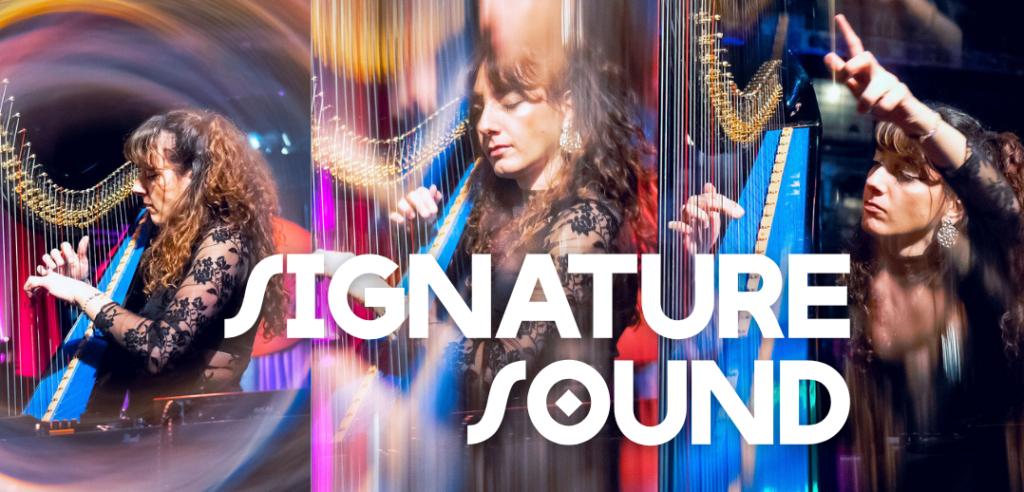


—photos by Roy Vergara
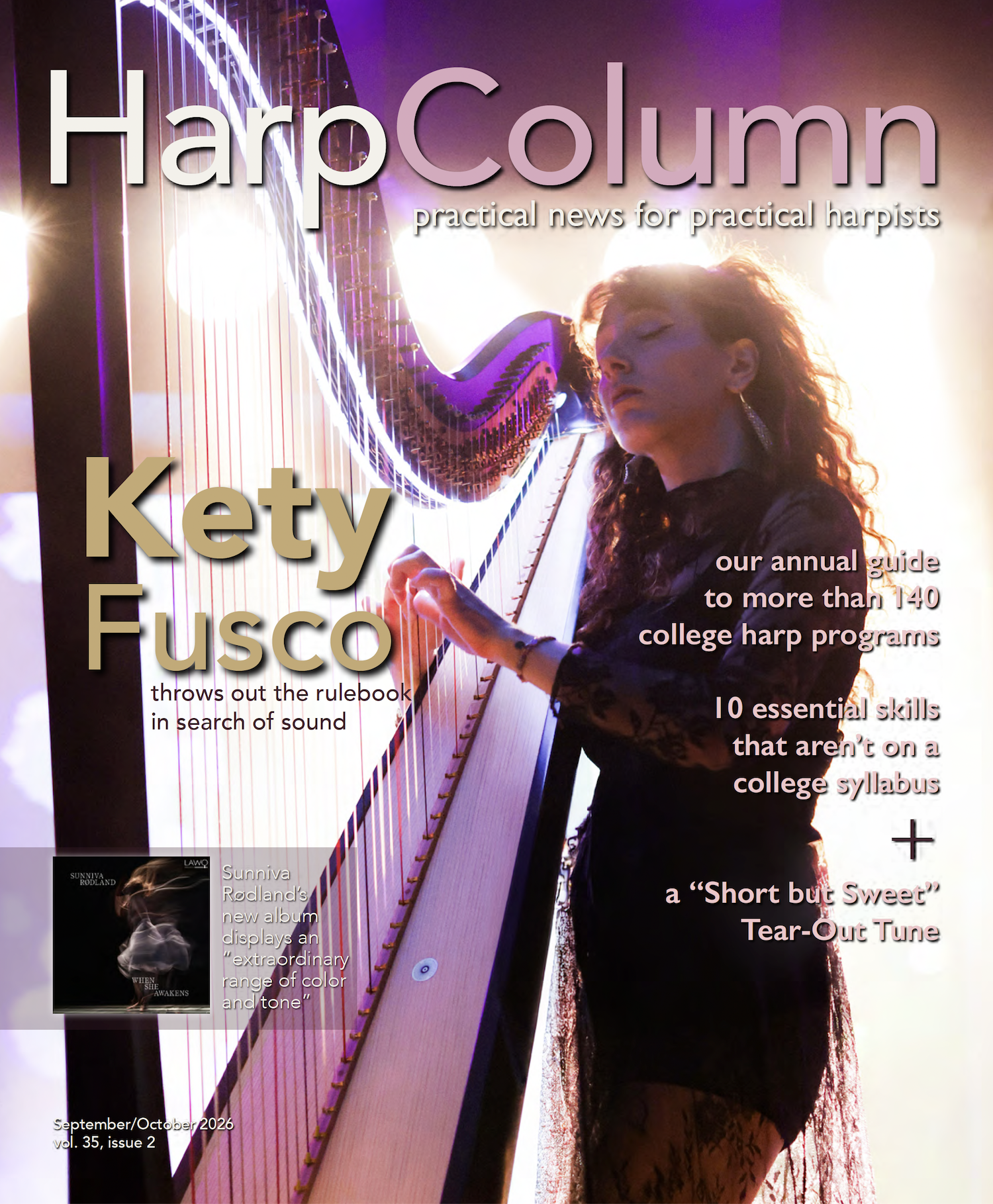
Electric harpist Kety Fusco on trading technical perfection for a voice that’s entirely her own
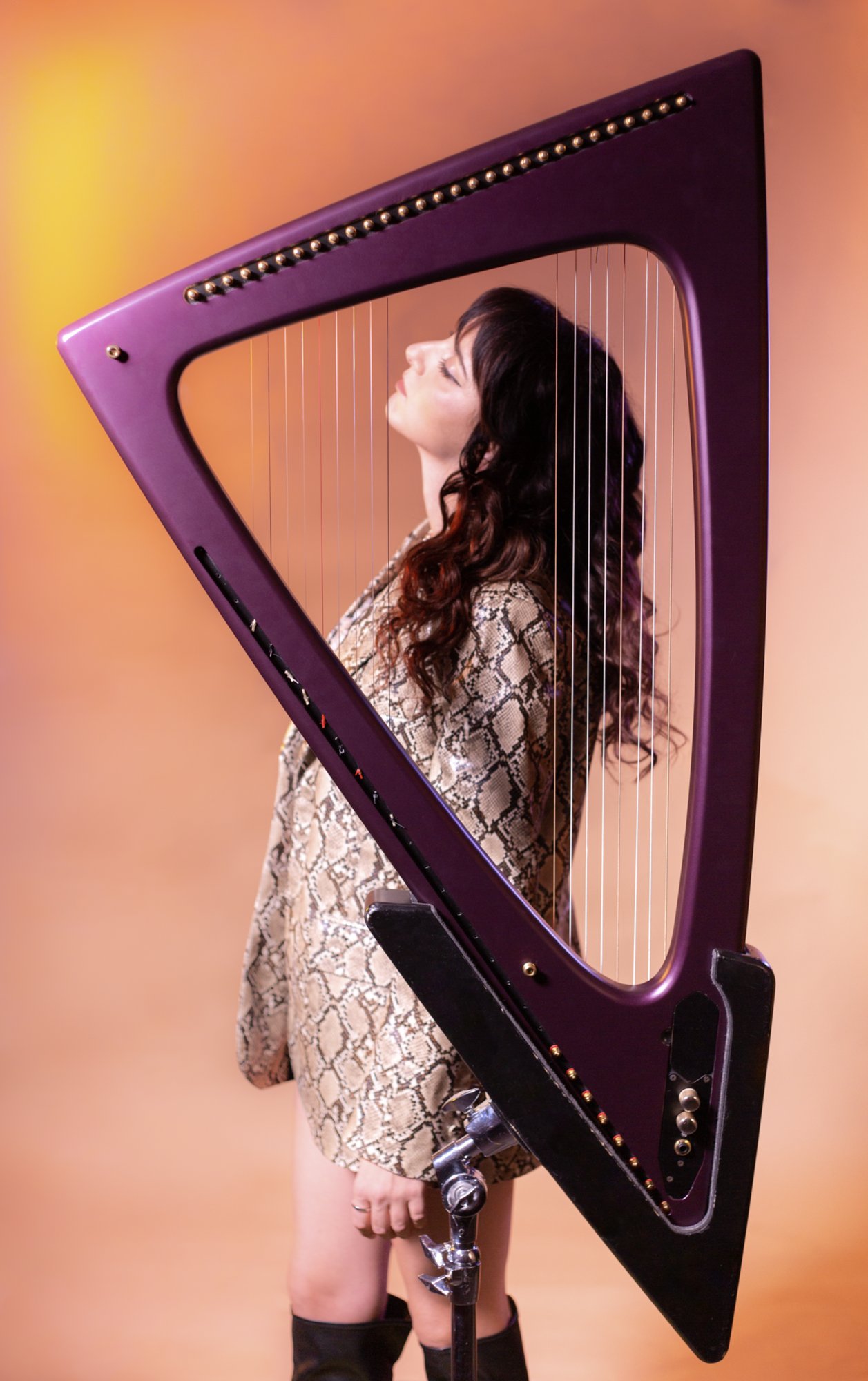
Sound is everything to Kety Fusco. Not just any sound—her sound. The search for her voice, and for the outer edge of what a harp can do, has led her to decisions that might make other harpists wince. She once wrote, recorded, mixed, and mastered an entire album—then threw it out and started over, because it no longer sounded like her. There’s also the vast library of harp sounds she’s built from scratch, the raw material for everything she composes. So committed is Fusco to the hunt for new sound that she once submerged a harp’s soundbox in water, chasing an aquatic resonance from an instrument meant to get wet.
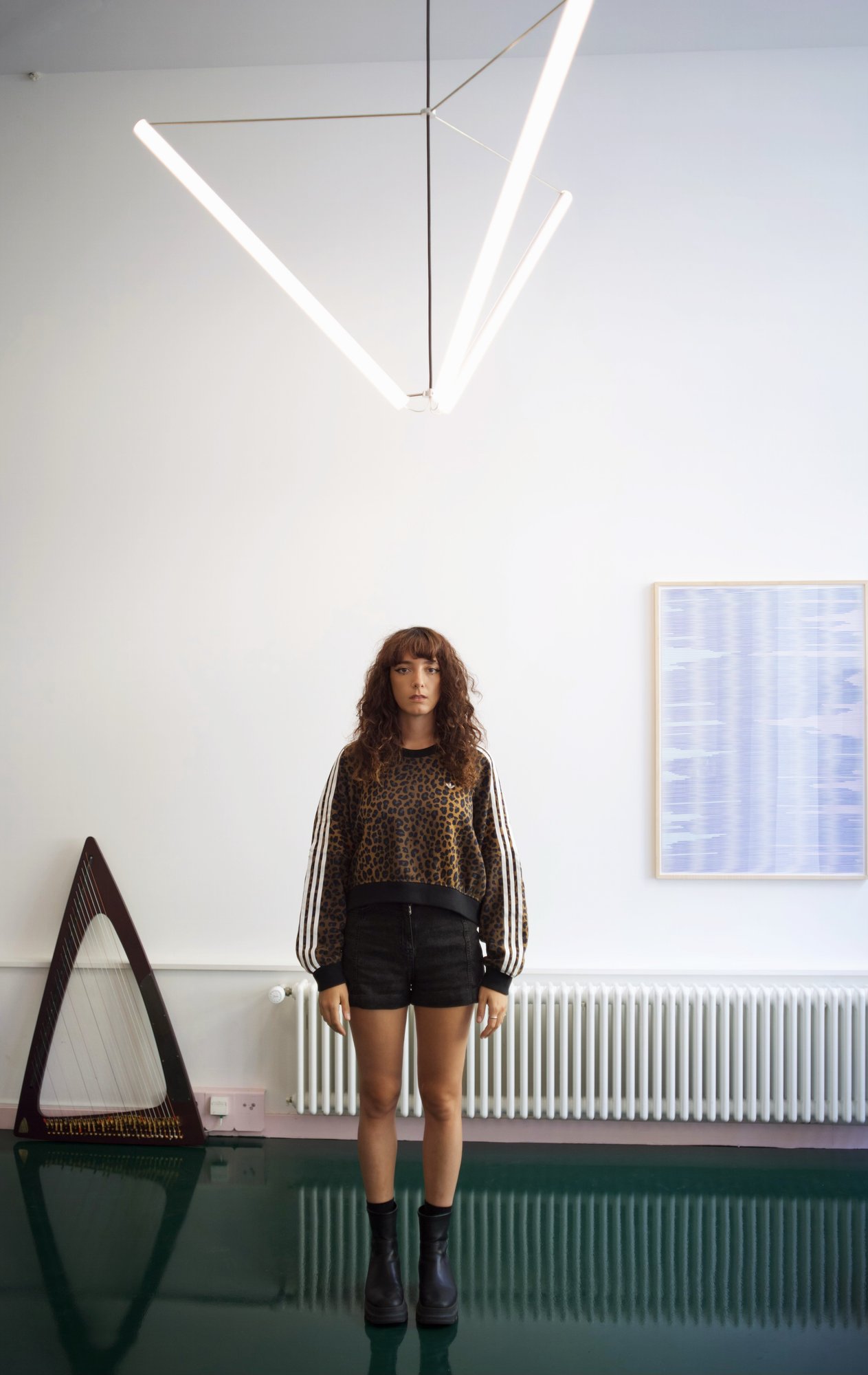
The search never stops for the Italian-born, classically trained harpist. From her home in Switzerland, she experiments with electronics, improvisation, and sounds no one has coaxed from this ancient instrument before. What keeps her going? An unwillingness to settle for anything less than “something that feels completely true.”
We often think of an instrument only in terms of the way it has traditionally been played, but I think there are endless sonic possibilities waiting to be discovered.
HARP COLUMN: I want to start by talking about what first drew you to the harp. What keeps you coming back to the harp?
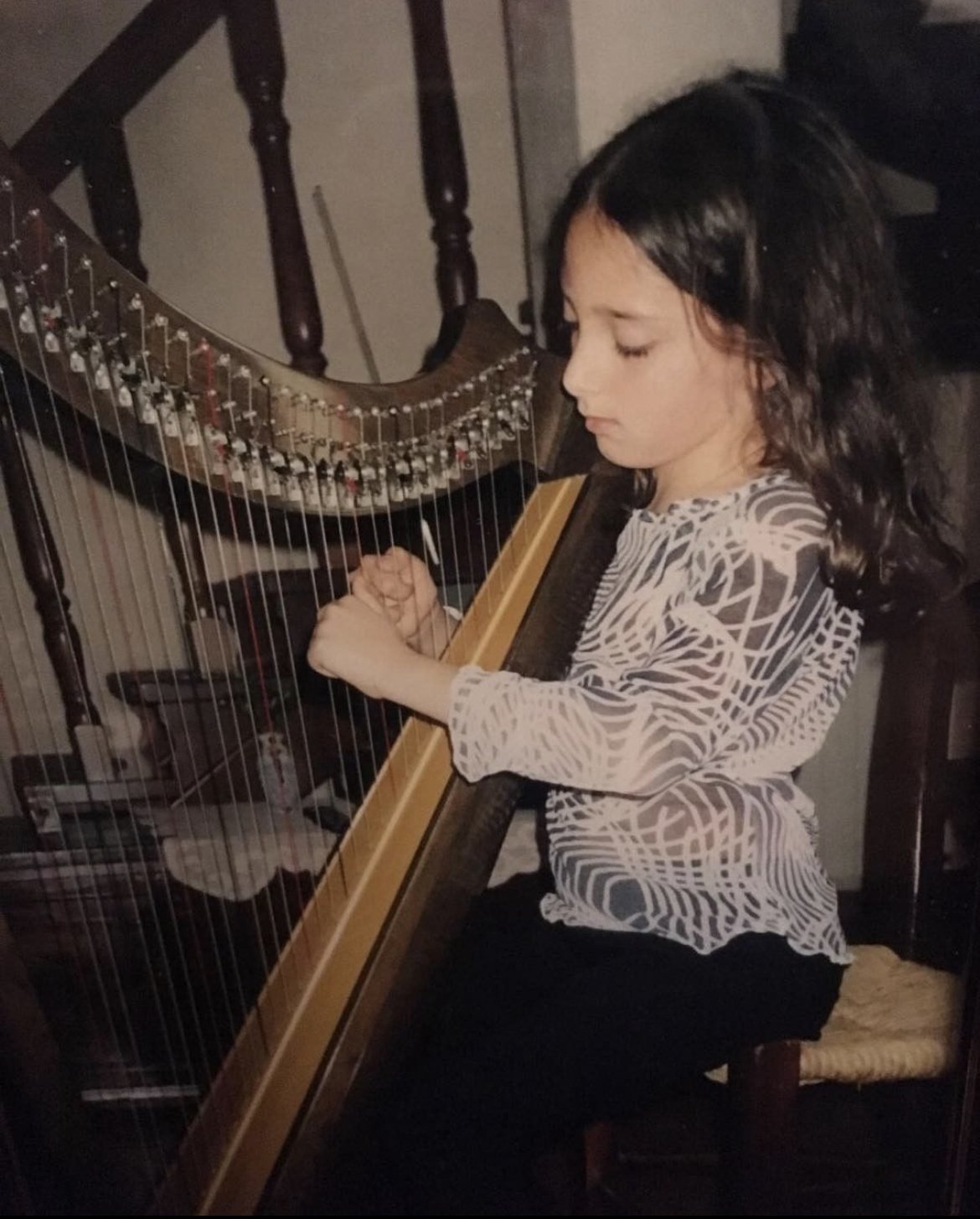
KETY FUSCO: I fell in love with the harp when I was 6 years old. I don’t come from a musical family, so it wasn’t something I grew up around; it happened completely by chance. I was on holiday with my family in the mountains of Tuscany, where I’m from, when I saw a harp for the very first time. What struck me first wasn’t even its sound, it was its size and its beauty. As a 6-year-old, I honestly couldn’t imagine how anyone could even play such a huge instrument. I remember being completely fascinated by it. And then, of course, I heard it, and I fell in love with its sound as well. From that moment on, I started playing the harp, and I simply never stopped. Even today, every time I see a harp, I feel exactly the same sense of wonder I felt that first day. It’s as if I’m seeing it for the first time all over again. I’m still completely captivated by it.
HC: You were classically trained—tell us how you started experimenting with electronics and the harp.
KF: I entered the conservatory when I was 11 years old. Before that, from the age of 6 to 11, I studied privately because I was too young to be admitted. At the time, there were no preparatory programs, so I completed all of my early training with private teachers before beginning the full conservatory course, which in Italy lasted 10 years. I studied with Laura Saviozzi in Lucca and Anna Loro in Brescia, and after graduating, I moved to Switzerland to pursue a master’s in music performance at the Conservatorio della Svizzera Italiana in Lugano. It was during that master’s that I first began experimenting with the harp in a completely different way. One thing that classical education often doesn’t teach is how to truly be on stage as an artist. During my master’s there was a course entirely dedicated to stage presence, and I remember performing Piazzolla’s Libertango with a cellist. What struck me most was that teacher wasn’t interested in whether we played every note perfectly. Instead, she encouraged us to enjoy being on stage, to communicate, and to express ourselves without constantly worrying about perfection. After that, I enrolled in another course called Free Improvisation. At first, it was terrifying. After so many years of classical training, someone suddenly told me, “Just play.” I remember thinking, “What do you mean, just play?” I began with my classical harp, but that class completely changed the way I thought about music. I’ve always been deeply inspired by contemporary art, especially figures like John Cage and the Fluxus movement. I was fascinated by the idea that the creative process and the artistic gesture could be just as important as, or even more important than, the finished work. Free improvisation naturally brought me closer to that philosophy. It taught me to embrace imperfection instead of fighting it, which was the exact opposite of what I had been taught throughout my classical training. That was also when I started composing my own music. I realized that you don’t necessarily need 15 years of composition studies to create music. I simply had to find my own language and my own personal way of approaching contemporary music. Shortly afterwards, I bought my first electric harp. It allowed me to imagine the instrument in completely different contexts, not only in traditional concert halls, but also in spaces where I could move more freely and explore a new relationship between sound, performance, and the audience. Looking back, that was really the beginning of everything I’m doing today.
HC: What is something from your classical training that you have deliberately moved away from, and what is something that you still lean on in your playing today?
KF: The biggest thing I’ve moved away from is the idea that a piece is only successful if it’s technically perfect. Even when I was studying at the conservatory, I never fully agreed with that mindset. I didn’t believe that a single wrong note could change the meaning of a performance, and I never felt that music should only be played exactly as it appears on the page. For me, that wasn’t artistic freedom. Today, I’ve completely let go of that way of thinking. I’m much more interested in honesty, emotion, and presence than in perfection. I’d rather hear a performance that is alive and authentic than one that is flawless but emotionally empty. At the same time, I’m incredibly grateful for my classical training because it gave me a very solid technical foundation. Everything I do today—my compositions, my extended techniques, the way I use the harp’s pedals, and the freedom I have while performing—is only possible because I know the instrument so well.
Technique, for me, is no longer the goal—it’s the tool that allows me to express myself without limitations. Because I don’t have to think about the mechanics of playing, I’m free to focus entirely on the music and on communicating with the audience.
HC: Let’s talk about this sound library you’ve built from the harp—recordings of different sounds you’ve found by experimenting with the instrument. Do you think you could do what you do with any other instrument? Do you think you will find every sound on the harp?
KF: I believe that every classical instrument contains an infinite world of sounds. We often think of an instrument only in terms of the way it has traditionally been played, but I think there are endless sonic possibilities waiting to be discovered. What I did was spend years exploring every harp I had access to. I’ve probably spent more time experimenting with the instrument, placing microphones in unexpected places, and searching for hidden sounds than practicing traditional repertoire. I experimented with my concert harp, a Celtic harp, an electric harp, and later I even acquired an experimental harp built with a plexiglass soundboard. With that instrument, I submerged the soundbox halfway underwater while keeping the strings above the surface, creating entirely new resonances and textures than I had ever heard before. This exploration was essential because my music is based on what I call organic electronics. I’m not interested in adding electronics to the harp. I’m interested in building an electronic language that could only exist because of the harp. All of the electronic sounds you hear in my work originate from the harp itself. I record the instrument, manipulate those recordings in the studio, and build my sonic world from those original acoustic sounds. Nothing comes from synthesizers or pre-made sample libraries—everything begins with the harp. So, do I think I’ll ever discover every possible sound the harp can make? No. I actually hope I never do. I believe the possibilities are virtually endless, and that’s what keeps me curious. It’s a journey that I think will continue for the rest of my life.
HC: You said in an interview once that you’ve “never liked doing things because they’re easy, but rather you’re always looking for something to drive you crazy.” What is currently driving you crazy?
KF: It’s true, I always seem to be looking for something that drives me a little crazy. For me, the hardest part isn’t writing music; it’s knowing when to stop. I find it incredibly difficult to reach a point where I can honestly say, This piece is finished. If I let myself, I could probably keep working on the same composition for another 80 years. I’m always hearing new possibilities, imagining different directions, wondering if I can go one step further. The most extreme example of this was when I completed an entire album. I wrote it, recorded it, took it all the way through mixing and mastering, and then I threw it away. Looking back, it probably wasn’t the smartest decision financially, but artistically it was the only one I could make. When I listened back to it, I realized it no longer represented who I was. So I made the difficult decision to start again from scratch. That’s probably what drives me crazy the most—this constant search for something that feels completely true. I’m always trying to push my sound a little further and asking myself what the harp can become in the 21st century. I don’t see that as frustration, I see it as curiosity. I hope I never lose that feeling, because it’s what keeps my music evolving.
HC: Your performances are as much a visual experience as they are a sonic experience—how do you design your performances? Is a multi-sensory experience an intentional goal of your performances?
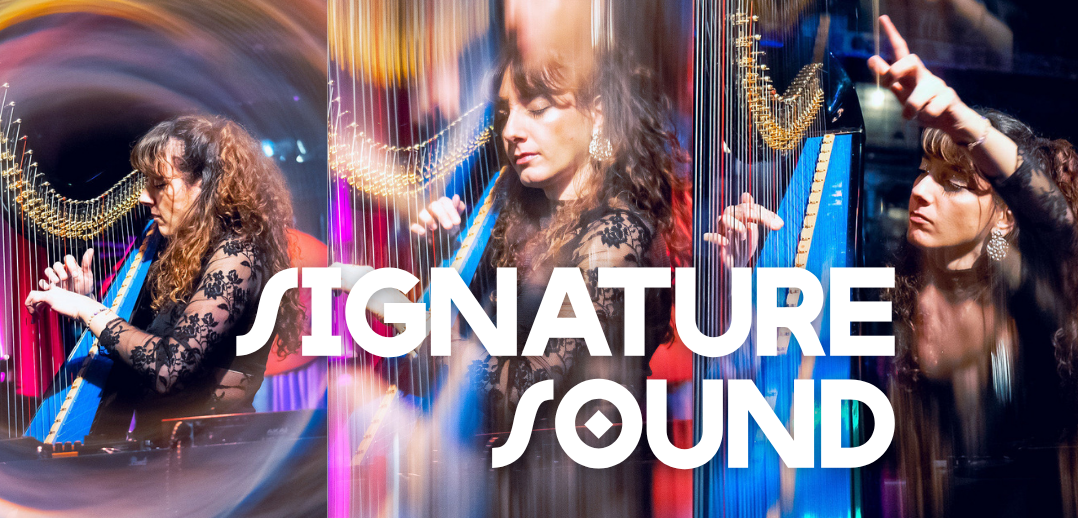
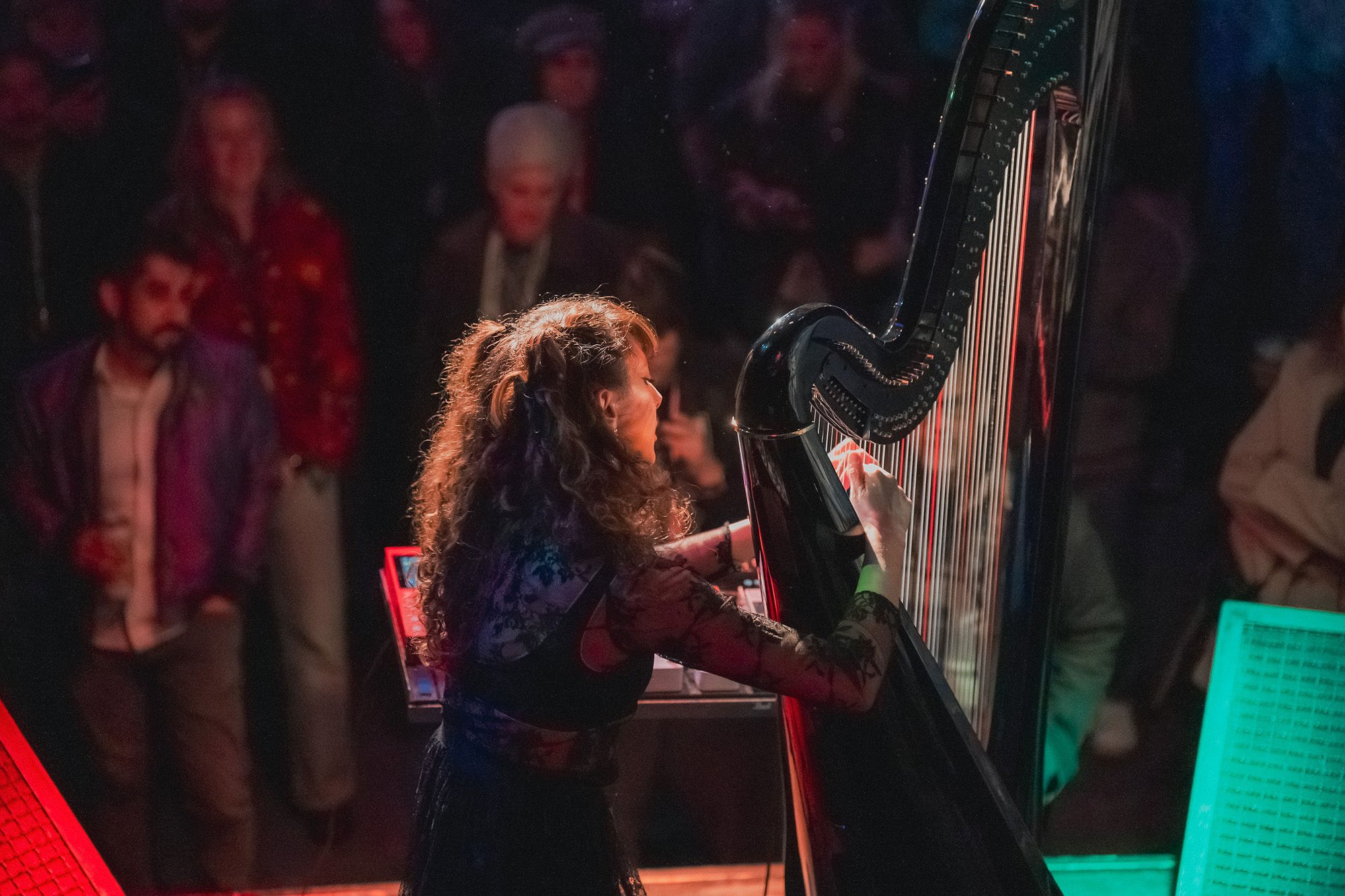
KF: For me, a performance is much more than simply playing music. I’m interested in creating a complete show, something that combines sound, visuals, light, and storytelling into a single experience. I think this also helps move away from the traditional perception of a classical performance, where the focus is almost entirely on the execution of the piece. In my work, music is always accompanied by visuals. For my latest album, I collaborated with two visual artists who literally transformed my thoughts and ideas into moving images using AI. It wasn’t about illustrating the music, but about creating another artistic language that could exist alongside it. I also pay a great deal of attention to lighting, my outfit, and the overall dramaturgy of the performance. Every element is designed to contribute to the narrative of the show, so that the audience experiences something immersive rather than simply attending a concert. Creating a multi-sensory experience is definitely one of my main goals. It’s also what allows my music to exist in many different contexts, whether it’s a festival, a club, a contemporary art venue, or a concert hall. I’m interested in building performances that can connect with audiences beyond the traditional boundaries of classical music.
HC: You’ve played everywhere from big concert halls to small jazz clubs and outdoor music festivals. How does the space in which you are performing affect the music?
KF: I’ve had the opportunity to perform in completely different kinds of venues, and the space absolutely influences the way I play. More than following a fixed setlist, I like to adapt to the moment—especially when I have the freedom to do so, and I’m not restricted by a strict performance schedule. I enjoy performing in dialogue with the audience. I respond to the atmosphere in the room, the size of the space, and even how I feel that particular day. A lot of my concerts include improvisation, and I’m constantly sensing how ready the audience is to follow me on the journey. In some settings, I can immediately push further into the more electronic, rhythmic, almost dance-oriented side of my music. In others, I feel that people first need time to understand what I’m doing with the harp and to enter my sonic world before I can take them somewhere more unexpected. That’s why I rarely play the same concert twice. I like every performance to be shaped by the people in front of me and by the unique energy of that moment. For me, a live performance should be a conversation, not a repetition.
HC: Tell us about working with Iggy Pop.
KF: Working with Iggy Pop happened in a very natural way. He discovered my experimental album, The Harp – Chapter I, which premiered at the Royal Albert Hall in London in 2023. After listening to it, he featured the album on his BBC Radio program, Iggy Confidential. During the show, he said something that stayed with me. He asked, “Why is the harp not heard as much?” It was such a simple question, but it perfectly captured something I had been thinking about for years. Two years later, I reached out to him and asked if I could use that sentence in one of my new pieces. He immediately said yes. That became “SHE.” In the track, Iggy repeats the phrase “the harp is not heard as much” almost like a mantra. For me, those words represent the entire philosophy behind my work: giving the harp a new voice, bringing it into new spaces, and allowing people to hear the instrument in ways they never expected.
HC: If you could choose another musician to collaborate with, who would it be?
KF: Right now, I’m especially interested in collaborating with artists who are pushing the boundaries of contemporary music. My goal is to bring the harp even further into contemporary music and place it at the center of the creative process. I’m excited by the idea of the harp becoming the main voice of a project, perhaps in a duo with a singer, where the instrument isn’t simply accompanying the vocals, but is an equal creative partner. If I could name a few dream collaborations, they would definitely be Jacob Collier and Rosalía. I’d also love to create an intimate harp-and-vocals project with artists like Rosalía, RAYE, FKA twigs, or Björk.
HC: Tell us about a current project you are excited about.
KF: One of the projects I’m most excited about right now is my collaboration with Jeff Mills. I’ve been invited to join him on stage to perform The Trip to Vega, the album he released this month. For these performances, we’ll present a new live interpretation of the album featuring harp, electronics, and immersive visuals. It won’t simply be a reproduction of the record; we’ll be telling the story of this journey through both Jeff’s vision and my own artistic language. Our first performances are at the Romaeuropa Festival in Rome and at the Philharmonie de Paris in December. It’s one of those collaborations that I never imagined would happen, and I’m incredibly grateful to be part of it.
HC: Many harpists are classically trained, like yourself—how would you suggest they get started if they are interested in experimenting with electronics and improvisatory elements in their music? What’s the first “classical” rule you’d tell them to break?
KF: The first thing I would tell any harpist who wants to explore electronics or improvisation is this: don’t start with the technology, start by finding your identity. Be curious. Listen to as much music and art as you can. Explore different worlds. But then take everything you’ve absorbed and transform it into something that belongs only to you. I think having a unique artistic identity is the most valuable thing an artist can have today. I often think about classical music. If I were standing behind a curtain listening to two or three world-famous harpists all playing Handel’s harp concerto, I would probably struggle to tell who was playing. Classical training often teaches us to pursue the ideal interpretation rather than our own voice. What inspires me is the opposite. When I hear Amy Winehouse sing, I know it’s her instantly. When I hear the touch and musical language of Nils Frahm, I don’t need anyone to tell me who it is, I recognize him from the sound alone. That’s what we should all aspire to: building a voice that is unmistakably our own. Even if it’s an instrumental voice, your instrument should become an extension of your personality. So if there’s one “classical rule” I would encourage people to break, it’s the idea that your goal is to sound like everyone else who plays your instrument. Your goal should be to sound like yourself.