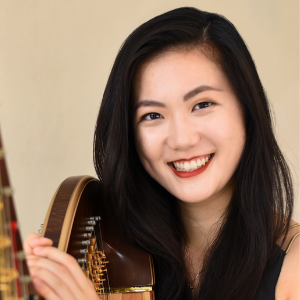


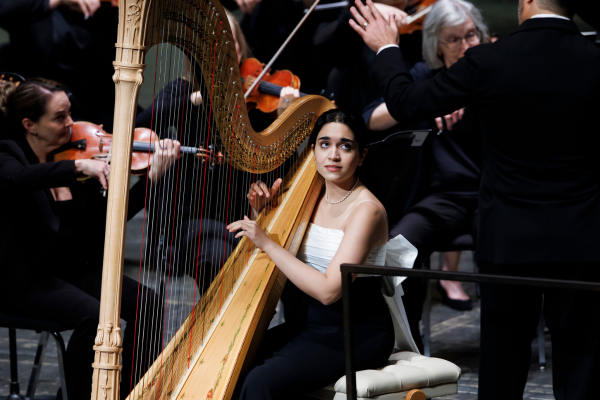
—photos by James Brosher
My first interaction with Shamim Minoo came just after I stepped off stage from my own performance this May at the first stage of the 13th USA International Harp Competition in Bloomington, Indiana. She greeted me with a cheerful “Oh you’re wearing green too!” We had drawn back-to-back numbers, and after our brief exchange about how green is an underrated stage color, we wished each other good luck.
Over the course of the competition—between late-night receptions and ice cream socials—we spoke more, and eventually she asked if I could sit in on her dress rehearsal for the final stage. I gladly agreed, doing my best to offer encouragement and practical feedback without being overwhelming. At the time, I didn’t yet know I’d be conducting this interview, but looking back, it felt like a front-row seat to the story I’d soon be telling.
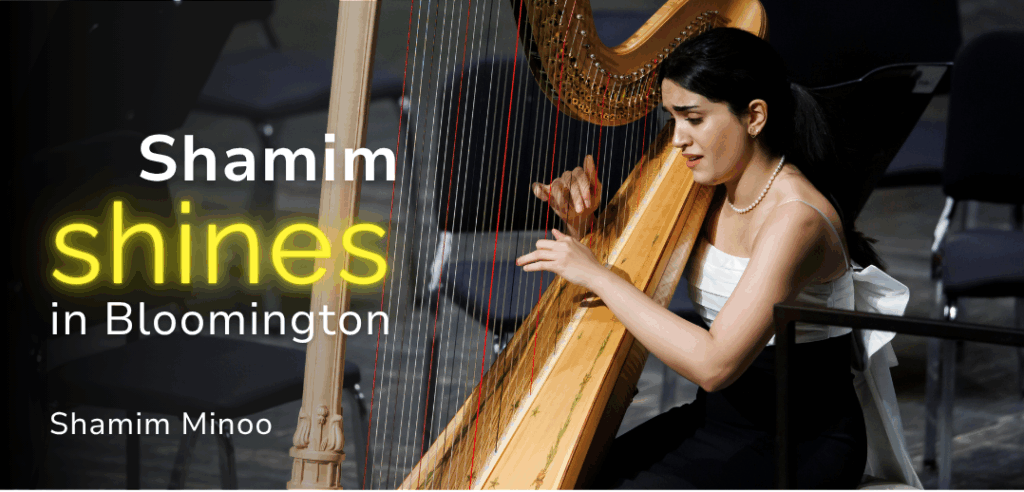
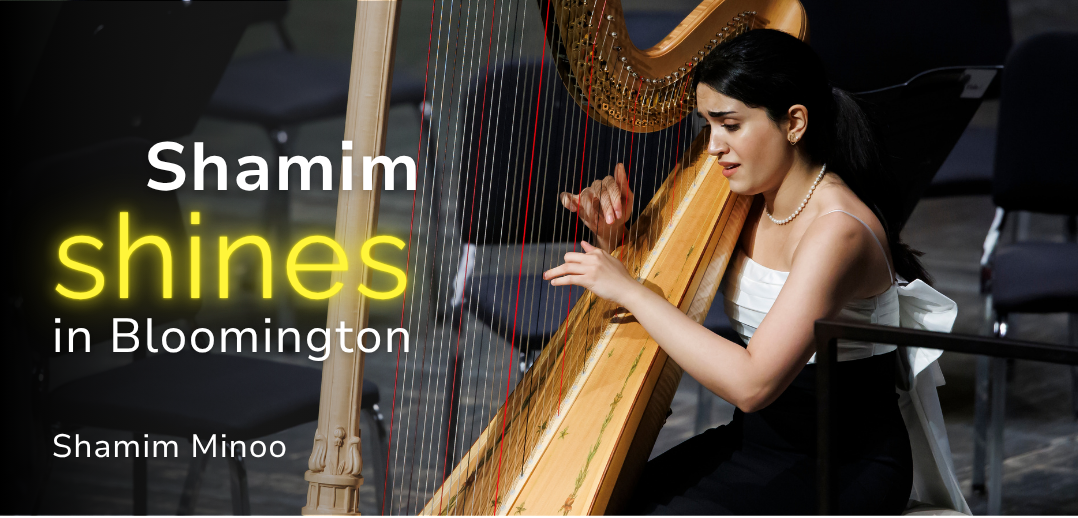
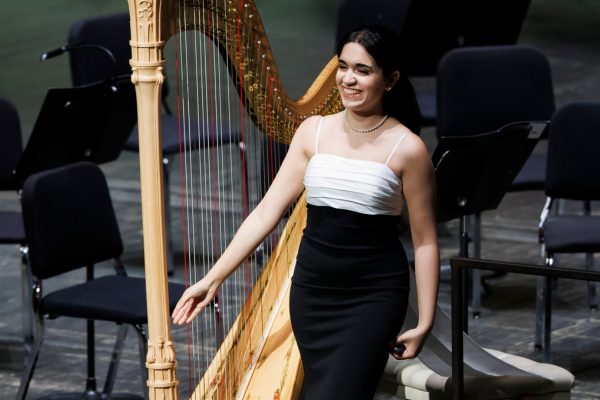
Watching her final performance, I saw glimpses of the work ethic, resilience, and thoughtfulness that define Shamim as an artist. She took feedback in stride, applied it thoughtfully, and delivered a performance that was polished and personal. She stepped into the spotlight, commanded the stage with quiet confidence, and made the moment entirely her own.
Speaking with Shamim for this interview revealed even more of what makes her stand out. Though just 20 years old, she spoke with clarity and sincerity, offering reflections that reveal both vulnerability and strength. Our conversation was full of laughter, honesty, and refreshing candor. It was a joy to speak with Shamim and learn more about the journey, discipline, and heart behind her music.
Editor’s note—The school where Shamim Minoo is currently studying with Isabelle Moretti is referenced several times in this interview using different names and abbreviations. The official French name of the famed music school in Paris is the Conservatoire National Supérieur de Musique, abbreviated CNSM. Many also refer to it as the Conservatoire or, in English, the Paris Conservatory.
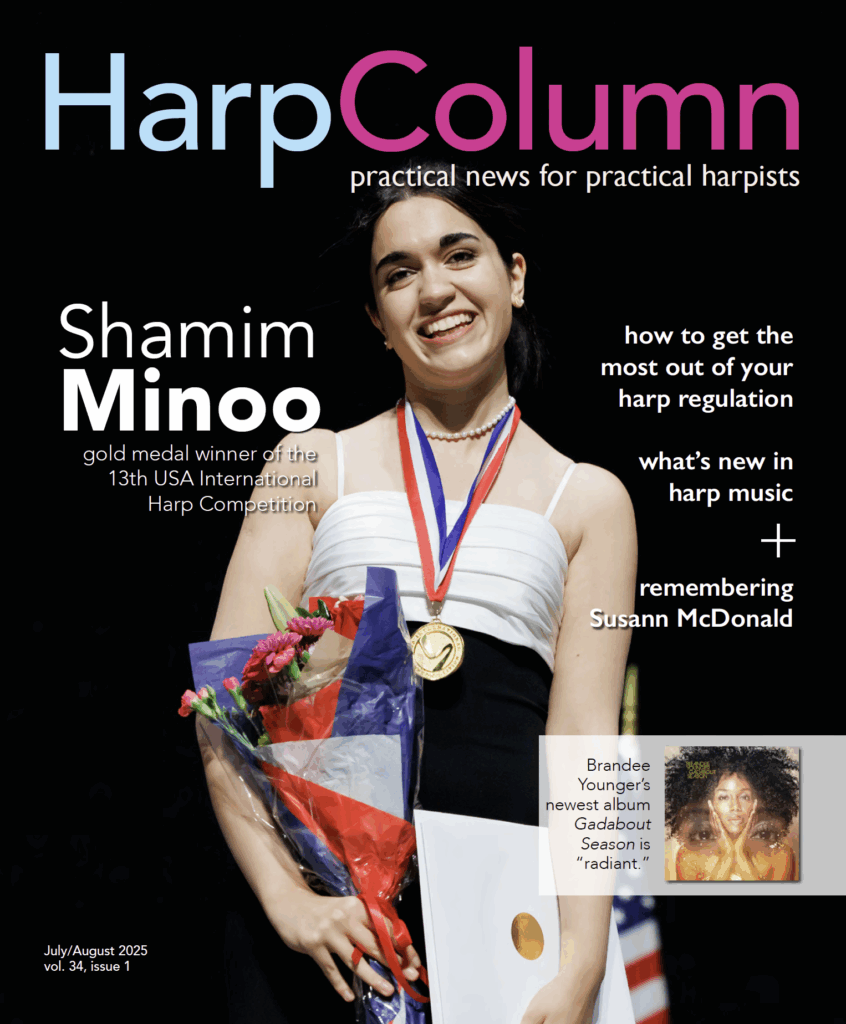
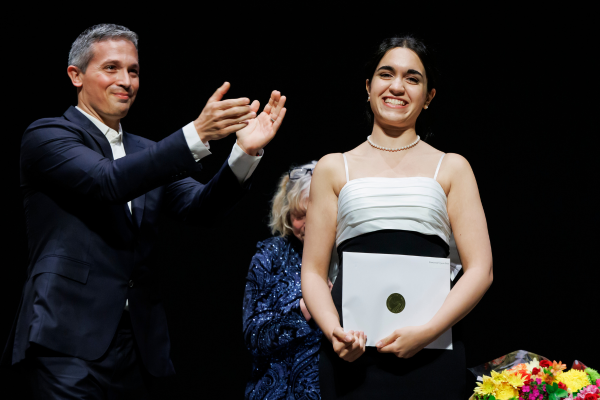
Harp Column: Congratulations on winning the gold medal at the 13th USA International Harp Competition! What was the first thing that went through your mind when you realized you had won?
Shamim Minoo: To be honest, I was happy, but at the same time, I felt relieved—it’s over now, you know? I was kind of shocked as well, because for me, the first prize felt so far away. There are four stages, and it’s not just whether you’re good or not. It’s about luck too and how you feel in the moment. You can’t just say, “I did my best, so I’ll win first prize.” So it was shocking. I was like, Oh…I just did that.
HC: Absolutely, there’s always that element of timing and luck. This time, everything came together for you—and you earned the gold! Was there anything that was easier than you expected?
SM: To be honest, I think “easier” doesn’t exist in our work. [Laughs] There were things I expected to be easier, like the first round, but I realized that it’s the hardest one! It’s your first time on that stage, in that hall, with that harp, and you want to give a good first impression. It was also a long time to wait your turn, so it gave me more time to be nervous.
HC: Whenever I watched you play, I didn’t sense nervousness at all. In fact, it looked like you were really calm under all that pressure. What goes on in your head when you’re on stage?
A competition by any other name
Many music competitions are mentioned in this interview by their abbreviations or more commonly used names. Here are some:
ARD International Music Competition—This German competition for all instruments is commonly known as ARD
International Harp Contest in Israel—Held in Israel every three years, it is commonly known as Israel
USA International Harp Competition—Held every three years at Indiana University in Bloomington, Indiana, this competition is commonly known as USA, Bloomington, or the USAIHC
Concours Français de la Harpe—Also known as simply Concours
International Harp Competition in Szeged—Held in Szeged, Hungary every three years, this competition is known simply as Szeged
International Harp Contest in Italy Suoni d’Arpa—Put on by the Italian Harp Association in conjunction with a festival, this contest is known as Suoni d’Arpa
SM: I always have stress before, so I do a lot of exercises to relax. It’s kind of funny because my nervous system affects my digestive system. But once I’m on stage, it doesn’t show, and I don’t think that much. I just let the music go. But I have to be really prepared to know what I want to do in every spot. Sometimes in my head, I even say things like forte, crescendo, piano to not get distracted. But it wasn’t always like this. I did two years of preparation and a lot of concerts to get to this level.
One of my big key things is mental practice. Before I go on stage, I imagine everything in detail. It has to be close to the performance though. I practice normally and do that mental practice one or two days before, or just before going on stage. For stage III, I woke up at 5:00 a.m. just to mentally practice everything.
HC: That kind of discipline to wake up at 5:00 a.m. just to visualize your performance is remarkable. How were you feeling in the days leading up to stages III and IV?
SM: When I got to stage III, I was really excited. I had practiced the first two stages the most, because I knew they were the most important. So when I got past them, I was really happy and excited—but maybe too excited. I did a lot of breathing exercises to stay relaxed, because sometimes too much excitement doesn’t help—especially if you’re nervous on stage and start playing too fast. By stage IV, I was just really tired, and to be honest, I was kind of down. But I think it was because of the tiredness, you know?
HC: I remember watching your concertino soundcheck, and I could see how much you were pushing through. And of course, by that point you’d been competing for eight or nine days straight. It’s completely understandable—the process is physically and mentally exhausting.
SM: Yes, you were at my dress rehearsal, and actually, right after you left, I was with my boyfriend and I started crying. It was just too much for me. I think it’s the same for everyone. There were so many surprises during the competition too, and only a day or two to prepare for the next stage. By the time you reach stage IV, you’re just exhausted. And with that concertino…it takes so much energy.
HC: Absolutely. But you gave a beautiful performance, and your encore was so lovely as well. How did you decide on that encore? Did you always know you were going to sing? [Ed.—For her encore during the final stage of the competition, Minoo performed Memories of Iran, by Mohamad Noori. The piece is based on the traditional Iranian songs “Coucou” and “Agharazi,” originally written for the qanun, an Iranian instrument. Minoo transcribed and arranged the music, in which she sang as well as played.]
SM: To be honest, I really love singing with the harp. It’s one of my favorite things. Since I was 10 years old, I started doing that with simple, traditional Iranian songs, but I never thought that singing and playing could be possible in a solo competition. I think it was my teacher, Isabelle [Moretti], who suggested it.
I really wanted to perform Iranian pieces, but there’s nothing written for harp. There’s an instrument in Iran called the qanun that sounds a bit like the harp, and I asked a qanun player that I know to recommend some pieces for me to arrange. She suggested a few pieces, so I listened to all of them and picked my favorites. I had to cut some sections since traditional Iranian music includes a lot of repeats, and I changed a lot to make it sound good on the harp. I had a lot of help from my teacher, Isabelle, and my Iranian composer friend who helped get my ideas down on paper. In the end, the song feels really special to me—it’s like my first original piece.
HC: Your encore certainly felt like a performance from the heart, and it was a beautiful moment on stage. I’d love to hear more about the harp scene in Iran. Could you give us some context?
SM: I’ll start with my own story to give you some background. Before me, there were maybe two harpists in Iran. The first one was the wife of a famous conductor. The second one studied in Paris, but she passed away very young—the year I was born, actually. And some people even say it’s like the harp passed on to me, in a way.
Then came my teacher, Fattaneh Shahin. I saw a harp for the first time at a music institute, and I just thought, I want to play the harp. There was no doubt. So at 6 years old, I became the first young student Fattaneh taught harp to. Over the next 10 years or so, she built a harp community, and at the end of it, I think she had like 80 students.
HC: That’s impressive. 80 is a lot of students!
SM: Yes, she really built a harp community in Iran. I just wish she had had more advanced training, because that would’ve helped her students develop further. But still, she made it possible for harp to grow in Iran.
When I first thought of moving to Paris, my dream was to go back to Iran one day and open a professional harp school. I wanted to bring back my training and experience I gained through competitions. But now…I’m not sure. The harp is such an expensive instrument. In Iran, I got a Salvi Daphne at a reduced price, thanks to Mr. Orang [the ownder of a musical instrument shop in Tehran]. In France, I didn’t own a harp at all until I won USAIHC, thanks to Lyon & Healy. I can’t wait to have it at home soon! I must also acknowledge Christophe Rançon, who generously facilitated my preparation by arranging the rental of a Style 23 Lyon & Healy harp during the critical six months leading up to the competition, making a huge difference in my readiness.
For most people in Iran, having a harp is just not possible. And classical music isn’t appreciated the same way as other genres, which makes things even harder. If someone wants to take the harp seriously, they need real resources to have a harp, to maintain it, to study it. What makes me sad is there are harpists who want to pursue harp, but they don’t have access or opportunity to. I haven’t let go of my dream, so maybe one day I can work with harp makers or musicians in Iran to find a way to make this happen.
HC: So you started harp in Iran, and when did you move to Paris?
SM: My teacher had a lot of connections, and thanks to her, I had the opportunity to meet different harp teachers from different countries. That’s how I met Véronique Chenuet, the founder of the Concours Français de la Harpe. She is one of the kindest people I’ve ever met and has made a huge impact on my harp journey and my life. I was 11 the first time I saw Véronique, and I went to her house. She didn’t know me at all, but she invited me and my mom to stay with her.
That meeting also marked my first time doing a competition. I didn’t compete at a really high level—probably level 7 or 8 out of 12—but it was my first time. I did a short preparation with Véronique while staying at her place for about a week. She was so kind.
Véronique came to Iran when I was 12 and 13 and gave some lessons for a week or two. Then I did the competition again at 13, this time at the highest level—level 12 —and I won first prize when I was 13! At that age, it meant a lot to me. I was kind of proud.
HC: Yes, you should be! It’s impressive.
SM: Yes, and I felt like I had prepared mostly by myself. My Iranian teacher helped a little, and Véronique helped for a short time. But that was when I realized that France is the best country to study harp. There are only one or two spots per year with Isabelle [Moretti at the Paris Conservatory]. If you have the chance, you should go.
HC: And when did you first meet Isabelle Moretti?
SM: Actually, the first time I saw Isabelle was funny because I stayed a whole day at the Conservatoire just hoping to meet her. I had just finished the Concours Français in Limoges, and went to Paris after the competition. Someone told me, “You can wait and take a picture with her.” So I waited the whole day. She has always been my idol, and since I was young, I would watch all her videos, especially her Fauré Impromptu. The funny thing is, the picture we took was right next to the practice rooms where I now practice. The second time I met Isabelle was after I won the Concours Français. One of the prizes was a recital at the next competition’s opening ceremony. And after me, Isabelle performed! It’s all kind of crazy. Then at 15, I auditioned for her class.
HC: What was that experience like?
SM: I didn’t get admitted because I was too young. But Isabelle said, “If you really want to study in Paris, Ghislaine Petit-Volta is the best person for now to guide you the right way.” So I applied to Ghislaine’s class, and I felt lucky when she accepted me. I was just thinking, “You have to go.” Staying in Iran didn’t feel right, because I couldn’t make progress anymore. And I felt that if I didn’t leave at the right moment, I would never grow.
So I moved to Paris when I was 15, and that was the worst. It was during COVID time, I didn’t speak French, and I was completely alone. My parents tried to come with me to help me move into the dormitory, but they couldn’t get visas because of COVID. So I came alone to Paris and studied with Ghislaine for a year.
That first year in Paris was incredibly tough. I didn’t have any friends or money. In October that first year, I went back to Iran for vacation, and actually, my parents told me they couldn’t afford it anymore. So I told Ghislaine I couldn’t come back, and she said, “No, just come back. We’ll find a way.” She promised to talk to people like Jakez François the Camac owner, and to Christophe Rançon, the Salvi and Lyon & Healy distributor in Paris. “Maybe they can help,” she said. And they did. They supported me financially so I could keep going.
HC: That’s an incredible amount of support from Ghislaine.
SM: Yes, if Ghislaine hadn’t been there, I think I would’ve stayed in Iran, and I might’ve quit. It’s crazy to think about. So I studied with Ghislaine for a year. Then in April 2021, I did the exam of Isabelle’s class again, and I was first on the waiting list. I was really disappointed, and my parents could no longer support me financially. If I had been admitted to CNSM, I could have received scholarships…but I left Iran, came all the way here, and wasn’t accepted. I thought I couldn’t stay anymore. That summer, I didn’t touch the harp at all. I just thought, Okay, I’m done. I will quit.
HC: That sounds like such a difficult moment, not knowing if you could keep moving forward with harp.
SM: Yes, I just thought I’ll have to find some way somehow. I didn’t know what I would do, but I came back to Paris in September to try continuing with Ghislaine. Then one day, CNSM called me and said I got admitted! One of the previously admitted candidates found a job, so she left CNSM. I got really lucky! But also I was thinking, Oh no, it’s bad because I haven’t touched the harp in months! And now, suddenly, I have to play for Isabelle.
HC: That’s so funny! But it all worked out in the end.
SM: Yes, it worked out, and I started studying with Isabelle. That first year was hard. At the end of the year, there’s a 20-minute exam where you play, and they rank you. I got the best mark, and after that everything got a little easier.
HC: I think your story shows a lot of your determination and personality, which has certainly got you to where you are today. It’s a testament to your drive that translates into all these successes in your harp competitions—you got first prize in Concours, Szeged, Suoni d’Arpa, and now Bloomington. What’s your main motivation to compete in all these competitions?
SM: I was always interested in doing competitions, because for me, it’s a way to improve yourself. I don’t go to win a prize—I just go to learn. And to be honest, I think the way your teacher works with you when you’re preparing for a competition is really different than when you’re just doing regular lessons. So I feel like competitions are the best way to improve. That’s really my main goal. In my first year studying with Isabelle, I asked her if I could do a competition. I made a list, and she chose one. That’s how it started.
HC: With all these competitions under your belt, how was this experience at Bloomington different?
SM: Oh my god—so much different. I always had a dream to participate in Bloomington. Not to win or anything, just to participate. I always watched Mélanie Laurent’s videos, and they were just so inspiring. [Ed.—Mélanie Laurent won the gold medal at the 11th USAIHC in 2019.] The main difference was that Bloomington has four stages. Besides ARD and Israel, I don’t know any other competition that has four rounds. So even from the first round, you have to do your best because the level is so high. I also had never prepared for such a long time before. For Bloomington, I started when the program came out two years and a couple months ago. It’s a long time, but I love to anticipate things.
HC: When did you feel ready with the Bloomington repertoire?
SM: I never felt ready. [Laughs] Maybe two weeks before I thought, Okay, it’s possible to handle this. I remember a week before, I had a masterclass with Isabelle, and I asked myself, Can I play like this in the competition? Is it okay? Because you don’t know the level, you know? I’m a perfectionist, so for me it never feels ready. Never.
HC: Was there something that helped you prepare the most for this?
SM: The first thing was the two years of preparation. My practice time was crazy, especially the last couple of months. I didn’t even realize when it was morning or night. It was really bad.
The second thing was Isabelle, my teacher. She’s so special. I mean, she’s tough, but at the same time she helps you so much. The third thing was doing a lot of performances and concerts. Even when I did Suoni d’Arpa, I did it on purpose to prepare for Bloomington. I used the same repertoire so I could already start preparing in advance. That helped a lot, and all the concerts really helped too. And lastly but most importantly, I was surrounded by an amazing family and a supportive boyfriend who were always there for me in every way they could.
HC: I think it was really smart of you to keep aiming for Bloomington as the final goal. Do you have more advice you would give to younger harpists who wish to compete at this level?
SM: Don’t compete just to win a prize. Please! It doesn’t work. Go to improve yourself. Go to make progress. And second, find your personality in the music. I think in Bloomington, I really found my personality,—what I wanted to say and what I wanted to share. That’s what it’s all about.
HC: What’s next for you after this?
SM: I want to take orchestra auditions. I did Aspen last year, and there I realized that I really love orchestra. Also, I think it’s more stable as a job. I’m also interested in teaching, but in France, it’s quite complicated—you need a certificate, and the exam is quite hard. For now I have my own private students, and if I leave France, it will probably be easier to find a teaching job. But my main goal now is to get an orchestra job or at least an academy position.
HC: Do you think your win will impact the harp scene in Iran?
SM: I really hope so. It would mean a lot to me if even one young Iranian harpist felt inspired to follow a similar path. At the same time, it’s a tough journey—leaving Iran and starting over in a new country. I went through a lot, and I wouldn’t wish the same struggles on anyone. But if my story shows someone that it’s possible—even if it’s hard—then maybe that’s enough to spark a dream in someone else. •
Minoo in a Minute
Dream harp? Actually, it’s the harp that I’m going to get—it’s the Style 11 Gold.
Favorite piece you’ve performed? My encore, Memories of Iran! No question.
Favorite performance outfit? The white and black gown I wore for the final.
Languages that you speak? Three languages—Persian, English, and French.
Non-harp related hobbies? I like cooking a lot. I cook a lot of Iranian dishes, and I like to invent dishes myself. I also like hiking and just being in deep nature. I love nature.
Pre-competition food? It’s kind of funny—I eat some meat like steak four hours before and plain pasta without any sauce two hours before. Two hours before is so important, because the point is to digest everything properly. Meat is really heavy to me, so I eat it four hours before. Then pasta two hours before, because I think pasta gives you so much energy, especially without the heavy sauce.
Career if you weren’t a harpist? I always said that I want to do something in mathematics. So, I’ll probably be a software engineer, because I was really good at mathematics. But I prefer to be a harpist.