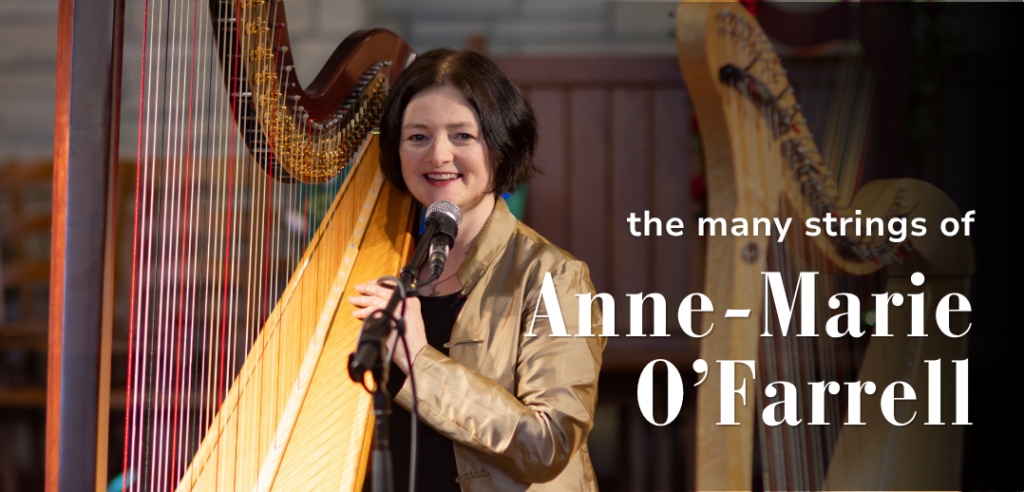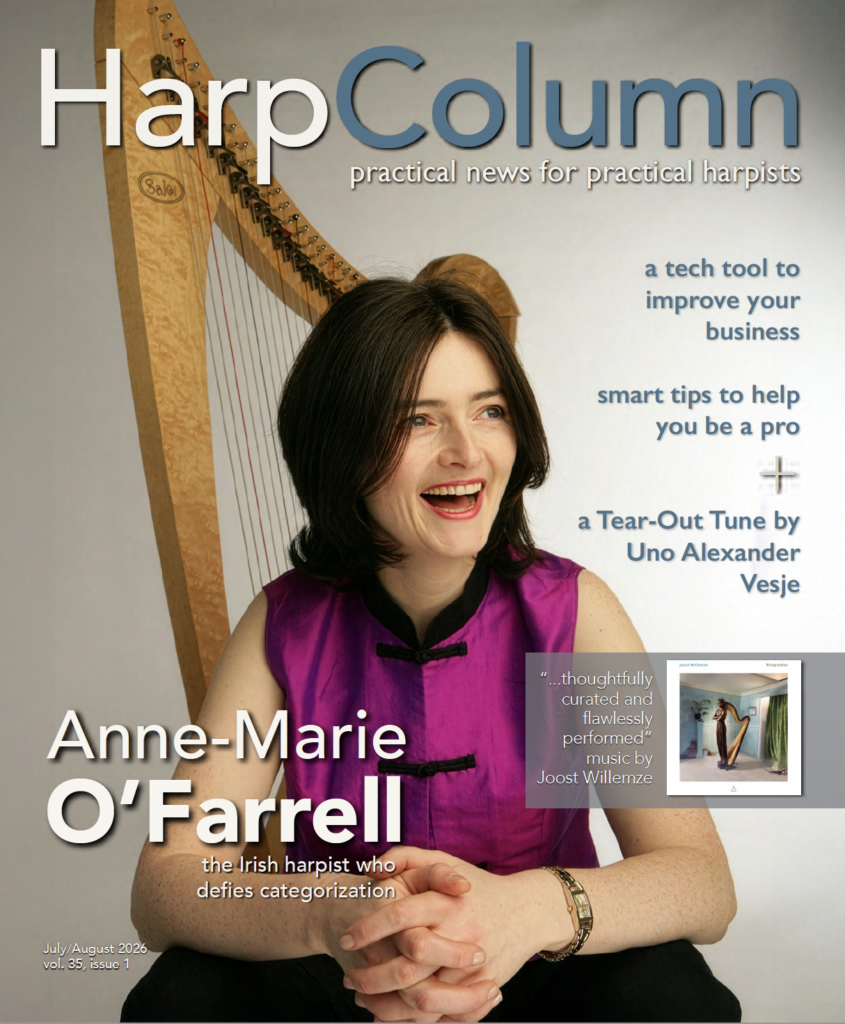


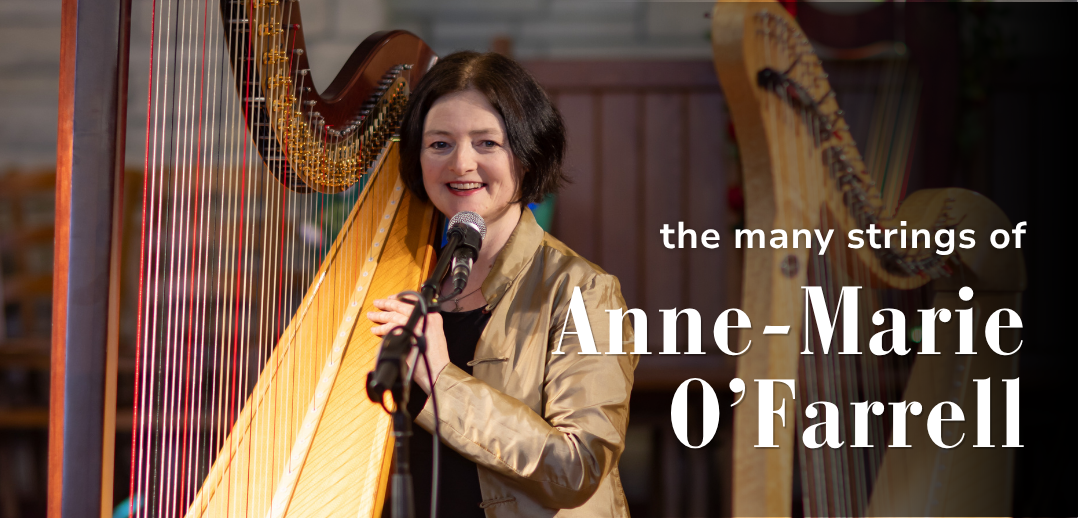
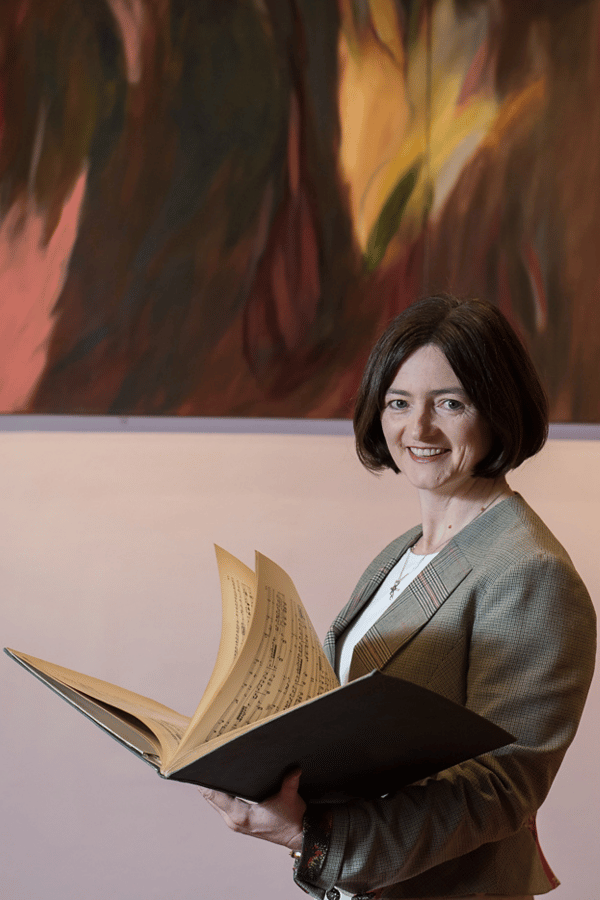
Anne-Marie O’Farrell defies easy categorization. The Irish harpist, composer, and educator is equally at home on lever harp and pedal harp. She is as likely to program Bach as O’Carolan or her own original works. She holds advanced degrees in both performance and composition, has published multiple volumes of meticulously researched editions and transcriptions for lever harp, and since 2022 has served as head of harp at the Royal Northern College of Music in Manchester. She is also an ordained priest in the Church of Ireland. Any one of those identities would be enough to build a career around, but O’Farrell holds them all simultaneously, and clearly delights in each one.
What comes through most in our conversation with O’Farrell is a mind that is perpetually in motion—curious, precise, and genuinely excited by what hasn’t been tried yet. She speaks about the circle-of-fifths relationships embedded in pedal harp design with the same enthusiasm she brings to a centuries-old Irish harp tradition she absorbed as a child through her mother’s songs and her first teacher’s love of O’Carolan. Whether she’s tracing the origins of a manuscript, coaching a student toward their own artistic voice, or composing a new piece, the driving question is always the same: why can’t the harp have that too? It’s a question that has shaped her entire career, and one she’s nowhere near done pursuing.
Harp Column: Most people are familiar with the harp’s importance in Ireland historically, but could you talk a little bit about what role the instrument plays in Irish music and culture today?
I want a wider range of styles, idioms, and dialects on [the lever harp] too, and whatever lever changes are needed to get there, I’m up for it.
Anne-Marie O’Farrell: It’s our national instrument, and it’s also our state emblem—we’re, as far as I’m aware, the only country that has it as our state emblem. A few years ago, Irish harping gained UNESCO status as a culture of intangible heritage. In terms of its place in the culture, it’s really increasingly prominent and visible. I’m speaking now of the Irish harp, what is known to people as the lever harp, and certainly the style of traditional playing—Irish traditional music on the harp is highly visible in Ireland today, far more so than when I was growing up. And the visibility is in the main of the playing of traditional music by ear.
HC: To what do you attribute that kind of resurgence or rise in importance today compared to when you were growing up?
AO: In the last decade and a half, the formation of organizations like Music Generation, which was initiated by Bono of U2, and designed with the Department of Education. It was initially fully funded by U2, and then gradually it was dovetailed across, and it’s now fully Department of Education, as far as I understand. They have pockets of music schools going all around the country, in ukulele, percussion, Irish harp, violin, choir, choral singing. The violin and choral singing include classical; the harping is largely traditional. That has contributed heavily [to the Irish harp’s resurgence]. And then Harp Ireland was formed. There was already a harp society in existence, but what Harp Ireland has done is tapped into government funding in a fairly significant way, and they too have furthered the visibility of the harp, and in particular, of the playing of traditional Irish music on the harp.
HC: That’s interesting. Growing up in Ireland, how did the country’s musical traditions—traditional Irish harp, Irish music—shape you as an artist?
AO: My mother taught me lots of songs in Irish, lots of songs from the tradition. As the years go by, I’ve come to appreciate what a really special thing that is. And equally, I was really fortunate in that my first harp teacher was not only a singing teacher, but also had a tremendous appreciation of Irish music, of the music of [Turlough] O’Carolan. Her name was Nancy Calthorpe. Her influence was really important, because, as well as giving me a classical background in terms of the style of tuition and the exams I did and learning from sheet music, she also taught me a lot of Carolan, a lot of really good Irish songs, self-accompaniment on harp with singing. At that time, the playing of Irish dance tunes was not yet mainstream in harp playing. The work of Máire Ní Chathasaigh and Janet Harbison was yet to become very widely known, which it did soon afterwards.
HC: Okay, interesting.
AO: Another major influence on my understanding of traditional Irish music—and just the appreciation of it and approaches to it—is my close friendship with the harpist Cormac De Barra. We’ve a long-standing duo together. Irish is his family’s first language. He comes from a long line of Irish harpists who also did quite a lot of singing to self-accompaniment on harp. Through Cormac, I began playing lots and lots of dance tunes.
HC: Are Irish harp and lever harp terms you use interchangeably when talking to others about what you do?
AO: I tend to use lever harp when I’m outside of Ireland, because it tends to be a word that’s very clearly understood. They know I’m not talking about the wire-strung harp, the design that is our state emblem. I tend to use lever harp or Irish harp, almost interchangeably. It depends a little bit on the context. And I am conscious that when I’m abroad, I’m representing my country, so sometimes I like to put Irish harp in there, but really in a festival, I often refer to it as lever harp, so people know it’s not a chromatic cross-strung harp, it’s not pedal harp. The word lever—it does what it says on the tin in terms of the mechanism.
HC: What do you think international audiences often misunderstand or overlook about the Irish harp?
AO: I’ve played in lots of places, far-flung places around the world, and people take my music as they find it. I realize I do slightly unusual combinations of repertoire. For example, I’m going to be playing Verdi’s choral Ave Maria on lever harp at the One Harp World in July. You can usually bank on a piece in my concerts being something that you mightn’t have encountered on harp before. And there will be some Irish music in there, but it won’t be a concert entirely of Irish music.
I’ve never stopped being tickled by this question of what’s possible on the instrument. I suppose people will have their own impressions depending on how they’ve encountered [the Irish harp], whether they’ve encountered it in Irish emblems and that kind of thing, or the more traditional side. And of course, there are Irish harpists who play classical pedal harp only, or primarily. I play both. I’m very grateful for audiences who just take me as they find me.
HC: How do you navigate those two traditions—Irish harp and classical pedal harp? Do you ever feel any tension between them?
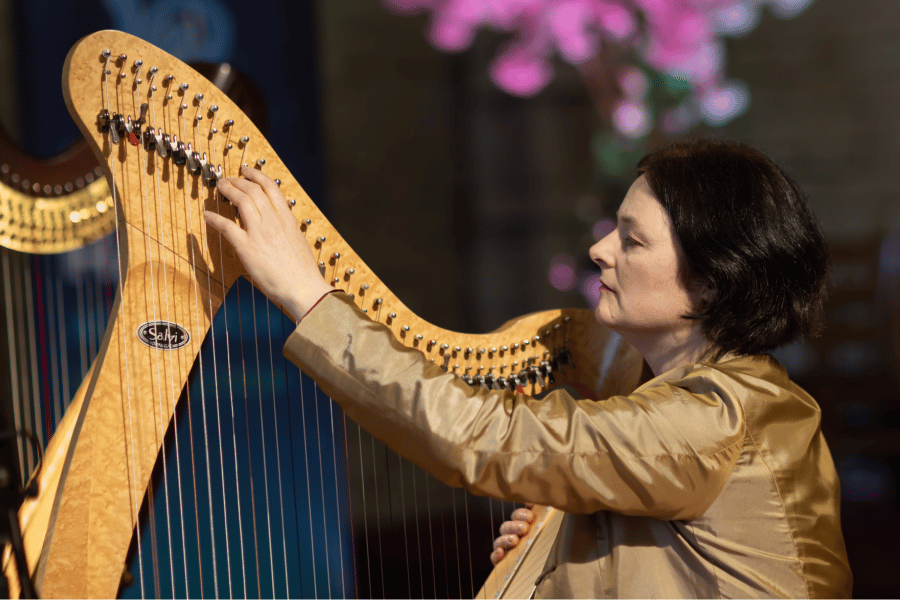
AO: I enjoy their differences, and I enjoy the diversity of the two. There are simply different styles, different traditions. I don’t have any difficulty switching from pedal harp to lever harp in terms of combining them in concerts, looking after my calluses for a good sound. I find all of that is very manageable. I’ve never had an issue combining the two. It could help that I have generally, over the years, had a preference for gut-strung lever harps, and I realize they’re something of a rarity. I do enjoy the tone production on gut. However, my lever harp for traveling is a 12-and-a-half-kilo Salvi Donegal, which has carbon fiber strings, and I simply navigate the difference. In my forthcoming concerts in New Zealand and Hong Kong in the next couple of weeks, I’m playing pedal harp and my Donegal lever harp, which is a bit lighter than my Salvi Livia, so I just use different pressure on my fingers. I play them differently.
HC: Do you think of pedal and lever harp as fundamentally different instruments, or variations on the same thing?
AO: I totally hear you on that, and I think it just simply depends on what the current project is at hand. What’s the best musical outcome for that project? What are the considerations? There are different possibilities on each, and I’m equally excited by the possibilities on each.
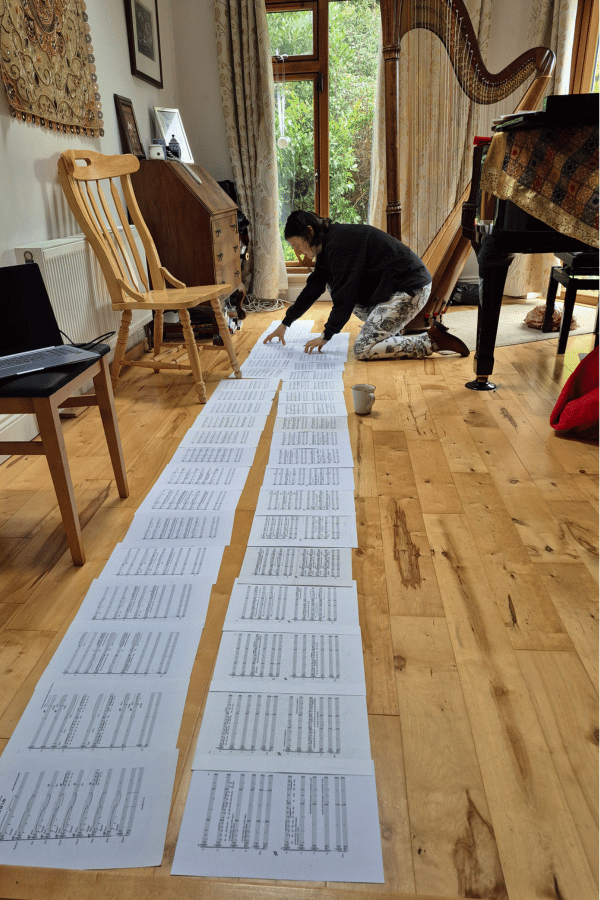
With the pedal harp, I’m particularly interested in the impact of the pedal layout. It’s designed around tonal keys and circle-of-fifths relationships, and I’m drawn to how those modulations connect to more colorful sets of pitches. As a composer, I think about how we can expand the musical language and styles available to the harp— making full use of the pedal options while cherishing the tradition and also moving beyond it. I’ve pursued that idea in a piece I’ve just written for Emmanuel Ceysson called Murmuration, which he premiered on a tour in Ireland and will perform at the One Harp World. I’m also giving a talk about the piece. Anyone who hears it will get a clear sense of what I mean by expanding beyond received musical styles.
That same question is consistent with my fascination on lever harp—I want a wider range of styles, idioms, and dialects on that instrument too, and whatever lever changes are needed to get there, I’m up for it.
HC: You’ve worked to expand the lever harp’s possibilities, and with this new composition, it sounds like the pedal harp’s possibilities too. Where do you think the ceiling is for each instrument?
AO: I’m delighted to say I haven’t discovered it, and I look forward to either discovering it and opening it many, many times, or not encountering a limit at all. You discover, oh, that works really well, or that works less well. I suppose maybe I’m dealing with what we might refer to as mini ceilings all the time. For example, I’ve done the Godefroid Étude de Concert on lever harp, in F minor, but at the Parish Alvars Sérénade, I drew the line. You try these things out, and then you go, is that going to serve the piece? No, it’s not. There’ve been fugues I’ve looked at where you realize it’s actually not going to serve the piece. In fact, there was one fugue I recorded for an album, and before making the final decision, I took off that track. I was just content that I had tried all I could to get it to a credible speed, and I still felt it was a bit under speed to serve the music well. I suppose we might call that a ceiling, but they’re just mini discoveries, really, of what will serve the music and what will delightfully expand the repertoire.
HC: You seem to really light up when you talk about figuring these things out and the possibilities. What would you say motivates you? You’ve published these Bach works for lever harp, made transcriptions, composed original works—what drives how you pick your next project?
AO: Lots of things. In the first instance, curiosity, and then the delightful serendipity of folks getting in touch and saying, let’s do this. Or the serendipity of keeping an eye out for what’s going on, and an opportunity comes up—maybe to apply for something—and it comes at maybe a good time for me. Or maybe an application turns out to be a learning experience and equips me for the next time round. I think there are lots of factors in the decision of the next project, and it could be a really nice collaboration. For example, I have a new pedal harp duo, the Stratus Duo, with harpist Louise Thompson in Manchester. Through the collaboration with her, I’ve done quite a few transcriptions of works for two pedal harps. In particular, Schubert’s Fantasia for Four Hands—a single movement, 20-minute piano duet—is an exquisite piece of music, and it works beautifully for two pedal harps. And then I’ve also taken three Debussy movements from his Épigraphes antiques, which was premiered this spring. It’s been absolutely lovely. I wouldn’t have met her had I not moved to Manchester for the job at the Royal Northern College of Music. That’s been absolutely great, to have a pedal harp duo for whom I can compose and arrange.
HC: Well, let’s talk a little bit about your teaching. You mentioned teaching at the Royal Northern College of Music. Are you teaching mostly pedal harp there, or lever? How does that work?
AO: I teach mostly pedal. But one of the things I did do after starting there was organize the purchase for the department of a Camac Excalibur lever harp, which goes down to the bottom A—it’s a really fine instrument. Students have the option of doing part of their recital, as they go into third and fourth year, using lever harp as well, and some take up that option.
HC: As an educator, what do you find most important that you want to pass on to this next generation of harpists?
AO: I find myself coming back to principles of education rather than anything specific about the harp. I keep coming back to the words curiosity and integrity—I really want to help each of them find their own voice. It’s really interesting when they’ve been with me a little while, say on the undergraduate program, and their individuality starts to blossom in the third and fourth year, when the course structure gives them the opportunity to make individual choices. There’s more scope in the third and fourth year for them to go, “Oh, I think I’d like to be that sort of musician,” or “I think I’d like to follow this avenue.” I feel strongly about supporting [my students’ choices], and helping them adopt really constructive, healthy working patterns that will help them look after their artistry and foster it for the rest of their lives. That’s also one of the reasons I’m currently training to be an Alexander Technique teacher—in the Interactive Teaching Method, specifically. It’s been a really positive influence on my own artistic practice, and on helping students use their systems the way they were designed to be used.
HC: You hold advanced degrees in performance and composition. Your editions and arrangements are incredibly informed and beautifully done. How do you think your academic scholarship shapes your approach to the instrument as a performer?
AO: It certainly helps me be very interested in tracing ideas, in being curious where something came from. And it’s something I strongly encourage my students to do. It can be very easy to grab a score from IMSLP, for example, or from other online resources where there are varying levels of curation. Encouraging students to ask, “Where did this come from? When did that happen, and what are the consequences of my using this score rather than that score?”—just discovering the kinds of questions that can arise between a publication and a manuscript. Carl Swanson’s Debussy editions are a good example of raising questions and spotting discrepancies between manuscript and a publication which has been used for some time, and in some cases all he’s able to do is identify the question—but at least say this question is here, and the player is going to need to make a call on that particular one.
I’m more conscious now than in earlier years of the necessity of tracing ideas’ origins, where things have come from. Why is it done this way? And giving a commentary before the score—in the harp world, we see a lot of scores where there isn’t anything very much in the preface. But it’s really useful to say where the dynamic markings have come from, or the phrasing—are they yours? Are they the composer’s? And then that really helps the performer go, “Oh, well, these are the editor’s, and I have a different view,” and off they go. They can make an informed choice.
I’m currently working on the publication of the D-minor Chaconne, BWV 1004 by Bach transcribed for lever harp and his Chromatic Fantasy in D minor, BWV 903, the one that goes before the fugue. And I perform those two pieces quite a lot on lever harp. In those prefaces, there’ll be quite a bit about the choices I made. I mean, the Chaconne it was originally written for solo violin, so there’s the question, what do you do with the bottom half of the harp? And there are transcriptions for pedal harp by Dewey Owens and also by Skaila Kanga. Each of them has reached various decisions on how to use the bass register. There is the question of arrangement versus transcription. In these two works—the Chromatic Fantasy and the Chaconne, and indeed in all of the pieces of the O’Farrell Collection, Volume Four, which was published a few years ago—they are transcriptions. And in the world of harp publishing, I use the word transcription as a way of saying, “No, I haven’t added notes. I haven’t filled out chords.”
HC: That was going to be my question—where’s the line between transcription and arrangement?
AO: I realize there’s nothing wrong with filling out a chord, but to my mind, it’s got to be consistent with what else there is in the score; it’s got to be consistent with the texture. A trait of an arrangement would be maybe diluting the harmony to make the lever changing easier—that is something I wouldn’t do. I would sooner not transcribe a piece than dilute the harmony, because each note in a chord has a function, and to remove a note from a chord is utterly changing the function that the composer designed. I would neither remove notes from a chord nor add any. What I will do is double a note in harmonics to enrich the timbre. And there’s a lot of that in the Chaconne—that whole bottom of the harp not being used. I thought, well, why don’t I make the most of sympathetic resonances? If there’s a C-minor triad just in the middle of the harp in the right hand, then I can do that in harmonics in the left hand, and just create a bloom on the sound. Any kind of structural alteration would be an arrangement. Changing the harmonies, for me, is a deal breaker.
HC: What range is ideal for you when you are transcribing or writing for the lever harp?
AO: For lever harp, while I love a bottom B and A where possible, a B is fine for me to enjoy. But if I’m publishing, I want to work with a 34-string setup, because I think ideally I want things to be reachable for people. Equally, there are some pieces where—for example, thinking of the slow movement of Bach’s Italian Concerto, which is in D minor and has bottom A’s quite regularly—that piece is far less satisfactory without the bottom A, because it’s a climactic moment where it’s part of the texture. But in general, I provide an ossia. I prefer to aim for a 34-string setup to help the accessibility and the dissemination of the work.
HC: That care for the player really comes through in your scores.
AO: I feel very fortunate that I have that working relationship with Andrew Jones of 80 Days Publishing. For a long time, I published my music myself, and as a composer I considered myself fairly well-trained in typesetting. But it was the association with Andrew that really brought that side of things to another level. What’s really fantastic about our working together is I can have the fiddliest lever change or the fiddliest damping technique, and he’ll go to no end of trouble to get it clearly notated, so that the player doesn’t have to navigate anything beyond the music itself. It’s an absolute win-win, as far as I’m concerned.
HC: I want to shift gears a little bit here. Looking back, can you point to any pivotal moments or decisions that shaped your path with music?
AO: Rather than being a single moment, I’d say there have been elements that have been there all along. As a youngster studying piano and vocal repertoire, I realize now that really influenced my work with the harp, because I saw what the singers have and I saw what the pianists have, and I went, why can’t we? I realized that kind of ignition question has always been there. And I think one of the things that propelled me into composition was on some level wanting to find a wider palette to play with. Over the last 20 years, I’ve written more and more orchestral music, and some years back, a lever harp concerto.
I’ve always been very interested in faith. I’m an Anglican or Episcopalian—I grew up Roman Catholic. Faith has always been a very big part of my life. I’m ordained in the Church of Ireland, and now, since I got the job in Manchester, I’ve had my license to officiate transferred to the Diocese of Manchester, so there are a couple of churches there where I help out. I’m really interested in sometimes expressing a theological idea through music, and on the harp—not necessarily on the harp—but sometimes it can be. I really enjoy the interaction between those elements.
HC: That’s fascinating. The breadth of what you do is amazing. What projects or directions are you most excited to explore next?
AO: What I want to continue exploring is music that hasn’t been done on harp before—that general vein of exploration. I’m also conscious of my back catalog, some of which I don’t think is that well known. I was recently asked to provide samples of some compositions, and when I looked, I thought, there’s actually quite a lot there. I’d like to devote some time in the next few years to making it more visible—especially work composed before the current Instagram era. I’ve just written a piece for mixed unaccompanied choir called A Can of Lilt, a kind of mouth music piece. At a recent rehearsal, one of the singers remembered a performance of a piece of mine from 1999—still remembered being in the choir—and spoke of it again. “I’d love to get a recording of that,” he said. Moments like that get you thinking about the dissemination of work from the pre-Instagram era, and that all takes time.
And then also, as head of harp at the RNCM, being there for the students—nurturing them, creating opportunities for them—is a really big priority.
HC: How many students are currently there in your studio?
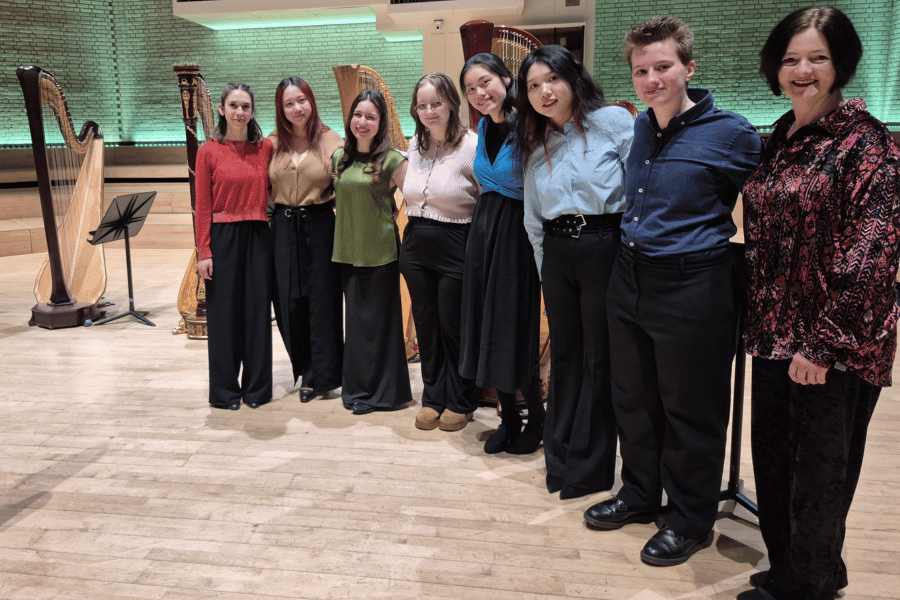
AO: I have seven in my conservatory class. Next year, three are coming and one finishing. I’m very happy with the size of the class, and also with the wide range of nationalities—Singapore, China, America, Turkey, Portugal, UK. And then we also have a Junior Conservatoire program on Saturdays, where my co-teacher is Lucy Nolan. And then a few private students, and I do tick-tack back and forth between Manchester and Dublin, so a couple of students in Ireland as well, and they can come to me on a more flexible basis, but that’s really enjoyable too.
On the visiting professor side of things at RNCM in Manchester, we have Marie Leenhardt, who is our visiting professor of orchestral studies. She’s based in Manchester, and she’s first harp with the Hallé Orchestra, so it’s really brilliant for her to be able to come in from time to time and work with the students on more detail of orchestral parts. And we also have Louise Thompson as our visiting professor as well, and Anneleen Lenaerts is our international visiting professor. I’m conscious nonetheless, as being the main harp teacher, of bringing in as many visitors as possible—if someone from abroad is traveling through the UK, I try to get them to Manchester as well, so that our students get exposed to a really wide range of inputs and influences, and get a sense of the harp community.
HC: For probably a lot of harpists, it’s the first time they’ve been exposed to such a range of international artists of that caliber too, I imagine.
AO: And there’s a really good, lovely spirit in the UK harp community as well. I’ve been [in Manchester] since January 2022, and the UK Harp Association does really great work. Hats off to them—it’s a really collegial spirit, which is lovely to encounter. •
Away from the harp
Quick questions about life beyond music.
Coffee or tea?
There’s only one response to that—tea.
Morning person or night owl?
Night owl.
What is your favorite place that you’ve performed?
I think the Royal Albert Hall is up there.
What is one food that you could eat every day and never tire of?
Oh, that would have to be the Co-op brand of Gianduja chocolate, made with hazelnut cream.
What’s the best book you’ve read or movie that you’ve seen lately?
I’m enjoying short stories by Richard Yates. And I also loved Mr. Mercedes on Netflix.
If you were not a musician, what would you be doing for a living?
Oh, well, that’s hard, because, you see, I’m actually really lucky that I am also a teacher and I’m a priest and I’m a composer. Well, composer counts as musician, so I’d probably say priest, or maybe gardener. I’m very amateur at gardening, but it’s utterly magic when I do it.
What is something small that instantly makes your day better?
The first mug of tea in the morning.
What is the best thing you’ve listened to lately?
My fix [right now] is Bach’s St. Matthew Passion by the Netherlands Bach Society.
On a plane, do you prefer a window seat or an aisle seat?
Window seat, so I can sleep.
What is the best piece of advice that you’ve ever received?
Look after yourself.