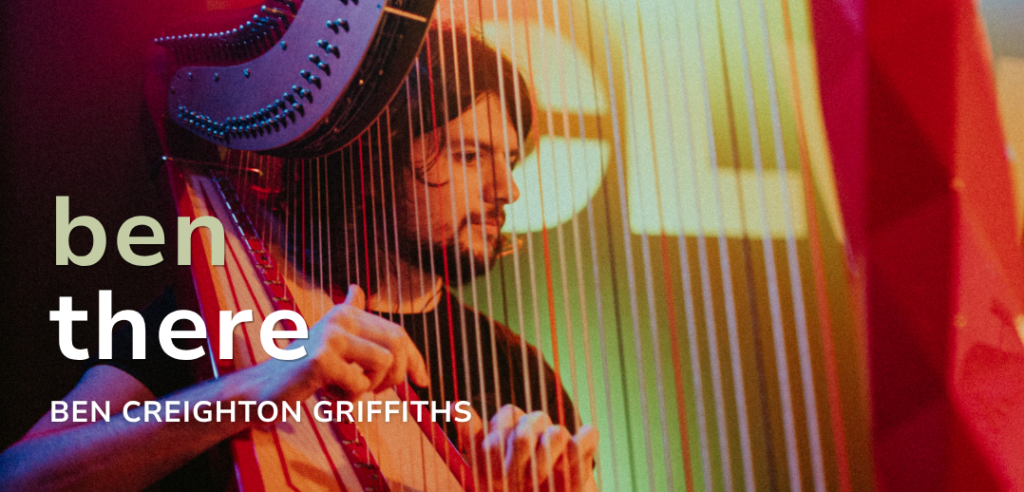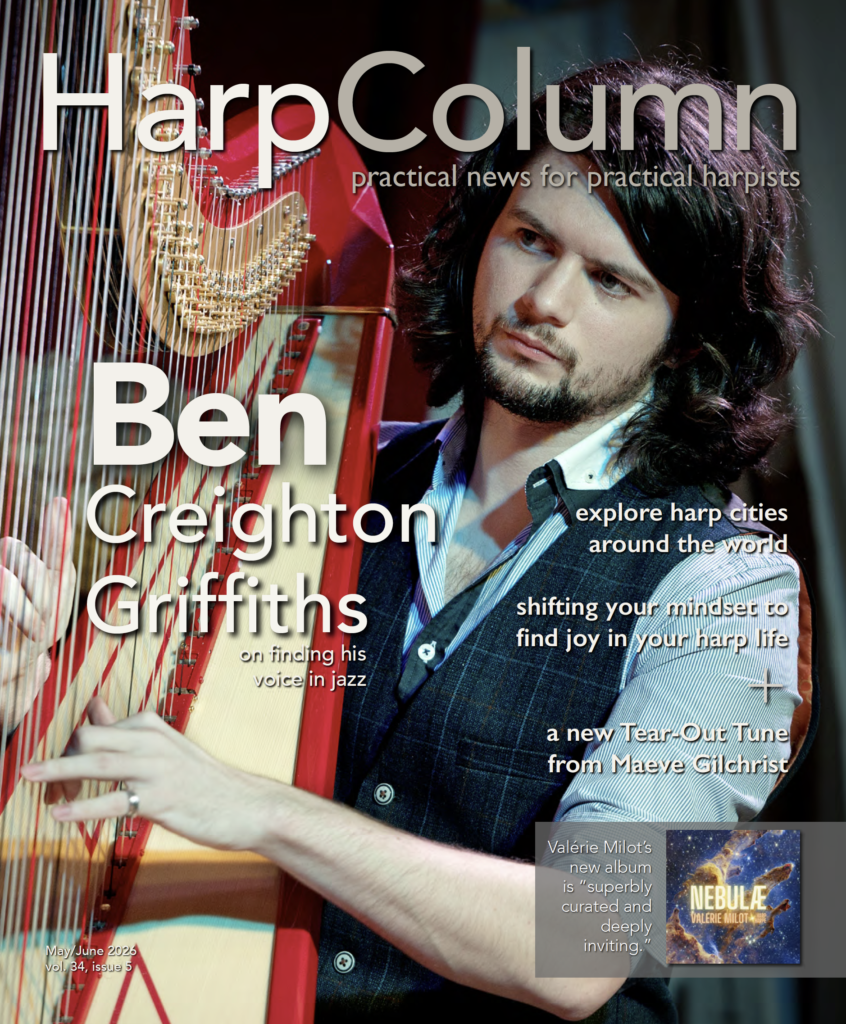

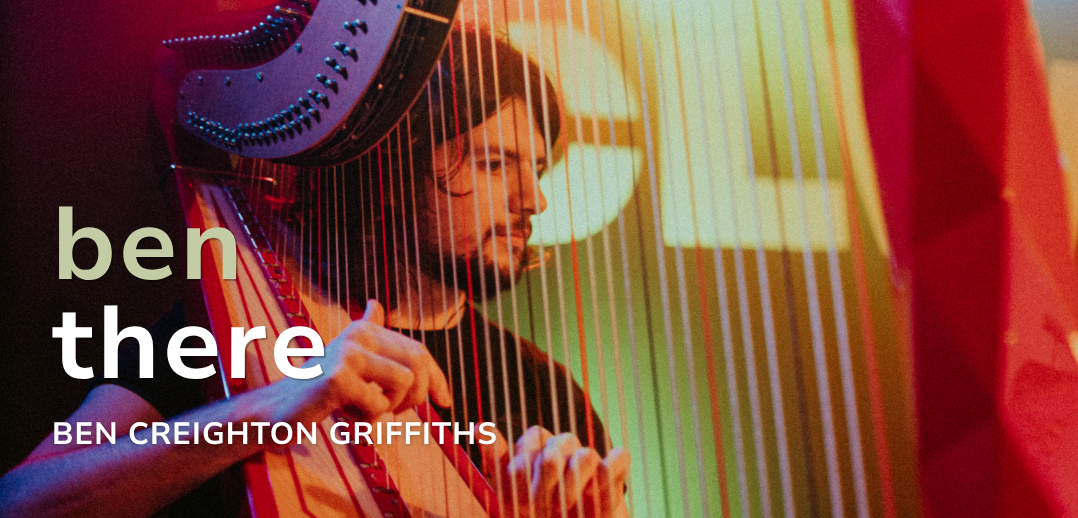
Ben Creighton Griffiths came onto our radar as a rising young harp star in 2013. With a foot in both the classical and jazz worlds, he was just beginning to form a name for himself. Now, more than a decade later, he has a thriving career touring jazz clubs and theaters across Europe with a packed schedule of nearly 120 gigs a year. His signature style anchors his eclectic, gypsy-jazz-infused Transatlantic Hot Club and other ensembles, and he has appeared as a featured performer at major harp events and music festivals around the world.
At the 2026 One Harp World conference, he’ll perform a newly composed concerto with his band Chube, marking his fifth World Harp Congress appearance—all before the age of 30. We caught up with Creighton Griffiths to talk about building a career, developing a distinctive sound, and planting both feet firmly in the jazz world.
Big Ben

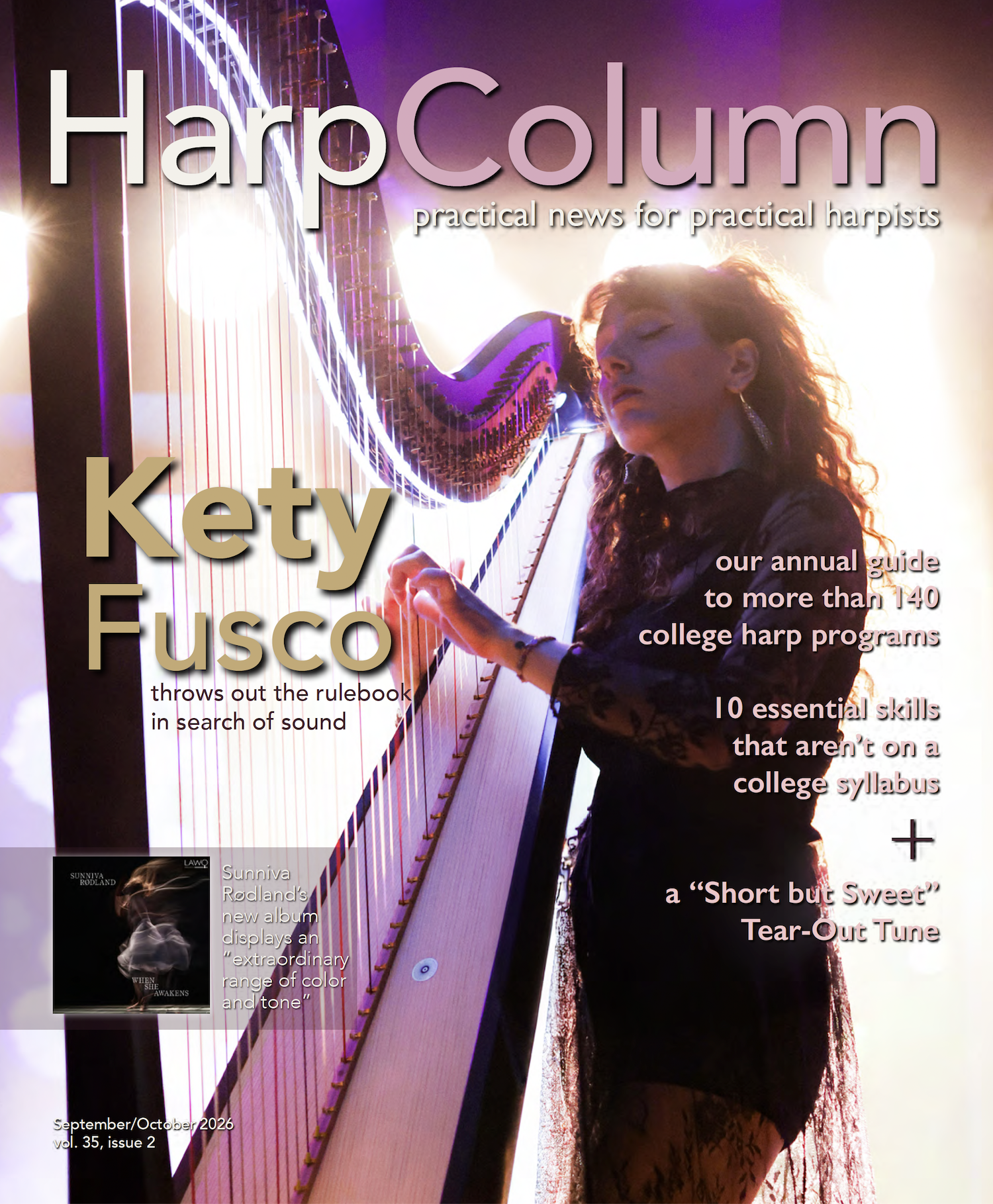
Harp Column featured wunderkind Ben Creighton Griffiths on the cover of our March/April 2013 issue. But after an early rise to fame competing and performing all over the UK and the world, Creighton Griffiths shifted his attention away from classical music and found his voice in jazz.
Harp Column: Wow, so I talked to you in 2013—quite a while ago. Can you remind me how old you were then?
Ben Creighton Griffiths: In 2013? I would have been 16 or 17.
HC:Well, thank you again for being here, because honestly, you have probably one of the busiest harp calendars I have ever seen. I went and checked out your schedule, and I just couldn’t believe it—I think you’re playing almost every single night this month.
BCG:Last year I did 120 gigs, and this year I think it’s going to be on schedule to be about the same. Some months are just ridiculous—I think in May I have around 20 gigs, and loads of traveling. April and March are pretty busy as well. So at the moment it’s pretty intense, but I like it.
HC:Wow, that is just amazing. Are there any particular performances that you are looking forward to coming up?
BCG:In the immediate future, I’m really excited about both the Transatlantic Hot Club tours. This is my gypsy jazz band, with Adrien Chevalier on violin, and for this year we’re a quartet again, with Ashley John Long on bass and Jeremy Lowe on accordion. We have two tours this year—in April, the boys are coming here and we have two weeks in the UK, and then pretty much the following week I load the harp in the car and drive down to Corsica, where we have two weeks on a tour that Jeremy’s organized, because he lives in Corsica himself.
I’m really looking forward to both of those. We’ve got loads of great venues—lots of jazz clubs, lots of theater-style venues as well. We’re really diving into the Corsican link that we now have through Jeremy, so there’s a lot of music and songs from the island, and it’s a slightly different take on the established gypsy jazz genre and style, with the harp as well of course. And I’m also looking forward to the One Harp World event and my concert there. I’m hard at work putting the finishing touches to the concerto I’ve written for Chube and chamber orchestra, which is going to be an awful lot of fun.
HC:I noticed on your calendar you’re normally playing with other people, whether it’s one of your ensembles or just other musicians. Is that normally how you perform?
It’s taken a long time to get from that point to actually doing loads of gigs in jazz clubs, bars, restaurants, speakeasies—the regular jazz circuit. But now here we are, and it works really well.
BCG:Yeah, a lot of things these days tend to be some sort of ensemble. Most of my focus is on jazz—90 percent of what I’m doing is jazz or jazz-related, and generally it’s a collaborative art form. In the classical world, particularly in the harp world, we’re used to solo concerts. But more generally in jazz, you don’t get a lot of solo shows outside of piano players. It’s nearly always bands, which means I’m always asked to provide bands for a lot of gigs. Trios, quartets, sometimes duos—it depends what’s going on. So I’m doing a lot of band leading, a lot of organizing as well, which is really quite fun. I have a wide roster of people I’m playing with—loads of guitarists, bass players, violinists, drummers. I love it because I get to hang around with friends and colleagues, travel together. There are some solo concerts in the diary as well, but more and more people want me to bring one of my bands or an ensemble.
HC: Where do you find these people? By this point in your career, you must have enough of a reputation that they know who you are.
BCG:Here in Cardiff there’s a great and growing scene for jazz in particular. Obviously we’ve got the music college here, but we’ve also got loads of great jazz musicians of all sorts of ages and walks of life. Some of it’s through connections I’ve made by meeting one musician—maybe through a teacher or through a mutual contact—and then they tend to have recommendations: if you need a bass player, grab this guy; if you need a clarinet player, grab this person. So it kind of spreads out like that.It’s great for me, because I’m booking a lot of people, and it’s wonderful that I have six or seven great guitarists I can call on for gigs. Some of them prefer different styles of music too, so I know if I need someone to do more of the gypsy jazz things, I’ve got one person who’ll do that; if I want someone more on the funky side, I’ve got another person for that. It’s really great to have a wide variety of musicians to call upon.
Being Ben
A glimpse at life beyond the harp.
Fish and chips or bangers and mash?
Bangers and mash.
Most memorable performance?
Probably the premiere of my concerto for jazz harp and symphony orchestra. That one’s special.
What’s on your Spotify playlist right now?
At the moment I’ve been listening to loads of pirate-themed metal—bands like Alestorm. I’m doing a lot of DIY, renovating a house, and I need loud music on.
What harpist do you most admire?
Always the late Ann Griffiths, my mentor. Always.
What classical piece is on your music stand right now, if any?
Nothing classical strictly speaking, but I have a new duo with a portable reed organ player, Benjamin Teague, and we’re transcribing Debussy’s “La Barque” at the moment.
What classical pieces do you want to learn?
I haven’t played any Liszt for years, and I feel like I should. I don’t think I ever learned “Le Rossignol.” It’s very pretty, so maybe that.
What jazz tunes are on your to-do list that you’ve never played?
I’m trying to make myself play more bebop—that’s the style I tend to miss out on. And I’m trying to learn more music by Chick Corea, because his compositions are wonderful.
Rugby or football?
Always rugby. Even though we’re terrible at the moment.
Favorite non-harp activity?
Going to the gym or gaming. I’m a big PC gamer.
What would you do if you weren’t a harpist?
Something to do with animals—a wildlife park or zoo, maybe. Or something in video games. Games design, perhaps.
HC:When we talked in 2013, I felt like your playing was pretty well divided between classical and jazz—you’d recently won classical competitions and were quite involved in that world. Would you say that’s still the case now?
BCG:No. Not that long after our interview, actually, I started not having such a great time on the classical side of things. I started struggling with the expectations on me, and just the way that maybe we treat young classical musicians when they’re doing competitions and concerts, getting into their careers. I really wasn’t enjoying that side of things for a while. There was a real question of what did I want to do—did I even want to keep playing the harp? Was that the career I wanted? Was I prepared to put myself through what I was finding to be more and more stressful, more and more difficult?
HC: How did you sort through that?
BCG:What happened was I got a wonderful invitation to go to the Journeys of the Heart Festival, run by French harpist Claire Le Fleur, held in the Caribbean, in Martinique and Guadeloupe. More importantly, when I was there, that’s where I met Adrien Chevalier, my gypsy jazz violinist, who’s a great collaborator of mine now, and we run the Transatlantic Hot Club together. Those couple of weeks—meeting him for the first time, experiencing that style of music, hearing about his life in New York and the way the industry works there for jazz musicians who collaborate and enjoy it—something really clicked for me. I thought, you know what, actually, maybe I could do this.
So I came back from that trip very much thinking: let’s not worry about the classical stuff, let’s not put myself through those competitions and all that—which was really making me ill at the time. Let’s have a go at doing this instead. Everything sort of changed for me. That was November 2013. The next year he came to Cardiff for the first time, we started working on things, and I started really pushing towards that style of music. It’s taken a long time to get from that point to actually doing loads of gigs in jazz clubs, bars, restaurants, speakeasies—the regular jazz circuit. But now here we are, and it works really well.
HC:That’s amazing. I did want to talk a little more about your different ensembles. Let’s start with Transatlantic Hot Club. How did you come up with the name?
BCG:The name is pretty simple—I’m based here in Wales, and Adrien, while he’s French, is based in New York. So if we want to play together, we have to cross the Atlantic. That’s the deal. We don’t rehearse a lot because it’s impossible, but what we’ve built up over the years is at least one UK tour a year, sometimes more. Now there’s going to be a tour in Corsica every year as well, and when I can get over to America, I go over and join him.
The idea of the project is the jazz Manouche—or gypsy jazz—style of Django Reinhardt and Stéphane Grappelli, but instead of the focus being guitar and violin, it’s harp and violin. We’ve done loads of duo gigs together, but over the years we’ve expanded the roster, and sometimes it’s duos, trios, quartets, sometimes even bigger. At the moment it’s the quartet formation with Jeremy Lowe on chromatic accordion. We’re having a lot of fun with that. We’re releasing our second album next month, in April, on the UK tour—we’re really looking forward to it because it’s sounding very, very good. We’re very proud of it.
HC:What’s the name of that album?
BCG:The first album was called From New York to Cardiff—that was recorded in Paris in 2023, and it’s mainly harp, violin, and bass, with some guitar and clarinet as well. The second one, releasing next month, is called Un Petit Goût de Myrte—“a small taste of myrte,” which is a Corsican liqueur made from berries that we’re all particularly partial to. It’s named that because this album was our first real taste of the Corsican link, which we’re looking to develop over the next few years.
BCG:The band is almost 13 years old this year, and we’re really beginning to develop and get out there, which is a lot of fun. People seem to enjoy it, which is great.
HC:I heard you in Orlando, I think it was. You were great! Tell me a little about your other group—the Ben Creighton Griffiths Trio. Is that a catch-all for whoever you’re playing with, or is it a fixed lineup?
BCG:It’s very flexible—sometimes a quartet as well. I noticed over the last couple of years I was getting asked to do more and more ensemble gigs at jazz clubs and arts centers, and they were all trios or duos, on the lines of the Hot Club but not so focused on the gypsy stuff. There’s a lot of swing, a lot of Great American Songbook, some Latin, some bebop—a real mix. And since it was me doing most of the organizing, it made sense to call it that.
The standard lineup is harp, bass, and guitar, but sometimes I’ve got a violinist who swaps in, or we’ll add drums for a quartet. It depends on what I’m being asked to do—some jazz clubs really want a drum kit, for example. A lot of venues wanted the Hot Club to come, but obviously because we’re spread across New York and France, we can only perform in very specific weeks when we’re putting tours on. So the trio or quartet was an idea to go to venues outside our touring window, and provide something similar, then bring the Hot Club back to them a couple of years later.
HC:This is amazing to me—that you’ve built up such a massive touring schedule with what a lot of people would consider quite a niche art form. How have you done that? Any tips for others?
BCG:It’s a lot of admin. I spend way more time at my computer doing admin than I do sitting and practicing. Because I don’t have a booking agent or a manager—I do everything myself, absolutely everything—I spend a lot of time researching venues, festivals, potential concert locations, finding out what they program, and whether I have a project that’s suitable for them. And if I find that there are lots of places that would have me but not quite the project I have, I’ll sometimes start something new. Which is a lot of work—but once you get the ball rolling on a project like the Trio, we don’t need to plan it, we don’t need to rehearse it, we turn up, we play, and it works.
It’s a lot of research, a lot of emailing, and a lot of places not replying and having to constantly follow up. Everyone has the same experience. But what I’ve found is that I’ve been doing this for a long time—knocking on a lot of these doors since before COVID—and it’s only now that a whole bunch of things I started working on six or seven years ago have all come together at the same time. It’s that having to persist for a very long time before it works out—that’s the frustrating part. But a lot of things have just come to fruition simultaneously.
HC:Congratulations on that. So there’s one group we haven’t talked about—Chube. Tell us a little about how that came about, and what you’re doing with it at One Harp World.
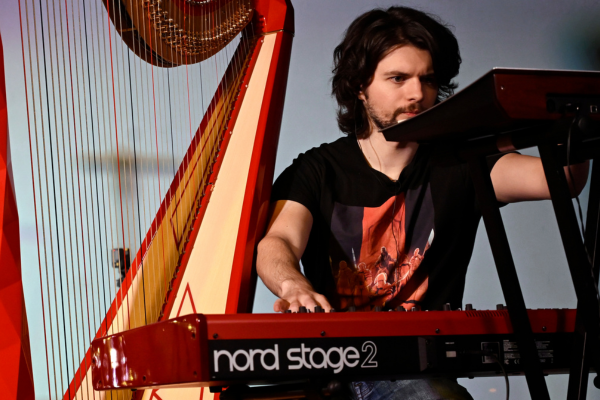
BCG:Chube is the project I started when I wanted to do all the really loud, inappropriate, non-harpy stuff—with drums, with bass, through big sound systems, with synths, all of that. The stuff that I wasn’t sure harpists would even enjoy, you know? It’s very much the project where if I want to write a disco track, that band can do it. We play any style of music, we mash it all together, which makes it really hard to market, but creates a very unique creative outlet.
The lineup now is myself on harp and keys, Ashley John Long on bass—he plays both electric and upright depending on the song—and John Bradford Jones on drums and percussion. It’s a really interesting lineup. Ashley is a doctor of musicology at Cardiff University, incredibly well read, one of the most academically influential people in what he does on the bass, and also a fantastic classical composer who writes a lot of modern avant-garde work and has received some huge orchestral commissions. On drums, John studied with Ashley at the Royal Welsh College and has done every kind of thing you can imagine—cruise ships, studios, rock bands. And actually, I’m not the first harpist he’s been in a band with, because he toured with Catrin Finch and her big band years ago.
It is loud, it’s really groovy, it’s not at all harp-like—but that’s what I love so much about it. Our first proper harp festival gig was last year at the European Harp Symposium. I was a little nervous beforehand, but it went down very well and people seemed to really enjoy it. So I’m really excited to bring it to the Congress and see how that goes.
HC:And you’re playing on the concerto night with them, is that correct?
BCG:Yes—I’ve written a work for Chube with chamber ensemble, which is going to be really interesting, because it’s something I’ve always wanted to do: to blend a larger sound with Chube. There are only three of us in the ensemble, so there’s an upper limit to how much we can do. Adding the chamber group around that is something I’ve always wanted to play around with.
HC:You’ve also written a concerto for jazz harp and symphony orchestra. When did you write that?
BCG: Actually, literally at the last World Harp Congress in Cardiff, while I was there, I got an email from a symphony orchestra in the UK—the Sinfonia Cymru—who I’ve played with for about 10 years as a rank-and-file player. They said they’d love for me to come and do a concerto. I saw an opportunity to create something new and have a go at writing it myself, and I was quite cheeky and asked if they’d be up for something really different, because they had a couple of specific ideas about what they might want. I pitched my idea to them, and they said yes. So I wrote the concerto, and we premiered it in March 2023—about nine months later.
It’s for amplified harp and symphony orchestra, with an additional jazz drummer—John, the drummer from Chube, played on the premiere because I needed to check things with him about how best to write for the drums. That was a lot of fun, it went really well, and since then I’ve performed it another five times. It had its international premiere in Tasmania last year on my Australian tour, which was great fun.
HC: What’s the reception been like?
BCG: Really, really good. I’ve had some very nice reviews, a whole bunch of standing ovations, and lots of lovely comments from audiences. But actually, the most important thing for me—and I say this as someone who’s done a lot of orchestral playing in chamber and symphony work over the last 13 or 14 years—is the feedback from the people playing it. There are a lot of times in orchestral work where musicians are in rehearsals going, “I don’t like this piece, I don’t enjoy it”—particularly some of the really intense stuff. But loads of players have turned around after this concerto and said they really enjoyed it. For me, that’s the most important thing, because if the orchestra isn’t having a good time, I can’t expect the audience to have a good time either.
HC: That’s a big compliment. When we talked before, you were just getting into solo arranging and had done some publications. It sounds like now you’re shifting more towards large-scale projects—would that be fair to say?
BCG: Actually, I’ve got a bunch of new arrangements coming out soon—I’ve just been so busy I haven’t been able to finish them. To go along with the Transatlantic Hot Club, I’ve got a whole series of Django Reinhardt arrangements, some for solo harp, some for harp and violin, some harp duets. The reason not much has come out is simply that I’ve been too busy. It just so happens that I did the first concerto, and then the Congress wanted me to write something too. But I’m keen to keep adding to the jazz harp collection and give harpists more repertoire to explore. I just need to find the time to finish it.
HC: We’ll look forward to any new publications. Now, on the technical side—I know you play an electroacoustic harp. Is it acoustic first, or straight electric?
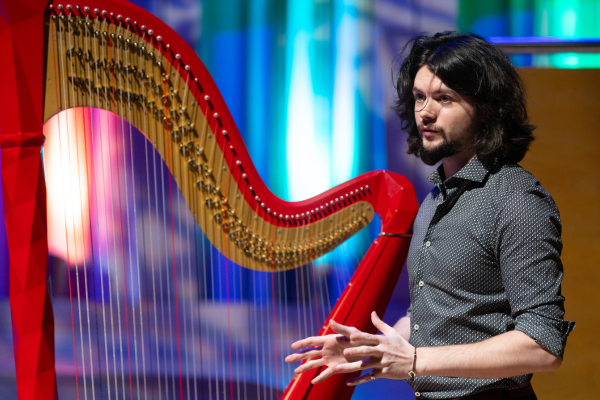
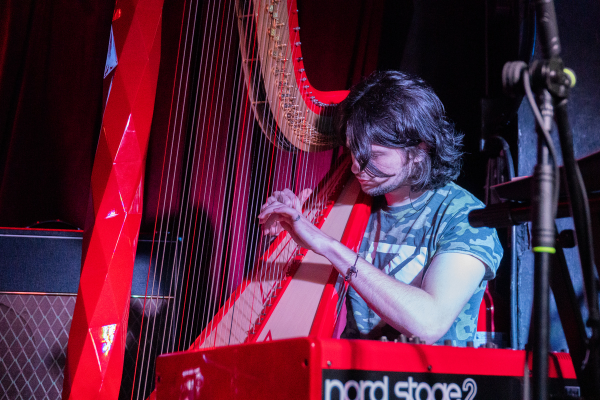
BCG: Most of my performances now are on my red Camac Jubilé, which is the electroacoustic model. I already had the Big Blue, which is also electroacoustic. The reason I bought the red is because when I tried the original model of the Jubilé they revealed at the [World Harp] Congress [in Cardiff], I could not get over how good the acoustic sound was. Phenomenal. I sat down, played it, did a little concert on the Camac exhibition stand, and fell in love with it after about one chord—and immediately realized how expensive an afternoon that was going to be. With the Hot Club and the Ben Creighton Griffiths Trio, if we can play acoustically, we will—that’s our preference. I got that harp because of the incredible acoustic sound. The fact that it can also be very easily amplified is a bonus, because Chube is all electric, and we do a lot of sound manipulation with effects pedals. And when we’re playing in larger venues, we amplify it too.
HC: What does your setup look like for Chube—what kind of effects are you using?
BCG: The main thing is running the harp through distortion pedals, phasers, wahs, delays—that sort of thing. I also play two synthesizers in that setup, so a lot of the organ sounds and pads come from the synths rather than the harp. So in a sense I’m playing three instruments together as one part most of the time. For the concerto I’ve written for the Congress, I was going to include keys but decided to focus entirely on the harp—though there will be electronic elements with that as well. I don’t do much looping anymore, since most of my gigs are with bands, but I used to do a lot of that.
HC: If your 2013 self could see where you are in your career now, what would you have thought?
BCG: I would be very pleasantly surprised that I’m working on completely different things than I was expecting back then. But I’d be very happy about it, because I’m enjoying it a lot more than I think I would be if I were still focused on the same priorities as I was back then. I’m really enjoying all of the gigs I’m doing at the moment.
HC: What do you think you’ll be doing if we interview you again in another 13 years?
BCG: I hope I’m not doing quite as many gigs, if I’m honest, because it is a little bit busy! But I hope I’m really focusing on the specific projects I want to do. By then I’d hope that the Transatlantic Hot Club and Chube would be fully developed, and there are a few particular venues and festivals that I’d really love to take those acts to. I also want to keep bringing the harp to audiences who don’t really have any relationship with it. When I’m going to jazz clubs, people aren’t expecting a harp—they don’t know what to expect. I want that to change. I want to keep showing people something completely different from this instrument that they expect to see only in the orchestra or at weddings.
HC: When we talked in 2013, you were active in several charity events. Is that still something you’re doing?
BCG: Yes—I still have a couple of charities here that I do a lot of work with. The main one is City Hospice. When you spoke to me, they were called the George Thomas Hospice—they’ve changed their name now, but it’s the same charity and they do a lot of great work. They phone me up a couple of times a year and ask if I’m free to come and play at an event, and if I am, I always go. And if any charity contacts me and I can make it work, I’ll try to make it work—I’m always happy to give back. I’ve also done quite a few music workshops with outreach groups, working with children or young adults, which is a lot of fun as well.
HC: I have one last question—and it’s a big one. What advice do you have for young harpists reading this about building a career in music?
BCG: The first thing I’d say is: don’t be worried about taking a different path to your contemporaries, or to what’s expected of you. There’s nothing wrong with the traditional route of competitions, conservatoire, degree, master’s—all of that. It works for a lot of people. But there are also a lot of people it doesn’t work for, and you shouldn’t be afraid to strike out on a different path. And if it doesn’t work, you can always go back to college a few years later. I did take a bit of a risk when I was 18—I didn’t go to study anywhere, I just went straight into freelancing and tried to build a career. I wouldn’t be where I am today if I hadn’t done that. I’m very happy with where I am now, and it happened against what a lot of people might have expected. So if there are students out there with ideas about doing something different, don’t be worried about trying something new.
The other thing I’d say is: really look after yourself. There are always lots of pressures on young musicians and students, and you have to be careful. It’s not worth compromising your health. Your happiness is the thing. You need to find a way to be sustainable in your music career and in your studies, and that’s something I’ve been working on the last few years—trying to come up with a healthier way of working. Unfortunately, sometimes you only discover that in hindsight. You’ll only realize you were working in a more healthy way after you’ve experienced the alternative. So find your own path, but find a way of doing it sensibly, without working yourself into the ground. •