
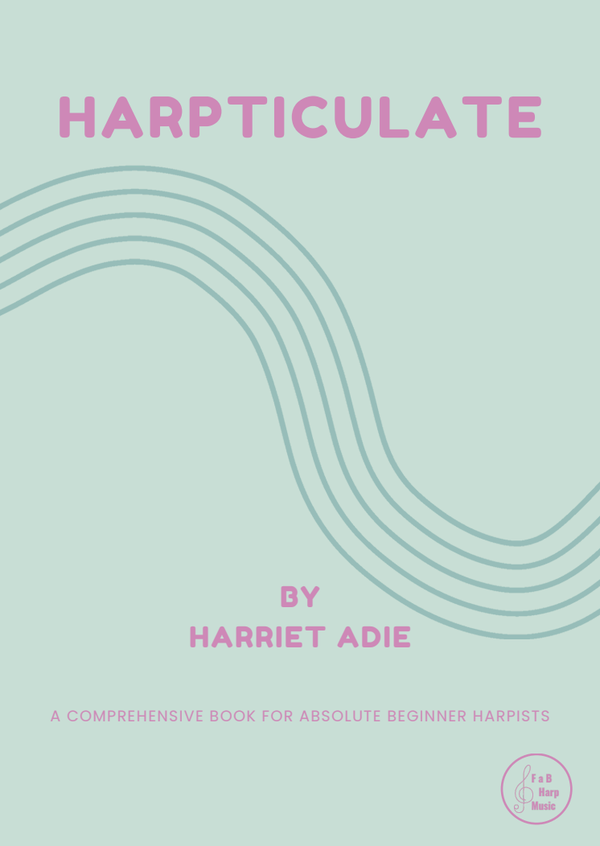
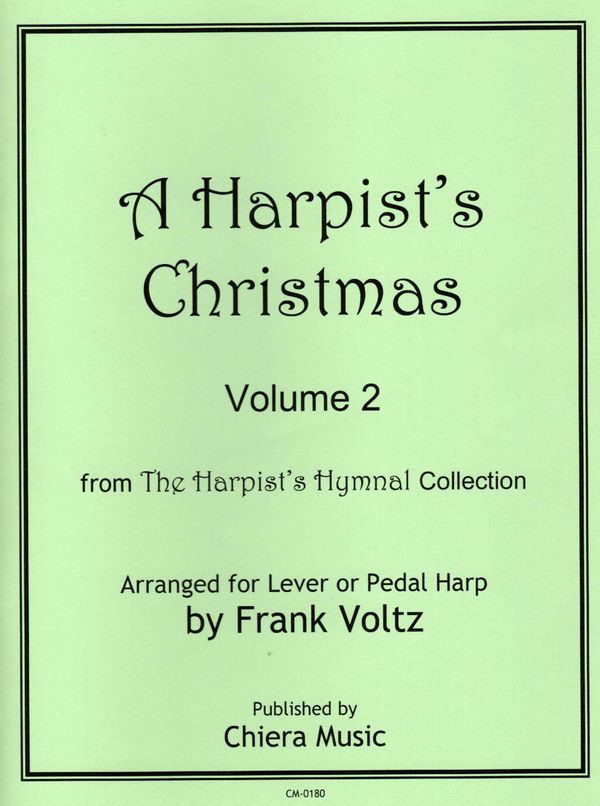
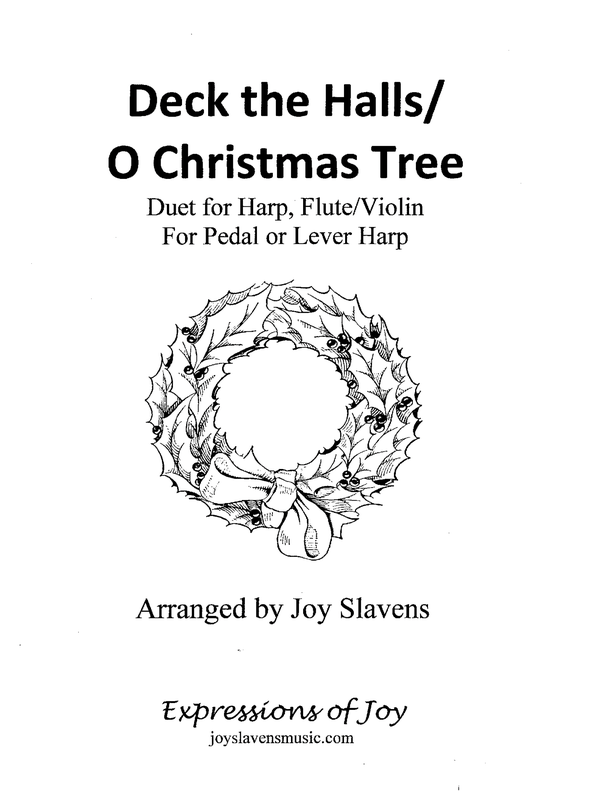
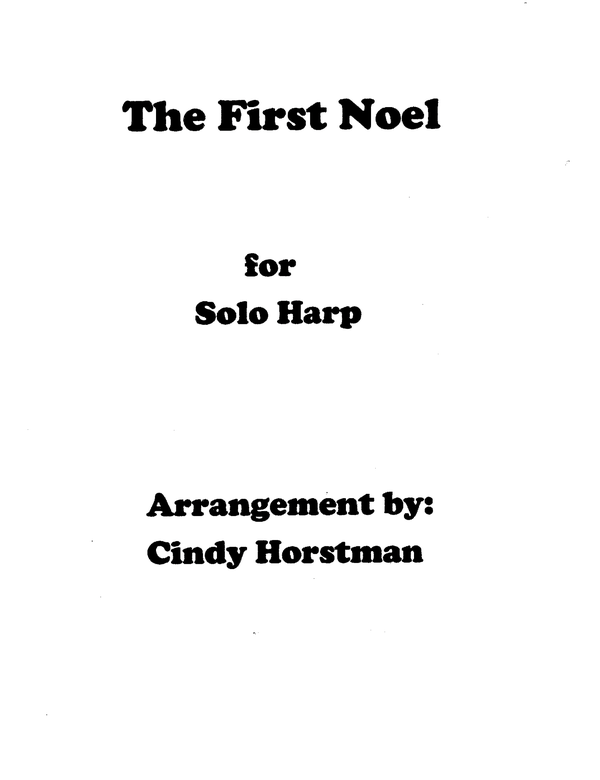
New instructional material and holiday arrangements for solo harp include (from left to right): Harpticulate by Harriet Adie; A Harpist’s Christmas, Volume 2, arranged by Frank Voltz; “Deck the Halls/O Christmas Tree,” arranged by Joy Slavens; and “The First Noel,” arranged by Cindy Horstman.
The new school year has begun so it seems like a good time to take a look at some new instructional material.
Harpticulate is a new book written by Harriet Adie and published by FaB Harp Music (available on harpcolumnmusic.com). It is meant to be a comprehensive book for beginner harpists of all ages although it is geared more toward young students than adults.
Adie felt the need for a really basic book that would introduce students to notes and rhythms in a manner that allows them to fully absorb the technical demands of the harp without moving to new concepts too quickly. The book requires only two fingers and is available in both a hard copy and digital download. It is meant to be used with a teacher and not intended as a teach yourself manual. Adie assumes the student is new to not only the harp, but to reading music as well.
It begins by explaining how to sit at the harp and a thorough description of hand position. Colorful drawings illustrate the concepts. She uses red C’s and blue F’s when explaining the musical alphabet and whenever she shows a C or F on the staff.
Since Adie is a colleague from across the pond, she uses different terminology to define note values and rests. Her Western Hemisphere contemporaries will want to change “crochet,” “minim,” and “semibreve” to “quarter,” “half,” and “whole” notes or rests. This is a simple change and also helps to make students aware that not all musical terms are universal.
She also introduces treble and bass clefs, rests, brackets and placing, dynamics, time signatures, some musical terms, dotted notes, and note reading.
The first note introduced is middle C, followed by treble clef D, then bass clef B, then treble clef E, then bass clef A, and so forth up and down the scale. By the end of the book, the student can read the notes between third-octave C and fifth-octave C (without sharps and flats) on the staff. There are many little tunes for the student to play to drill on each new note as it is introduced, all with just the thumb and second finger.
There are also exercises to count and clap along with a teacher. Interesting historical facts and harp trivia are scattered throughout the 69-page book.
If you teach absolute beginners, you may want to give this book a try.
It’s also time to start planning for the holidays, so here’s a look at some Christmas fare.
Frank Voltz has a new collection of five Christmas carols, A Harpist’s Christmas, Volume 2. It is similar in style to Volume 1 that was published last year, also by Chiera Music. The arrangements are intended for lever or pedal harp, and there are no pedal or lever changes. All the music is in either the key of G or F major, so they can be played on a lever harp tuned to at least F major.
“Sussex Carol” is probably the easiest and features a lot of triad chords. Two pieces, “Good Christian Friends, Rejoice” and “O Christmas Tree” include verses with Voltz’s signature style of syncopated left hand accompaniment, lending a contemporary feel to the tunes. Triplets are also highlighted in the latter piece.
There are several scale glisses in “Away in a Manger” (Kirkpatrick version) and the final arpeggio ends on the ninth. “Still, Still, Still” is particularly pretty with some attractive left hand accompaniment and scales.
The typesetting is easy to read and some fingering is suggested. Page turns are manageable and chord symbols are included if you want to improvise. Intermediate players will find the music sight-readable and it should also be accessible to upper beginners.
This volume provides some fresh arrangements of traditional carols for your holiday performances.
If you could use a duet for harp and melody instrument (flute or violin), consider Joy Slavens’ arrangement of “Deck the Halls/O Christmas Tree,” for pedal or lever harp (joyslavensmusic.com). This is in F major and the harp part includes some harmonics and scale glisses. There are no pedal or lever changes as the only accidentals are in the flute part.
It starts out in 4/4 for “Deck the Halls,” changes to 3/4 for “O Christmas Tree,” and returns to 4/4 to end with the first tune. The two instruments alternate playing the melody or play in harmony. There are a few rehearsal markings but they are barely necessary as the measures are numbered and the flute part is included on the harp score. Intermediate players can sight-read this music and late beginners should be able to manage it. Page turns are easy and there are a few fingering suggestions. This is a likeable, readily playable addition to Christmas duet music.
Cindy Horstman has written and published a lovely contemporary arrangement of “The First Noel” for pedal harp. The soothing, jazz-based harmonies require some pedal changes that are clearly marked, and most of them are on the last page.
The eight-measure intro is repeated after the first verse as an interlude before the second verse. If you’re not good at improvisation, no worries—Horstman does the improvising for you. The second verse is a mellow, laid-back variation on the melody that culminates in a downward scale of sixths to lead into the chorus. Some fingering is suggested, but intermediate and above players should find most of the music falls comfortably in the hands. This appealing arrangement should be a crowd-pleaser at parties and for both traditional and contemporary Christmas services. •