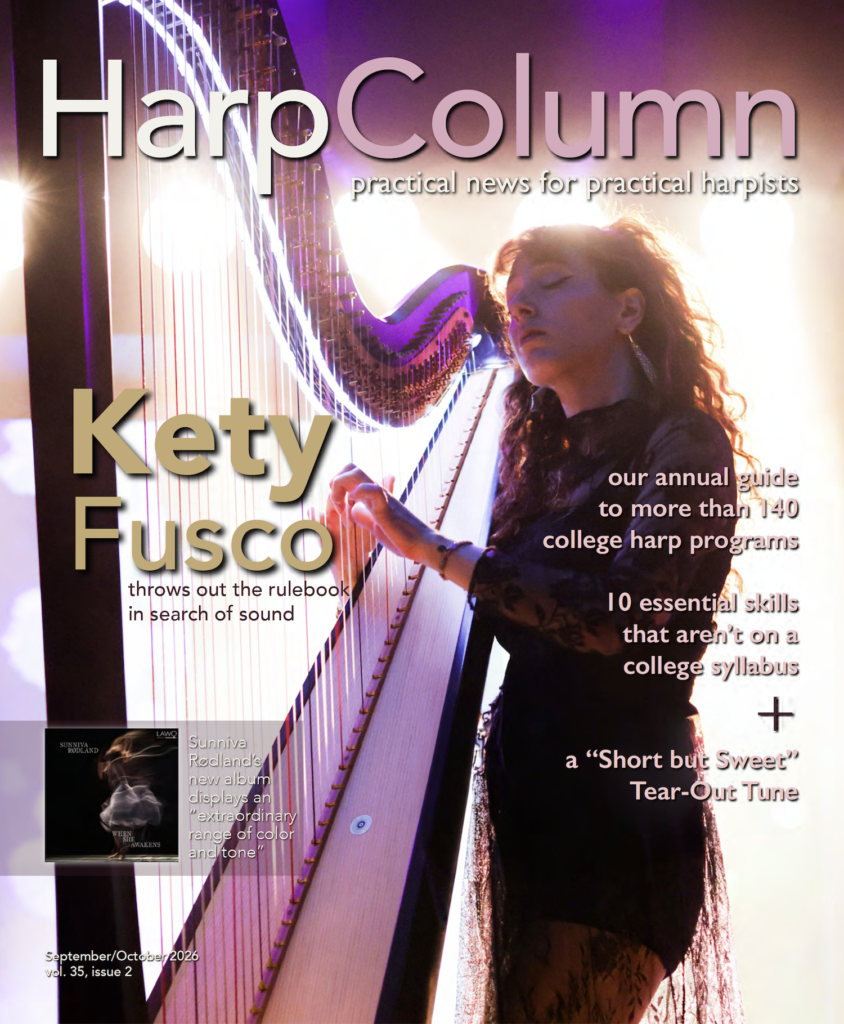

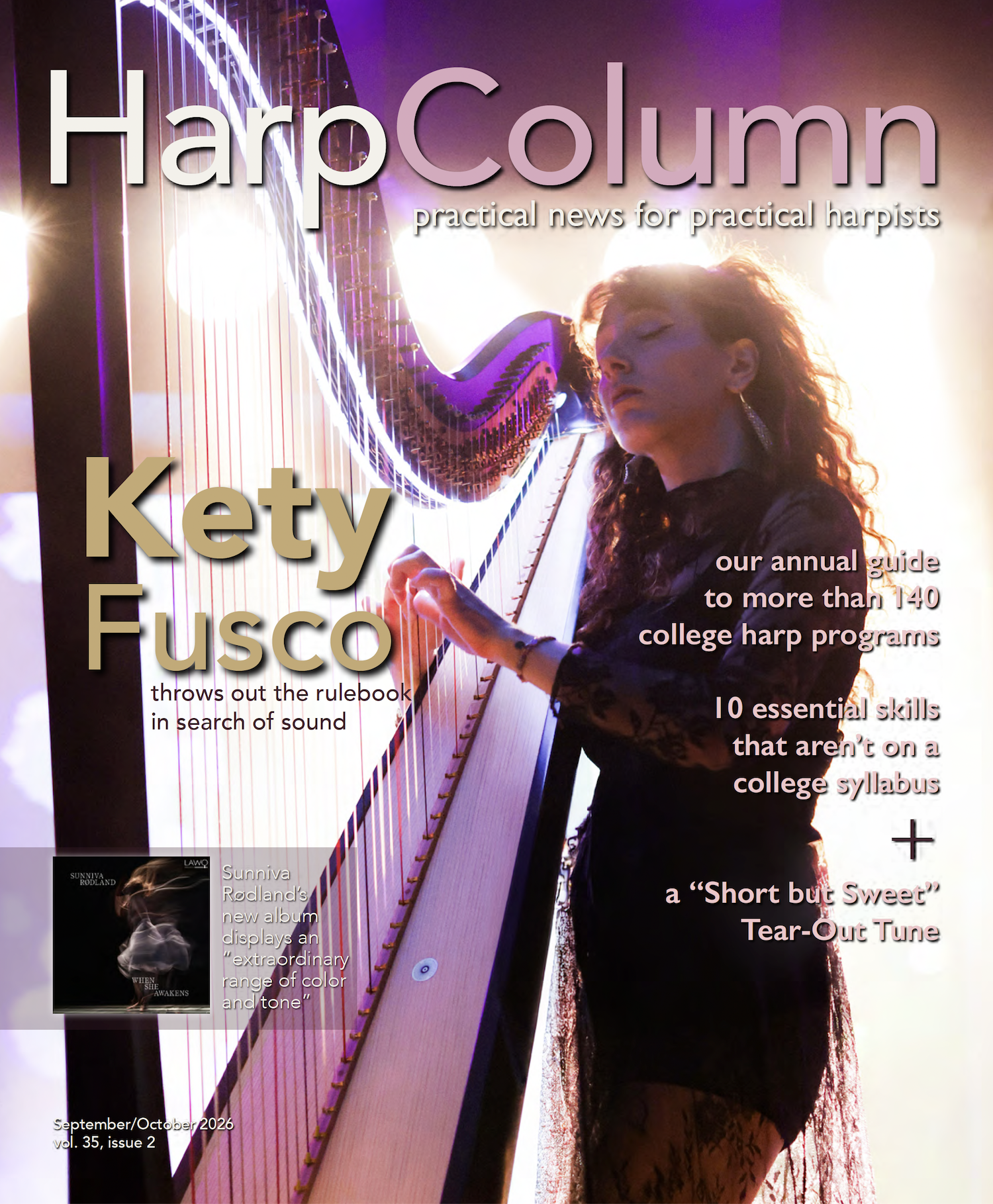
Download this issue to get this tune now!
Each installment of our Tear-Out Tunes series features a new piece written by one of the best harpist-composer-arrangers in the business. Each composer will tell you a little bit about their piece, and also give you some helpful tips for learning it and getting the most out of the experience. The new piece (on the following pages) is yours to keep. We even put it right in the middle of the magazine so you can tear out the whole sheet and put your new tune on your music stand.
It was a great pleasure for me to compose Short but Sweet for both lever and pedal harp for this issue’s Tear-Out Tune. My aim of this project was to provide harpists with engaging and accessible contemporary repertoire, and I wrote this piece with both musical enjoyment and technical development in mind. Although the title suggests something light and compact, the composition contains a variety of musical colors, rhythmic ideas, and technical challenges for players of different levels.
I built the piece around two contrasting moods. It opens with a rhythmic and energetic section that immediately establishes a strong groove and forward momentum. The pulse is driven by syncopation and off-beat emphasis, giving the music a lively, almost jazzy character. In contrast, the middle section shifts into a lyrical and dream-like atmosphere, where the music becomes more flowing and expressive. After this calmer and more reflective passage, a transition gradually leads back into the opening rhythmic material.
“Learning how to combine relaxation with precision is an important skill that can help players develop a more rhythmic style of playing.”
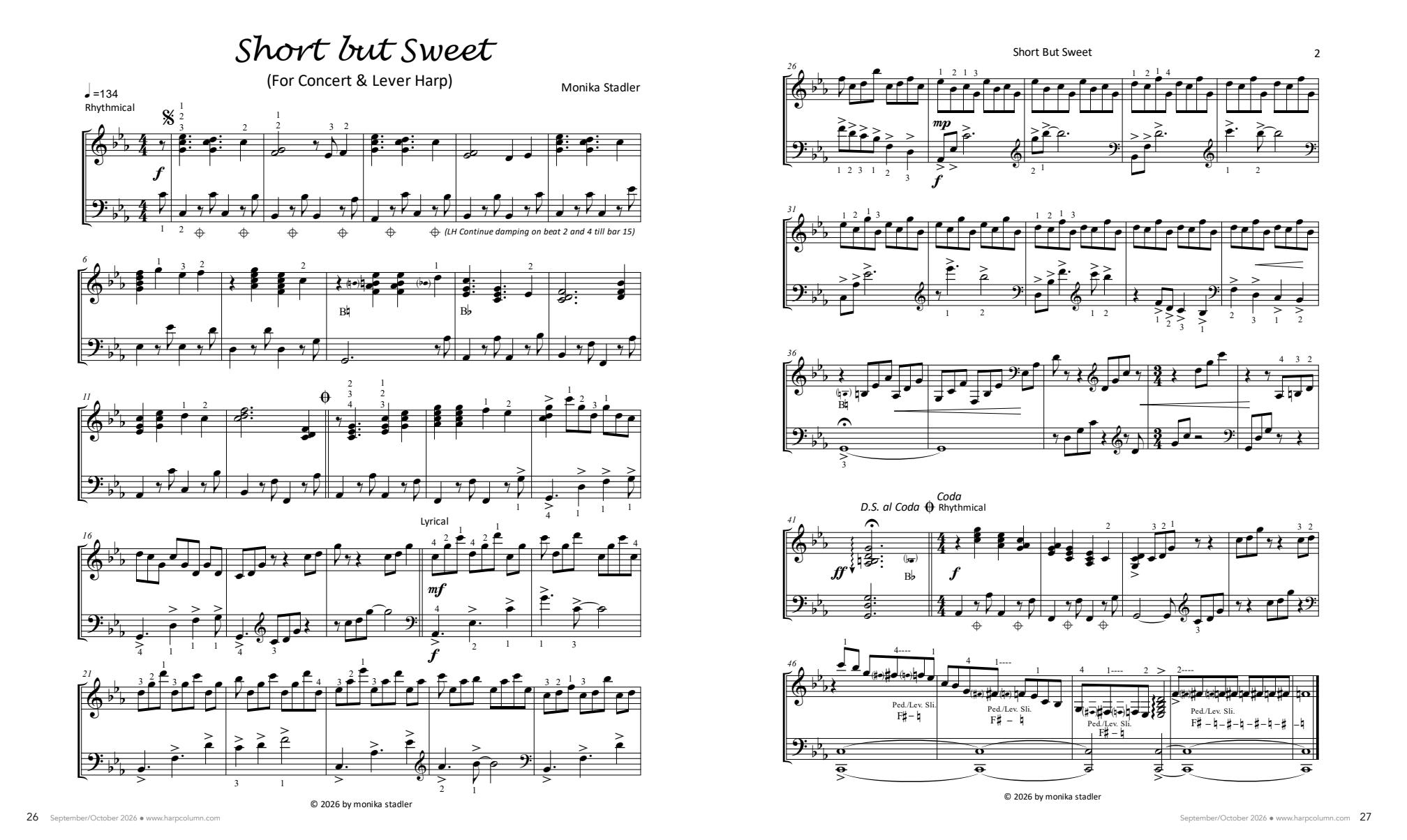
Short but Sweet is written in C minor and can also be approached as a study in that key. What a player can learn from this composition depends greatly on their level of experience. Advanced beginners may focus on becoming comfortable with the rhythmic patterns and coordination between the hands, while intermediate and advanced harpists can explore the subtleties of groove, voicing, and tonal control. One of the technical features I used in the piece is the slap technique in the left hand. For harpists unfamiliar with this effect, the piece provides an excellent opportunity to practice it in a musical context.
I use the slap technique to reinforce the groove of the opening section. The emphasis falls on the off-beats, while damping takes place on the beat itself. This creates a rhythmic tension and release that gives the music its distinctive character. To achieve the best effect, the damping should not be overly delicate or restrained, as it often is in classical repertoire. Instead, the strings should be struck with a relaxed and natural hand movement so that the damping also creates a strong rhythmic presence. Learning how to combine relaxation with precision is an important skill that can help players develop a more rhythmic style of playing.
In the right hand, I introduce another important aspect of the piece: harmonic voicing. Many of the chords are written as basic triads consisting of root, third, and fifth, together with their inversions. However, the harmony frequently expands beyond traditional triads by adding sevenths, ninths, and elevenths. These added tones create a richer and jazzier sound world that broadens the player’s harmonic awareness. For harpists who may not often encounter jazz harmonies in standard repertoire, this piece serves as an accessible introduction to these colors and voicings.
I experiment with the left hand as well. Instead of always placing the root note of the chord in the bass, I sometimes use inversions in which the third is the lowest note, which alters the character and weight of the harmony.
In the lyrical middle section, the role of the hands changes significantly. Here, the left hand takes the lead by playing a strong melodic line, while the right hand supports the texture with quieter eighth-note patterns that maintain a constant flowing rhythm. These accompanying figures add countermelodies around the main melodic line. This contrast between melody and accompaniment helps the harpist learn how to shape different layers of sound within the same musical texture.
A few bars later, another technical challenge arises: the left hand moves between different registers through hand crossing. The player must shift smoothly between treble and bass clefs, learning to adapt quickly to changes in range and hand position. This develops flexibility and spatial awareness on the instrument. The transition back to the opening rhythmic section introduces yet another harmonic element: triads built in fourths. These quartal harmonies produce a more open and modern sound compared to traditional chord structures based on thirds.
Toward the end of Short but Sweet, I introduce the C-minor blues scale. Here, harpists learn how to use levers or pedals to produce the characteristic blues note, often with a slide that creates the expressive bending effect associated with blues music. This section adds a playful quality to the ending while also exposing players to techniques and sounds that are less common in traditional harp repertoire.
The final chord of the piece is a C-minor chord enriched with the ninth and eleventh on top, leaving the listener with a colorful and slightly unresolved sonority.
Whether you see it as a practice piece, a concert piece, or simply for enjoyment, Short but Sweet offers both educational value and freedom of expression, drawing inspiration from classical harp compositions and jazz-influenced rhythms and harmonies.
I hope you enjoy playing Short but Sweet as much as I enjoyed composing it.