

Download this issue to get this tune now!
Each installment of our Tear-Out Tunes series features a new piece written by one of the best harpist-composer-arrangers in the business. Each composer will tell you a little bit about their piece, and also give you some helpful tips for learning it and getting the most out of the experience. The new piece (on the following pages) is yours to keep. We even put it right in the middle of the magazine so you can tear out the whole sheet and put your new tune on your music stand.
I love teaching the harp—sharing ideas, demonstrating technique, burrowing into the fundamentals of breath and hand release. Dimension, texture, rhythm, and treating our notes with the ultimate care—I love teaching the harp! Yet every time I’m asked to write or arrange a piece of harp music I face an existential conundrum. I internally rebel against the idea of distilling the music and everything it evokes into notes on a page. It’s not that I don’t appreciate written music. I have the deepest respect for the rich catalogue of harp music we have via the Western classical cannon. Notating music is an incredibly efficient tool of communication and learning and I use it daily myself composing for chamber ensembles, solo instruments, and lead sheets. Besides, where would the Celtic harp be without that young Irish musicologist, Edward Bunting, when he collected material and published his book, A General Collection of the Ancient Music of Ireland in1797? It is still referenced by Irish harpers and Celtic music enthusiasts around the world today as the preeminent notated collection of Baroque-era Irish harp music.
My issue is not with the written note, it’s with the dogged culture of reading “arrangements” as a means to an end. Particularly for those who play the lever or folk harp. It is not an instrumental tradition that evolved within the context of written music. These are tunes that blossom through individual interpretation, ornamentation, and the idea of a continually changing harmonic setting. Learning to listen deeply to tonal nuance, integrating imagery, thinking of breadth of texture instead of simply right hand and left hand. For someone who does not come from an aural tradition, these facets of music-making can be very intimidating. And I understand! There is something satisfying about reading an arrangement and having a piece to show for it. Integrating imagination and interpretation to the forefront of your practice involves a lot of conceptual work that can be subjective, overwhelming, and time intensive. What we’ll do with Three Buds—and what I’d encourage you to do with other music, new and old—is to break down the facets of improvisation, phrasing, and ornamentation into manageable chunks and chip away at it in small ways. We are all creative beings with unique imaginative pools that, when utilized correctly, can expand our experience of music making.
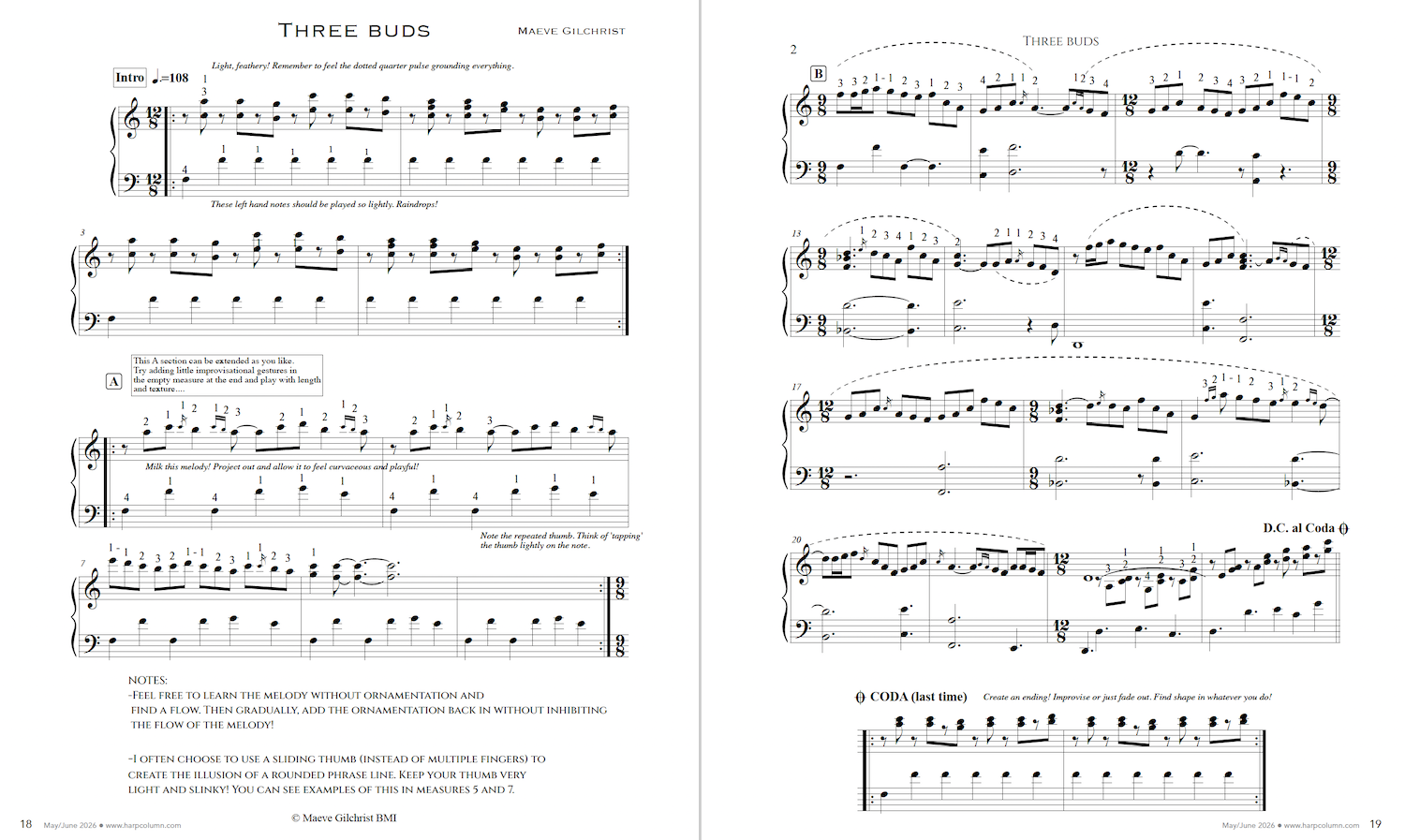
In Three Buds, we explore compound time through dotted and regular quarter notes, moving between two different interpretations of pulse while maintaining an easy, circular flow. Within the Celtic tradition, we are known for stamping our foot enthusiastically on the downbeat, but the secret of the lilt actually comes from a slight lean towards every third eighth note (within each group of three). We can break this piece down into three sections: Intro Vamp, A section, and B section.
During the Intro Vamp, keep your metronome in 12/8time with the click outlining each dotted quarter. This will keep us rooted, though we are essentially outlining quarter notes between our left and right hands. This section should feel feathery and light. We are using the tonality of F lydian, and once you are familiar with the written part, this repeated four bar phrase is a great opportunity for right-hand improvisation while your left hand keeps those quarter notes going.
In the A section, our right hand introduces a melody. This is a spot to think about manifesting a light, buoyant sound. Make sure your right hand is not heavy on the downbeat (even though it will want to be!). A large part of making interpretive choices is controlling our sound. Memorize the right-hand melody and the left-hand pattern and sit with the metronome to very patiently start to find autonomy between the two hands. Is the left hand anchored? Is the right hand bouncy? Can we start to create miniature right-hand variations in that last measure? There is so much to work with here—think of the written music as a starting point for a texture that should brim with life!
The B section is our homecoming, bringing the two hands together in a dotted-quarter feel. We move away from the lydian tonality and integrate B-flat, outlining an F major (ionian) and D minor (aeolian) scale. It’s incredible how this one note transforms our sound world. It should feel tender but forward moving. Be careful to not sink into the downbeat! In measures 23 and 24, I’ve created a ladder-like phrase to blast us back into the Opening Vamp. Try finding other ways to ascend the harp and utilize this section as a technical exercise. I love these multi-finger shapes—I feel like a kinetic machine, working like clockwork to make the harp tick!
I leave you with three pieces of practice advice:
• Memorize small, manageable chunks and practice away from the music.
• Turn any technically (or rhythmically) challenging sections into a mini-loop (memorized) and stick with it, gently, on a daily basis until your hands find that mechanical intuition.
• Find time in each practice session (even 10 minutes) to incorporate tiny (or big) moments of improvisation and be sure to work with a metronome so that you are evolving your creative practice while still solidifying your rhythmic core! •