
Download this issue to get this tune now!
Each installment of our Tear-Out Tunes series features a new piece written by one of the best harpist-composer-arrangers in the business. Each composer will tell you a little bit about their piece, and also give you some helpful tips for learning it and getting the most out of the experience. The new piece (on the following pages) is yours to keep. We even put it right in the middle of the magazine so you can tear out the whole sheet and put your new tune on your music stand.
“Look, it’s coming out nice now!” was always a much anticipated phrase on those all-too-frequent rainy days during my childhood summer holidays in the north of England. A hint of blue sky promising a sunny afternoon of freedom down the fields or in the woods after a morning stuck indoors was simply intoxicating to 10-year-old me.
This unabashed joyful tune was written to evoke that same exciting feeling of the sun coming out after the rain.
How the piece came to be
It’s Coming Out Nice began life as a tiny fragment of melody intended for use in a video game soundtrack commission. However, in that annoying way that ideas with potential do sometimes, the tune simply refused to crystallize, so I put it aside in my somewhat unimaginatively titled “ideas-and-sketches” folder to come back to at a later date. So often I rediscover these abandoned half-baked bits of tune that just weren’t quite ready to become fully-fledged works yet, and find that playing them through with fresh ears and in a different state of mind helps me to turn them into finished pieces.
When Harp Column contacted me and asked me to write a piece for the Tear-Out Tunes, I immediately thought of this cheerful fragment. I wondered if it might be worth trying again to develop it into a longer piece. (Actually, first I immediately jumped up and down with excitement at being asked to share a tune, and then I remembered this sketch.)
Structure
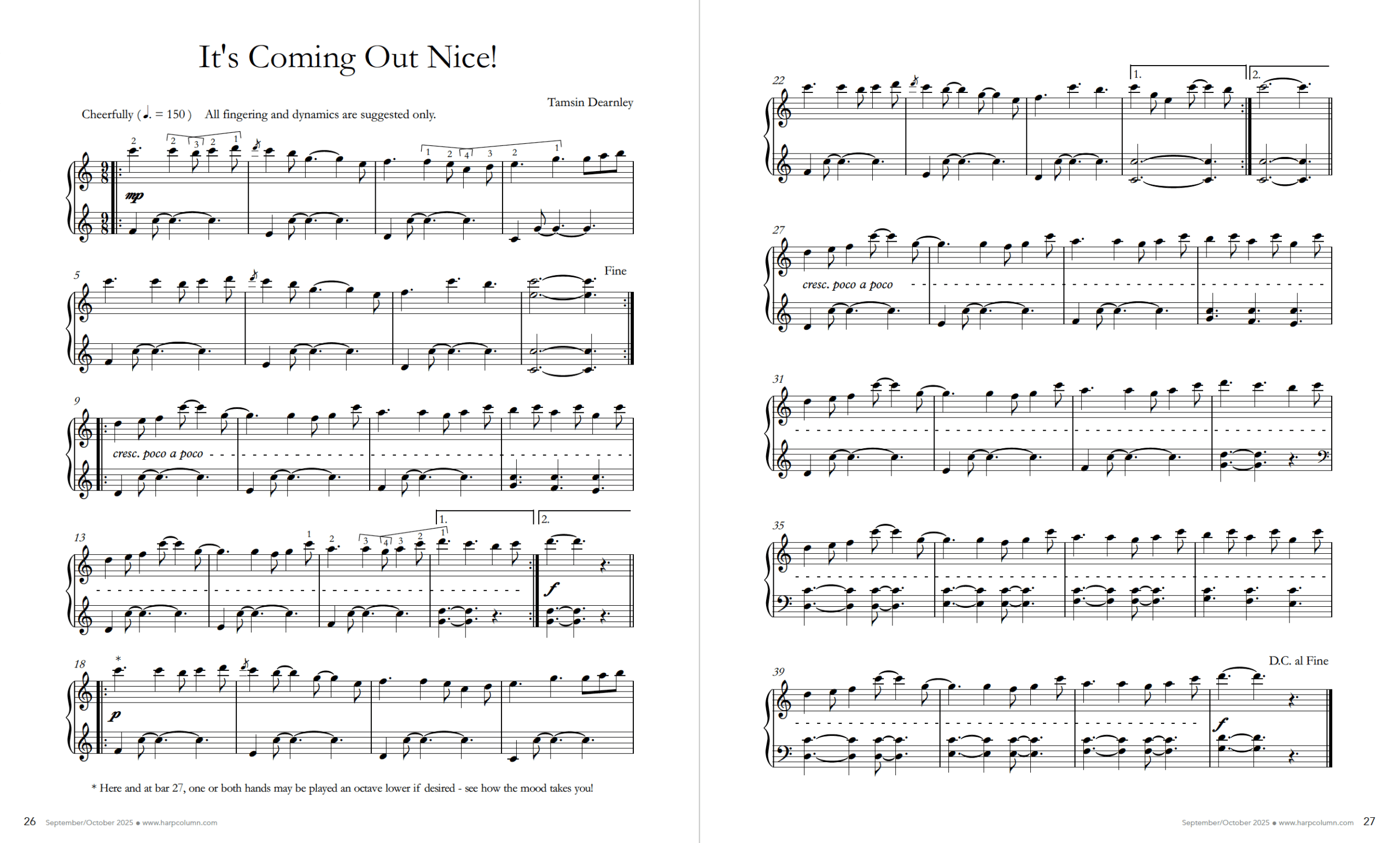
The piece is in C major, and has a very simple A-B structure. Each section consists of eight bars, made up of a repeated four-bar motif.
The A section has a descending bass pattern that begins on the subdominant chord of F before arriving at the tonic of C four bars later. This effectively makes each phrase into a kind of extended cadence, accentuating the feeling of resolution when the home chord is finally reached.
The answering B section is based around a rising bass line which goes from a D-minor 7 chord to a G chord (the dominant), creating a pleasing symmetrical shape to the piece.
Ending on the dominant chord adds a certain momentum to the piece, as it leads so nicely back to the beginning of the A section, meaning that you can just keep repeating the piece until you’ve played out your sunny-day energy and want to have a rest!
Composing techniques
Whilst the piece can be analyzed in this way, I think it is extremely important to stress that this is not really the kind of thought process that I go through when composing.
There is, of course, no right or wrong way to compose, and I confess that I am not at all methodical. My usual modus operandi could be better characterized as random. I choose an arbitrary key or lever setting, play around until I hit on a melody/chord/sound that I like (or which fits my current mood), and then try to turn it into a piece, which admittedly has a somewhat unpredictable success rate.
However, as this tune began life as one of a commissioned set of pieces, I had at least been given some guidelines regarding the desired feel and theme, as well as a playlist of tunes the video game developers thought had the right atmosphere.
As the game was sea-themed, I decided to use lilting triple meters and dotted rhythms for most of the tracks to evoke the rise and fall of waves, as well as to emulate the traditional folk dances that I was given as references. Although this tune didn’t end up in the final commission, these influences can still be seen in the 9/8 time signature and dance-like rhythms of this tune. (As for the game soundtrack, if you’re interested in what did make the developers’ final cut, check out the original soundtrack to Isles and Tiles, a Breton folk-influenced set of harp and clarinet duets, arranged as harp solos and lead sheets and available soon from Harp Column Music.)
takeaways
When composing anything for the harp, my main goal is to write something that is fun to play, because if I don’t enjoy playing it, there is no reason to expect anyone else to either! I hope very much that other harpists will simply find this a fun, joyful piece to play, and that it might lift some moods on dull winter days.
As the simple melody lends itself to repeated playing, there are so many ways to make this tune your own: the repeats may be played in any octave, and you may, of course, move the accompanying hand up or down depending on your mood. It’s nice to add some low bass octaves for extra oomph if you have a larger harp, but also keeping the whole piece higher up makes it delightfully light and airy. All dynamics, grace notes, and fingering given are suggestions—experiment to see what works best for you.
Although written as a harp solo, I think this melody would also work really well on other instruments (particularly the violin). So if you have a handy duet partner, do try this out, and feel free to share your versions! •