


Download this issue to get this tune now!
Jump to end to watch a supplemental video by Park Stickney!
Each installment of our Tear-Out Tunes series features a new piece written by one of the best harpist-composer-arrangers in the business. Each composer will tell you a little bit about their piece, and also give you some helpful tips for learning it and getting the most out of the experience. The new piece (on the following pages) is yours to keep. We even put it right in the middle of the magazine so you can tear out the whole sheet and put your new tune on your music stand.
Since the brief for the Harp Column Tear-Out Tune was to write something that would work on both lever and pedal harp, I decided to focus on texture. This turned out to be a lot of fun—in my regular pedal harp life, I spend a lot of time thinking about pedals, especially for complex harmonic changes and melodic pedal slides. Stepping back from this invited me to think about some of the other cool things the harp can do.
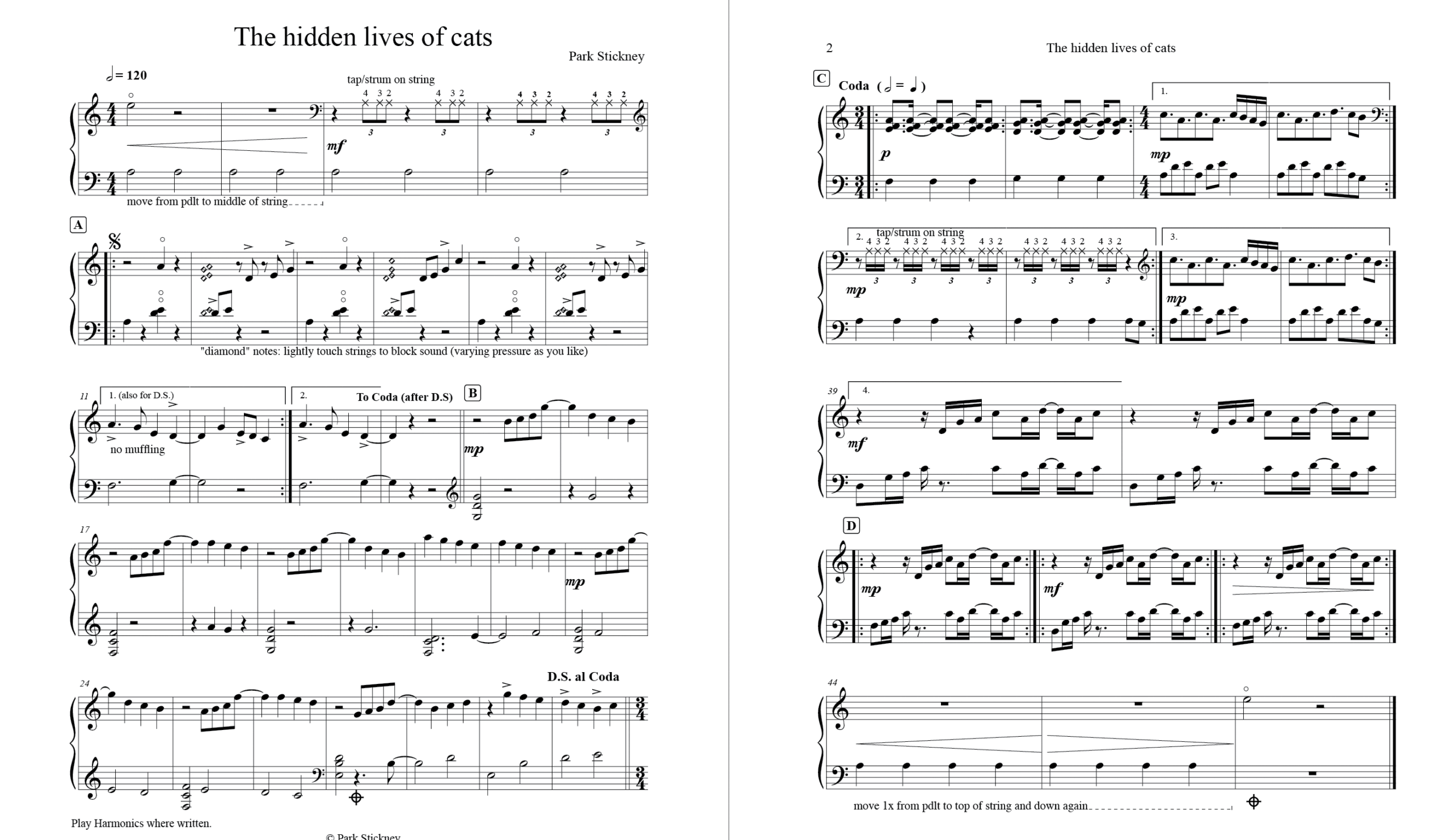
I started with a technique that I’ve been playing around with for a while, a sort of simultaneous double muffling. [Ed.—Stickney explains and demonstrates this and other special techniques in an instructional video available on harpcolumn.com.] By placing the fingers of both hands on the same strings and randomly playing patterns, while also varying the amount of muffle, it’s easy to get cool, syncopated, grooving patterns which remind me of a combination guitar and kalimba (thumb piano).
Side story: I showed this technique to the composer Henry Fourès, some years ago when he was writing a piece as part of my Ph.D. project. He loved the sound and proceeded to write a long passage using it, but with specific requests for which notes would be muffled and which would sound. This ended up being incredibly complicated, and it took me weeks of work to figure out how to play it. In the end, I added a separate dedicated staff showing which fingers would be muffling at any one time, with notated fingerings for the muffles. The irony was that a technique, which gives instant freedom, led to this arduous task. So beware: maybe we just keep this technique for us, and don’t show anyone?
In the current piece, the notes that you’ll be holding/placing are marked as diamonds. Since the left hand only muffles the D and E, the right-hand Gs and Cs will sound—meaning not all of the “diamond strings” are muffled. You’re free to decide how much the D and E strings are muffled, how much pressure is used.
In addition to the double muffle, I used two very subtle effects. One is just moving from pdlt to the middle of the string (or to the middle and then back down), while plucking. This gives a sort of textural crescendo which has a visual component (of course), and also a kinesthetic “moving in space” element. I liked the feeling of focusing on this perhaps overlooked axis.
The second is a sort of right-hand finger drumming. While the left hand is plucking the A string repeatedly, the 2-3-4 fingers of the right hand tap (or even lightly pluck) the vibrating string in a triplet rhythm. As with the vertical slide, this is a super subtle effect, but I think it’s audible—and if not, then the muffling itself will probably be. And if not, well, then I still think that the feeling of groove, of fun, will somehow affect how the other notes sound. Plus, there’s a visual element to this effect, and I find it really satisfying to do.
Finally, there’s a grooving four-against-three chordal section. I think it’s important to think of this as 4:3 and not 3:4. The left hand is the core element, and the right is providing rhythmic “dissonance.”
I chose a specific “road map” for these various sections, but this was mostly determined by the two-page space limitation in the magazine. It’s also for this reason that I didn’t include an improvisation section. But please don’t let this limit you. Feel free to jump around, repeat sections—or add new ones, improvise, expand… Do as you like!
To be clear: this isn’t a piece that explains the “secret lives of cats,” because then they wouldn’t be secret. Instead, it’s a piece that acknowledges that these unknown feline moments exist, imagines what they might be, and, above all, admits that ultimately we really have no idea what they are up to. •