


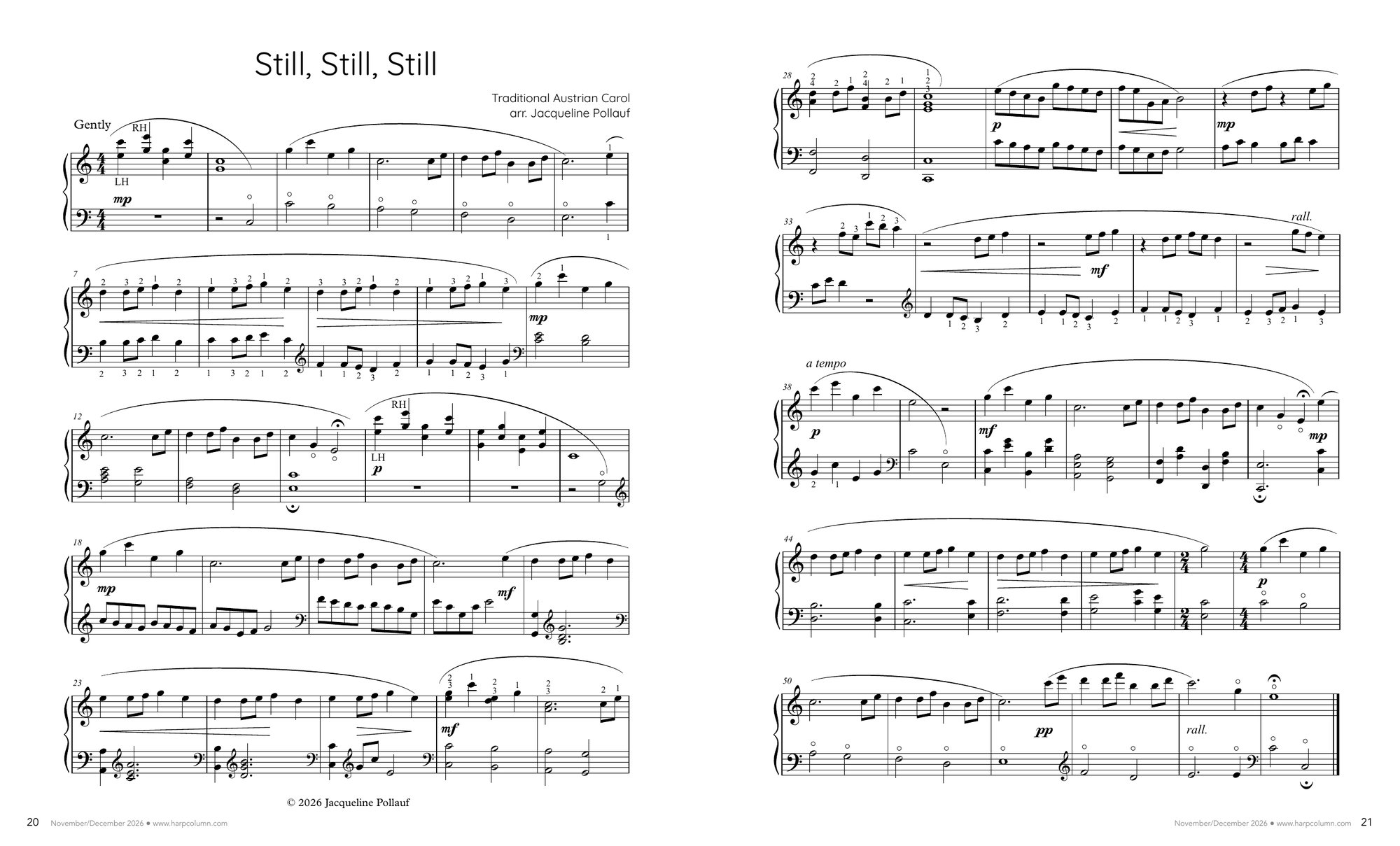
Download this issue to get this tune now!
Each installment of our Tear-Out Tunes series features a new piece written by one of the best harpist-composer-arrangers in the business. Each composer will tell you a little bit about their piece, and also give you some helpful tips for learning it and getting the most out of the experience. The new piece is yours to keep. We even put it right in the middle of the magazine so you can tear out the whole sheet and put your new tune on your music stand.
A shimmering snowflake ornament inspired the first piece I ever wrote. I was 8 years old and had excitedly helped decorate the family Christmas tree, carefully hanging ornaments while humming carols under my breath. I was entranced by a snowflake ornament that glittered under the lights of the tree. I loved looking at all of the different ways the light could shine through it, but just admiring it wasn’t enough for me. I sat down at the piano and tried to express the image. I found a group of repeating notes with my right hand that sounded like a shimmer and slowly added a melody in my left hand. When I had finally worked out something that I felt captured the snowflake ornament, I painstakingly wrote my composition out on staff paper and proudly titled it “Snowflake.”
“From that enjoyment came the same impulse I had as a child: to convey outwardly what I heard internally.”
As I got older, I was dismayed to realize that the snowflake ornament was just an inexpensive trinket. Sure, it was shiny under the lights, but certainly not the heirloom that I had imagined. I also found that Christmas music lost some of its luster upon annual repetition. Playing the harp for holiday events in high school became something of a chore. There were many carols and songs that I didn’t particularly like, and others that fell a little flat. The magic faded.
Of course, the holiday season returned year after year, so there was no way around it. But instead of growing more frustrated, small changes started sneaking in, much to my surprise. Even when I felt grumpy about playing A Christmas Festival by Leroy Anderson yet again, I’d find myself smiling while Ella Fitzgerald sang “Have Yourself a Merry Little Christmas” over the grocery store’s speakers. Little by little, I started taking the time to listen more closely and find music that I did enjoy.
From that enjoyment came the same impulse I had as a child: to convey outwardly what I heard internally. Several years ago, I made a list of holiday music to arrange, with the hope that I would arrange a new piece each fall. I haven’t quite met that goal, but I’ve completed some arrangements, including “O Come, O Come Emmanuel” and “Of the Father’s Love Begotten,” among others. There are many more works waiting in the wings.
In keeping with this long-term project, this year I’ve arranged “Still, Still, Still,” a traditional Austrian carol, based on a folk tune from Salzburg. In addition to the original German text, there are various English translations of this lullaby about Mary holding the infant Jesus. I love the simplicity of the melody and the unhurried feel it has. Together, both the words and the music are encouraging a moment of stillness.
Musically, “Still, Still, Still” is written in a simple A-B-A form, with three four-measure phrases in each verse. The melody alternates between outlining chords and simple stepwise motion. As the first and last phrases are exactly the same, the carol feels suspended in time rather than moving forward.
I chose to use a descending scale passage in the bass as the primary accompanimental figure. To me, this sounds like snow falling very gently, as if time has slowed and you’re surrounded by the softness and hush of snow on a moonlit night.
In the first phrase, this descending line is played as harmonics, which gives a delicate feel to the opening. Each time this phrase returns, the bass line expands, using thirds, a passage of running eighth notes (with the descending scale falling on the strong beats), low octaves, and alternating octaves and chords. For all of the B sections, the accompaniment varies, to offer a gentle contrast to the A sections. My arrangement includes three verses, with a short interlude between the second and third verses. This uses material closely related to the melody and the accompanimental patterns, but it has a more free-flowing feel. For the final phrase, harmonics return.
There are not any major technical challenges in learning this arrangement of “Still, Still, Still,” but there are a few small areas to consider. Given the sparseness of the texture in the arrangement, each harmonic is quite important and so might need some extra attention in practice. There is also some contrary motion, particularly in measures 9 and 10, and 34 through 37. I have included some suggested fingering here, but there is room for individual preference. The arrangement is written in the key of C with no accidentals.
I hope that you enjoy playing this arrangement of “Still, Still, Still,” whether it’s for family, friends, a performance, a church service, or for your own enjoyment. Arranging this to express what I hear in it was just as satisfying as writing that first composition all those years ago.