



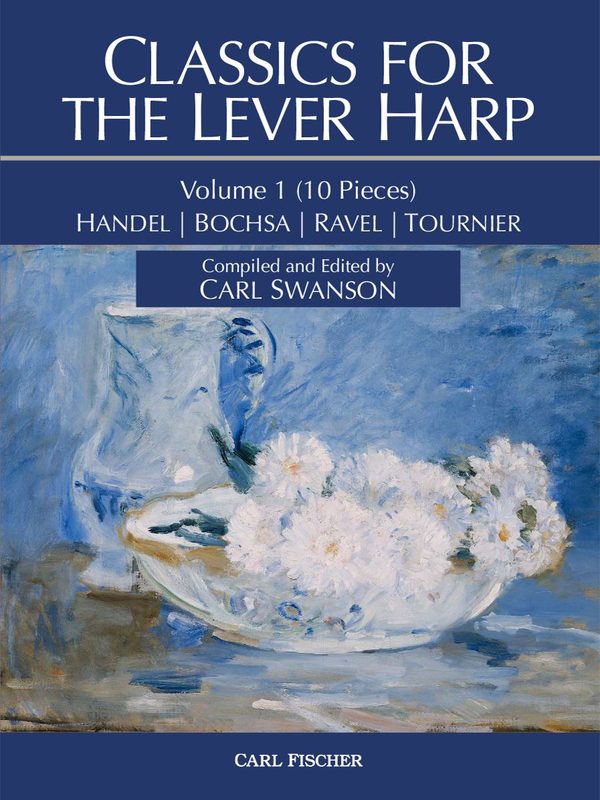
Left: Carl Swanson’s Classics for the Lever Harp is “an absolute treasure for lever harp players.” Right: Erica Messer’s new book is a “handy reference” for fledgling freelancers and seasoned professionals alike.
There’s still time to add to your holiday wish list, and if you play or teach lever harp, there is a wonderful new publication you’ll want to add to your list. Classics for the Lever Harp Volume 1 is a collection of 10 classical pieces from a variety of musical periods. It was compiled and edited by Carl Swanson and published by Carl Fischer.
The selections were meant to be played on a 36-string lever harp with a full set of levers and a range from first-octave C to sixth-octave C. Harps with fewer strings may require some adjustments, and the harp should be tuned to E-flat. Swanson also includes a glossary of musical terms and a brief background on the pieces in the preface. Some fingering is suggested, and most page turns are manageable. The music is suitable for the intermediate or upper intermediate lever harp player.
Swanson uses the now standard diamond-shaped note heads on the staff to indicate lever changes, but he also uses some other notations that aren’t common in lever harp music. First, when the lever has to be moved almost precisely as the note is played, a diamond note head appears directly above the note rather than on the staff, indicating that it must be moved immediately before the string is played.
Second, Swanson included lever diagrams above the staff throughout the most chromatic pieces to indicate which levers are up at that point in the music. It is difficult to practice lever harp pieces starting at various points in the music because of the positions of the levers that have already been moved. So he lists the note, octave, and accidental (e.g. F3#) for whatever levers are up. This makes practicing much eahsier, as you don’t have to go back to the beginning of the piece to reset levers.
Last, a tie or slur marking from one diamond note head to another indicates that you should keep your fingers on the lever because it needs to be changed back right after the accidental is played. These innovations to lever harp notation are brilliant and should be adopted by all lever harp arrangers.
The first piece is “Chaconne” (from Suite in C Major, HWV 443) by Handel with “Variations.” Swanson selected 15 variations that are playable on lever harp and that offer variety in texture and sound. There are no lever changes on any variation except number 13, and they are quite manageable. And, of course, you can choose whatever variations you want to play.
Next is “Nocturne in G Minor” (Op. 34, No. 2) by Nicolas-Charles Bochsa. This very beautiful piece is from Bochsa’s set of 50 etudes and is in the style of an Italian bel canto opera aria. Swanson had to cut the middle section because it was too chromatic, but your listeners aren’t going to notice. There are quite a few lever changes throughout the piece, and they appear to be in a slightly smaller font than subsequent pieces. You’ll probably want to highlight them.
The next seven pieces are by Tournier. Pedal harpists will recognize the first two from the Deux petites Pièces Brèves et Faciles that are standard pedal harp repertoire: “Soupir” and “Offrande.” There are quite a few lever changes, especially in the latter piece, and the lever diagrams are extremely helpful here. There is a minor omission in “Offrande” where the footnote for the lever changes in measure four should have a double asterisk directing you to the correct footnote.
Also included is a lovely piece from Tournier’s first Images suite, “Au seuil du temple.” There are no lever changes in this piece, and the only difference from the pedal harp version is that Swanson changed the key to accommodate the E-flat tuning.
The remaining four Tournier pieces are déchiffrages or sight-reading exercises that Tournier wrote while a student of Hasselmans at the Paris Conservatory. These pieces had never been published until recently discovered by Swanson and distributed by Carl Fischer for pedal harp in three volumes. Swanson chose four that were adaptable to lever harp with only minor changes.
“Tranquille” is not too difficult and has several lever changes that must be engaged just as you play the string. “Décidé” has quite a few tricky lever changes, and again, the lever diagrams are exceedingly useful. “Allegretto” is short and sweet and not too difficult. “Adagietto” is the final Tournier selection and another accessible and delightful choice.
The final selection is “Pavane de la Belle au bois dormant” by Ravel from his Mother Goose Suite. This pensive melody depicts the peaceful slumber of Sleeping Beauty as she awaits her Prince Charming. It is just one page in length but has several lever changes. The slur symbol was omitted from the lever change in measure 12 indicating to keep your finger on the E lever.
This book is an absolute treasure for lever harp players, and Carl Swanson has done an outstanding job of editing these lovely pieces. We eagerly await volume 2.
Another harpist has written and published a book. The Freelance Harpist Handbook: from Practice Room to Paid Gigs) is a helpful book of advice from Erica Messer. The author says the book is for “harpists who are ready to start gigging but don’t know where to begin” or who “feel confident playing, but not booking.” It is an easy read, and at just over 80 pages, you can read it in one sitting.
Messer shares several real-life experiences throughout the book with her “Gig Gone Rogue” stories. We benefit from her years as a successful freelancer. You don’t have to agree with her on everything, but her suggestions give you a starting point and food for thought .
She offers equipment suggestions including types of harp dollies, covers, amplification, recording equipment, gig bags, and digital music apps. There is also advice on networking, marketing, pricing, contracts, repertoire, instrument and performing insurance, and how to play for weddings. Her sample scripts are especially helpful in learning how to interact with clients and other vendors.
This is a handy reference for someone just starting a freelance career, but seasoned professionals may also find it useful. Teachers can recommend this book to students about to embark on a career, as musicians often don’t have experience in the business world. It is available on Amazon (in print) and on Kindle.