


10/10
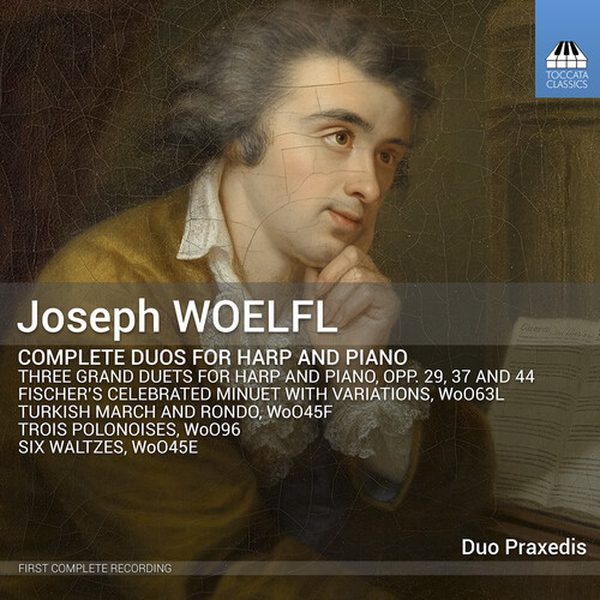
Duo Praxedis: Praxedis Hug-Rütti, harp, and Praxedis Geneviève Hug, piano. Toccata, 2026.
Joseph Wölfl, a contemporary and rival of Beethoven, was an imposing man, standing more than six feet tall. His hands were equally remarkable, long, broad and capable of extraordinary reaches. Even as a young man, Wölfl could span a thirteenth on the keyboard. His talent was so exceptional that he was welcomed into the Mozart household, where he received instruction from both Leopold Mozart and Mozart’s sister, Maria Anna.
Wölfl’s career as a performer and composer flourished in Vienna. At one aristocratic competition, he even bested Beethoven in a contest for audience favor. Across Europe, he became known as “the famous Wölfl,” celebrated as one of the continent’s most remarkable pianists. Like Mozart, Wölfl died young, at just 38, though by then he had achieved both wealth and considerable acclaim.
And yet today, Wölfl’s music is largely forgotten.
Wars, changing tastes and the simple fact that Wölfl was no longer alive to perform and promote his own music all contributed to its disappearance from the repertoire. His distinctly Classical, often delicate style eventually fell out of fashion even as his work helped point the way toward the early Romanticism of composers such as Mendelssohn and Schubert.
With their scintillating new recording, Joseph Wölfl: Complete Duos for Harp and Piano, Duo Praxedis makes an eloquent case that this composer should never have been forgotten. The album is filled with one delightful discovery after another, music that demands extraordinary precision and technique from its performers while somehow retaining the impression of having been tossed off with effortless élan.
Duo Praxedis has devoted itself to rediscovering repertoire for harp and piano while also commissioning and arranging new works. Here, however, the music was already waiting for their expert hands and musicianship.
The lever harp was developed around 1800, and soon afterward the harp-and-piano duo emerged as a dedicated ensemble. Two circumstances helped make this repertoire possible. First, Wölfl had access to some of the leading harp virtuosos of his day. Second, as a freelance musician, he had every reason to keep pace with the latest fashions and instrumental developments.
What is particularly striking is the way Wölfl treats the harp almost as he would the piano. He writes intricate, orchestral, and expansive music that exploits the instrument’s full capabilities. The Grand Duo pour Harpe et Piano in F major, Op. 29, for example, showcases the exacting technique of both instruments while giving the performers music with enough presence to command an entire room. Though likely intended for salon performance, there is nothing slight or inconsequential about it. The writing is symphonic in scope, full of character and muscular energy.
Pianist Praxedis Geneviève Hug and harpist Praxedis Hug-Rüttiand meet these demands with a combination of elegance, polish, and force. Their playing possesses both refinement and a distinctly masculine energy, giving the music a sense of authority without sacrificing its grace.
The Grand Duett for the Harp and Piano Forte in B-flat major, Op. 37, was composed in London for one of the era’s greatest harpists, François-Joseph Dizi. Dizi was not only a virtuoso performer but also worked with harp maker Sébastien Érard on important improvements to his new instrument.
Wölfl’s piece unfolds as a continuous musical thought, a theme, three variations, and a coda played without interruption. Here, Duo Praxedis draws out an especially atmospheric and dramatic quality. Their interpretation feels almost operatic, building considerable tension and revealing an emotional depth that might not be immediately apparent on the page.
The album includes waltzes and polonaises along with, in a delightful echo of Mozart, Turkish marches and rondos. Throughout, Wölfl proves to be an inventive and remarkably versatile composer, while Duo Praxedis brings every piece to life with exceptional vitality and apparent ease.
This is a superb album from beginning to end and a persuasive reminder that some composers are forgotten not because their music lacks value, but simply because history moved on. Duo Praxedis makes a strong case for moving Wölfl back into the light.