

Ukrainian Patterns
Veronika Lemishenko, harp. Self-released, 2026.
Veronika Lemishenko opens her sublime album Ukrainian Patterns with Gennadiy Lyashenko’s Contra Punctum. Originally referring to the musical practice of setting note against note, the title takes on a poignant resonance in modern-day Ukraine, where creating beauty exists alongside the struggle just to survive. Yet this album ultimately celebrates resilience, revealing the richness and vitality of Ukrainian music. Lemishenko brings a supple tone and heartfelt commitment to Diana Shpylova’s Fantasy on the Ukrainian Folk Song “At the Cherry Garden.” Valeriy Antonyuk’s The Garden of Paradise Birds, performed with harpist Larysa Klievtsova, is a joyful, mixed-meter showcase, beautifully balanced by the serene Nocturne. Cellist Maksym Rymar and violinist Dmytro Udovichenko add warmth and depth to works by Mykhailo Shukh and Evgen Andreev, including Leaving My Hometown. Together, they enrich the harp’s luminous sonorities with colors that evoke a profound sense of longing and nostalgia. Harpist Kateryna Muslienko is the second in a harp duo for Verkhovynka, drawing us into the mystical spirit of the Carpathian Highlands. The album closes with Valentin Silvestrov’s haunting Barcarole, a work that lingers in the memory long after its final notes have faded.
Rotten Fruit
Stephanie Babirak, harp. Self-released, 2026.
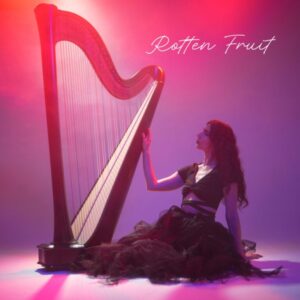
In her indie-rock project, Rotten Fruit, New York-based singer-songwriter and classical harpist Stephanie Babirak explores a deceptively simple question, “What do we do when words and actions don’t align?” Drawing on biblical imagery, she examines love, estrangement, and the slippery notion of what it means to be “bad.” Curiously, the weight of these themes often contrasts with the music’s breezy, beach-rock energy and the infectious, youthful warmth of Babirak’s voice. On Hey Cain, she confronts a particular kind of grief, the painful act of mourning someone who is still alive. Apocalypse captures the constant motion and agitation of carrying on in a world that feels broken, while still finding solace in love: “With you, apocalypse is easier to bear. This is a good old-fashioned love affair.” The album’s most harp-centered track, Waterline, ties its themes together through the biblical image of good and bad trees bearing fruit, reminding us that actions ultimately reveal people’s true character. Throughout Rotten Fruit, the harp is re-imagined alongside guitar, bass, drums, and synths, in collaboration with the very talented Peter Scoma.