

10/10
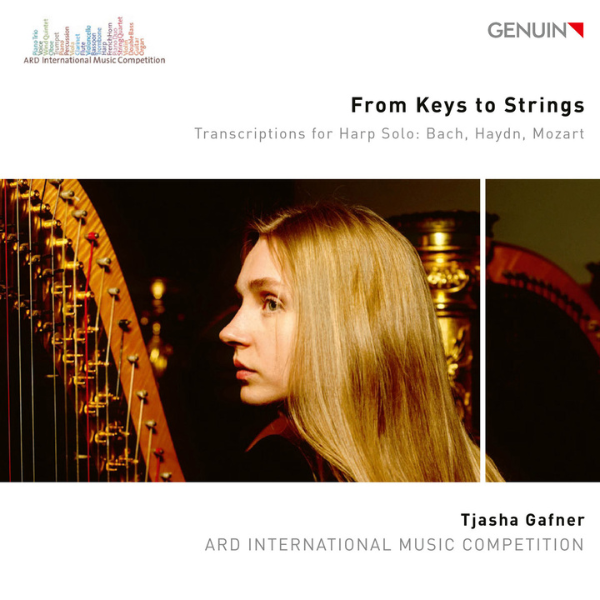
Tjasha Gafner, harp.
Genuin, 2025.
Like many harpists confronted with a far more limited repertoire than that enjoyed by string players or pianists, ARD Competition first prize winner Tjasha Gafner turned to arranging music herself for her beloved instrument.
What sets her apart is her remarkably fearless approach. She never once considered the technical challenges involved, focusing only on whether the music moved her and whether she felt compelled to play it. Allowing emotion to guide her ambition has resulted in the magnificent album From Keys to Strings. Throughout, Gafner plays with such aplomb and grace that one could easily believe these works were written for the harp all along.
Bach’s Suite in C Minor for Lute is a fascinating case in point. This complex and evocative work has long been the subject of debate. Was it truly intended for the lute, or for the rare lautenwerk, a harpsichord-like instrument designed to imitate the lute’s sound? The presence of a fugue, highly unusual for a plucked instrument, has only fueled the controversy.
Gafner’s performance strengthens the argument that music of such depth and intricate polyphony belongs in the hands of a master harpist. She revels in the harp’s natural resonance while also introducing a tone that feels as if made by a hammered instrument. The result is nothing short of revelatory.
Gafner also includes one of her earliest transcriptions, Haydn’s Keyboard Sonata in A-Flat Major. Brimming with the composer’s characteristic wit and tenderness, the piece sparkles under Gafner’s fingers. Her technique, particularly in the elegant trills, is flawless, allowing her to heighten Haydn’s mischievous spirit, his musical laughter and sheer joy. In her hands, we encounter a composer utterly distinct from Bach, rendered with clarity and charm.
Mozart was a close friend and admirer of Haydn, even played string quartets with his older friend, viola to Haydn’s violin. Their relationship was marked by mutual respect and a rare absence of jealousy and you hear the musical influence in Mozart’s Sonata in C Major. Written when Mozart was just 18, it was likely intended for private, amateur performances. Yet even here we hear the budding operatic genius to come. The music is simple and direct, but rich in emotional line. Gafner shapes these legato phrases as if she were a singer herself, allowing the music to breathe and speak.
The album concludes with another Haydn work, Sonata in E Minor. I have never heard this piece, and what a discovery! The first movement is especially profound, sounding almost as if it is weeping. Haydn soon returns to brighter and more familiar territory in the “Allegro,” yet not without reminding us of the darker places we all occasionally inhabit—even a composer so closely associated with joy.