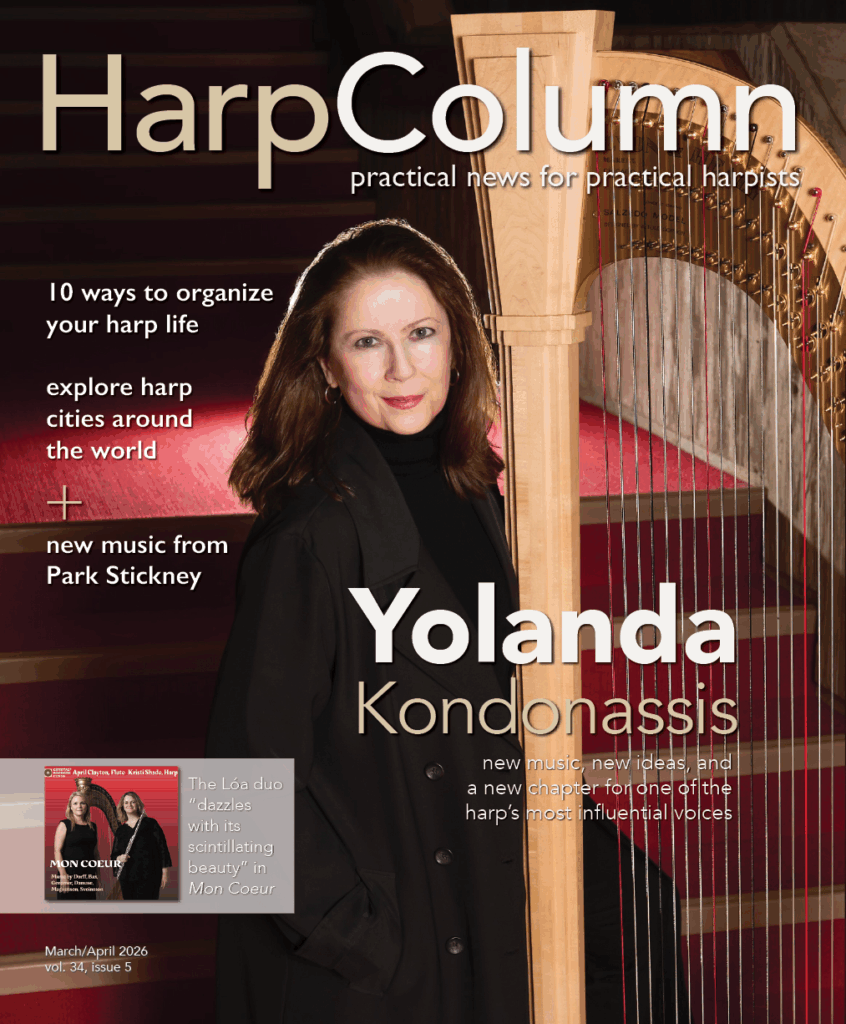

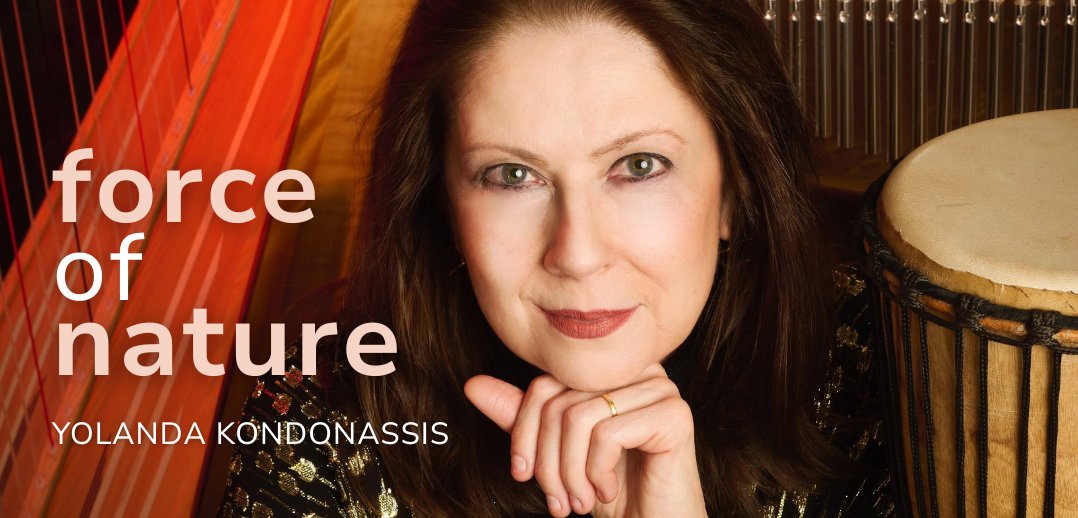
In music, a select few performers are so iconic they are known by their first name alone. Cher. Beyoncé. Madonna. Shakira.
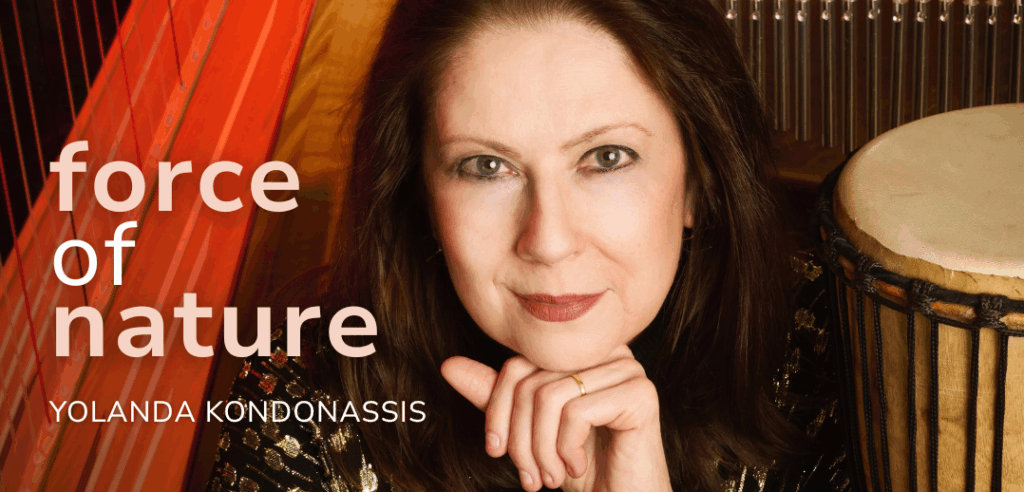
In the harp world, there is Yolanda.
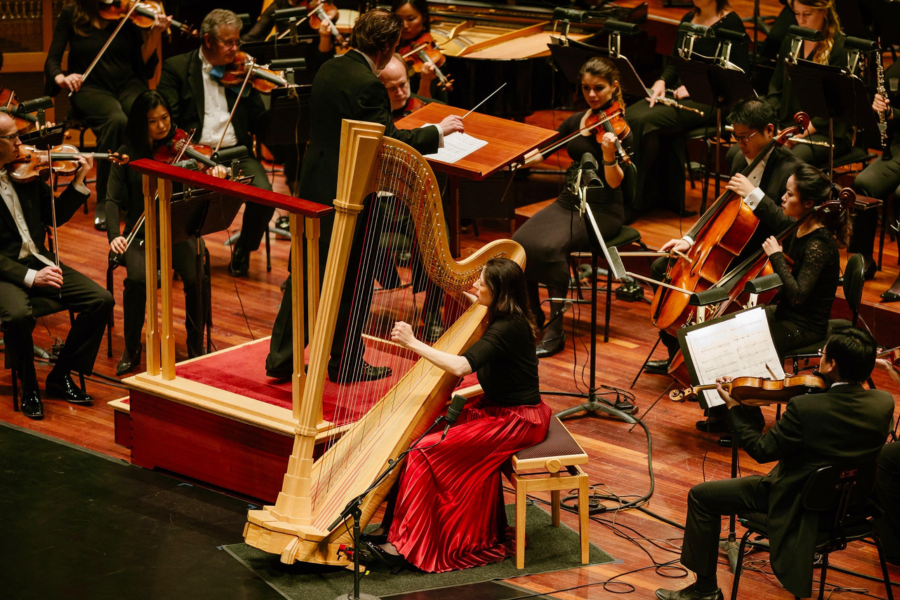
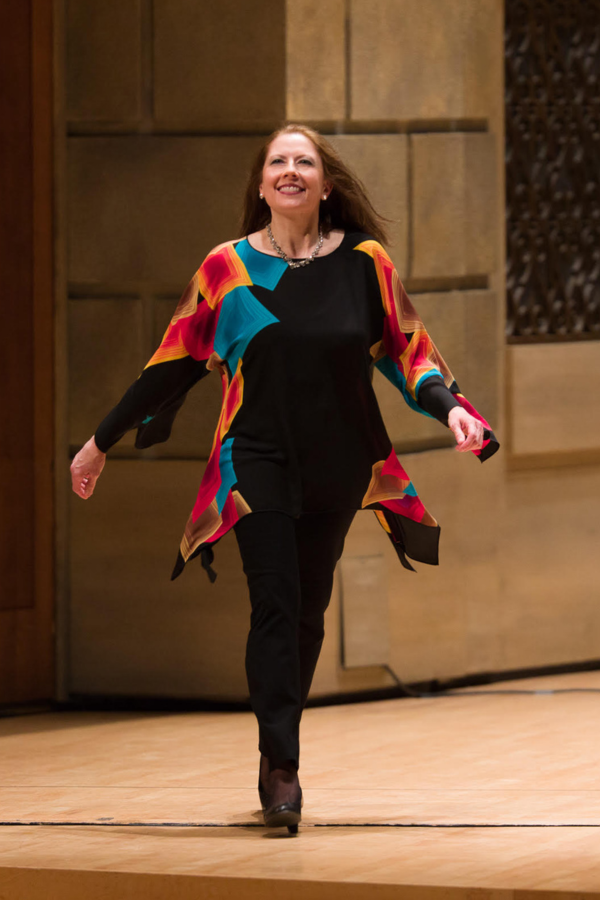
Yolanda Kondonassis’ influence is unmistakable in the harp’s repertoire, sonic range, and stature as a solo instrument. Over a 35-year career, she has continually pushed the instrument forward through bold performances, visionary commissions, and purposeful teaching at two of the nation’s leading conservatories. When Yolanda moves, the harp world takes note.
So when she accepted a new appointment at the University of Michigan School of Music, Theatre & Dance, it signaled a major shift. After more than a quarter century teaching at Oberlin Conservatory and her alma mater, the Cleveland Institute of Music, Kondonassis says it was time to pivot. We spoke with her just after the completion of her ambitious commissioning project, Terra Infirma, as she considered what lies ahead in this next chapter.
Harp Column: I want to start by talking about Terra Infirma. You’ve been working on this project for a while, and it’s quite an undertaking. Could you start by giving our readers an overview of the project?
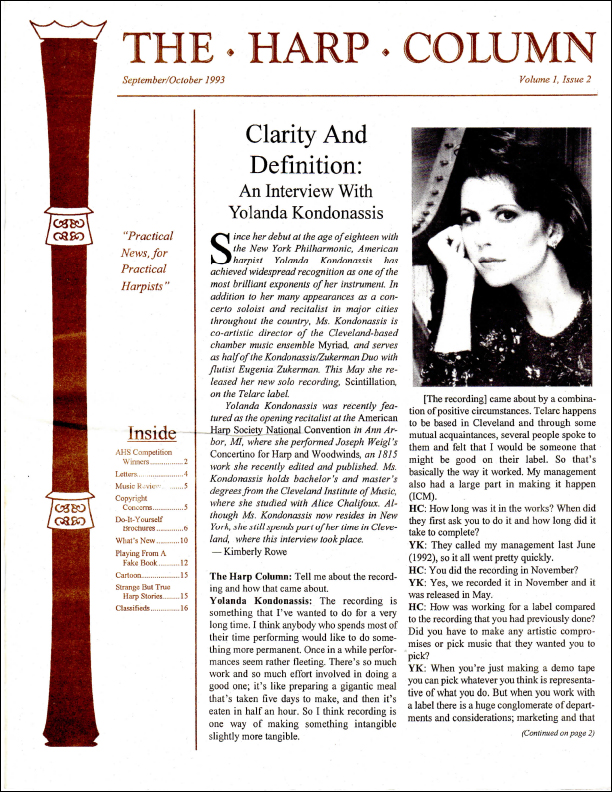
Back to the beginning
Harp Column last featured Yolanda Kondonassis on the cover of our second issue back in September/October 1993 when Kondonassis had just released her first album, Scintillation. Today she has more than 25 commercial recordings to her name. Her latest recording, Terra Infirma, will be released in April. Download this issue here.
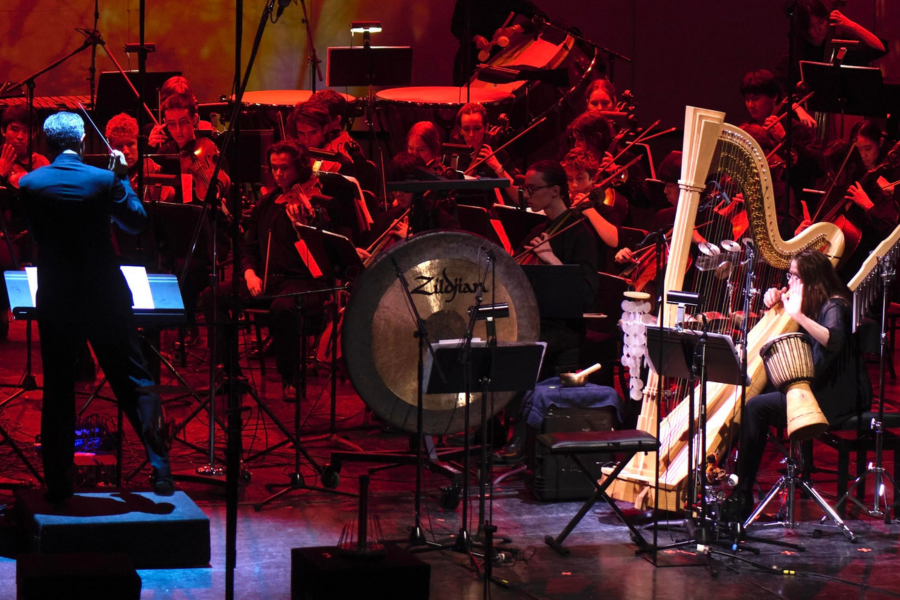
Yolanda Kondonassis: The Terra Infirma project started bubbling about five years ago. [The composer, Reena Esmail,] and I brainstormed endlessly. I knew I wanted a harp concerto of some kind, and we toyed with the idea of many different collaborations with harp. Somewhere along the way, I started thinking about percussion and all the color it could bring to the texture. I had played works that used a percussive element before, but the idea of using big-scale percussion became this sort of bee in my bonnet. Reena was quickly on board, and Terra Infirma all came together as a double concerto for harp/percussion and orchestra, with me performing as both solo harp and percussion. In addition to the world premiere at Interlochen Center for the Arts this past October, the project included a commercial recording that’ll be released in April, a live concert video, a documentary for PBS, and a three-part residency at Interlochen.
As for the percussion element, I was both excited and slightly terrified by the challenge of learning a completely new set of skills. Combining idioms, playing both harp and extended percussion at the same time? Could I do that? Would it be a disaster? Of course, these are the questions we ask ourselves when we dream up something new, but in the end, you have to banish those doubts and see where it takes you. One of the many things I love about Reena Esmail is that, like me, she doesn’t dwell on what could be a problem. We get to troubleshooting right away. We think, okay, could we have a complex harp figure in the left hand while looking through the strings and playing a precision line on almglocken and crotales with the right hand? Hmm. How could we make that work? So it was a long gestation process.
On top of all that, whenever you do a big-ticket project like this, you need sponsorship. I, like most of us, am not independently wealthy. You need people and places to believe in your ideas as much as you do, and Interlochen was the perfect partner. Their slogan, “Only at Interlochen,” is no lie.
I must say, being filmed and interviewed for the documentary was also super interesting. I was narrating events as they were happening, which I’ve never really done before because I’m usually so focused on the task. The documentary is about the creative process of bringing Terra Infirma to life, and I think that theme brought us all into a heightened awareness of every step along the journey. By nature, I’m a very tidy person, but the one place I’m not tidy is when I jump into a creative process, because I know it’s going to be chaotic and fragmented for a while until the concepts align. Some ideas won’t work. It’s a constant act of leaning into the wind where you think, this isn’t quite right yet—but what could work? One of my favorite writing teachers once told me, “Don’t edit as you write—just get things down, see what develops, and edit later.” When we finally finished, there was a lot of metaphorical wadded-up paper on film.
Sometimes it’s actually perfect when a project takes a while to hatch. That lead time gave me a full year to practice percussion and gain some mastery. Oddly enough, it also brought me a completely new perspective on bounce, physics, and trajectory as it relates to the harp. The principal percussionist of The Cleveland Orchestra, Marc Damoulakis, is a dear friend, and he was my percussion guru throughout the project. He introduced me to instruments, loaned me equipment, worked with me on technique, and was amazingly helpful in a hundred ways. It definitely takes a village.
By nature, I’m a very tidy person, but the one place I’m not tidy is when I jump into a creative process, because I know it’s going to be chaotic and fragmented for a while until the concepts align.
During the course of the roughly 30-minute work, I play 16 different percussion instruments and I actually shove my harp from one side of the stage to the other, moving through five percussion sets and a few small stations along the way. There is this climactic movement when I rather violently shove my harp the farthest distance, and I’m pushing and glissing in this furious rhythm. We were trying to figure out how many shoves I needed, and for how many beats. One night, Reena sent me a note that said, “Is eight shoves enough?” After laughing at the question I’ll probably never be asked again in my life, I thought, I don’t know—we’ll have to try it, and we were still working it out literally until the day before the premiere. In one rehearsal, while attempting to gauge the proper distance for each shove, I had a lot of force and adrenaline flying. I made my final shove, angled the harp between a bass drum and a tom-tom, and had to cue a big moment by raising my arms over my head. When I came down from the cue and hit the bass drum, I had so much momentum going that the motion catapulted me backward. I literally fell flat on my back. The orchestra stopped playing—I’m sure they were horrified. I got back up and said, “Folks, if you haven’t figured it out by now, the process is messy.” [Laughs] Even so, I can’t remember a time when I’ve felt more alive and totally in the swirl of a creative process.
That’s what the documentary is about. It’s not a glorification of classical music in the 21st century or about the importance of saving it. It’s just about what we do. We make things, figure out how to get them to a point where an audience will find meaning, and then we throw them out into the world and see what happens.
Music is powerful because it inspires, and inspiration can spread exponentially.
HC: This is obviously not the first time harp and percussion have been used together. What makes this piece different?
YK: That’s a good question. Why not just hire a great percussionist and make it a double concerto? Or maybe just pick a few manageable percussion instruments, place them next to the harp, and stay in one place for the whole concerto? Jennifer Higdon’s Harp Concerto, which she wrote for me, has a final movement called “Rap Knock” that is largely a duet between harp and percussion. With that, I learned that even in the best of circumstances, there’s an acoustic delay between harp and percussion when called to do intricate things—it can be very tricky. In Terra Infirma, there are moments of extreme synchronicity that realistically can only be achieved by one person. And as for the wisdom of selecting a few instruments and placing them near the harp, as opposed to a stage full of everything but the kitchen sink? Of course, that was way too doable to consider. [Laughs] This format just gave us so much creative latitude. We also incorporated giant, projected images by multi-media designer Camilla Tassi. All the sonic and visual elements fell together kind of miraculously, morphing from fire to devastation to hope.
Neither of us wanted Terra Infirma to be a musical armageddon—some kind of cautionary tale or a haunting warning—because there are still things we can do environmentally, and we have to maintain our optimism and motivation to fix what’s coming off the rails. I’d say that Terra is part storytelling, part theatrical catharsis, and part hope. I play the last movement in near darkness while wearing a ring on my left hand with a tiny light mounted on it. That’s the light of hope. I started thinking about all this in a deeper way when I had my daughter 23 years ago. Suddenly it’s not just about Earth lasting another 40 years for me. Now I’m thinking about centuries. It sharpens your focus about where we are and where we’re going. That’s what parenting does. As I always say, parenting does for your perspective what teaching does for your playing.
HC: You kind of read my mind—that was my next question. Your nonprofit and environmental advocacy—I was curious what that grew out of and what sparked that in your work.
YK: Well, you know, it’s always a slow burn, because first you have an idea, and then you’ve got to figure out what that idea looks like and what you might actually do with it. I think it’s very important to remember your wheelhouse, because when people try to do things they’re not qualified to do, it usually doesn’t go so well. So I thought, how could I, as a musician and a reasonably smart person, contribute to environmentalism? Honestly, my aha moment didn’t come until after I’d been thinking about it for quite a while. An early album of mine featured the music of Alan Hovhaness, and one of the tracks was called Spirit of Trees. I thought, wouldn’t it be great if I funneled some of my royalties from this recording to the Rainforest Alliance? So, I started trying to do what I could quite some time ago. It wasn’t a ton of money, but it was a baby step in the direction of how music can relate to environmentalism.
Then, in a rather weird coincidence related to Spirit of Trees, I was walking around Greenwich Village one day back when I lived in New York, and it started to rain. I ducked into the first little shop I came to. It was a gift shop with wind chimes, singing bowls, books, and things like that. I walked in, and they happened to be playing my recording of Spirit of Trees. I knew it was mine because it was the only recording of that piece that existed. Once in a while, if I hear my music somewhere, I’ll ask about it, so I said, “What is that you have playing?” The woman said, “Oh, we play it on a loop in here, over and over.” She said, “I don’t remember the name, but we keep it going because we find this music makes people get in the mood to buy our merchandise.” And I thought, wow, music can be a motivator. Music can be a catalyst to do stuff. Aha moment.
So the rain stopped, I walked around, and I kept thinking: music as motivator, music as catalyst—really, art in general as catalyst. So, the mission of the nonprofit I founded about a year later was simple: to inspire environmental action and awareness through the arts. I named it Earth at Heart and that was the official beginning of an organization that means the world to me now.
COVID was terrible in so many ways, but from a creative standpoint, it was kind of a boon. I had been a crazy chicken for over 30 years, playing 60–70 concerts a season, teaching in two places, making a recording every year, and raising a daughter. COVID allowed that big machine to grind to a halt, which unleashed tons of creativity once I got past the “What now?” stage. I had founded Earth at Heart a few years earlier and done a few interesting projects, but the real challenge was still there: inspiration is great, but how do I turn inspiration into impact? Predictably, the process was a bit messy. I tried a few ideas and finally landed on what has become our signature initiative, FIVE MINUTES for Earth, where composers and artists are invited to create and donate a five-minute work with an earth-inspired theme. It can invoke the beauty of Earth, catastrophe, natural elements, or whatever moves an artist—just so it motivates thought and inspiration. Then, with this catalog of artistic works, Earth at Heart honors each verified performance with a monetary donation to a worthy environmental organization, essentially turning music and art into money. The performance donations are perpetual. Artistic creations, such as poetry and visual art, are honored at their completion.
Phase One of the musical works collection is for solo harp because I assembled it during COVID when life was a solo affair, and all of those works are recorded on my album, FIVE MINUTES for Earth. The Phase Two collection is for all instruments and I look forward to launching that soon. Folks can go to EarthatHeart.org if they want info on how to participate in the project.
HC: You keep answering my next question, which is great—you’re reading my mind. I was going to ask how environmental concerns factor into your artistic decisions. It sounds like it has found its way into what you’re doing almost organically at this point. Fair to say?
YK: Oh, very much. I’m kind of prone to high energy—I drink a lot of coffee—and most people would probably describe me as someone who always has a coffee cup in hand. But strangely enough, I’m also very good at being still and thinking. We only get one life. We only get one set of people we love and one world where maybe we can help or make things better. I think my next chapter will be increasingly guided by those considerations, both in the music I make and the people I interact with.
Nobody can do everything. The whole idea of “changing the world” is unrealistic, but we can make incremental changes. Real change happens when everybody participates. I have a quote on my bulletin board that keeps me grounded. It’s from a ceramist named Ellen Tao: “There’s nothing I do that I think is going to change the world, but there’s nothing in the world that releases me from my obligation to try.” The world is extremely complicated right now, and it’s easy to feel overwhelmed, but we can’t just tune out. We have to stay informed while also protecting ourselves from burnout.
It’s like learning a new piece of music. You don’t master it all at once. You go measure by measure, and eventually your mind and body integrate it. Addressing our environmental crisis works the same way. Music is powerful because it inspires, and inspiration can spread exponentially. One person doing one small thing, multiplied by many, is when change happens. Sometimes as musicians, we might wonder what kind of reach we really have. But if our job is to inspire, that’s a pretty great job.
HC: Do what you can in your wheelhouse, right? Let’s shift gears and talk about teaching. This won’t be news to most by the time this interview comes out—you’re going to begin teaching at the University of Michigan this fall after more than 28 years at The Cleveland Institute of Music (CIM) and 25 at Oberlin. Going from a conservatory environment to a large university is a big change. How do you anticipate that will feel after so many years at conservatories?
YK: I think it’s going to feel fabulous. I often think about how musicians will navigate this next challenging frontier. The music business is completely different than it was when I got started about 35 years ago. That sounds like an eternity, but it went by in a flash. A couple things really changed the music industry rapidly. The recession in the late 2000s forced presenters and orchestras to learn how much they could cut and still function, and when the economy improved, many of those cuts remained. Then COVID accelerated change even further.
What excites me about the University of Michigan is that it gives musicians the opportunity to be truly educated. I don’t see how musicians can move forward in this landscape without a broad education. My father was an economics professor and my mother was a pianist, so I always felt compelled to satisfy both worlds. I attended CIM, and my father made a deal with me: if I went there, he would choose all my academic classes for both my bachelor’s and master’s degrees. So, every semester for six years, I took rigorous academic courses at Case Western Reserve University. I sometimes hated it, especially while I was subbing with the Cleveland Orchestra and traveling, but now I’m incredibly grateful.
Musicians need to know how to read contracts, build budgets, lead a meeting, write well, and run nonprofits, because most of us will eventually do some or all of those things. These skills deepen from studying subjects like psychology, economics, journalism, sociology, business, history. Students might wonder how academic classes will help their musical careers, but they absolutely do—in both conscious and subliminal ways.
I also believe that students need to learn more than just how to play the harp in my programs. My weekly harp seminars are very structured and topic-driven. We cover professional protocol, the business of music, collaboration, and project development, as well as orchestral repertoire, performance and practice techniques, memorization strategy, and transcribing. It’s not enough to just play your instrument well anymore. Lots of people can do that. You have to identify what you do uniquely well, and then decide how you can contribute to the field in a way that hasn’t been done a thousand times before. Getting a full education builds the critical thinking skills needed to do that. It’s not just a good idea, it’s imperative.
HC: The decision to leave CIM must have been difficult, having gone to school there and then teaching there for so many years.
YK: If there’s one thing we learn after being alive for a while, it’s that sometimes it’s necessary to pivot—at least after careful thought and deliberation. I’m not a person who makes snap judgments about people or situations, but when I’m in that still, reflective part of my life, I tend to look at things from every angle. And after doing that last year, it became clear to me that it was time to move in a different direction. I trust my own judgement after I’ve analyzed a scenario, but moving towards change sometimes requires the hardest kind of courage. We get used to certain situations and become devoted to what something was, and at some point, we have to take a hard look at what something is and decide if it’s still right for us.
HC: You mentioned that you studied at CIM and got both your bachelor’s and master’s there with the legendary Alice Chalifoux. Could you talk a little bit about how her teaching influenced you, both as a musician and as a teacher?
YK: Yes, well, Alice Chalifoux was an absolute original. The summers I spent with her in my teens at The Salzedo School up in Camden, Maine, and then my six years at CIM, were incredibly formative—in all the best of ways. I owe the world to her. She was an incredible teacher, an ally, a great supporter, and a trusted mentor. She talked straight when I needed it, and picked me up when I was down. Her devotion to her students was extraordinary, and really, all any of us can do to repay her is try and pay it forward to our own students—and quote her often. [Laughs]
In the harp world, we have always had this method debate, and when I started out, there were at least two very distinct pedagogical “camps.” This made things difficult for many of us as students and young professionals—on both sides of debate. It was almost like a red and blue divide—French or Salzedo. Today, I think things have gotten a lot better on this front, and I hope the progress continues. It all just has to boil down to a love of the instrument, genuine curiosity, and respect for ways of doing things that are different from our own. When we’re preoccupied with being right about whether a finger should be curved or not, or the height to hold an arm, we miss a great opportunity to be inquisitive researchers in our field. I do believe in the foundations of the technique that I play and teach, but we all need to have a nuanced approach, use our good sense, and remember that the music is the end game—not the technique or school of thought. As I like to say, our technique is the car, not the destination, and it shouldn’t be a label stamped on someone’s forehead. Honestly, I’ve never met a harpist from any tradition who isn’t a quilt of many influences.
From a teacher’s standpoint, however, I strongly believe that it’s essential to be both a musical and technical guide for your students. Folks don’t seek out training to be told they can just find their own way. It’s important to help them develop a technical foundation that forms the groundwork for problem-solving in the future and musical tools that will support their artistic goals. I’m always extremely mindful of helping my students avoid injury, and I find that a systematic learning approach usually works best. I feel tremendous responsibility for my students’ outcomes, so I’m all “up in their business,” as the saying goes. Students don’t have to reinvent the wheel from scratch at every turn. If someone is facing a technical challenge, I will almost always say, “let me show you what I’ve found works well” or “here are a couple good options for that.” We can’t lose sight of the fact that there are smart, time-tested ways to do things, and organized methodology can be a fast track to developing the tools that make all the fun musical stuff possible.
All that said, there is one universal truth: no two hands, brains, or people are the same, and when you sit down with a student, it’s almost like making a diagnosis where you ask yourself, what are we working with here, and how do I help this person reach their goals with understandable options that work?
HC: At Harp Column, we rarely interview anyone for the cover more than once. You were on the cover of our second issue back in 1993, and obviously you’ve done so much since then, that we had to talk to you again. Looking back over the last 30-plus years, you’ve built such a diverse and unique career. How much of that evolution has been intentional, and how much has been organic?
YK: That’s a really interesting question, because I think there’s a third category—accidental. I’d say accidental is a small slice, organic is a slightly larger slice, and the rest is intentional. I love the harp, but I love music more. I started on the piano, and it was actually a difficult choice between instruments when the time came. I didn’t play the harp until I was 9, after studying the piano with my mother from earliest memory.
I began playing the harp after we took a trip to Chicago one Valentine’s Day weekend. Back then, Lyon & Healy had a big music department store downtown and they had a huge window display featuring harps and cherubs and big sparkly hearts. My mom was particularly fascinated. While I was busy banging away on the massive array of pianos in the showroom, my mom was chatting with the man behind the counter. A few weeks later on a rare snowy day in Oklahoma, a walnut Troubadour arrived at our door.
I liked the harp, and it came quickly because of all my prior piano training. But I wasn’t sure it fit me. When I played the piano in public, I always wore little pantsuits with a flower on my lapel and platform wedges—very Debbie Boone style. I felt comfortable and strong in that get-up. But my mom felt that I couldn’t wear pants to play the harp and insisted on finding me a frilly dress. I was about 9 and felt ridiculous in it, but I agreed that it made me fit in better with the harp folks. That frilly dress situation created somewhat of a cognitive dissonance with me and the harp that lasted until I was about 16. But everything changed when I began learning the Ginastera Harp Concerto. I remember thinking that a frilly dress would look ridiculous with that piece, and it helped me feel a connection between my personality and the harp. That probably explains why I’ve done so much commissioning of “non-frilly-dress repertoire.” When I finally chose the harp over the piano, I decided that the harp probably needed an advocate more than the piano, and that perhaps I could maybe even stretch the acceptable wardrobe choices for harpists along the way. [Laughs]
For a long time as I was building my career, I played all the major traditional repertoire, in addition to playing the Ginastera Concerto as often as possible. But then I started gravitating in the direction of new music. For years, as I was premiering and promoting new works I had commissioned, I would pair these pieces with something familiar such as the Debussy Danses—almost like giving audiences a spoonful of sugar with their entrée. Now I don’t have to do that as much. I can present the main event on its own, which feels like real progress for the harp. I am so thrilled to see harpists expressing themselves in all kinds of ways today, not just fitting into traditional expectations.
Even so, I’ve often felt that I had to advocate for the harp as an instrument in the same way I’ve had to advocate for myself as a woman. The harp has its own kind of glass ceiling and there is most definitely something I call instrumental misogyny. When you are a woman who plays the harp, I believe that you frequently have a feminist battle on two fronts. That’s why I love Terra Infirma so much—it really pushes both the instrument and the player to the limit in sonic scope, strength, and perception. In the piece, both the harp and I represent Earth—fragile and powerful at the same time—and that really resonates with me. Don’t fool with Mother Nature. [Laughs]
HC: We talked a little bit about recording—you’ve made so many records, and you have been an equally prolific solo performer. Do you feel more at home in the recording studio or on stage?
YK: That’s a great question. When I finish a recording, I can’t wait to get back on stage. And after performing a piece live, I can’t wait to record it because I can be meticulous in a way that isn’t possible in live performance. Live performance has electricity and excitement, but recording can present a different kind of tension. You want to capture the best possible version of any given piece, and it’s physically demanding because you’re trying to eliminate all extraneous noise while keeping everything musical and natural. I would also say that recording was an education in itself. Back in 1993 when I made my first album, it was mind-blowing to hear myself recorded with amazing mics and acoustics, and that gave me some musical perspective I didn’t have before. I learned what I liked and what I didn’t like very, very quickly.
HC: You haven’t been sitting back with your feet up after completing the Terra Infirma project. You have a lot of other things in the pipeline, including a new book of earth-inspired compositions coming out.
YK: Yes, The Earth Collection will be published by Theodore Presser just as soon as I proof the final draft. My recording of Takuma Itoh’s new harp concerto, Koholā Sings, will be released within the year, and I’ll have a new method book coming out as well, also with Theodore Presser. Nobody’s going to understand this reference, but that method book will be my sort of Jerry Maguire manifesto on harp technique, musicianship, and ideology—50 years of figuring things out and traveling to the beat of my own drum. It will not be a short book. •
Yapping with Yolanda
Lakes or oceans?
Oceans.
Favorite footwear at the harp?
Comfortable.
Heels or flats?
Moderate heel.
Coffee or tea?
Coffee. Black with a little stevia.
Best advice you’ve ever received?
Don’t take yourself too seriously—but take what you do seriously.
First thing you do when you sit down to practice?
Stretch and warm up.
Hidden talent?
Organizing drawers.
Early bird or a night owl?
Night Owl.
If you weren’t a harpist, what would you want to do for a living?
I would probably write.
Favorite thing to do away from the harp?
Spend time with my husband and daughter. And eat.
A piece that you never tire of playing?
The Ginastera [Harp Concerto]. I discover something new every single time I trot on stage to play that thing.