


Ed. note: find part 2 of this series in the May-June-2026 issue of Harp Column.
Editor’s note: This is the first installment of a two-part series touring 25 harp cities around the world. Be sure to check out the May-June-2026 issue of Harp Column to follow along with our travel guide to the best harp spots in each city.
Any harpist who has traveled or moved to a new city will tell you—every place has its own harp vibe. Shaped by a combination of history, culture, people, and institutions, the harp scene varies widely from place to place. Even cities within the same country can have distinctly different harp identities.
We thought it would be fun to take a trip around the world and explore some significant harp cities. Of course, it’s impossible to visit every destination, but in this two-part series we highlight 25 cities with rich cultural and historical heritage and vibrant present-day music scenes. We asked harpists who call these cities home to serve as our tour guides, sharing must-see attractions and harp connections at each stop. Music is a universal language, and the harp is the only passport you’ll need. Let’s go!
 Toronto, Canada
Heidi Bearcroft
Toronto
We begin our tour in Toronto, located in the Canadian province of Ontario, where I had some of my first experiences with the international harp world during my undergraduate studies with Judy Loman. Loman brings a procession of internationally renowned harpists such as Alice Giles, Marie-Pierre Langlamet, Emmanuel Ceysson, and many others to give masterclasses for her students at the Royal Conservatory of Music and the University of Toronto. A recipient of the Order of Canada in recognition of her contribution to the arts in that country, Loman has taught generations of Canadian harpists, including fellow Juno Award winners Erica Goodman and Angela Schwarzkopf.
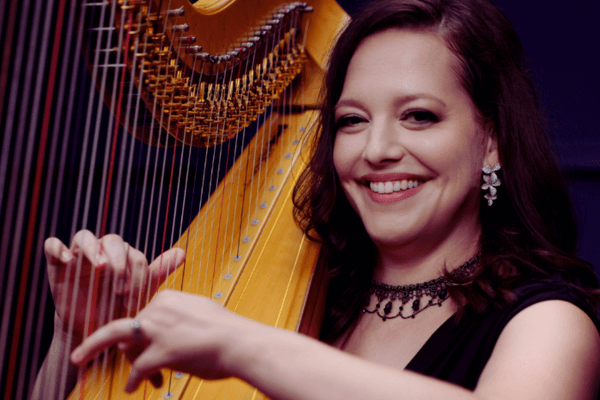
Royal Conservatory of Music harp faculty and Toronto Symphony Orchestra principal harp Heidi Bearcroft agrees. “This city has a rich harp legacy shaped by legendary figures such as Judy Loman and Erica Goodman, whose artistry and teaching set a standard of excellence that still resonates today,” she says. “Being a harpist in Toronto is both inspiring and humbling. I feel incredibly fortunate … to share music at the heart of such a vibrant arts community.” Bearcroft also names Lori Gemmell, who serves as harp faculty at Wilfred Laurier University and for the National Youth Orchestra of Canada, and National Ballet of Canada principal harp Clara Wang among her current colleagues who continue to inspire her.

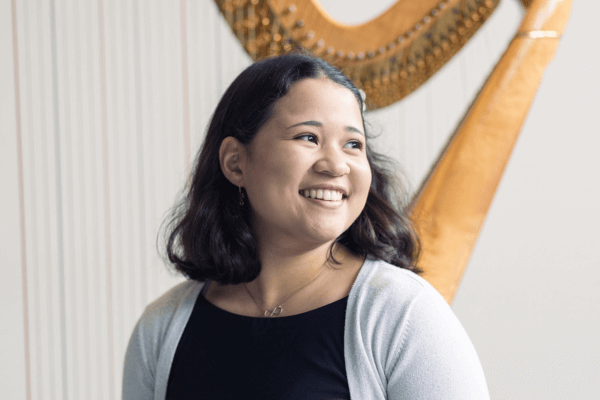
Renée Murphee
New York
New York, USA
Just a quick up-and-down flight from Toronto is New York City (NYC). “Not long after the turn of the 20th century, New York was home to pioneering harpists—Mildred Dilling, Harpo Marx, Carlos Salzedo, and Marcel Grandjany, who led Juilliard’s harp department where I now study [with Nancy Allen],” says Juilliard master’s student Renée Murphy, also fifth prize winner at the 13th USA International Harp Competition. NYC is also home to harp programs at the Manhattan School of Music and New York University.
During our visit, we’ll attend a concert at historic music venues such as Carnegie Hall, Broadway, and Lincoln Center (the stage of the New York Philharmonic, The Metropolitan Opera, and the NYC Ballet). Don’t miss the collection of harps spanning millennia of harp history across the globe, housed at The Metropolitan Museum of Art—just across Central Park from the site of Victor Salvi’s repair shop in the West End of Manhattan, where he built his first harp in 1954.

Helen Liu Gerhold
Philadelphia
Philadelphia, USA
Let’s catch the train for a 90-minute ride to Philadelphia, Pennsylvania,a hot spot for harp studies for over a century. We can catch a harp student recital at the Curtis Institute of Music, where the legendary Carlos Salzedo founded the harp department in 1924. Helen Liu Gerhold, a guest faculty member at Curtis, traces the historic ripples of generations of trailblazing Philadelphia harpists. She says Salzedo’s student Edna Phillips—the first woman to hold a principal position in a major American orchestra—expanded harp education in local schools. Ann Hobson Pilot, an alumna of the Philadelphia School District’s harp program in the 1950s and ’60s, became the first Black principal of any instrument of an American orchestra. In turn, Pilot inspired Elizabeth Hainen to start the Lyra Society (a nonprofit offering secondary school harp education to low-income students), of which Gerhold is executive director.
Before leaving Philadelphia, we watch a masterclass at Lyra or one of Philly’s other music education institutions (including Settlement Music School, Temple University’s Boyer School of Music, and the Philadelphia Youth Orchestra). “Our city’s tradition of innovation, community, and excellence makes this city an inspiring and vibrant place to be a harpist,” Gerhold says.

Angelica Hairston
Atlanta
Atlanta, USA
A two-hour flight takes us to the world’s busiest airport, Hartsfield-Jackson in Atlanta, Georgia. Atlanta-based harpist, educator, and activist Angelica Hairston describes the city as a great hub for touring musicians. “[Atlanta combines] the warmth of Southern hospitality with the dynamic energy of one of the fastest-growing cities in the country. [The city offers] performance opportunities across thriving music, tech, and film scenes, [plus] genre-blending gigs all within driving distance throughout the Southern region,” Hairston says.
While in Atlanta, we’ll visit the showroom at the Atlanta Harp Center and check out a performance by the Urban Youth Harp Ensemble, a nonprofit that makes harp lessons available to public school students of diverse income ranges and backgrounds. “Rooted in the legacy of the Civil Rights Movement, Atlanta remains a place where music meets meaning and programs like the Urban Youth Harp Ensemble remind us that the richly diverse future of the harp community thrives here,” Hairston says.

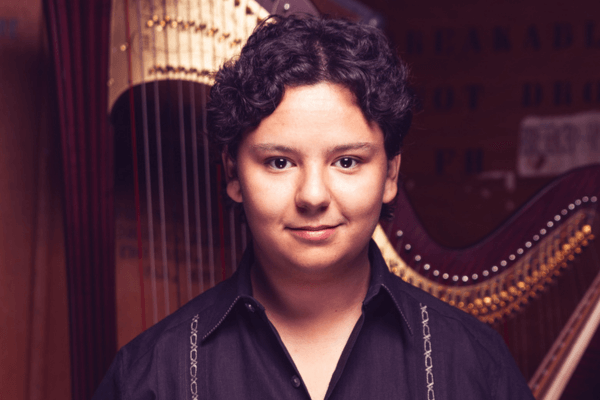
Emmanuel Padilla Holguín
Mexico City
Mexico City, Mexico
Next, we hop a plane for three and a half hours to Mexico City, home of the Mexico International Harp Competition. Here, harp music is part of all kinds of events: formal and informal, in churches and at social gatherings. According to Latin American Harp Association founder and National Conservatory of Music harp professor Emmanuel Padilla Holguín, the presence of the harp across this range of settings reflects the harp’s importance in Mexican culture. “Mexico City has a long and layered relationship with the harp,” Padilla Holguín says. “While folk harps have deep roots across the country, the pedal harp has flourished here since the early 20th century, especially with the rise of formal music education and symphonic institutions.”
While we’re here, we can attend a performance by a professional orchestra such as the one at the National Institute of Fine Arts, where Padilla Holguín is the solo harpist, as well as a harp chamber music concert in one of the city’s main concert halls.

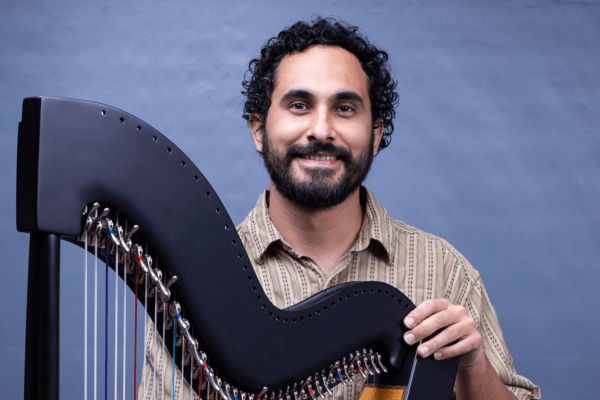
Juanjo Corbalán
Asunción
Asunción, Paraguay
Buckle up for a cross-continental connecting flight to Asunción, the capital city of Paraguay and host of the nation’s annual Festival Mundial del Arpa (World Harp Festival), usually held in October. As we scout out local venues, Paraguayan harpist and composer Juanjo Corbalán says it won’t be hard to find traditional festivals, which usually feature several bands with a harpist. We can also catch a few performances by solo harpists and bands showcasing today’s harpist-composers, both those who lean toward folk tradition and those who blend other genres and traditions with their Paraguayan heritage.
We can take a day trip to experience the history of Paraguayan harpmaking at artisanal factories in Asunción and its suburbs Luque and Ñemby. Corbalán guides us through a timeline, beginning with the arrival of the harp in 16th-century Paraguay during the Spanish conquest. “The Jesuits, in their missions, introduced the instrument and worked with the native Guaraní people to adapt it to their needs and local resources,” he says.
In the 20th century, other musicians and harp makers made further adaptations: Félix Pérez Cardozo (1920s) and Papi Galán (1970s) modified the number and arrangement of strings, Nicolás Caballero (1970s) began using a tuning key to produce semitones, and Mariano González (1980s) added levers. “These elements gave the diatonic harp greater musical capacity, opening up possibilities for playing other musical genres besides folklore, such as bossa nova, jazz, blues, funk, and disco, among others,” says Corbalán, whose Juanjo Corbalán Quartet explores many of these genres. He estimates that hundreds of Paraguayans play the harp today, trained by private teachers and at national and private conservatories, music schools, and universities.

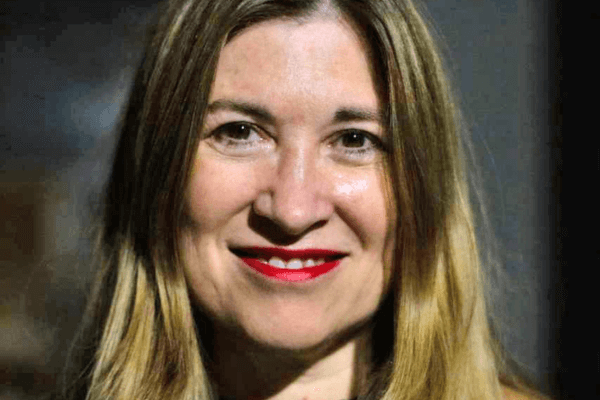
Lucrecia Jancsa
Buenos Aires
Buenos Aires, Argentina
After less than two hours in the air, we land in Buenos Aires, Argentina, which also boasts an abundance of concerts to attend. Lucrecia Jancsa, principal harp of the Argentine National Symphony Orchestra and a harp professor at the Manuel de Falla Conservatory of Music, points out several highlights for our visit. We hear one of the Colón Opera House’s two orchestras (the Ballet Estable and Orquesta Filarmónica) or the Argentine National Symphony Orchestra, all three of which have permanent principal and associate harp positions. Also on our schedule are concerts by solo harpists and chamber and contemporary ensembles.
As we explore the city, we pass theaters and jazz clubs before stopping to meet a few students at the Manuel de Falla and Astor Piazzolla Conservatories and the National University of the Arts. Jancsa says, “European immigration between the world wars greatly contributed to the development of classical music, leading to the creation of orchestras and conservatories offering training on all instruments—including the harp.”

Clíona Doris
Dublin
Dublin, Ireland
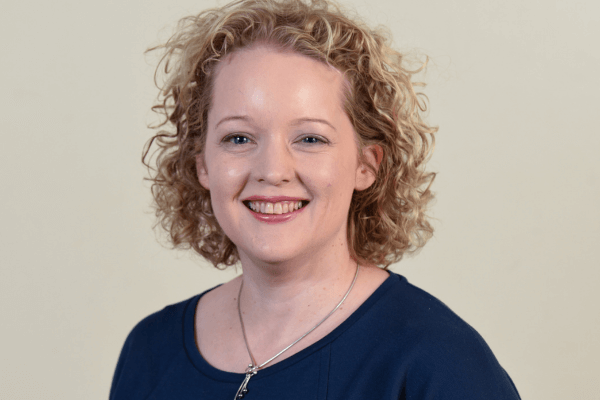
Journeying across the Atlantic, we find ourselves in Dublin, the capital city of Ireland. “[The harp] is the country’s national emblem, appearing on seals of office and on Irish-minted coins,” says TU Dublin Conservatoire harp professor Clíona Doris. We’ll stop by two of Dublin’s must-see sites, which (of course) feature the harp. “The impressive Trinity College Old Library houses the medieval instrument known as the ‘Brian Boru’ harp, and the landmark building of the Guinness Storehouse displays its logo based on the same harp (facing to the right, whereas for the national emblem the harp faces to the left),” Doris says.
We can also connect with local harpists and harpmakers who maintain the instrument’s living tradition in Ireland. Doris mentions two Dublin-based harp organizations, Cairde na Cruite (Friends of the Harp) and the Cruit Éireann | Harp Ireland collective, as examples of a strong harp community. Traditional musicians preserve the harp’s place in Irish culture through the Comhaltas Ceoltóirí Éireann (Gathering of Musicians of Ireland) and the Irish Traditional Music Archive, as well as the Historical Harp Society of Ireland (which focuses on the early wire-strung Irish harp). For students in Dublin, it’s easy to find both lever and pedal harp instructors, including at the city’s two music conservatories, the Royal Irish Academy of Music and TU Dublin Conservatoire.

Caryl Thomas
Cardiff
Cardiff, Wales, U.K.
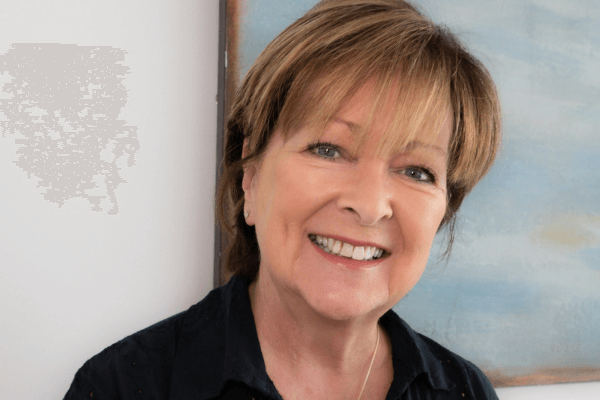
After crossing the Irish Sea by ferry, we take a train ride to Cardiff, Wales, through five scenic hours of Welsh coastline and English countryside. “Proudly serving as the national instrument of Wales, the harp is seen on the concert platform, at major events, at sporting fixtures, and when members of the royal family visit,” says Caryl Thomas, harp teacher at the Royal Welsh College of Music & Drama in Cardiff. “The instrument is deeply embedded in Welsh culture, is taught in Welsh-language schools, and has a special place in local, national and international ‘Eisteddfodau’ (cultural festivals), where [the harp] features in competitions and performances.”
Thomas says the city is home to numerous harp professionals, students, and teachers, in addition to two harp shops, two symphony orchestras, and many harp ensembles. “Several harp celebrations have been held in the city, including the World Harp Festival in 1991 and 1992, the European Harp Symposium and the European Harp Competition in 2007, the Lyon & Healy Awards in 2013, and more recently the World Harp Congress in 2022,” she says. “It really is a fun place to be a harpist!”

Isabelle Marie
Paris
Paris, France
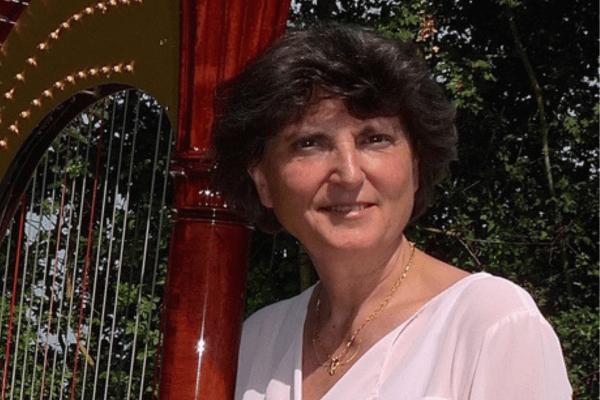
We continue our trek by catching a train to Paris, France. Our visit here is guided by Isabelle Marie, a performer and former harp teacher in Paris at the Schola Cantorum and several municipal conservatories. Harp students from across Paris love to gather and inspire each other, meeting for everything from auditions to chamber music. Every two years, they get the chance to participate in the contemporary repertoire competition Collegium 21. We can join in the lively Parisian student scene by observing a masterclass at one of the city’s 17 conservatories, which all have at least one harp studio, or “class.”
The storied harp class of the Conservatoire Supérieur de Musique de Paris (Paris Conservatory) is currently led by Isabelle Moretti, renowned both as a soloist and as a teacher whose students have won many awards and professional positions. Marie tells us that the legacy of this harp class began in the 19th and 20th centuries, first under Alphonse Hasselmans, then Marcel Tournier. Although French pedagogue Henriette Renié never taught at the Paris Conservatory, she also built a lineage of well-known students.
We conclude our visit to Paris with a tour of the music museum run by the Philharmonie de Paris. There, we see several instruments from Paris’ golden age of harp. “The most active period concerning the harp in Paris was undoubtedly that of Queen Marie-Antoinette in the 18th century, who herself played the harp,” Marie says. “The instrument quickly became fashionable, and many luthiers opened their shops in Paris, such as Renault & Chatelain, Cousineau père et fils, and Jean Henri Naderman.” Sébastien Erard, a piano and harp manufacturer, also established his firm in Paris around 1780, patenting his famous double-action mechanism for the pedal harp in 1810.
Performers and teachers also flourished, including those who performed at the Concert Spirituel (a public concert series held from 1725–1790). “In 1784 there were 60 harp teachers in the city of Paris,” Marie says. Wolfgang Amadeus Mozart also composed his concerto for flute and harp in Paris in 1778 for the Duke of Guines (an amateur flute player) and his harpist daughter.
Jakez François
Mouzeil
Mouzeil, France
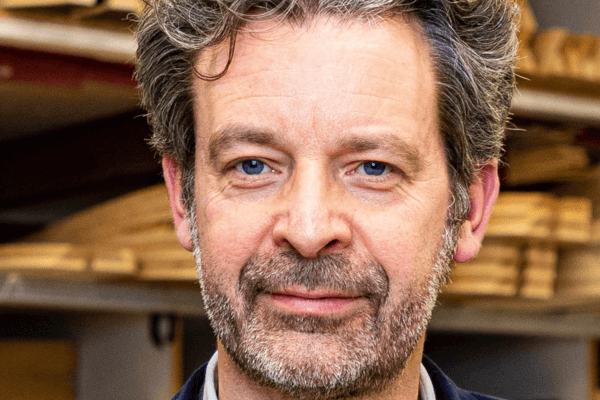
We take the TGV express train to the city of Nantes in the Loire Valley of northwestern France, then change trains to reach the Breton town of Mouzeil (located about 25 miles northeast of Nantes). “Mouzeil is a small rural village with a unique distinction in France: it is home to a pedal harp manufacturer,” says harpist Jakez François, who has served as president of Camac Harps since 2000. “Mouzeil became the home of Camac Harps’ workshops [because] it was the village where one of the company’s two founders [Gérard and Joël Garnier] lived. They therefore decided to set up on their own land, and soon workers from the surrounding area with skills in woodworking were recruited and trained in harp making.”
But Camac’s story didn’t begin with the pedal harp. Founded in the 1970s during a global folk revival, Camac took advantage of the increasing popularity of the lever harp in Brittany (a region of France with Celtic roots). The company says on its website, “From the second half of the 20th century, [the Celtic harp became a Breton] symbol of resistance against the centralizing French State, drawing a parallel with the Irish harpers who had to burn their instruments when the English invaded.”
François says that Mouzeil belongs to a group of 20 municipalities in the Pays d’Ancenis, known collectively as COMPA. “What truly sets this intercommunal region apart is its strong support for the harp: every two years, it hosts ‘Harpes au Max’ [Harps to the Max], an international harp festival. In 2025, the festival featured 167 artists from 10 countries, with over 30 concerts and nearly 10,000 attendees,” François says.
Most harpists in the area find their careers in the nearby city of Nantes, although the village itself offers one harpist the responsibility of testing and adjusting the instruments at Camac—the role that François held when he first joined the company in 1988.

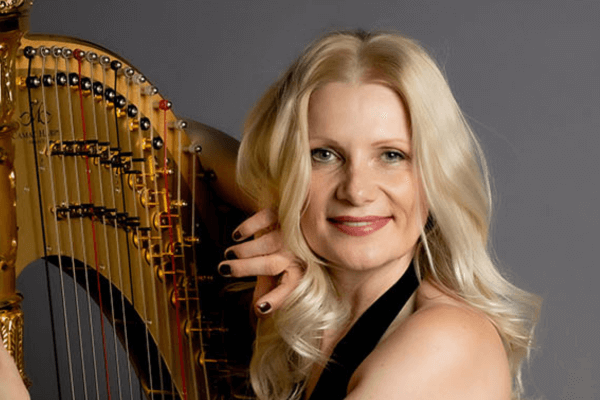
Evelyn Huber
Germany
Munich, Germany
We arrive in Munich, Germany, after a 10-hour train ride, to discover a surprising number of similarities to the Breton village we came from, including a rich folk tradition. “Many children are introduced to the harp early through Bavarian folk music and the single-action folk harp—which explains the large number of harpists in the city,” says German harpist Evelyn Huber. “Munich is also home to one of the world’s most renowned concert harp makers: the Horngacher Harps company, which recently celebrated its 100th anniversary.”
The city offers a harp program at the Hochschule für Musik und Theater, where Huber taught for over a decade. “Longtime professor Helga Storck played a key role in shaping Munich as a harp city, and today Professor Cristina Bianchi continues that tradition with great success,” Huber adds.
As a harpist who blends jazz, tango, and world music in her international performances, Huber says she appreciates the variety of musical influences in her city, from major classical orchestras to performers in other genres. “The lively and diverse harp scene here in Munich is increasingly opening up to jazz, folk, experimental, and world music,” she says. “The harp is shedding outdated clichés and continues to surprise audiences.”
‘til next time!
Four hours by train through northern Austria takes us to Vienna, where we’ll pick up next time in the May/June 2026 issue of Harp Column. •