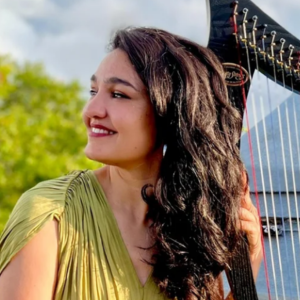


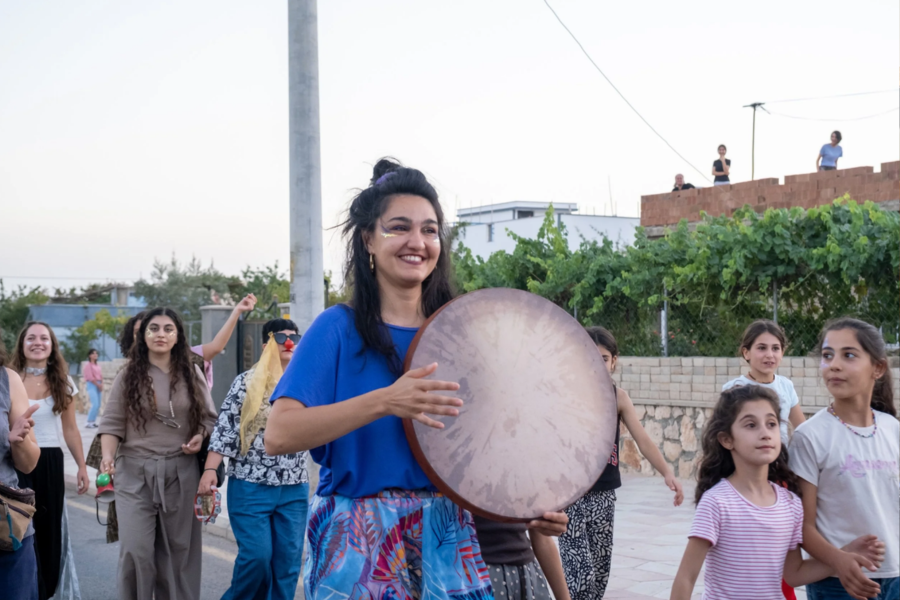
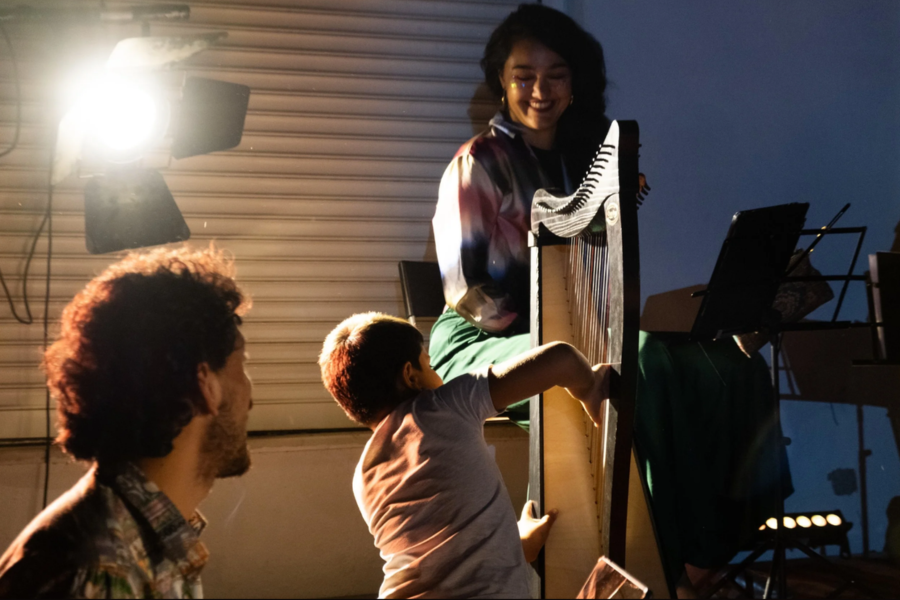
Samira Memarzadeh writes that performing on the harp at the 2025 Flying Carpet Festival in Mardin, near the Turkish-Syrian border, felt like she had brought her instrument home. “Of course, [the harp] was one of the instruments the children wanted to try most,” she adds.
How can I travel the world with my harp?
How can I reach people beyond the concert hall with my instrument?
Some of the earliest depictions of the harp come from Mesopotamia, but what role does the instrument play there today?
These were some of the questions I was wrestling with as I completed my studies in Germany.
Out of the concert hall, into the street
Big tours or overseas concerts? Not a chance. Most of the orchestras I played in were focused on Bach and Schubert. I stayed home and listened to the stories of others. With the harp, you rarely travel, I thought. I couldn’t settle for that. I love traveling, so I did it anyway, just without the harp.
When I started earning money, I bought a 34-string harp, then a 26-string. Suddenly, my possibilities expanded. I was no longer confined to concert halls—now there were small venues, cultural cafes, and even pedestrian streets. The harp was no longer just a concert instrument—it became a companion on my own journeys.
Mesopotamia: a harp homecoming
Scrolling on Instagram one day, I discovered the Flying Carpet Festival. Founded by Iranian composer Sahba Aminikia, the interdisciplinary festival is aimed at children, focuses on socially relevant themes, and brings together local and international artists. I wrote to Sahba, expressing my admiration, especially for the social focus and work with children, and offered to help voluntarily.
Sahba suggested I apply as an artist for the festival—after all, I was a harpist and a musician. I wondered what they would want in a harp. In concert halls, it is part of an orchestra, but at a circus festival on the Turkish-Syrian border? I asked if I could participate with my 26-string harp, even though it lacked bass strings. “Of course,” he said. A harp is a harp.
In May 2025, I received confirmation that I had been accepted as a festival artist. I was thrilled. The festival takes place in Mardin, a former northern Mesopotamian metropolis where Kurdish, Arab, Turkish, and Aramaic speakers live together. Sahba told me I was the first harpist at the festival. I felt honored and welcomed.
The harp on the road
The harp didn’t fit in the overhead bin, so I traveled with my stringed companion in the neighboring seat. Security guards looked curiously at my awkward luggage. In Mardin, I cursed every kilogram in the sweltering 40°C (100° F) heat and the narrow, steep streets. Even a small harp isn’t light.
Before the festival, I visited the ethnological museum and saw a harp depiction from around 4000 BCE in this region. At that moment, I realized that in bringing my harp to Mesopotamia, I had brought it home.
Within two days, we rehearsed a circus and music theater performance with artists from about 50 countries, including dancers, fire-eaters, circus performers, directors, lighting designers, costume designers, filmmakers, puppeteers, actors, and musicians. Many languages were spoken, yet origin didn’t matter. The shared goal was to reach, empower, and move children.
We performed traditional Kurdish, Persian, Palestinian, and Turkish songs, improvised, interpreted Bach, and premiered two original works. The Loveland levers of my harp allowed microtones, essential for the region’s music.
For nine days, we traveled through cities and villages, leading workshops, circus parades, and evening performances with young regional circus artists, many with refugee backgrounds. The harp illustrated a Blue Fairy and her magical moments. Of course, it was one of the instruments the children wanted to try most. On stage, I sat next to a qanun player from Iran, and our instruments were quickly dubbed “sisters.” Together with an oud player, we formed a plucked string group.
Reflections and answers
By the festival’s end, I had found answers to my questions. Yes, you can travel with a harp if you find the right project and the right instrument. The harp is more universal than I had imagined. In southeastern Turkey, it is mostly remembered from painting and poetry. Its classical orchestral role is only one of countless forms it enjoys worldwide. Its existence is vast and varied across many musical cultures and styles.
The harp is not just my instrument; it is my language. It takes me to places I never thought reachable as a harpist and connects me to communities, histories, and children in a way that concert halls alone never could. •