
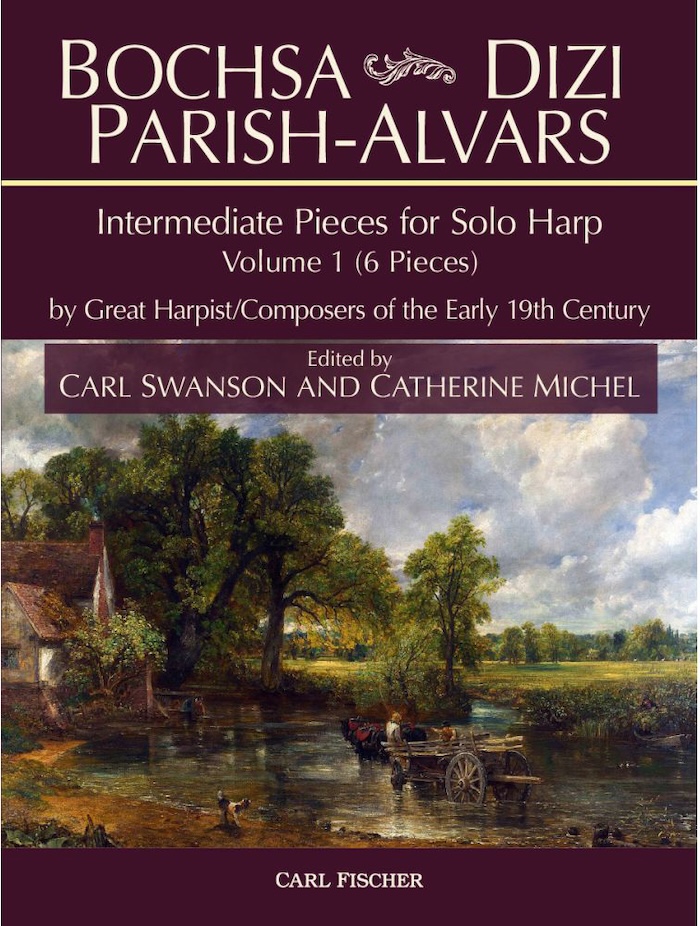
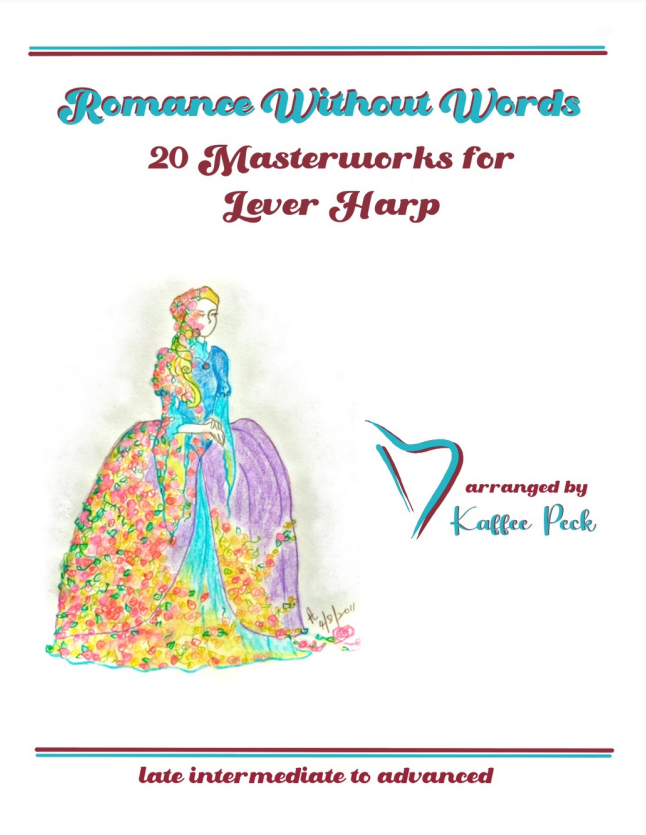
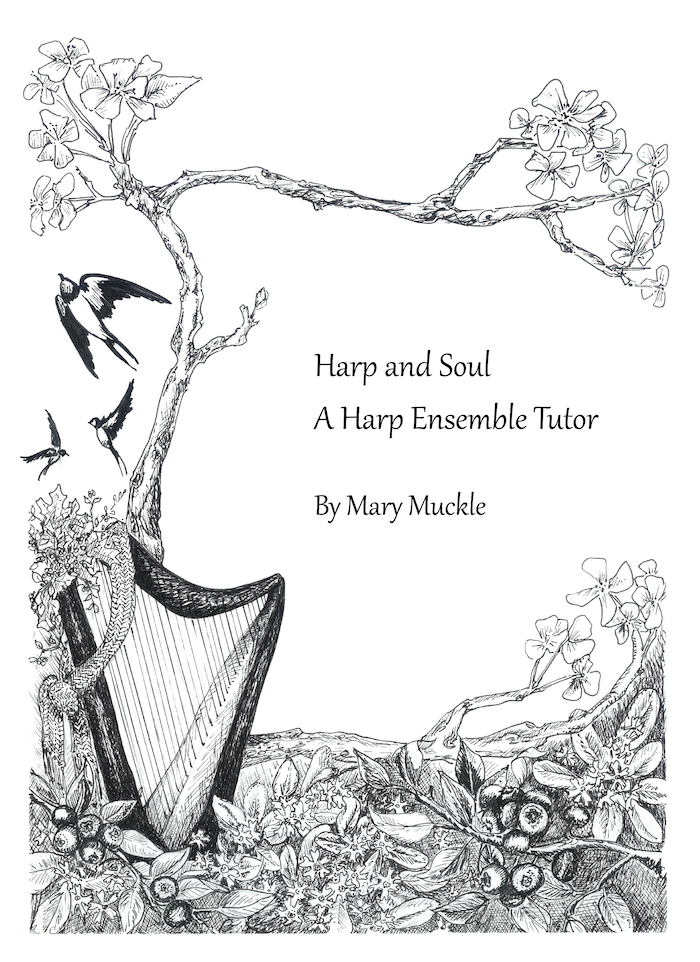
From l. to r.: A collection of “thoroughly researched” 19th century music editions published by Carl Fischer; an “ambitious and effective collection” of mostly classical works for lever harp from Kaffee Peck; and a collection to use “ensemble playing as a tool integrated into regular lessons” from Mary Muckle
There are several recent collections that offer something for multi-level players of both lever and pedal harp.
Edited by Carl Swanson and Catherine Michel, and published by Carl Fischer, Bochsa–Dizi–Parish-Alvars: Intermediate Pieces for Solo Harp, vol. 1 is a collection of works by three 19th-century composers. Like Swanson’s other editions, this set is thoroughly researched and annotated with care.
The six pieces in this volume are nocturnes and arias in the “bel canto” style, popular in the early Romantic era. As Swanson points out in the preface, there was actually quite a lot of music composed for harp during that period, but much of it is forgotten today. Even in the case of recognizable composers like Parish-Alvars and Bochsa, large portions of their works remain unknown and out of print. It’s exciting to see modern harpists resurrecting some of these lovely pieces and making them readily available.
All of the pieces in this book are for pedal harp only. Though the title specifies the level as intermediate, the pieces would be suitable for late intermediate or early advanced players and would be a stretch for early intermediate harpists. As a scholarly edition, this is an excellent starting place to dive into early-Romantic works and would serve well as a stepping stone to these composers’ more virtuosic and difficult pieces.
The introduction includes historical context and performance notes about playing in the fluid, melodic, bel canto style. Pedal changes and pedal diagrams are printed in the music, along with some fingerings. One other helpful feature, particularly for those new to this style of music, is dotted lines showing clearly how the extensive and often complex ornamentation lines up with the left hand accompaniment.
For advanced and professional harpists, these works are also worth exploring, providing an opportunity for lyrical expressiveness. More experienced harpists might find the amount of markings unnecessary, but even so, the neatness and generous size of the staves prevent the page from appearing cluttered.
Kaffee Peck’s publication Romance Without Words: 20 Masterworks for Lever Harp is an impressive collection of mostly classical works. Peck’s arrangements range in difficulty from intermediate to early advanced, constituting an ambitious and effective collection for lever harpists seeking a challenge.
It takes a skilled arranger to make difficult pieces accessible while maintaining what is captivating and interesting in the original, but Peck does just that. My favorite example in this book is Isaac Albéniz’s Asturias, which is a difficult work even on pedal harp. Peck’s modifications make it not only playable on lever harp, but accessible to an intermediate player, while still capturing the piece’s character and rhythmic energy. The collection includes skillful arrangements of other beloved classical works such as Puccini’s “O mio babbino caro,” Massenet’s “Meditation” from Thaïs, and Debussy’s “Clair de lune,” as well as some lesser-known pieces. One selection, Bach’s “Ave Maria,” includes an optional part for melody instrument.
The music is clear and easy to read, with print that should be large enough for most to see without difficulty. Fingerings and lever changes are printed in the music. The lever changes are notated with diamond-shaped noteheads on the staff, and they are highlighted yellow, making them extra visible. This notation is especially helpful given that some of the pieces have quite a few lever changes. Peck specifies that these pieces work on pedal harp as well, but in order to avoid confusion with the included lever changes, pedal changes are not printed.
The introduction to the book contains brief information about the works and a set of QR codes that lead to reference videos of each piece. On a non-musical note, the book is sprinkled with charming illustrations drawn by Peck’s sister. This music is self-published and available as a PDF download or printed copy.
Last up in our collection of collections is Harp and Soul: A Harp Ensemble Tutor by Mary Muckle, published by Afghan Press. This book can simply serve as a source of music for harp ensemble performances, but its unique value lies in Muckle’s perspective of using ensemble playing as a tool integrated into regular lessons and learning. Muckle wrote these arrangements for her students over the span of 25 years of teaching, both privately and in group classes. The book contains a large selection of beginner and mixed-level ensemble music, including harp duos, trios, quartets, and a sextet, as well as a couple of arrangements for harp and other instruments.
Each piece has a score followed by individual parts. Muckle also includes an introduction to each, with historical context, playing instructions, and descriptions of the difficulty level of the parts. Some of the pieces can be joined together or altered for flexibility. For any songs with words, those are included as well, and Muckle writes tips for incorporating singing as a way to hone rhythmic, melodic, and listening skills.
The selection of pieces is quite varied, including folk songs from around the world, standard classical, and early music. There are even a couple of mid-century pop tunes! Muckle relates the pop chord progressions to other ostinato progressions in classical music and uses both to encourage players to experiment with improvisation across musical genres.
Muckle’s arrangements are simple but also creative, effective, and fun to play.
Overall, this book is a great resource for students and teachers. Harp can be a lonely instrument, and Muckle provides materials and a framework to integrate collaborative playing from the early stages of a harpist’s journey. •