

We all benefit when an artist or musician takes something that has had a profound effect on them and shares it with others. In this issue, we find two harpists who are sharing a passion with us.
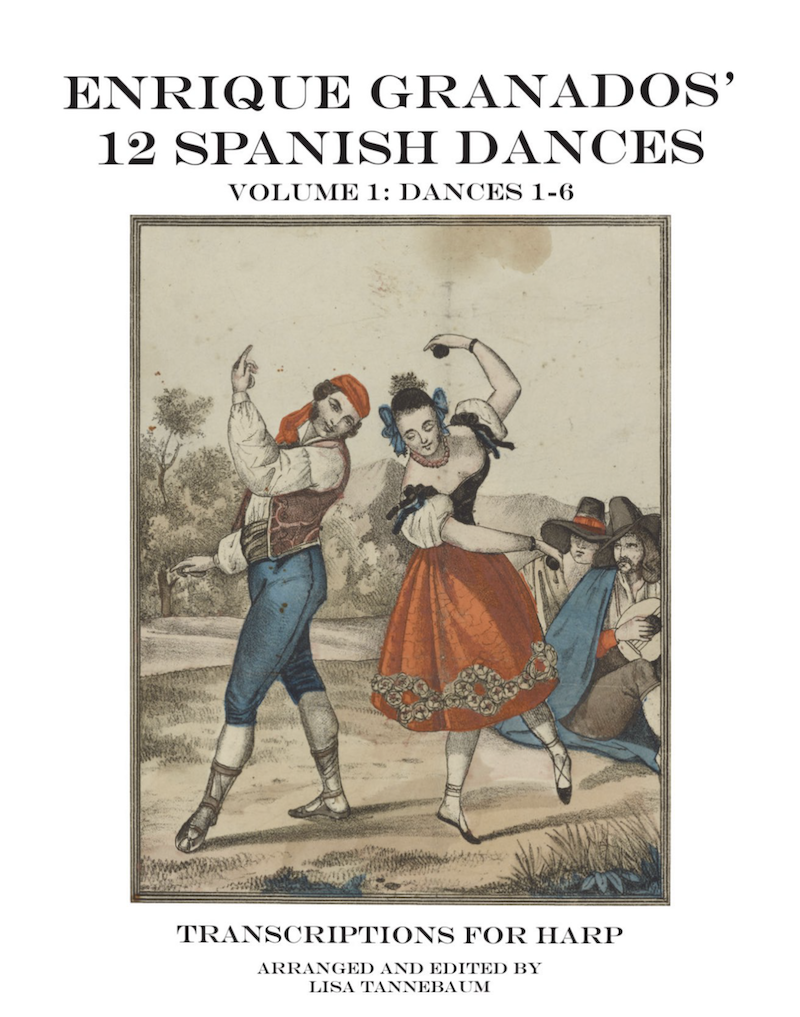
new collection Enrique
Granados’ 12 Spanish
Dances Vol. I includes
dances one through
six, transcribed in their
original keys.
Lisa Tannebaum was introduced to the music of Enrique Granados several years ago and fell in love with his 12 Spanish Dances. They were originally composed for the piano and believed to be written between 1892 and 1900. Tannebaum invested a great deal of time transcribing them for harp in the original keys to preserve Granados’ “musical prose and authenticity.” Her goal is to see these pieces added to the standard harp repertoire, and she is publishing them in two volumes. Enrique Granados’ 12 Spanish Dances, Vol. I includes dances one through six and is available through the publisher, Trevcomusic.com. It is available as a PDF or a hard copy. The music is suitable for the intermediate to advanced pedal harpist. Volume II will contain dances seven through 12 and is currently in production.
Most of the pieces have a recurring theme or section that repeats. “Galante” begins in the key of G major in 3/4 time, and the theme repeats until it transitions to a section in G minor. It returns to G major and the original theme, with only slight alterations. It is approximately three minutes in length and includes etouffées, muffles, and staccato notes.
“Oriental” is in C minor and features a very busy left hand. There are some trills in the right hand, and the main theme is played first in the upper register and then in lower octaves. The music changes time signature for a middle section in a slow 6/8. It returns to the main theme in 3/4 to the end and is just shy of six minutes with repeats.
The spirited “Fandango” is in 3/4 and D major. It has a frequently recurring theme that slows to lento toward the end before accelerating to a final flourish played in octaves.
At approximately six minutes, “Villanesca” is the longest piece in the collection, and it is also one of the most appealing. The main theme is in 2/4 in G major with an occasional measure of four inserted. It requires the left hand to pluck a note above the right hand after playing a chord in the bass, simulating the ringing of a bell. The middle or “song and chorus” section is in 4/4 and G minor and requires some fast and frequent pedal changes.
The familiar “Andaluza” has a passionate, flamenco flavor, with the main theme suggesting the strumming of a guitar. The sweet middle section exudes an almost reflective mood.
“Rondalla Aragonesa” starts allegretto in 3/4 and ends in a scherzando dance in 2/4. It is playful and challenging to play clean and fast.
Tannebaum provides a glossary where she highlights the notation in a particular measure. For example, she uses diamond-shaped notes to indicate muffles to specific strings (see “Fandango”). Fingering is provided, and all pedal changes are notated in the middle of the staff. Pedal charts appear throughout the pieces. You can hear Tannebaum play each piece beautifully on YouTube.
Whether you are looking for some solo repertoire, groups of works, encores, material for students to study, or you simply like Spanish dances, there’s a lot to like in this book.
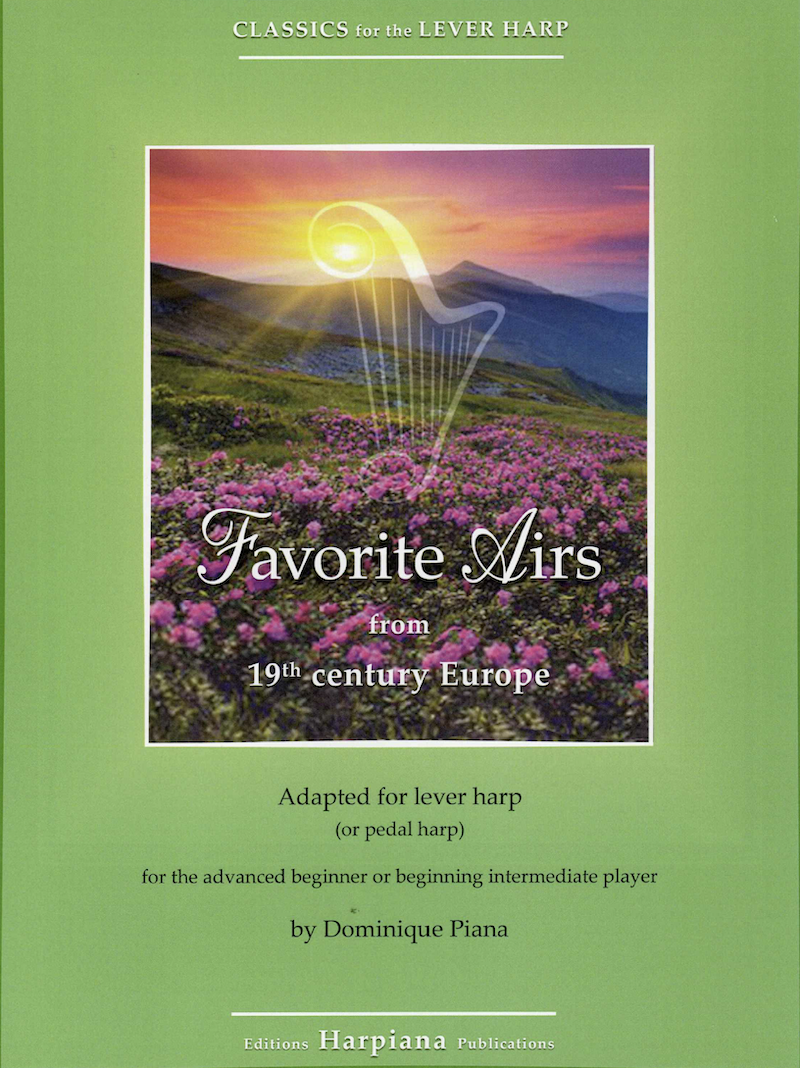
Dominique Piana spent her early years in Belgium, a multi-cultural country where the music she heard “sweetened the human condition” of the times. The music ingrained in her memory brings forth tender sentiments, and she has published a charming collection of Favorite Airs from 19th Century Europe (Editions Harpiana Publications). The arrangements are for the advanced beginner or early intermediate player of lever or pedal harp. There are 20 tunes in this compilation, and Piana includes a brief description of each one.
Only seven melodies don’t have any lever or pedal changes. Pedal changes are written below the staff. Lever changes are in the middle of the staff. Instead of using diamond-shaped notes for lever changes, Piana uses the more outdated method of indicating the note, accidental, and octave (e.g., C#4). It works, but adopting the more modern notation is preferable. Ideally, lever harps would be tuned to B-flat to accommodate the lever changes, as there are A-sharps in “Wiegenlied” (Lullaby),“The Last Rose of the Summer” (a.k.a. “The Groves of Blarney”), and “Heidenröslein” (Little Rose on the Heath). It is suggested to simply omit the A-sharp in the latter tune.
All the selections are just one page long except for “Herdegossen” (The Shepherd Boy). There is one pre-set lever that doesn’t need to be moved while playing in “Believe Me, If All Those Endearing Young Charms.”
The music gets a little more difficult for the last few pieces, incorporating larger, rolled chords, trills and other ornamentation, and more octaves. “Der gute Kamerad” (The Good Comrade) has harmonics and prés de la table as special effects. Most fingering is included. A couple of pieces have circled notes to indicate enharmonic substitutions. The typesetting is large and easy to read and printed on ivory paper. You can hear all the selections on Piana’s Harpiana YouTube channel.
Perhaps these pieces will provide some lever harp repertoire, music for students to learn or play as early recital pieces, and even preserve a little slice of European musical history. •