
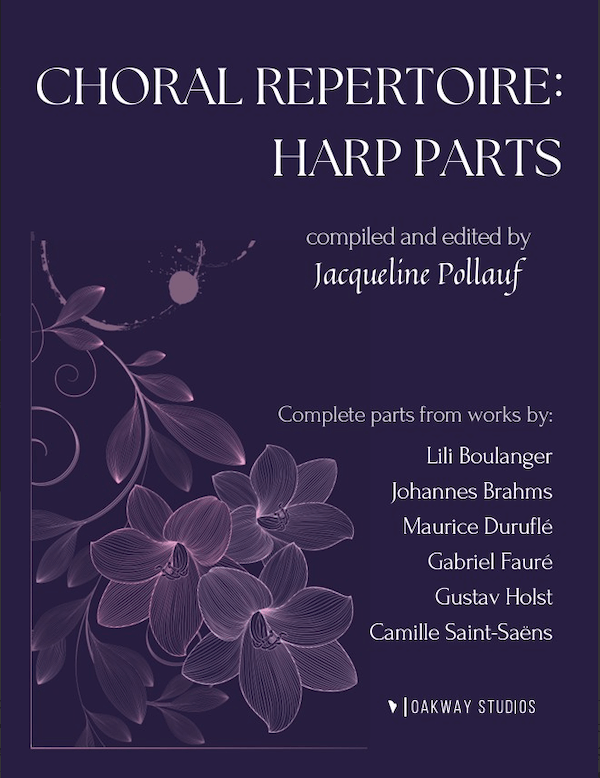
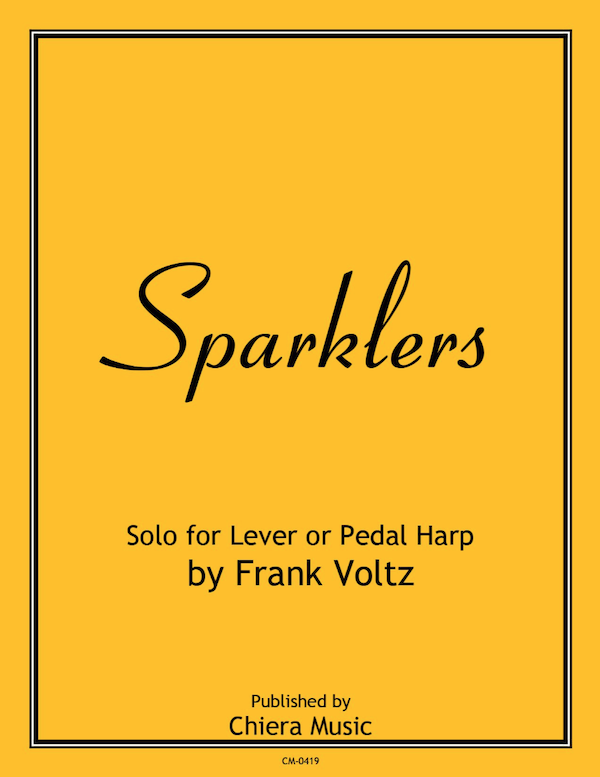
Left: Jacqueline Pollauf’s collection Choral Repertoire: Harp Parts is a “must-have addition to your library.” Right: Frank Voltz’s Sparklers is an homage to the classic Nancy Gustavson collection of the same name.
Any harpist who accompanies choral works will be interested in a recent publication from Oakway Studios. Choral Repertoire: Harp Parts is a valuable resource of harp parts from seven choral works. It was compiled and edited by Jacqueline Pollauf and contains six standard choral pieces and Pollauf’s transcription of a piece by Lili Boulanger. The harp plays an important role in each of these works, and is sometimes the only accompanying instrument. Let’s take a closer look at what is included.
The first selection is Pollauf’s transcription of the gorgeous Soleils de Septembre (Suns of September) by Lili Boulanger. She includes both the score and harp part. You can hear this lovely piece on Pollauf’s YouTube video. Her transcription includes some optional xylophonic effects in the right hand while playing octaves in the left hand. In the introduction, she explains how she cleverly executes this effect with one hand.
Next is Ein Deutsches Requiem, op. 45 (A German Requiem) by Johannes Brahms. Even though Brahms used harp in just three of the seven movements, the role of the harp is very important, and he preferred the use of two harps playing in unison.
Vier Gesänge, op. 17 (Four Songs) is the second Brahms selection in the book, and the harp plays in all four movements. To eliminate page turns in the third movement, Pollauf uses the maximum number of repeats.
French organist and composer Maurice Duruflé wrote three versions of his Requiem, op. 9, each with nine movements and various instrumentation. The harp is used in two versions: the full orchestra version and the chamber orchestra version. The amount of participation of the harp depends on which version, and Pollauf includes them both.
Pollauf also includes the beautiful and well-known Requiem, op. 48, by Gabriel Fauré. The harp plays in three of the seven movements. Fauré wrote two versions but there are many editions with slight variations. Pollauf’s harp part is meant to be as universal as possible.
Choral Hymns from the Rig Veda, op. 26, Group 3 is written by the English composer Gustav Holst. He published several sets of hymns during a period when he was influenced by sacred Indian literature, and he labeled them in groups. Group 3 is the only one that included harp.
The final selection in Pollauf’s book is Oratorio de Noël, op. 12 (Christmas Oratorio) from the French composer Camille Saint-Saëns. Of the 10 movements, the harp plays in three.
The page turns were painstakingly planned in this spiral-bound volume. However, some are still challenging and Pollauf offers suggestions and alternatives. Each part has been re-notated (not simplified or altered) with modern notation, pedal markings, suggested fingerings, enharmonic equivalents, and more. Pollauf includes an introduction with facts and background about the music and the composer. Performance notes are also included with each piece. Her use of cue staffs is immensely helpful. The thoughtful typesetting and layout, useful rehearsal markings, frequent cues, helpful fingering and hand distribution suggestions, and much more make this a must-have addition to your library. It is available in print or digital, and you can find the PDF version on harpcolumnmusic.com.
Even if you only play one of these works, you will likely play the part with more assurance and enjoy the entire experience more thoroughly with the information gleaned from this book. Whether you are a seasoned performer of choral works or a novice playing one of them for the first time, you will find Jacqueline Pollauf’s book of harp parts a valuable reference.
Most harpists are probably familiar with Nancy Gustavson’s brilliant collection of glissando pieces for pedal harp. Just in case you’re not, let’s quickly review. Sparklers is a book of five original tunes by Gustavson written and published more than 50 years ago. Her intent was to provide repertoire to help her students with specific issues. If you haven’t used this very delightful collection, check it out!
One of the selections in Sparklers, “Great Day,” became a popular ensemble piece for pedal harps played in unison. Eventually, Stanley Guy wrote a wonderful second harp part to “Great Day” for lever harp (reviewed in the March/April 2014 issue of Harp Column.)
Now, Frank Voltz (Chiera Music) has written and published a new solo for lever or pedal harp called Sparklers as an homage to Gustavson. He wanted it to be reminiscent of the style of her pedal harp pieces, but also playable on lever harp. He has, indeed, achieved that.
There are no lever or pedal changes throughout the four-page piece. It assumes lever harps are tuned to E-flat. Then, just pre-set all the levers as indicated and you’re ready to start glissing! There is a pedal chart provided as well.
There are a few performance notes at the end of the piece. Some fingering is included as well as what hand to use for some of the glisses. The single page turn is manageable and the typesetting is easy to read. The music is suitable for the lower intermediate player and is available in PDF or print versions.
It is rare to have a piece for lever harp with glisses that aren’t scale glisses or that require one hand to muffle while the other hand plays a limited range gliss. Sparklers is a fun and appealing addition to lever harp repertoire. •