

Organization is not about finding the perfect bin, box, or bag. It is about creating systems that work for you so you can quickly access what is in your physical and digital storage when you need it.
I love organizing! Who doesn’t love those aesthetically-pleasing organizing videos with their visually tidy rainbow colored products in clear acrylic bins? I’m an original fan of the Container Store, color coding, and creating organizational systems! The short videos and the organization aisles at your favorite stores are actually selling you the illusion of calm and control. While a good container is helpful for organizing, what is essential is the system that container helps you implement.
Creating effective organizational systems ensures having quick access to what you need when you need it. What makes sense for one person’s brain, may not work for you. We spoke with harpists about how they organize different aspects of their harp life. Candace Lark, a Philadelphia-area harpist shares, “I struggle with ADD, and I’ve learned organization, consolidation, and convenience are imperative to my career. If something has too many steps, and too many pieces all over the place, my stamina takes a hit. I become overwhelmed, and I lose focus.” We’ve all been thwarted by a lack of organization, so let’s dive into ten ways to organize your harp life for efficiency and convenience!
1A: Print Music



Meet the contributors: (top to bottom ) Emily Levin, Candace Lark, and Angela Schwarzkopf
I had an analog childhood and a digital adulthood, and my harp music collection did too! I use both physical originals and digital music on my iPad every day. So how do you store, and just as importantly, find the music you want to play?
Toronto harpist Angela Schwarzkopf suggests, “The key to organizing your physical music is to find a system that is intuitive and easy for you to use. My organizational system may not make the most sense to others but is clear to me and I can find what I need in seconds.”
Schwarzkopf organizes her music in magazine file holders, using lots of categories such as:
- Technique books
- Beginner harp books
- Royal Conservatory of Music (in Canada RCM) repertoire organized by level
- Music by Tournier
- Music by a single composer (e.g. Salzedo)
- Holiday music
- Popular music
- Music for weddings
- Collections by genres (e.g. Irish music)
- Theory books
- Ear training books
- Orchestral music
- Oversized scores
Schwarzkopf admits, “There is music that overlaps in categories but I file items where I would go to look for them the most. For example, if a book has music that is intermediate level and also has wedding music in it, I would likely grab it first for teaching so I would put it in the intermediate folder.”
Emily Levin, a harpist in Dallas, Texas, designed and built her own storage solution. “After many years of vague daydreaming, and about six months of concentrated planning, I finally built a custom music cabinet for storing my music. The design was inspired by the apothecary and printmaker cabinets, and the dimensions are fitted for music and odd score sizes.”
Levin also organizes her music using broader categories such as: Solos, Chamber (both subdivided into A-G, H-P, R-Z), Orchestra, Concerti and Ensemble. If you don’t want to take up woodworking as a hobby, Levin suggests magazine holders as another good option. She notes that adding peel-and-stick wallpaper to the outside can make the utilitarian boxes aesthetically pleasing. For oversized music like orchestra parts, Emily has previously used decorative boxes from craft stores. Emily also suggests map drawers, and tall bookshelves for storing oversized music.
Less decorative than Schwarzkopf’s shelves or Levin’s custom cabinet, legal sized file drawers are also a great way to store and organize physical music. I keep music in legal file folders organized by broad genre/category (solos, harp ensemble, chamber music, etc.), then alphabetically by composer. I also include additional visual cues on the label beyond the usual composer/arranger, and title. Wedding music has a blue sticker, holiday music a red sticker, harp ensemble includes the number of parts in a circle. If the music is on a graded repertoire or competition list, sometimes I’ll include the level on the label.
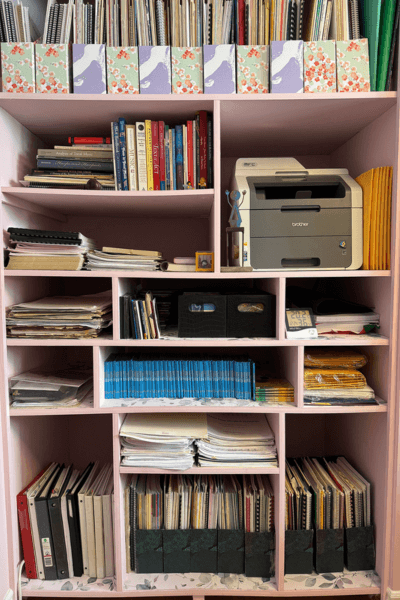
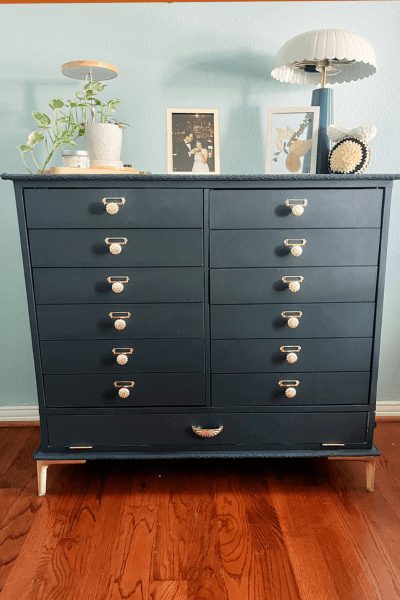
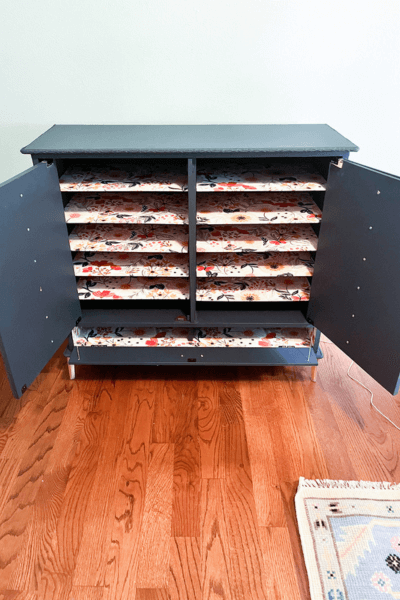
Left: “In my music room, the closet was turned into shelves which has worked perfectly for my system and allows room for my printer/copier, CDs, and music books,” says Angela Schwarzkopf. Center and right: Emily Levin designed and built her own music storage to accommodate both standard and oversized scores.
1B: Digital Music
For digital music, find a cloud storage system such as Dropbox, iCloud, Google Drive, One Drive, Box, etc. When choosing a cloud storage system be sure you can access files from all your devices, and choose one that easily integrates with your sheet music app on your tablet. Just like my filing cabinet, I use Dropbox folders organized by genre then subfolders with composers organized alphabetically. Create categories and folders that match how your brain thinks. For example, I often add a Christmas & Holidays subfolder within a genre/category as well.
For iPad users, forScore is a favorite app to organize music due to numerous capabilities for annotation, cropping, rearranging pages, and folder and set list organization, as well as the ease of importing music from many cloud storage services. Android tablet users often recommend MobileSheetsPro. These apps allow you to find music quickly using the search tool, create setlists to organize pieces, and export music with your annotated markings (to back up your markings in your cloud storage). In forScore I have a weddings folder that contains setlists for each particular client’s ceremony as well as prelude and postlude setlists. Check out the article “Making the Switch” from the January/February 2018 issue and “Going Digital” from the January/February 2015 issue of Harp Column for some great tips for using forScore. In addition, YouTube has some helpful videos on how to use either app.
One of the cleverest tips about music organization comes from Delaine Leonard, a professional harpist based in Charlotte, N.C. She keeps her notes from masterclasses and copies of scholarly articles about a piece with the music. The American Harp Journal published an article by Sara Cutler in the Summer 2019 issue about the performance practice by various ballet companies of Tchaikovsky cadenzas, and I keep a PDF of that article with my Tchaikovsky cadenzas folder in Dropbox. Organizing your music takes time, but it is worth the effort when you can find the piece you are looking for quickly.
2: Practice Space
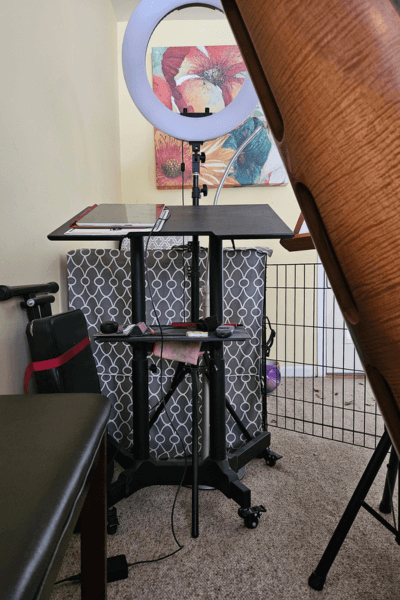
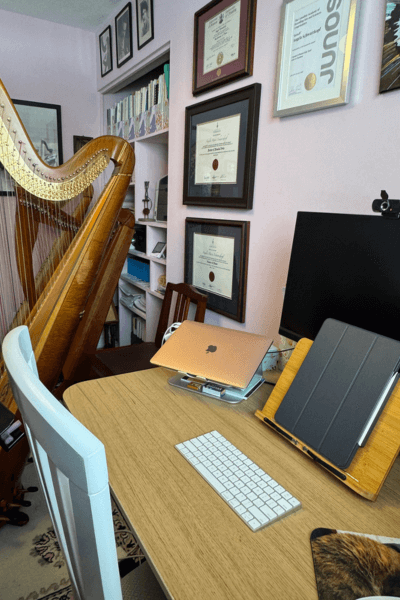
Left: Lark uses a mobile conference podium next to her harp. Right:Angela Schwarzkopf designed her desk setup to have everything she needs within arm’s reach.
Whether your practice space is a corner in your living room, shared with your home office, or a dedicated area just for music, how you organize the space can boost your practice productivity. Candace Lark, whom we met back in the intro says she has learned that as her music life changes, so does her practice space. “Don’t feel bad about not figuring it all out; once you do, it will need to change again, and that’s okay.”
Schwarzkopf’s office is also her practice and teaching space. “It was important for me to create a space that was organized, fun, and allowed me to work in the most ergonomic way.” Keeping your practice space clean, organized, and tidy can be a challenge. Lark says she uses a mobile conference podium (pictured below) next to her harp. “[It] houses my rotating practice pile, my laptop for recording and Zoom lessons, my coffee, and accessories.”
Schwarzkopf employed similar “arm’s reach” strategy when she designed her desk setup. “I have a monitor in addition to my laptop screen, a separate keyboard and mouse, and a stand for my iPad. I also have a cat bed attached to it so my cats can come up and hang out with me while I work.” Schwarzkopf’s desk adjusts for sitting or standing. “This allows me to attend meetings, catch up on emails, or teach online with ease. I can also sit at my desk and type notes while teaching in person as the harp is right next to me.”
3: Recordings
Have the ever-changing media formats of vinyl records, cassette tapes, CDs, mp3s, and streaming services over the last 50 years caused chaos in your recording collection? Sometimes an essential part of organizing is knowing when to say goodbye to things. If you no longer have the means to play that particular recording format, do you need to keep the recording? You don’t have to get rid of your prized autographed CDs or the recording that inspired you to become a harpist, but do take some time to think about how you regularly access recordings today. Just like with physical and digital sheet music, organizing your recordings library by genre and then alphabetically by artist works well.
With streaming services or digital recording libraries, try organizing by creating playlists like: currently practicing, arranging projects, and inspiration pieces. For repertoire you play on a regular basis, make a playlist for that particular piece with recordings by several artists such as a Fauré Requiem playlist, or a Nutcracker playlist. For orchestra or gig repertoire you have coming up, playlists can be organized by concert, semester, or year. Levin encourages, “If you are playing with an orchestra, it’s really important to allocate enough time for score studying, away from the harp, with multiple recordings as well as time at the harp.” It is also fun to see all the repertoire you worked on over the past years in your old playlists.
4: Financial Records
Organize your financial workflow by creating a folder structure that matches your harp business needs. A Harp Finances folder structure might include subfolders for Expense Receipts, Client Invoices, Contracts, Mileage Records, Tax Documents, and Financial Statements.
Use this folder structure on both your computer or cloud storage as well as in your email inbox. Remember you can scan any physical documents and store them digitally as well, or keep them in physical folders. File away emails with receipts for things like music, strings, instrument insurance, maintenance, etc., in the Expense Receipts email folder. Using folders in your email inbox keeps harp-related financial records separate from your personal finances, makes it easy to find information later, and keeps your inbox from feeling so overwhelming.
To ensure accurate record keeping, reconciling your financial records against a bookkeeping ledger is an important time- and money-saving step. A spreadsheet to track your income and expenses is a free option, and there are templates and YouTube tutorials to get you started. It takes only a moment to update this spreadsheet every time you file away an email receipt or make a deposit. If creating or maintaining a customizable spreadsheet seems too overwhelming, there are paid online bookkeeping software solutions like Quickbooks or Xero for small businesses. You will still need to reconcile bookkeeping software with your source documents and financial statements regularly.
Manage your time and energy by setting aside a designated bookkeeping time each day or week to reconcile things. This makes your life easier when it is time to work on taxes or invoice a client. You are much less likely to make mistakes if you are not in a hurry and can easily find the financial documents you need.
5: Gig Bag
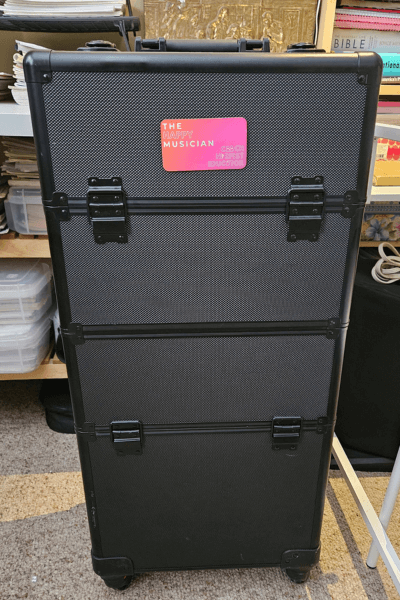
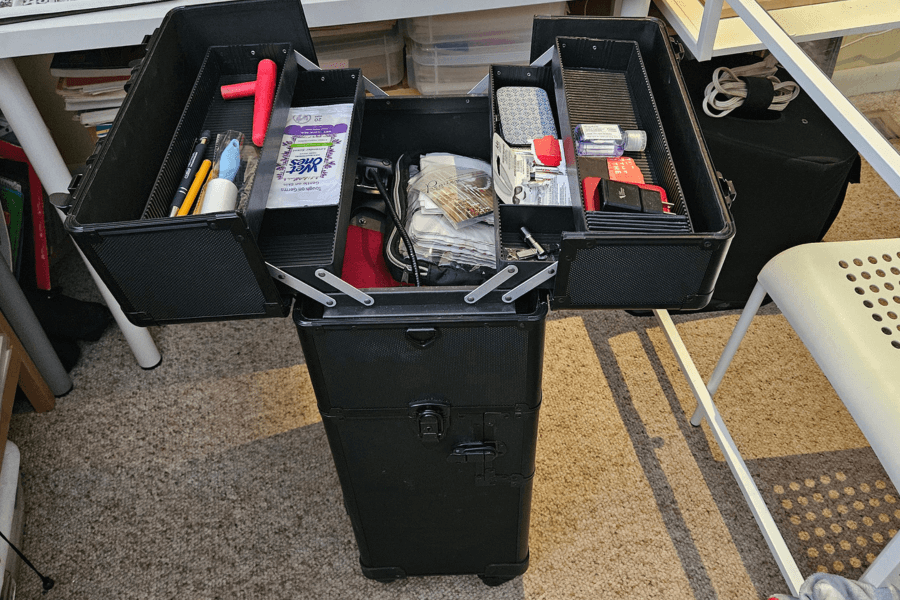
Candace Lark repurposed a rolling train case designed for cosmetic professionals as her rolling gig trunk.
Choose a gig bag that supports your needs, and organize it so you can find things. A professional looking backpack or messenger style bag might suit you best if you need something hands free and are not carrying tons of gear. Rolling briefcases or suitcases work well for heavier equipment if you don’t mind making a few more trips to and from the car.
Make a list of all the supplies that are important for you to have at gigs. Prioritize the non-negotiable, must-have supplies, and then if you have extra room consider the nice-to-have supplies. At the college where I teach, we bring the HARP kit (Help All be Ready to Perform) to harp ensemble performances. It contains emergency supplies such as a first aid kit, sewing kit, a dust cloth, nail clippers, extra hair accessories, etc. The HARP kit, in combination with the strings & tools bag, saves valuable time if we need to solve a problem at a rehearsal or performance. Organize smaller items in bags within the bag. Angela uses a pencil case within her gig bag to hold pencils, pens, highlighters, colored stickies, nail file, and glissando pics. Once you have your gear prioritized, then determine how best to transport everything.
Need to bring a lot of gear to gigs? Think outside the bag. Lark uses a repurposed rolling train case designed for cosmetic professionals as her rolling gig trunk. (See the photos to the left.) The spinner wheels and a collapsible handle make her gig trunk easy to roll around. The list of gear Lark transports in her gig trunk is as impressive as it is almost comprehensive. In addition to music, tuning supplies, strings, and other usual gig bag suspects, some of the more amazing items include: harp seat, shoes, mirror, purse, wireless fan, a thin carpet, and three sizes of door stops. Lark concedes her music stand rides on top, but a collapsible tablet stand could possibly fit in the gig trunk. “I can fit just about everything in it, even my seat, and it keeps my gig prep at a minimum.”
6: Strings
Most harpists benefit from storing spare strings in a portable bag or container. Angela keeps her strings in her gig bag, which, “has separate compartments for each octave making it easy to find strings.” Having a discreet string bag you keep next to the harp can save the day if you need to change a string quickly in rehearsal or during a performance.
Many harpists and technicians recommend storing spare strings in heavy-duty zip-top bags within your string bag or bin. On his website, harp technician Peter Wiley recommends using back-up strings only when a string breaks. “The back-ups will have already aged in storage no matter what you do,” he explains. To get the best sound, manufacturers and technicians typically recommend using fresh new strings if you are replacing entire octaves or your wire strings. Some harpists label the string packages with the month and year purchased, while others label packages with the date the string was replaced. Either system gives you a general idea of the string’s age.
7: Harp Maintenance
While on the topic of strings, organization all-stars keep maintenance records of the dates when they replace strings, dates of harp regulations with technician’s name, repair work completed and by whom, and notes about future repairs needed. You can keep these records in a small notebook or journal that stays with your strings. Or for the spreadsheet lovers, maintenance records can live in Excel, Numbers, or Google Sheets. These records help you make informed decisions about when to schedule an appointment with a technician and which strings need replacing prior to that appointment.
Since I maintain both personal and school harps, I keep a Google Sheet for each harp in a Harp Maintenance folder. Files are named with the harp make, model, and serial number; one page/tab is devoted to string replacement records, and another to the regulation and repair records. I can easily share maintenance records with other people who regularly replace strings on that harp. In-a-hurry-hack: If I replace a string and don’t have time to update the string log, I’ll snap a photo with my phone of the string package next to the harp’s serial number, and set a calendar reminder to log the string replacement later.
Even simple harp maintenance can be intimidating. Being organized can help relieve some of that stress. Having a box or bin to store tools like lever regulation tools, extra wire cutters, Allen wrenches, a screwdriver, abrasive cord, cleaning cloths and supplies, brushes for dusting the mechanism, and assorted spare parts can save time and boost confidence when changing those wire strings or fixing a loose foot.
8: Performance Calendar
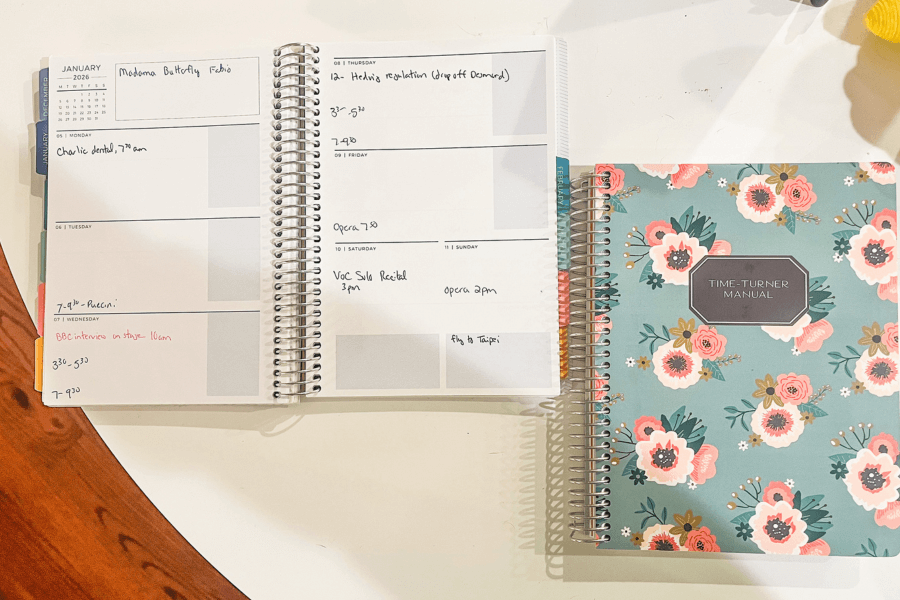
“Your calendar should bring you joy,” says Emily Levin.
An organized calendar system can do much more than schedule rehearsals, lessons, and gigs. Calendars can lighten your mental load and help you make informed decisions about managing your time. Think about what you need from a calendar platform and decide if a digital or paper calendar works best for you.
Levin says your calendar should bring you joy. She strongly advocates for a paper calendar and took the time to create a customized calendar using Plum Paper so it fits exactly what she needs. “My calendar shows a month view, has a two-page weekly view with enough room to write all commitments in daily, as well as multiple pages for keeping track of expenses, performances fees, birthdays and more. Because I am in an orchestra, I create my calendar by season, so my year goes June–May.”
Color code calendar entries by location or event type, so you can tell at a glance what kind of day or week to expect. If remembering to do something in the future gives you anxiety now, automate a reminder for it in your digital calendar or use a Post-It on your physical calendar. Reminders help save mental load capacity for other things.
Lark uses her calendar to make informed decisions about her time and “follow a nutritional artistic diet.” She carefully chooses to accept “performances and gigs that sustain me financially, mentally, emotionally, and artistically. I’ve burned out twice, and learned the hard way how important a nutritional diet of artistic experiences is for me. When I need to say no, instead of FOMO, I’m happy that another harpist gets an opportunity.”
Just because something fits in your schedule does not mean that it is a good idea to say yes. Lark encourages harpists to “set a realistic and flexible practice schedule and give yourself permission to be selective with your performance opportunities.” She recommends looking at the music before committing to a gig. “I always purchase my own harp part whenever possible, so if I don’t already have the music or I can’t secure music for certain gigs, I will pass that gig on to someone else.”
9: practice scheduling and journaling
Speaking of practice, scheduling your practice time in the calendar creates a practice routine that will keep you on track when life gets busy. Lark uses overlapping blocks of time for practicing different repertoire. “If I need to spend extra time on something, I can without getting stressed about getting off schedule.”
To prepare for her busy solo and chamber music performance calendar, Levin uses a quarterly system for organizing and planning her practice. “As a general rule, I work in two phases: six months in advance, and three months in advance.” Levin assesses the repertoire she needs to learn about six months in advance. “Some pieces take longer than others, and going through the music and deciding what will take the most time keeps me from encountering any nasty surprises. Most of the time, unless it’s a really hard solo program, I will be working about three months ahead of schedule.” That means in January Levin practices repertoire for March, April, and May, so she can have the music “performance-ready a month before. This gives me time to practice play-throughs, explore open-ended musical ideas, and refine hard technical passages.”
When Levin is preparing an orchestral piece she has played before, she will reserve the week before rehearsals to begin practicing and listening. “Listening by far takes the most time,” she says, “so I know that this week will have long hours.” For new orchestral repertoire, Levin’s process starts a month before, giving her time to break up the listening sessions. “This is extremely time-consuming, but non-negotiable to doing your job at a high level.”
Once you have your practice time scheduled, set yourself up for a successful practice session. Lark suggests, “I’ve learned to prep my stand before I go to bed with the pieces I plan to practice the next day. If I need to search for my music, I’ll get distracted…and lose track of time. My ADD brain requires consolidation, organization, and convenience to be productive.” Create practice routines, schedules, and systems that support your brain, your time, and your goals.
Logging your daily practice and tracking short- and long-term goals ensures you will be ready for performances. Research shows that physically writing down notes and goals helps our brains remember and process them more effectively. All of my college harp students are required to keep a practice journal because, when used properly, practice journals help us stay on top of our goals, track progress, and make practice time more efficient and effective.
You can use an inexpensive notebook (blank, lined, or graph paper), customize your own, or purchase a practice planner. The Musician’s Practice Planner by Molto Music uses a two-page format for setting weekly goals and logging daily practice. The Purpose in Practice Journal by Rachel Lee Hall offers 26 weeks of daily practice tracking pages, weekly goals, and pages for lesson notes or journaling about the week. The Practizma Practice Journal by Susanna Klein offers 16 weeks of guided goals pages, action challenges, reflective prompts, and practice log pages for each week. In addition to her calendar, Levin uses a “projects notebook” where she keeps track of all her concerts and repertoire, organized by genre. “It is really helpful to open a page and see all the music I have to learn.”
10. Inspiration
Regularly exploring music and art for ideas and inspiration nurtures our creative process, but how do we reference this inspiration later?Quickly record and organize new musical composition ideas using the audio recordings feature in a note taking app like Evernote, Notes, or Voice Memos. Give these files descriptive names so you can find it later. Keep a playlist for recordings and a folder with sheet music of pieces you want to arrange. Follow artists you love on streaming services and save inspiring performances to playlists. When creativity and time align, you can pick up where you left your artistic endeavors.
Organization is not about finding the perfect bin, box, or bag. It is about creating systems that work for you so you can quickly access what is in your physical and digital storage when you need it. Design your systems for the life you live today, customize solutions that make sense to you, and reap the benefits of an intuitively organized harp life. •