

Ed. note: jump to the end of this article for the author’s Simple Chair Yoga For Harpists.
seva (noun)
The practice of selfless service—offering one’s work for the benefit of others without expectation of reward or recognition.
For a long time, I struggled tremendously with anxiety as a musician. The cause of my anxiety? Imposter syndrome and self-doubt. What would others think of my playing? Would my students trust me? Was I good? Was I only good enough? The questions never ended, and the constant mental chatter dramatically diminished the joy I felt as a teacher, performer, and musician.
If this sounds all too familiar and you too find yourself struggling to find joy in all aspects of being a musician, I am here to pitch an alternative approach—a mindset you might not have considered as a musician.
The concept of seva—selfless service—was one of my earliest lessons in yoga teacher training, and it transformed who I was as an artist, teacher, and performer. Seva is the altruistic practice of selfless action, offering help without expectation of reward or recognition. It is a form of karma yoga (the yoga of action) that fosters love, compassion, and unity while breaking down the ego. As musicians, it is easy to become egocentric and ego-informed because most of our preparation and performances revolve around acceptance by our teachers, peers, audition panel, etc. By incorporating seva mentality into your work as an artist, my hope is that you not only rediscover your love for the instrument, but also share that joy with others.
Daily reminders
Here are some questions you can ask yourself to practice selfless service
every day.
In teaching:
- What does this student need today?
- What are this student’s goals?
- Is this student struggling mentally or emotionally, and do I need to take
that into account?
In performance:
- Who is my audience?
- Who am I serving?
- What does this audience need?
- Can I find a more personal, intentional mantra to reduce my heightened performance anxiety?
In practice:
- Where am I holding tension in my body today?
- What does my body need right now?
Being of service as a teacher
When I first began teaching, I still felt like a student myself. Would my students trust me? What would be the best music for them? What will people think of me if my students don’t perform well? These ego-centric questions drove the imposter syndrome that made it difficult for me to show up in the way that I wanted to for my students. Incorporating the seva mindset allowed me to escape my own self-doubt, and re-prioritize my students. Here are some tips to help you do the same.
Tip #1: Put your students and their needs first
Being of service to your students means helping them reach their goals and work to achieve their highest musical selves. Teaching to feed your own ego is not service-minded. This service-orientation requires you to get to know your students, their goals, their personalities, their interests, and the most effective ways in which they learn. A check-in at the beginning of each lesson is a great place to start. If a student is struggling mentally or emotionally, knowing about their current head space will help inform how you lead that lesson.
It is easy to assume that our students have the same goals that we did as young harpists. To be of service to your student, it is important to learn about your students’ personal goals. Are they seeking to have a career in music, or is playing the harp a hobby? Are they interested in playing classical music, pop, jazz, folk? The answers to these questions will inform how you teach and motivate them, as well as how you set your musical expectations for the lesson. Their aspirations may change over time (and their aspirations may not be the same as your hopes for them), but being connected to your students will help bring awareness to those goals, and ultimately create lifelong bonds with your students.
Here are some simple and effective questions to ask a student:
- How are you feeling this week?
- How is your mom, dad, sibling, partner, etc.?
- How did practicing go this week?
- Do you have any specific goals for this piece?
- Would you like to perform this piece?
- How can I be most helpful to you in your preparation this week?
Tip #2: Focus on technique early
This tip may seem obvious. The early focus on technique is about longevity and being of service to one’s body as their instrument. When accepting a student early on in their studies, we must focus on etudes and technical exercises as the primary goal before diving into real repertoire. Building a strong technical foundation will help them thrive later on, no matter what direction they take with the harp. The service-minded goal as their teacher is to help your students have technical ease at their instrument so the music naturally flows. By establishing this technical foundation, your student will be better equipped to approach any piece with confidence and will be more likely to avoid injury throughout their career. Guiding students to a durable and healthy technical foundation is one of the best ways we can be of service to our students. It will help them avoid persistent pain and musical roadblocks down the road.
Here are some of my favorite etude books for technical work early on with students:
- Exercises for Agility and Speed by Deborah Friou
- 40 Études faciles et élémentaires, Op.318 by Nicholas Charles Bochsa (my personal favorite)
- Method for the Harp by Maria Grossi
- Studies of Moderate Difficulty by Ettore Pozzoli
Find your favorites and use them at the beginning of each lesson. You will not regret it, and your students will learn to trust their fingers!
Tip #3: Lead with non-judgment
This tip may not seem intuitive from a teacher’s role. While it is our job as teachers to provide feedback, and to sometimes be firm with our guidance, it is also our job to nourish a student’s spirit and individuality. Once you’ve provided them with the technical basics, musical markings, fingerings, dynamics, etc., I truly believe that a teacher’s role is not about being the ultimate authority and judge, but is about guidance and mentorship.
There is a big difference between feedback and criticism. Criticism is usually problem-focused, whereas feedback is solution-focused. I remember beginning piano lessons when I was 5 years old and—confession time—I did not practice. My teacher used the critical response, enforcing the importance of practicing and assuming I did not care because I did not practice. The truth was, I didn’t understand how to effectively practice at that age. A feedback teaching response could have been to ask how I practice, and to empower me with practice skills and tools that I could use at home.
Here are a couple more examples of common criticisms and how we can easily reframe them as feedback:
Criticism: Your interpretation of this piece is in completely the wrong style.
Feedback: It was interesting to hear your interpretation—I have never heard it this way! Do you know the time period of when this piece was written, and the artist’s intention? How about the dynamic markings? Let’s take a peek together to really be true to the style and intention of this piece.
Criticism: Every time you learn a piece it is too fast for your fingers and you are unable to get through it.
Feedback: It seems like we often start our music at a tempo that is too fast for our fingers and we are playing “catch up.” Do you use your metronome when beginning a piece? What tempo do you usually set it at? Starting at the listed tempo often isn’t possible right when we are learning, so let’s work up to it and create a tempo range so that our current tempo is sustainable, and that fast tempo becomes our goal over time.
We are not here to break our student’s spirit through judgment, but to feed their creativity and inspire them. I find that using inclusive language (let’s, we, or us) in your feedback, helps a student to not feel as though they are approaching a problem alone or that there is something “wrong with them.” By approaching lessons with non-judgment and providing feedback rather than criticism, we can give our students the freedom to learn and grow in environments that are productive and enriching, as opposed to environments that are high-stakes and intimidating.
Being of service as a performer
After many years of performing, I would be lying if I said I didn’t get nervous almost every time I walked on stage. What leads to these nerves? Ego. Thoughts like: What if I mess up? What if I move the wrong pedals? What if I play the wrong notes? What if the audience thinks I am not good enough? What if I blank out?
Musicians are often fueled by their egos and allow their egos to drive their motivations as performers. As musicians, we often believe that “perfect performances” are what audiences are looking for. We can have the unfortunate belief that audiences are just attending a concert to see “how good we are” at our instrument. We may feel that we have something to prove to our peers, family, or teachers. While these thoughts are completely human and natural, they can sap joy out of a performance that would otherwise move, touch, and transform your audience. These negative thoughts also may lead us to lose that spark of why we became musicians in the first place. The essence of seva work is acting without attachment to results or personal gain, and essentially eliminating those unproductive questions entirely. Here are some tips on how to practice seva work as a performer, and how to let go of the downhill mental glissando.
Tip #1: Follow heart-centered motivation rather than ego-driven choices
Heart-centered service work brings us back to why we became musicians and artists in the first place—it was not an ego-driven obsession. If you’ve strayed too far from why you love to play the harp, planning a community event—a performance where you are not at the center—will feed the musical souls of both you and your audience. These events can include playing at libraries or schools, performing at nursing homes or fundraisers, creating a music festival, or collaborating with wellness spaces like yoga studios.
Trust me, this may be the most valuable and creative work you will ever do. It’s not always the high-prestige Carnegie Hall performances that fulfill you artistically. I’ve done those too, but I have found that the most rewarding, selfless, heart-opening work comes from community building. Being of service as a performer requires a heart-centered motivation that gives back to your audience and community.
Tip #2: Use the power of mantras
When we are performing, it is easy to get caught up in the toxic mental chatter. Mantras provide the alternatives to these negative thoughts. A mantra is defined as “a thought behind speech or action.” Some examples of mantras are: I am enough, This too shall pass, etc. The key with any mantra is that you truly believe it. For me, the mantra “I am enough” still doesn’t land when my anxiety is high before I go on stage. So I have created my own mantras that work for me. Some of my favorites are: “progress rather than perfection” and “you’ve done the work.” This puts the focus more on the process and effort, rather than the outcome, and helps me remain in the moment on stage. This focus on progress truly follows the essence of seva, removing any egoic attachment to results. I highly recommend developing some mantras of your own so that when nerves creep up on you during a performance, your mantra is there to block the negativity. You may need to try on a few mantras before you find the perfect fit, but they are worth it. Once you find your mantra, here’s how to make it a part of your practice:
Steps for a five-minute seva performance visualization using mantra:
- Close your eyes and imagine yourself on stage.
- Feel the lights upon you, the audience watching you, your performance gown, and you may begin to feel your heart pound.
- Take a deep breath in, and begin to tell yourself your mantra internally, and then release a long exhale.
- Inhale: mantra, exhale, then pause. Repeat this at least 5x until you feel your heart rate begin to slow.
During your run-throughs the week prior to your big performance, take this extra time before starting and repeat this visualization, breath work, and mantra. This will help the skill become more natural so that when your nerves kick in, you are able to return to your breath and your mantra. Just like we practice our music for a performance, the skills we use to manage performance anxiety need to be practiced as well.
Being of service as an artist
Tip #1: Take care of yourself so you can care for others
True service comes from a place of love, rather than obligation. To effectively serve others, you must first take care of your own needs. Self-care of your body and your mind is its own form of service. What would our practice sessions look like if we treated our bodies as well as our instruments? Think about how our breath works: we are unable to exhale unless we inhale, proof that we need to feed ourselves to be able to give back.
As harpists, we tend to hold tension in our neck, wrists, shoulders, and hips. I have developed a focus on chair yoga before playing. These short postures will help you release tension before you play, and it is important to continue this mindful movement before you perform as well. Our self-care work in the practice room shouldn’t stop before a nerve-wracking performance. I have included a few step-by-step practices in the sidebar on the opposite page. Before you know it, these practices will become a natural part of your daily routine and musical preparation.
Tip #2: Practice mindfulness
After many years of playing your instrument, it is easy for practice sessions to feel routine. To keep your practice sessions fresh, I highly recommend mindful journaling. After each practice session, notate what you practiced, what stretches/poses you find most effective, what you accomplished, and what you want to focus on tomorrow. This regimen keeps us both in the present moment and goal-oriented for the future. Even after just a few of those journaling sessions, you may realize what time of the day works best for you to practice, where you hold tension, and ultimately how to have a much more focused practice session just getting to check off things on your practice agenda.
Practicing mindfulness doesn’t have to be complicated. Here’s a basic mindful practice journal entry example:
- Date:
- Time:
- Length of practice session:
- Stretches incorporated today:
- Accomplished during practice session:
- Objectives for next practice session:
Simply recording these details each time you sit down at the harp can help you develop mindfulness into your practice.
Selfless service is a practice—one that requires intention, consistency, and patience. I would be lying if I said it comes naturally and without effort. It is something I return to each day, actively working to embody until it becomes more instinctive. As musicians, we already understand the value of practice, and this is simply an extension of that same mindset into how we teach, perform, and care for ourselves. In the spirit of service, I hope that you can carry some of these ideas into your own musical world, shaping a more mindful, connected, and compassionate approach to your artistry. •
Simple Chair Yoga For Harpists
As a 500-hour registered yoga teacher, I have taken the tools that I learned from my yoga practice to the practice room. In an effort to avoid injury, turn to these effective poses and stretches before practicing and performing.
Yoga for your shoulders
All of these postures can be practiced on your bench, if you choose.
- Take a deep breath in through the nose, and a long breath out of the mouth.
- Draw some gentle neck circles clockwise and counterclockwise.
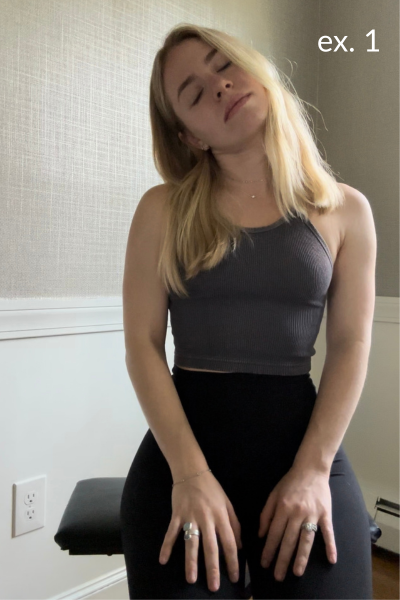
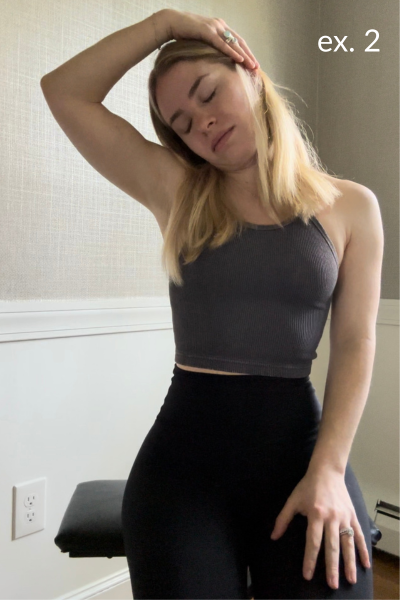
- Drop your right ear towards your right shoulder. Tuck your chin in towards your chest, and place your right palm on your left shoulder to add some weight. Option to place your right palm on your left ear for additional weight. (See ex. 1–2)
- Drop your left ear towards your left shoulder. Tuck your chin in towards your chest, and place your left palm on your right shoulder to add some weight. Option to place your left palm on your right ear for additional weight.
- Inhale: squeeze and lift your shoulders up to your ears. Exhale: allow them to drop down dramatically. Repeat as many times as needed.
- Seated cat/cows:
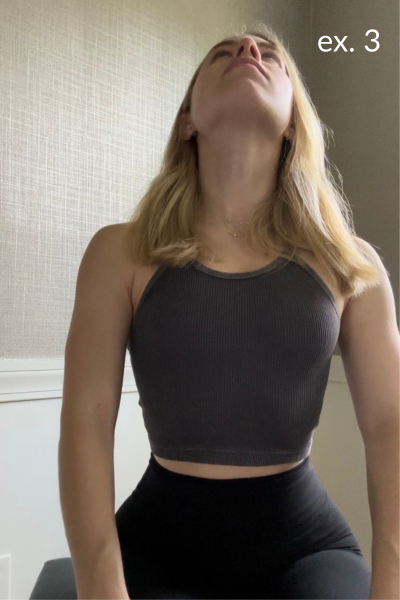
Inhale to seated cow: placing your palms on your knees, press and arch your heart forward lifting your chin and chest. Feel your shoulder blades squeeze towards each other. (See ex. 3)
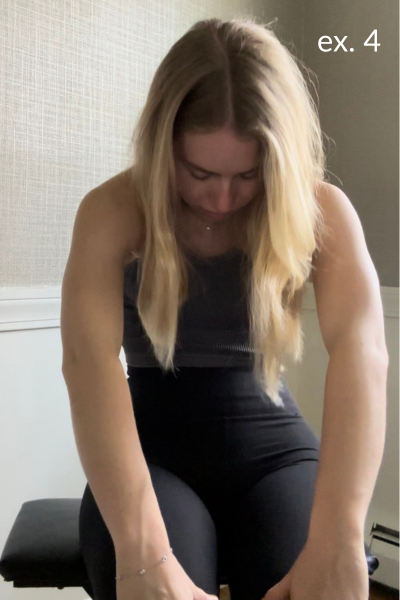
Exhale to seated cat: Tuck your chin into your chest, rounding your spine, releasing the shoulder blades from each other. (See ex. 4) - Inhale: sweep your fingertips up towards the ceiling (i.e. extended mountain pose). Exhale: lower your fingertips back to your lap.
For more information on the mindfulness work that I focus on before practicing, check out my book The Musician’s Guide to Mindful Practice: The Journal.