

Download this issue to get this tune now!
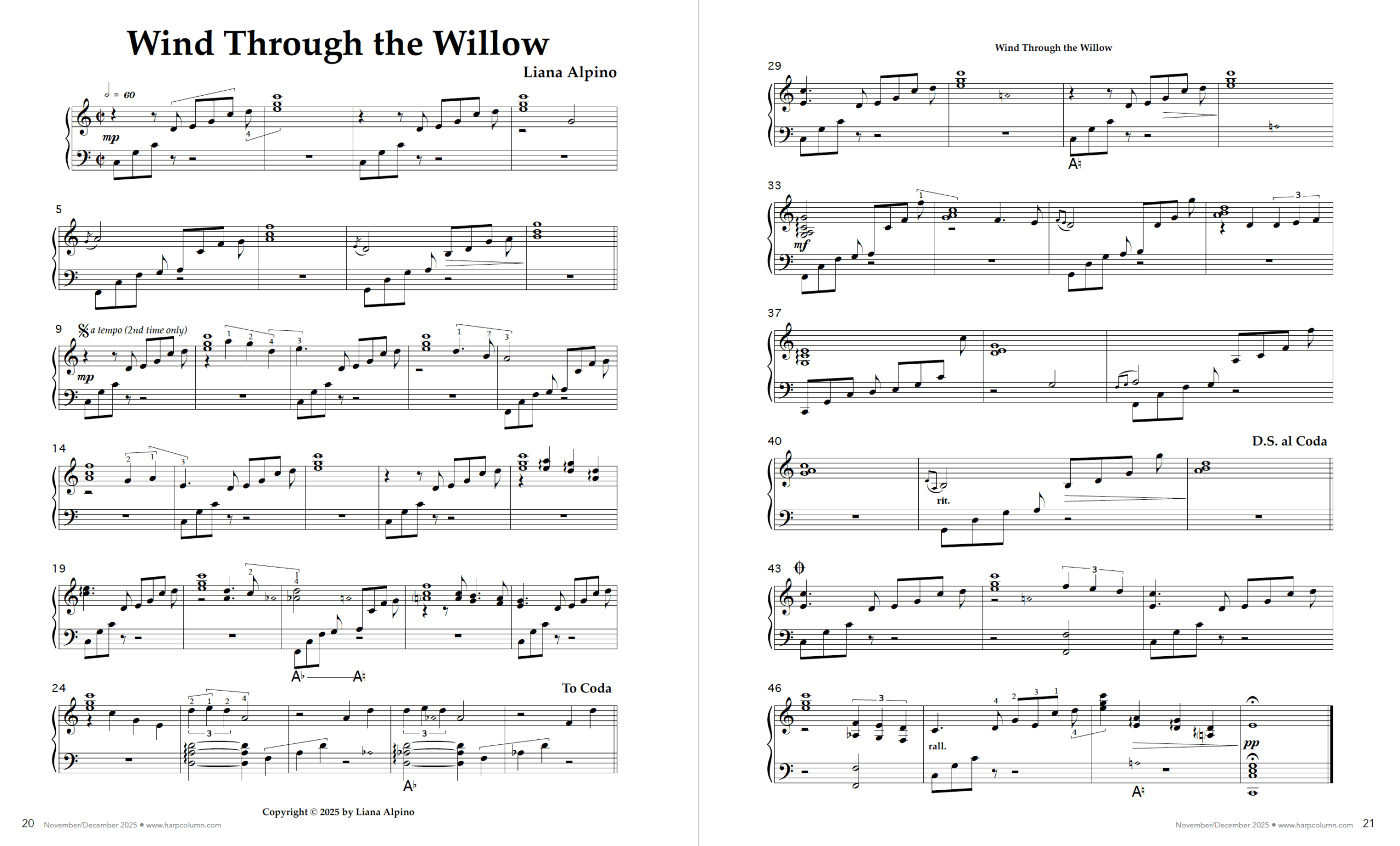
Each installment of our Tear-Out Tunes series features a new piece written by one of the best harpist-composer-arrangers in the business. Each composer will tell you a little bit about their piece, and also give you some helpful tips for learning it and getting the most out of the experience. The new piece (on the following pages) is yours to keep. We even put it right in the middle of the magazine so you can tear out the whole sheet and put your new tune on your music stand.
There’s something magical about the quiet moments at the harp—the way a single arpeggio can calm your breathing and shift your whole mood. This piece was born out of one of those moments, when a simple warm-up exercise grew into a melody that reminded me of willow branches swaying in the breeze.
How we got here
The musical idea came from a warmup I play every time after tuning for a performance. I like to run through the length of the harp starting with a low C–G–C and then work upward with arpeggios (D–E–G–C), alternating hands. There’s something I’ve always loved about this chord. The arpeggio sits so comfortably under the fingers, and the addition of the D to the C major triad (C–E–G) adds a touch of whimsy (we’ll come back to this).
As I expanded this idea, the piece naturally settled into cut time, giving it a gentle rocking quality with two steady beats per measure. For me, that swaying motion felt like tree branches moving in the wind. The image that came to mind most vividly was that of a willow tree, one of my lifelong favorites, with leaves shifting gently on a calm autumn day. That rhythm and imagery became the heart of the piece.
I specifically wrote this piece with a 34-string lever harp in mind. Many of my students play harps about this size, and several are at the early-intermediate level. I sometimes find it tricky to find music that fits this in-between phase—after basic skills are learned, but before they are mastered. Many of my own compositions and arrangements tend to sit between the intermediate and advanced level, so it was nice to challenge myself to create something more approachable. One of my favorite works to teach at this level is Petite Berceuse by Alphonse Hasselmans. With that in mind, I set out to write something similar: accessible, melodic, and satisfying to play, with limited lever or pedal changes. My natural writing style leans romantic, influenced by composers such as Debussy, Liszt, Smetana, and Tchaikovsky, and I’m always drawn toward melodic lines and flowing phrasing.
Mini theory lesson
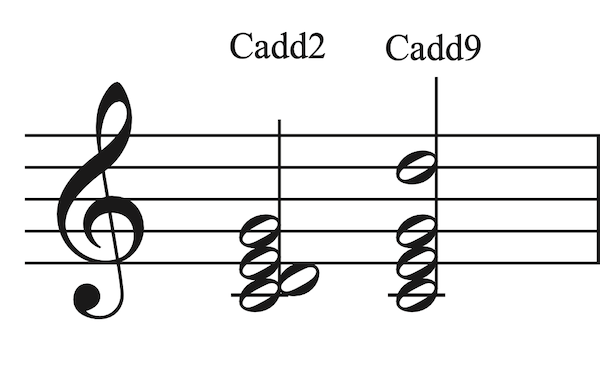
Depending on how you interpret it, the addition of the D in the opening arpeggio pattern can be labeled as a “Cadd2” chord or a “Cadd9” chord (see ex. 1). In C major, the added note is D—the second or the ninth scale degree. Personally, I think of it as an “add2” chord. You’ll hear these woven throughout the piece through the recurring arpeggio pattern. For those who enjoy a bit of theory, here’s a quick reference guide:
- Scale degree 1: C (root)
- Scale degree 2: D (major second)
- Scale degree 3: E (major third)
- Scale degree 5: G (perfect fifth)
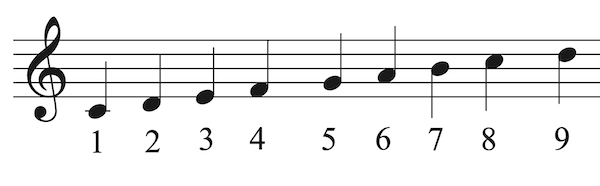
By adding the second scale degree (D) into a C triad, you transform a simple chord into something more serene and whimsical.
What you’ll work on
Beyond the harmonic color, I wanted this piece to provide a technical focus for early-intermediate players. Much of the writing focuses on crossover placement. You begin with both hands positioned on the harp, but the left hand must cross over to play the final notes of the arpeggio. For most of the piece, the motion connects upward, but in the bridge section (m. 33–42), the pattern reverses at the top of the arpeggio, connecting downward instead, offering the opportunity to develop another skill. Players will also practice grace notes and learn to highlight melody notes while letting the arpeggio accompaniment stay in the background.
Options for adaptation
Lever harpists may find the A-flat accidental in measure 21 challenging. If needed, you can play it enharmonically as a G-sharp, which allows you to make the lever change in measure 20 and focus solely on the G-natural lever change in measure 21.
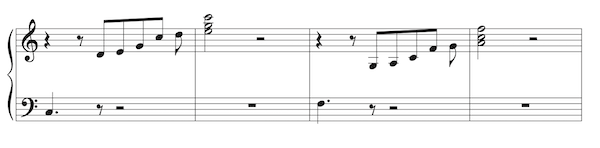
If you’re using a smaller 26-string harp or would like to simplify the piece, here’s a tip: since the piece is in cut time, think of each measure in two large beats subdivided into four (1e+a / 2e+a). On beat one, play the lowest bass note available on your harp. Then, join in with the arpeggio on the “a” of one.(See this adaptation written out in ex. 2.) This keeps the rocking motion intact with fewer notes to juggle. The low notes in the bass octaves from measures 44 onward can easily be omitted, too.
Above all, my hope is that this piece feels like a little haven, something you can turn to when you want a few quiet minutes at your harp. It’s not meant to be overly demanding, but rather something you can enjoy and take your time with, whether you’re a student learning crossovers for the first time, or an advanced harpist looking to relax. For me, it is a musical reflection of the willow tree: graceful, steady, and peaceful, always swaying gently in the breeze. I hope it brings you that same sense of calm whenever you sit down to play. •