
“Don’t you wish you played the piccolo?” There is possibly nothing more grating to say to a harpist as they wrestle their instrument into a vehicle. Harpists know the truth: we are persistent, ingenious, and strong—nothing will stop us from getting to the gig with our fabulous, yet slightly cumbersome instruments. While many of us use conventional methods to load a harp into a vehicle, there are also lateral thinkers who have discovered all kinds of creative ways to get their instruments where they need to go.
The classic haul
For most harpists, the harp travels in a personal vehicle. Once the question “does it fit?” is answered (check out our latest harpmobile review for the answer to that question), the next concern is always “how do I keep it safe?”
The SUV or station wagon are classic choices. Denver harpist April Dominick moves hers in a small SUV, adding layers of protection before sliding it inside.
“I use a two-piece custom soft case to protect the harp,” Dominick says. “To ensure the harp is protected from both scrapes from the car and road bumps on the way to the gig, I lay it on a twin sized mattress. First, I lean the mattress against the car and then lay the harp against the mattress. With these in place, I can easily squat to lift the mattress and harp up together and slide the mattress into the car on my own, knowing it is protected fully. Finally, I place my stand, stool, and harp dolly on either side. The harp’s case protects the harp from these items. The mattress also makes taking the harp out of the car easy, and I simply slide it out the way I put it in.”ew
Minivan magic
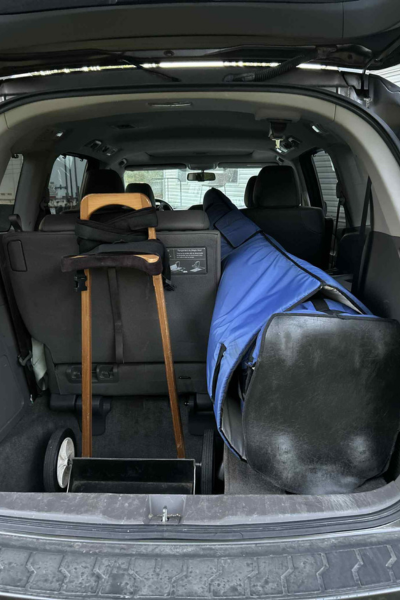
Minivans are another go-to, offering space and flexibility for different loading strategies. Dade County, Georgia, harpist Hailey Ann Moore loves her Honda Odyssey for its harp-hauling capacity—and for the laughs it brings.
“At about every other engagement I play, someone makes a comment like, ‘Why didn’t you choose the mouth harp?’” Moore says. “They usually go on to joke about how easily I could just stick a harmonica in my back pocket and carry it home. The harp, on the other hand, is a rather cumbersome, expensive, and fragile instrument to transport—but there are excellent ways to do it!”
She says her husband teases her driving style. “I’d say I drive my harp around with care, like there’s a baby in the back. My husband says he drives it like a load of cattle: easy around the turns, gliding into a stoplight, and so on.”
Even with jokes about driving a “mom van,” Moore insists it gets the job done. “I’ve driven a ‘mom van’ since I first got my license, and I absolutely love it. My husband and I are newly married, and because he is a mountaineer, no one would ever think of challenging his ‘man card.’ But he’s just about ‘over’ my Honda Odyssey. We may be upgrading to an SUV, which is another great option for a harpmobile.”
Moore describes two reliable approaches: the “flat load,” sliding the harp peg-side-down flat on the cargo bed of the van, and the “column load,” where the harp rests fully supported by the middle seats (Moore’s preferred method). “It is entirely possible to get your harp safely around town with low stress,” she points out.
Packing a Prius
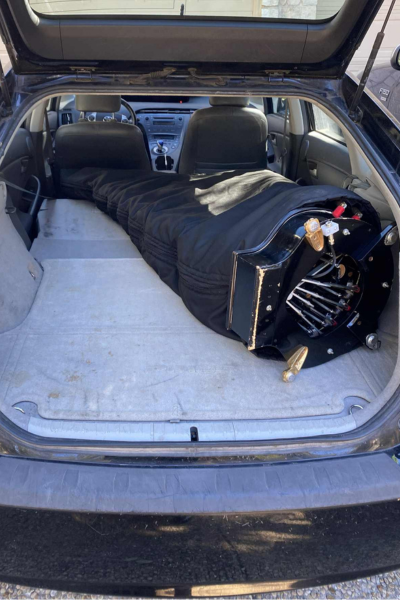
Even compact cars can work if you are willing to consider an unconventional loading strategy. When the Prius V came out, harpists rejoiced at a fuel-efficient harpmobile option. Fredericksburg, Texas, harpist Laura Pradia became adept at packing her instrument into the famously snug hybrid.
“I lay the harp on its side with the column toward the driver’s side and slide it in like a pizza,” Pradia says. “I keep pillows handy to wedge anywhere the dolly, or any other hard gear, might touch the harp. I called my Prius the ‘Polly-Pocket’ because everything barely fit inside, but it snapped shut.”
She didn’t stop there. “I’ve even hauled a smaller pedal harp in a Montego sedan. With the back seats folded down, I treated it like a hatchback. It was snug (probably too snug for a semi-grand) but a 40-string Salvi Angelica fit with the dolly and all when angled through the trunk. Loading always feels like a 3-D game of Tetris, but as long as the overall space is bigger than the instrument and the essential spots line up, it’s surprising how many types of cars a pedal harp can fit in!”
Efficiency is mission critical when making such a small harpmobile work. “Making everything else compact is key. I use a folding stand that packs down to briefcase size, and I’ve switched to an iPad for sheet music. One time, I even fit a cellist’s instrument alongside mine for a gig an hour away. With extra pillows between us, nothing touched the harp’s discs, and his cello rode safely on top.”
Double the challenge
Some harpists face an even bigger hurdle: transporting multiple instruments, or sharing space with colleagues.
As members of the duo Strange Interlude, harpist Lily Press and cellist Simon Linn-Gerstein have their routine down to a science.
“We face the challenge of moving two large instruments together,” Press says. “We start by loading the wells of the car with two music stands, a cello chair, an amplifier, two bags of mics, cables, and extension cords, plus two more bags with harp strings, tuning equipment, and gig binders. Then I slide the harp in on a moving blanket. I always move the harp myself, though Simon helps push it as far forward and to the right side of the car as possible.”
Next comes the cello. “Every step has to happen in sequence, so it’s very much like Tetris: wells first, then harp, then harp bench, then cello, then harp cart,” Press explains. “The cello is strapped in with a seatbelt, so while it’s close to the harp, it never leans on or touches it.”
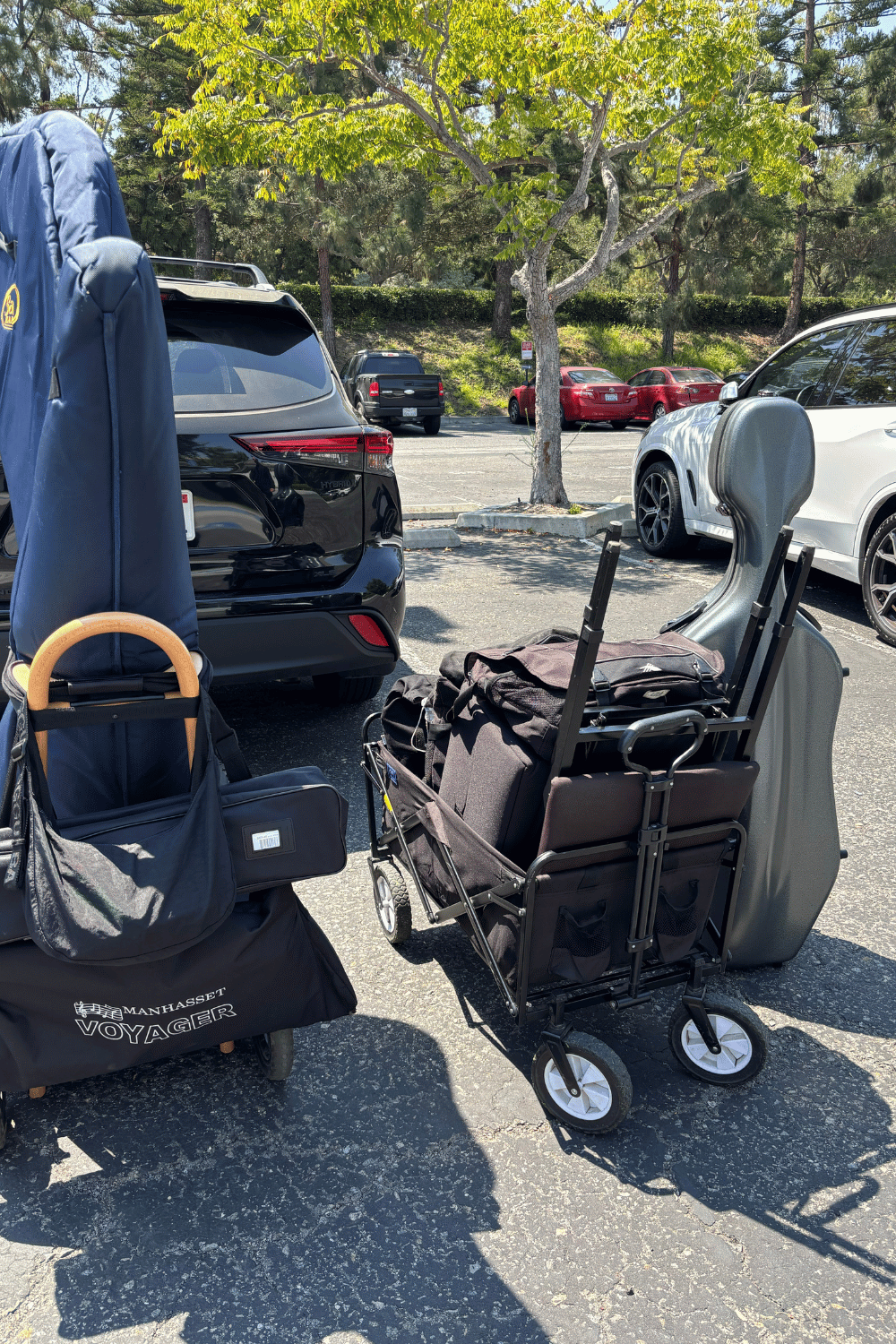 The harp and cello duo of Lily Press and Simon Linn-Gerstein utilize every inch of space in their vehicle to squeeze in all of their gear.
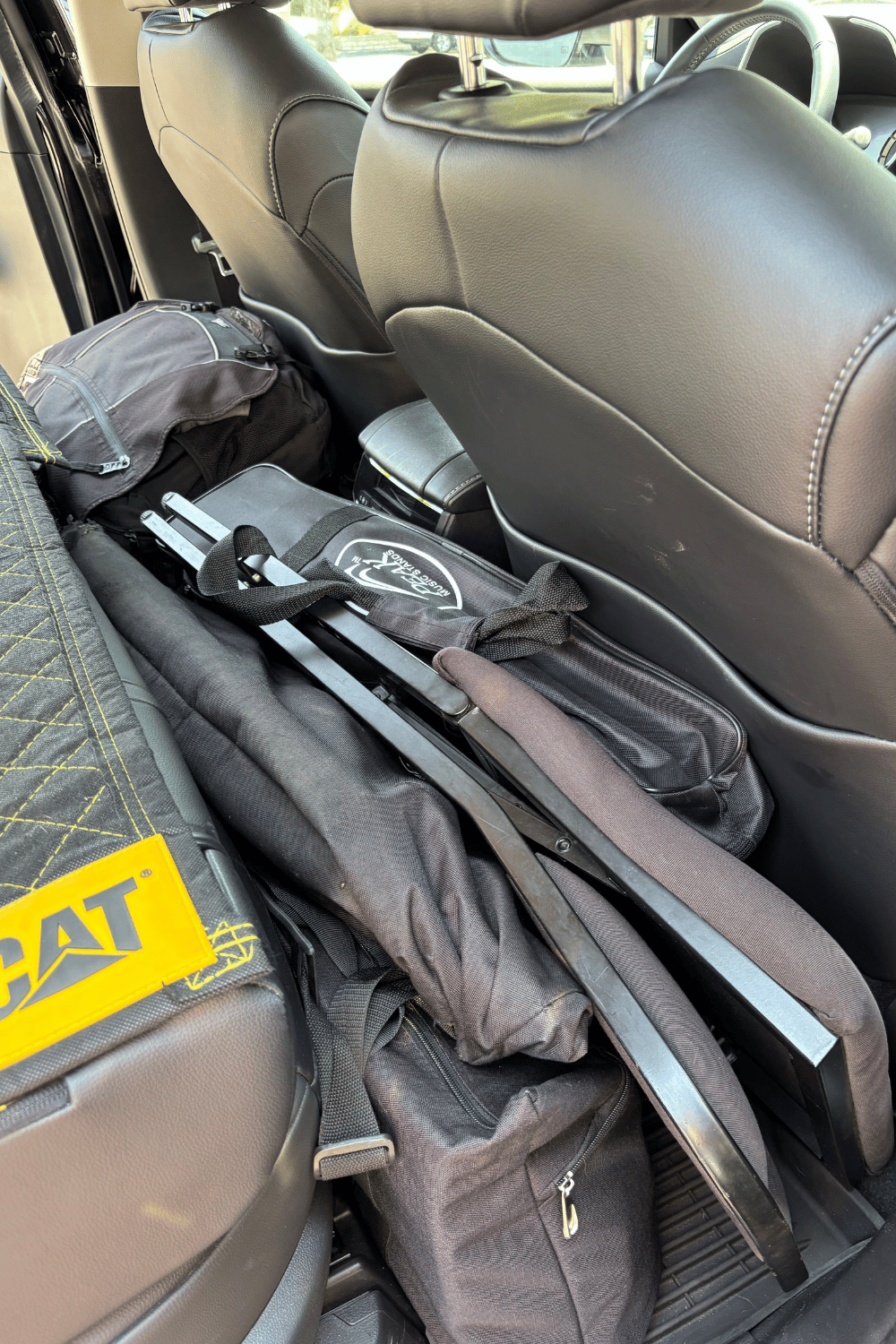 They start by filling the space behind the front seat.
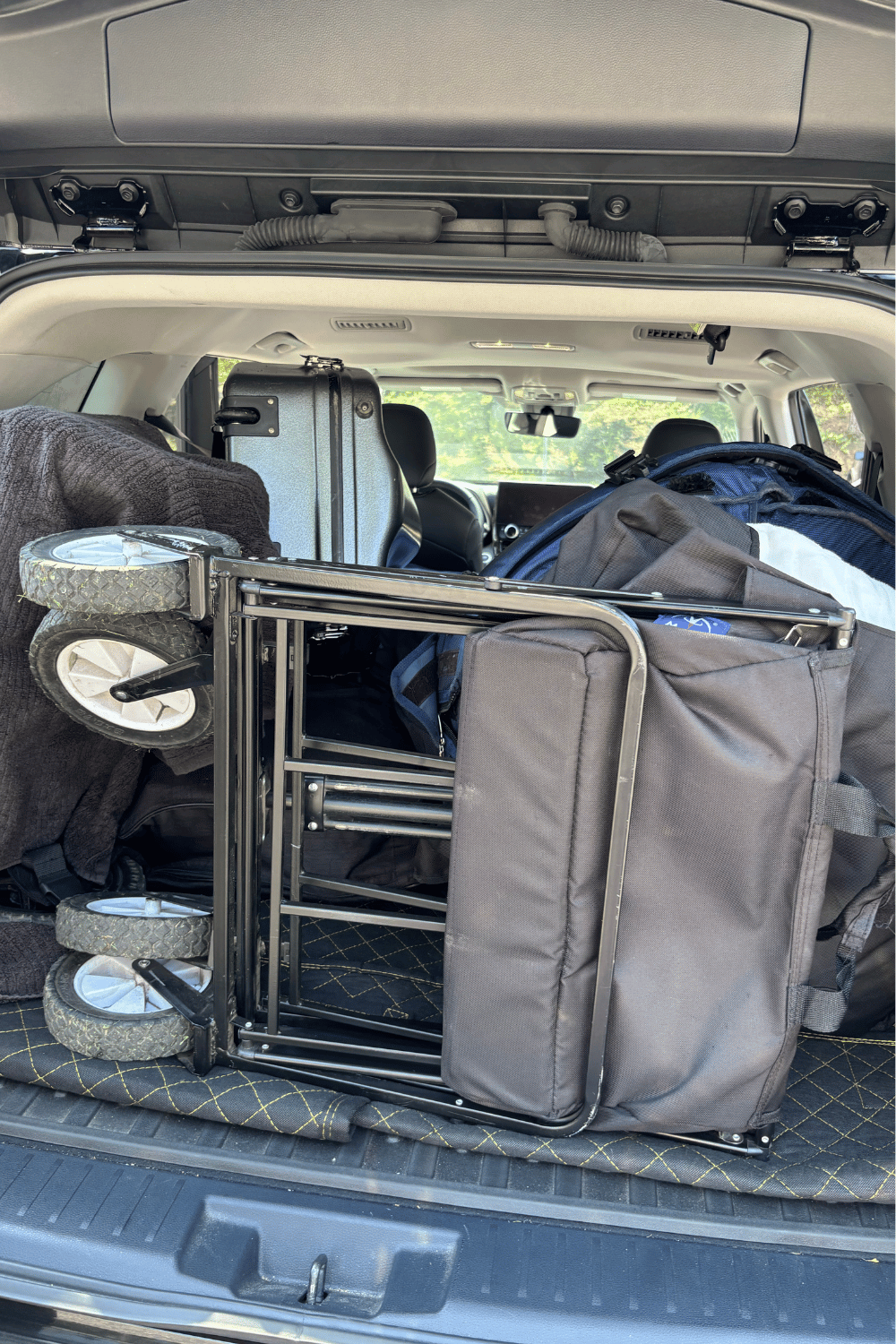 Then go the harp, bench, cello, and dolly in the cargo area.
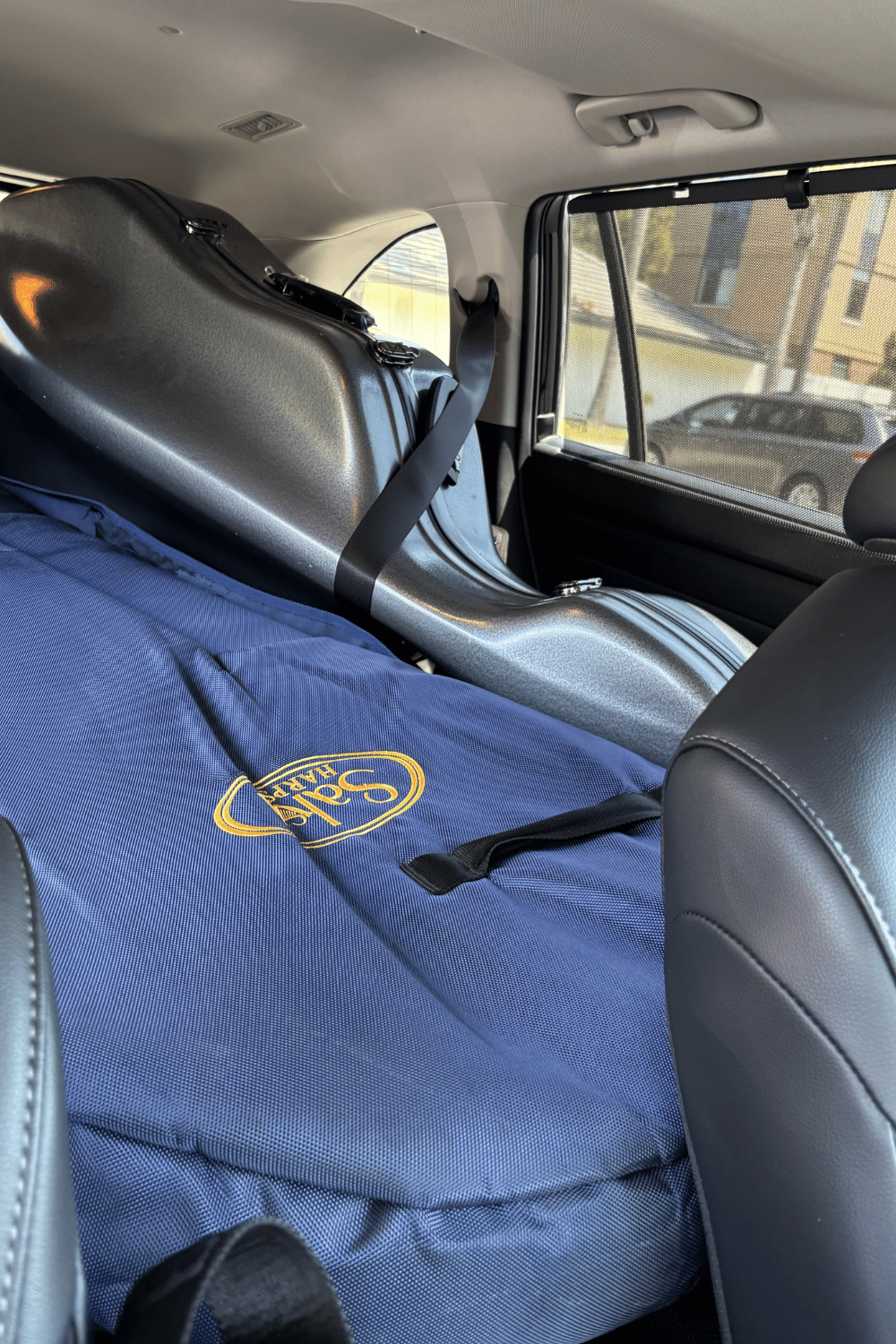 Once the cello is buckled in with a seat belt, theyare off to their gig.
Quartet on the road
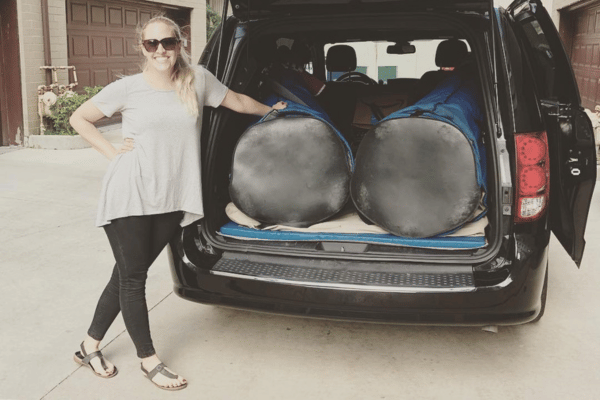
For the Chicago Harp Quartet, the challenge multiplies: four players, four concert grands. Their solution? Teamwork and careful planning.
“The Chicago Harp Quartet has had its fair share of schlepping harps!” member Catherine Litaker says. “As a touring group of four harpists, there were some learning moments, most of which were laughed about after the fact. What seemed to work the best is two harps, column-loaded in a minivan with two harpists in each. That left enough room for benches, suitcases, string bags, etc. Two Minivans with four harps and four harpists driving across the country can actually be fun!”
Practical details make all the difference. “It’s always important to be aware of the weather, even if sometimes the amount of snow you are greeted with after a concert is surprising,” Litaker adds. “To help prevent damage to our harps we also carried outdoor doormats to put on the ground when loading a harp, and this helped to keep the base cover from getting wet. Finally, having a good, reliable dolly with fully inflated tires also is a must.”
Harps on the metro
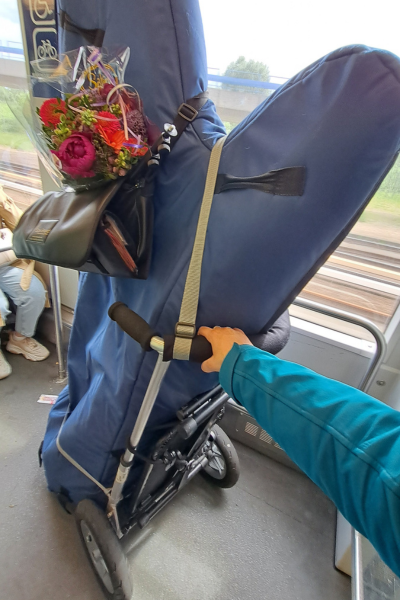
Not every harpist has a vehicle at all. Some rely on ingenuity—and public transportation.
Dutch harpist Imre Hartog often moves her instrument through Rotterdam on trains, trams, and metros. “Every now and then, I transport my harp by public transport,” she says. “I don’t own a car, and borrowing my parents’ car isn’t always possible. Even when I do borrow it, my dad has to help with loading and unloading, which means coordinating his time as well.”
Hartog has learned which options work best. “My favorite is the metro. It’s easy to get in and out because the platform is level with the train and the gap is small,” she notes. “Trams are my second choice. With regular trains, I always travel with someone to help, since you have to climb steps and the gap is larger. The one option I avoid completely is the bus, as the gap is simply too big.”
Despite challenges, there are surprising benefits. “Of course, there are downsides. Not everyone is considerate when you’re maneuvering a giant instrument. But there are upsides too. Adults and children alike often open doors, make space, or ask friendly questions. Some are amazed at the harp and want to know where I’m going.”
New York City mayhem
In New York City, harpist Mia Theodoratus has faced every imaginable transportation nightmare—traffic, tickets, even mid-gig shutdowns.
“When I moved to NYC, I was completely unprepared for the hardest part of being a harpist here: getting a six-foot, expensive, wobbly triangle through the city,” Theodoratus says.
Her adventures range from pleading with police to avoid a parking ticket in Midtown at Christmas to running her harp out of a Fifth Avenue fashion show just as a monsoon hit. “I wheeled the harp out, shut the hatch, and looked up just in time to see parking police about ten feet away. I barely escaped a $150 ticket.”
Sometimes survival meant improvisation. “I didn’t have a car, so I called an Uber,” she recalls. “Halfway across the Williamsburg Bridge, the car lurched to a stop. I couldn’t wait. I unloaded the harp right there and wheeled it, in heels, down the middle of the road for half a mile. Some drivers screamed curses, others catcalled. By the time I reached soundcheck, I was completely wrecked,” Theodoratus recalls.
Desert hacks
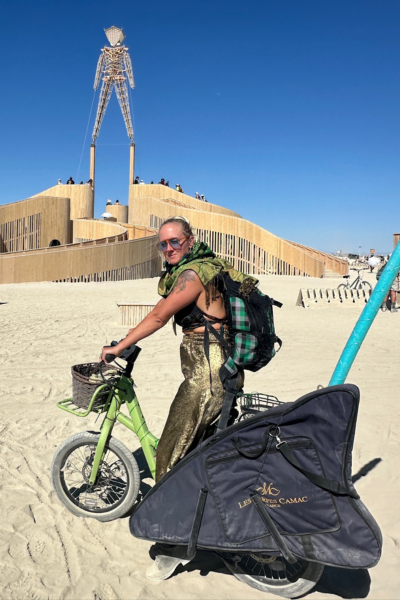
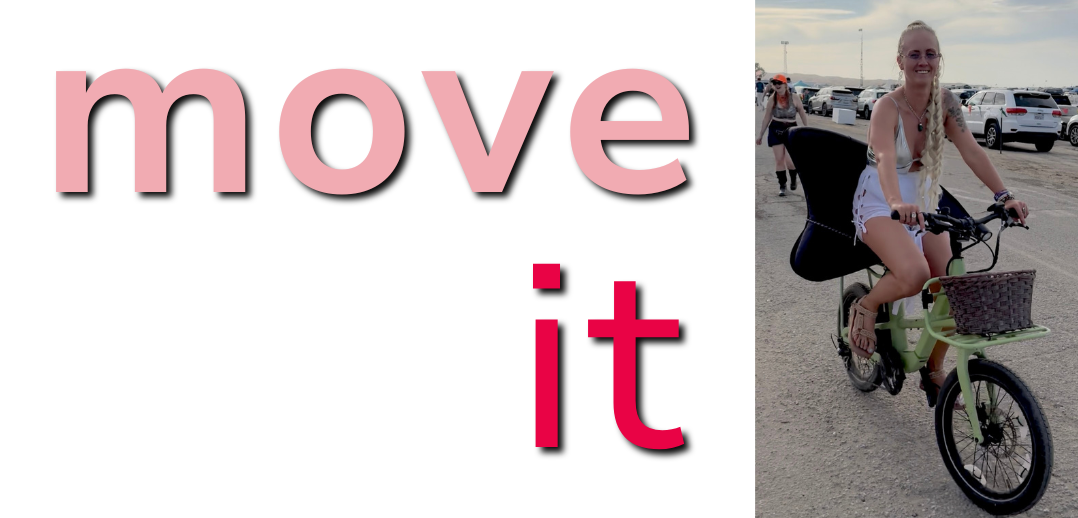
Some harpists embrace alternative setups altogether. At Burning Man, a weeklong event held outdoors in the Black Rock Desert in Nevada, Arizona-based Adrienne Knauer turned her electric harp into a desert-ready companion by strapping it to a bike.
“The idea of transporting my harp by bike came after my first Burning Man, when I wanted to take my Camac DHC 32 across the playa to collaborate with other artists,” Knauer says. “One night, my husband Jay suggested attaching a surfboard rack to my electric bike and strapping the harp onto it. We tested it at home, and it worked!”
She has since upgraded. “Conditions out there aren’t exactly harp-friendly—hot, sunny, and dusty—but I bought this harp for adventures, and it has seen plenty. More recently, I purchased a Harp-E, which is even more durable and portable. It’s smaller and lighter, so I can carry it on my back instead of strapping it to the bike. I’ve tested it around Phoenix, and it’s a game-changer.”
At sea with a harp

Cruise ship harpist Lora Panosyan knows that moving a harp doesn’t always involve roads at all. Onboard, she maneuvers the instrument daily from deck to deck.
“A concert grand harp on a rocking boat? Why not!” Panosyan says. “I worked as a harpist for a major cruise line. The harp onboard was provided by the company, and it was the harpist’s responsibility to make sure the instrument (and everyone near it) was always safe. The guests were always amused to see the harp rolling slowly along the deck with little me hidden behind it.”
But there are challenges unique to life at sea. “I had to be wary of a few things, one obviously being securing the harp when the ship was rocking. I found it to be more stable when attached to the trolley. While in between performing sets, I would move the bench or chair so it was snug against the back of the harp to make sure I wouldn’t come back from a break only to see the harp on the floor. I also had to watch out for the low ceilings in certain areas, minding the top of the harp and making sure not to break fire sprinklers or cameras.”
The final stretch
Harpists know better than anyone that the gig doesn’t start on stage—it begins the moment we coax our six-foot, 80-pound partner out the door. Whether it’s Tetris in a Prius, dodging Midtown traffic, or hoofing it down the street in heels, we always find a way. However chaotic the journey, the harp arrives—and the music that follows makes it all worthwhile. •