
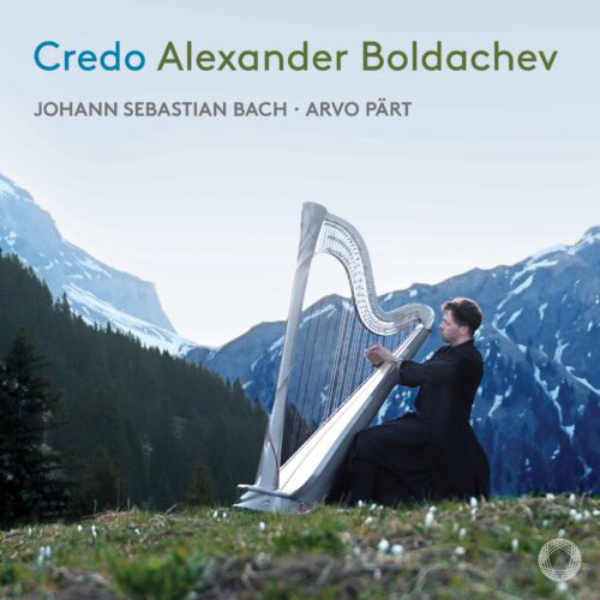
Credo
Alexander Boldachev, harp. Pentatone, 2025.
Also worth highlighting this month is Credo, an atmospheric and contemplative album from classical crossover artist Alexander Boldachev. Inspired by the music he turns to whenever he flies, the program of J.S. Bach and Arvo Pärt becomes a source of calm both for him and, in turn, for us. Yet this is not simply meditative background music. Rather it unfolds in a timeless way. Pärt himself drew inspiration from Bach, admiring his ability to create music bound by rules yet infused with deep spirituality. Boldachev captures that spirit in performances of Pärt’s Für Alina, the bell-like Fratres, and the weightless suspension of Spiegel im Spiegel, alongside diverse Bach selections from the earthy Cello Suite to the grand drama of the Toccata and Fugue in D Minor, capped by the monumental “Chaconne” from the Violin Partita No. 2.
Is it indulgent? Certainly. But in this case, indulgence feels not only justified, it’s irresistible.
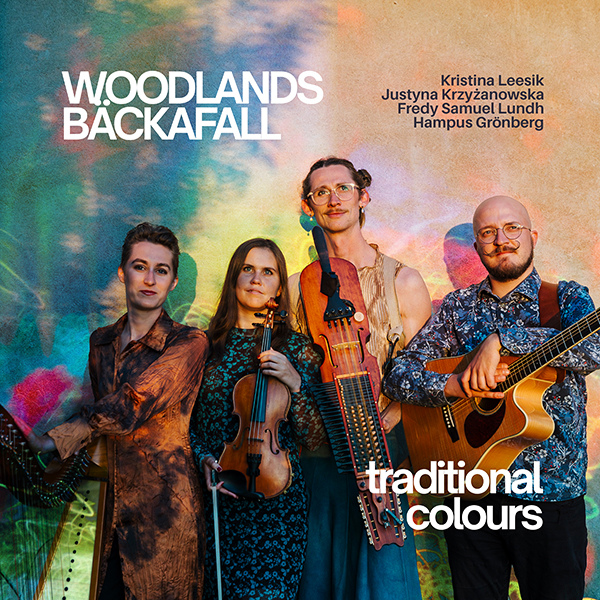
Traditional Colours
Woodlands Bäckafall quartet: Justyna Krzyżanowska, harp and vocals; Kristina Leesik, fiddle and vocals; Fredy Samuel Lundh, nyckelharpa and vocals; and Hampus Grönberg, guitar. Kakafon Records, 2025.
Even though we’re far from midsummer here in the Northern Hemisphere, I was thrilled to hear the joyous, hopeful, and beautifully crafted debut album from Woodlands Bäckafall, Traditional Colours. The quartet— Kristina Leesik (fiddle, vocals), Justyna Krzyżanowska (harp, vocals), Fredy Samuel Lundh (nyckelharpa, vocals), and Hampus Grönberg (guitar)— first came together for a single performance at the Göteborg Folk Festival in 2020. The spark from that night grew into a five-year collaboration and now this radiant album. The recording opens with Leesik’s original Sommarpolska, an effervescent, toe-tapping piece that sets the tone with infectious energy while somehow maintaining an intimate, pub-like warmth. Highlights include the Bonnet Reels, showcasing Krzyżanowska’s gloriously husky alto; Leesik’s Udda Låten, a playful study in odd meter that nevertheless grooves with ease; and the ancient Polish wedding song “Chmiel,” whose spinning, symphonic accompaniment evokes the solemn beauty of a maiden’s passage into womanhood, while the anthem-like rendition of “Wild Mountain Thyme” reminds us that spring and renewal always returns. •