

10/10
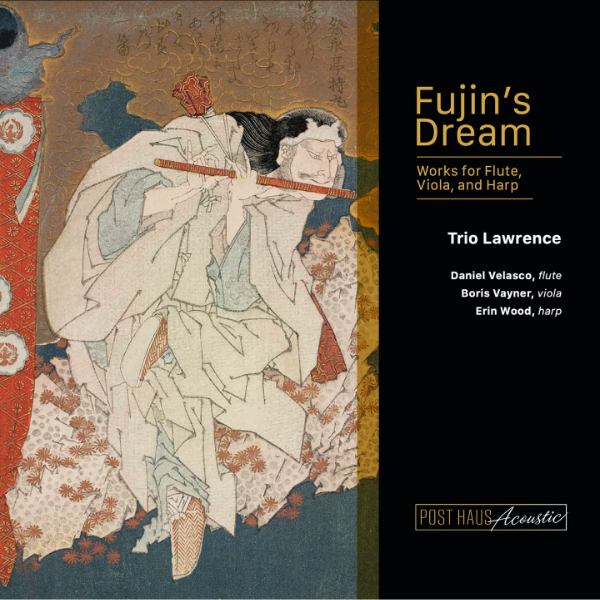
Trio Lawrence: Erin Wood, harp, Daniel Velasco, flute, and Boris Vayner, viola.
Post Haus, 2025.
While harp, violin, and cello make for an unusual ensemble, the combination of harp, flute, and viola immortalized by Debussy has become a more established trio. What a privilege to hear the debut album Fujin’s Dream from just such a combination of instruments, Trio Lawrence, combining new works with less-heard gems. All University of Kansas faculty members, Erin Wood (harp), Daniel Velasco (flute), and Boris Vayner (viola) bring exceptional style, sensitivity, and thoughtful programming to this recording.
The album opens with the exuberant Bacanal by Mexican composer Eduardo Angulo. Originally the finale of his Viola Concerto, the work feels tailor-made for this instrumentation, with each instrument’s expressive qualities on full display. From the first notes, Trio Lawrence establishes itself as an ensemble of remarkable energy and polish.
The title track by Canadian-Tatar composer Airat Ichmouratov draws inspiration from Japanese mythology, depicting Fujin, the capricious wind god. This red-haired, green-skinned demon, clad only in a leopard-skin loincloth, carries a great bag of storms capable of unleashing devastating typhoons. The trio delights in the sonic possibilities, weaving extended techniques and brilliant gestures into music that seems to breathe and swirl as though the instruments themselves were powered by wind.
It feels only natural, then, that the program turns to songs by Mikhail Glinka, the “Father of Russian Music.” Of his nearly 80 art songs, three are included here, Do Not Tempt Me, Cradle Song, and Doubt. Simple in form but rich in pathos, these songs unfold with tenderness, longing, and quiet anxiety. Trio Lawrence captures these qualities in a palette of dark, hushed tones and seamless lyricism.
The mood shifts with David Bruce’s The Eye of Night, a work presented from the perspective of night itself, gazing down unblinking at earthly life. Each section is titled simply as a “Movement,” encouraging listeners to form their own interpretations. The trio plays with a dreamlike quality, their phrasing imbued with wonder and quiet intensity.
The recording concludes with Théodore Dubois’s Terzettino, the earliest known piece for this instrumental combination, one written a decade before Debussy’s Sonata. Though Dubois, as Paris Conservatory director, famously forbade students from attending the premiere of Debussy’s Pelléas et Mélisande, even as he privately admired Debussy’s genius, his own music looks backward to the Romantic era. And it sits perfectly in Trio Lawrence’s hands, allowing them to sing, soar, and move listeners with elegance and warmth.