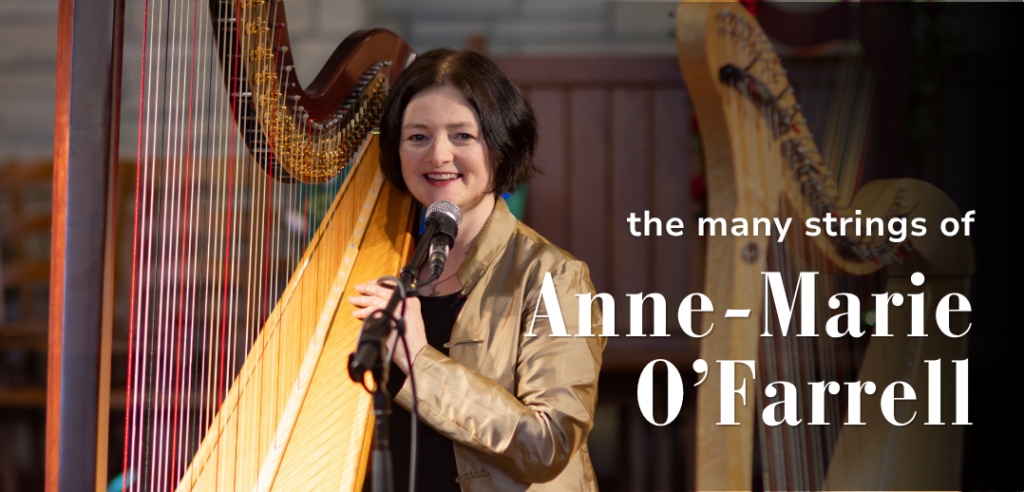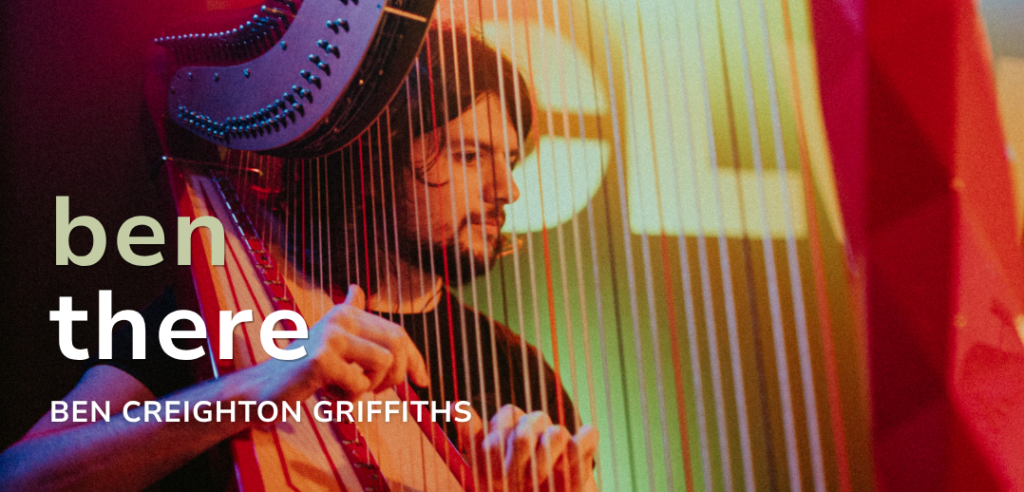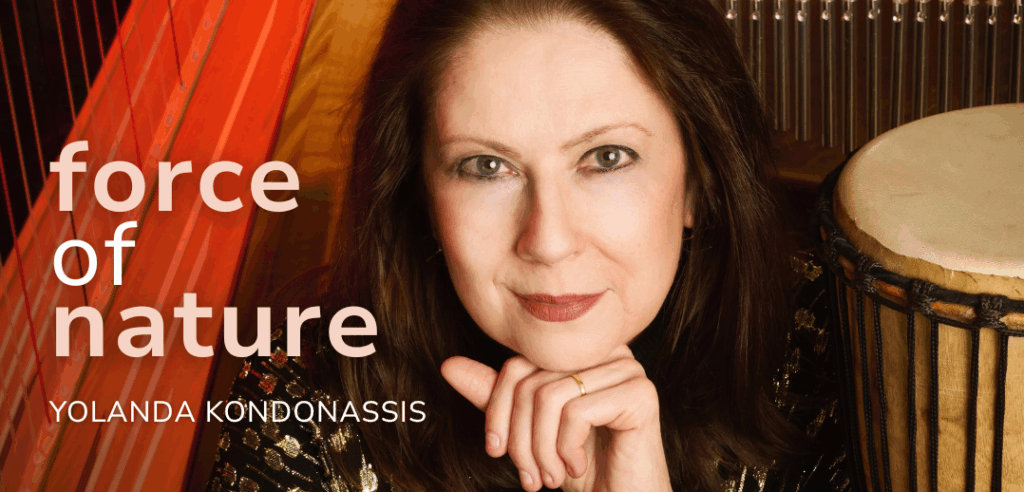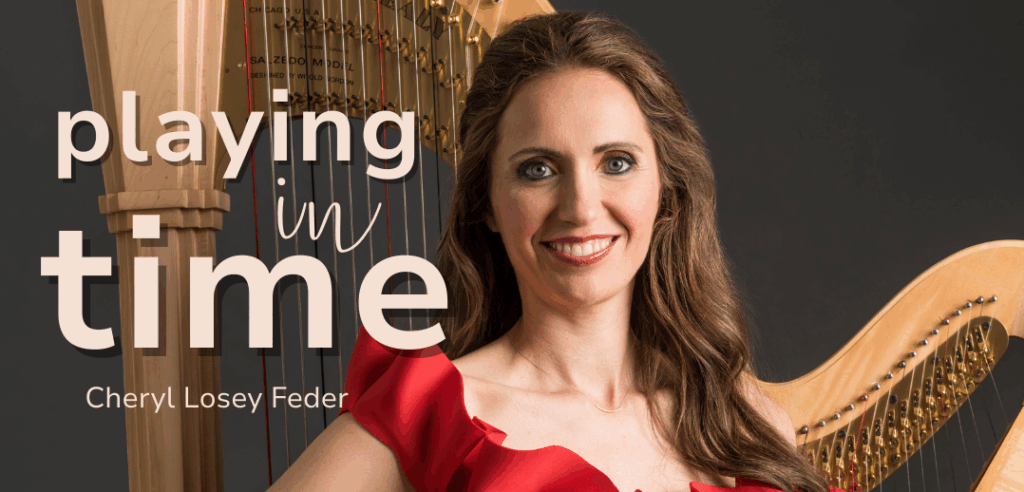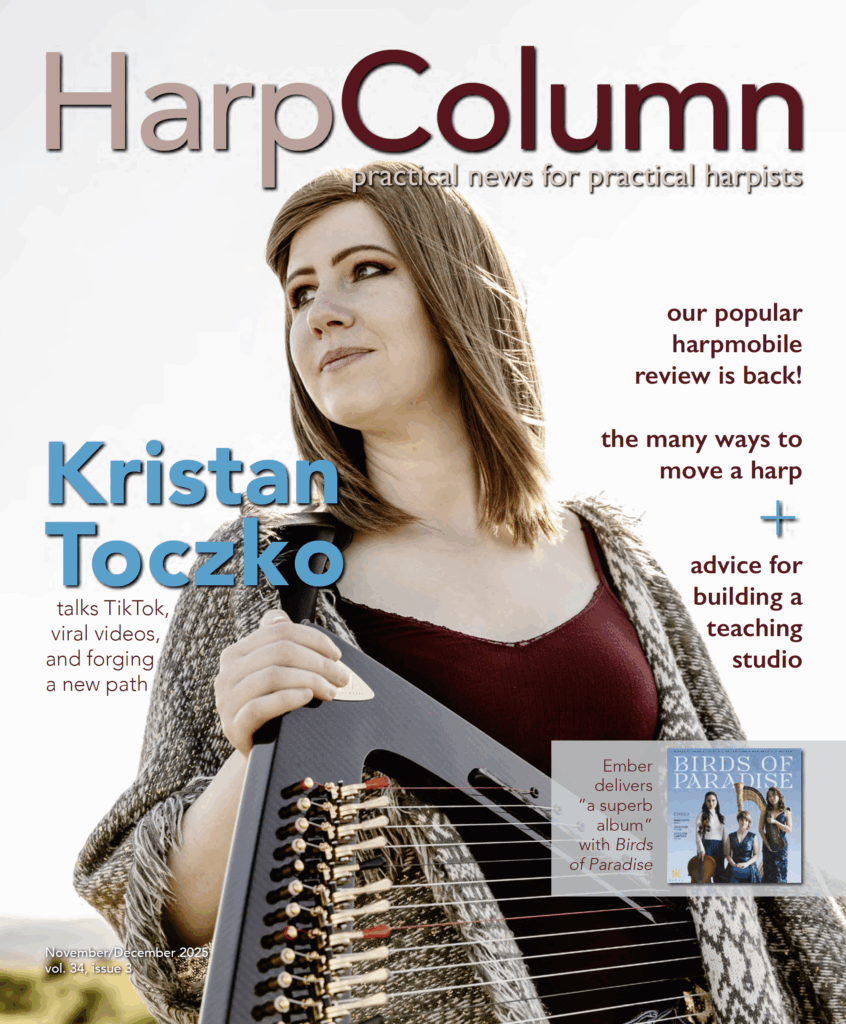

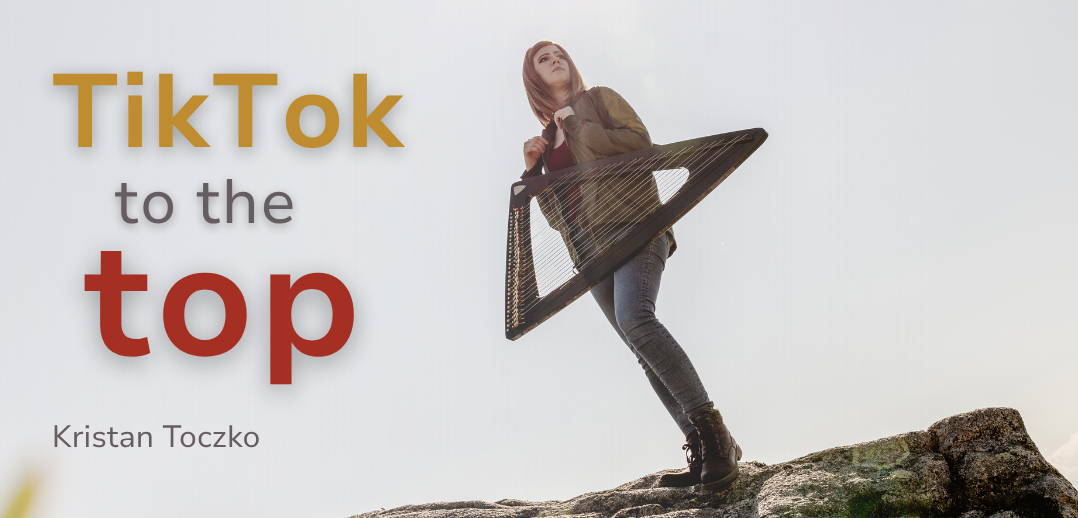
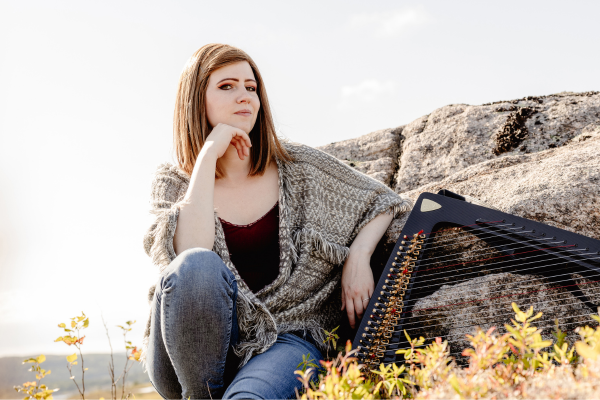
—photos by Kristan Toczko Photography
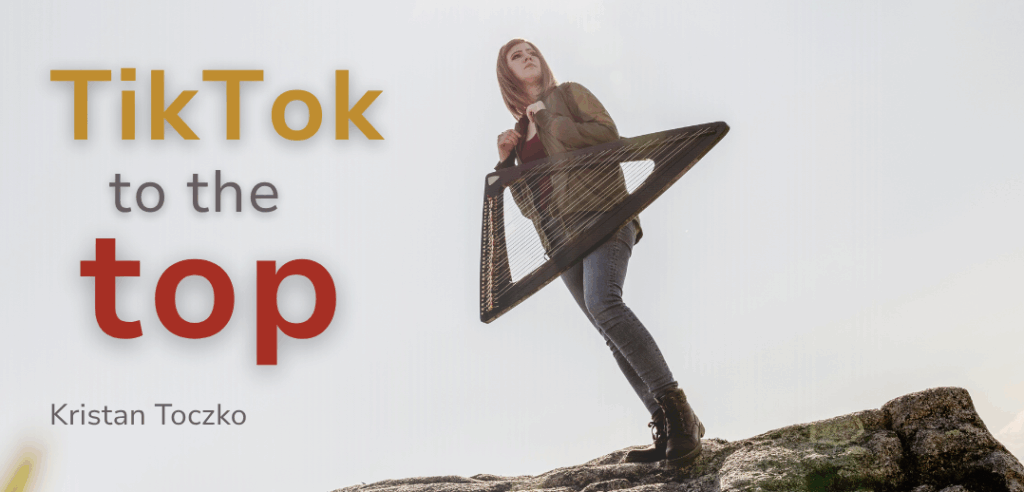
When the pandemic shut down the world five years ago, countless freelance musicians saw their livelihoods turned upsidedown overnight. In our Harp Column freelancer interview series this year, everyone we’ve spoken with has described how the pandemic sparked a major shift in their career. But few stories illustrate that transformation more dramatically than that of Canadian harpist Kristan Toczko.
Already an accomplished classical freelancer early in her career, Toczko rolled with the punches of lockdown life and began making TikTok videos for fun. It didn’t take long for Toczko’s short music clips to go viral. While her live audiences vanished overnight, a new one appeared almost as quickly online. Soon Toczko’s videos were receiving tens of thousands of views from people around the world, extending far beyond her city, her country, the harp community, or even the music world.
Today Toczko has 4.3 million followers across six social media platforms. We caught up with her this fall on a Zoom call from her home in Newfoundland to hear more about her story of creativity, adaptation, and connection.
Where is Kristan @?
You can find videos by Kristan Toczko @harpistkt on social media:
- TikTok
- YouTube
- Threads
Harp Column: We’ve followed your career trajectory over the last five years since the pandemic, which has been incredible to watch. How would you have described your harp career prior to 2020, and how would you describe it now?
Kristan Toczko: I would describe my career before COVID as finally feeling like I had “made it” as a freelancer. I had enough gigs coming in, enough steady income that I felt comfortable and happy with the work I was doing. At the time, I was living in Sudbury, Ontario, but still commuting frequently to Toronto because that’s where most of the work was. Things felt really good. Then COVID hit, and everything was canceled. I was super bummed because I had some pretty exciting gigs lined up. But at least, in a strange way, I felt comforted knowing everyone was in the same boat—we were all figuring it out together. That’s when I realized I needed to pivot, and that’s when online projects really started to take off for me.
HC: Your videos have reached a level of popularity that is remarkable, even for independent content creators. For a harpist, though, there’s really nobody in your league. How did you find this successful formula?
KT: Honestly, I feel like it was kind of an accident. Once I stumbled on it, I definitely pursued it more, but at first it just happened. After my busy freelance career came to an abrupt halt [when COVID hit], I realized that as much as I love freelancing, I needed a break. It’s so hard to take a break as a freelancer, whether by choice or circumstance. But when everything stopped, I thought, Hey, this isn’t so bad. By week two I was still enjoying the downtime, but by week four I was missing the harp and playing with others. That’s when musicians started collaborating online, making videos together. I did a few projects like that with orchestras that were commissioning virtual performances, and I thought it was great—a little video gig here and there. But I also missed performing for audiences. That’s why I went into music in the first place.
Because of my freelance schedule, I was always told what to play. I rarely had the chance to play what I wanted. For the first time, I found myself missing playing just for the sake of it. I’ve always loved film music, so I thought, Why not start sharing some of this? At first I made arrangements of orchestral pieces—things like “Dance of the Knights” from Romeo and Juliet [by Sergei Prokofiev]. I’d record myself playing duets, just for fun, and share them with Facebook friends. Then one day I downloaded TikTok and saw some musicians posting on it. Some were playing rock, video game, and film music, and they were really good. They were also out of work, but they were sharing their music and reaching people. I figured I’d give it a try. The first video I shared was a cover from Finding Nemo. It was super easy—I just adapted piano music I found online—and when I posted it, it got more traction than my Instagram ever had. People I didn’t know were commenting, thanking me, saying it calmed them after a stressful day. I thought, Wow, this is bigger than me. This is filling the same role live music does—connecting with people.
That gave me the same feeling I get after a live performanceå, when audience members tell you how much the music moved them. I realized I wanted to do more. Soon people were making song requests in the comments, and I started responding to them.One request was for “Great Fairy Fountain” from The Legend of Zelda. I had never heard it, never played the games, though a friend had been bugging me for years to try it. The music itself was tricky—huge leaps, stretches that weren’t very playable—so I spent an entire hour working on just a 30-second excerpt. It felt less like a casual video and more like preparing for an audition. That challenge really excited me, and when I posted it, the video went viral. That was my first taste of viral fame—the good and the bad—and it’s really what started everything.
HC: Anyone who has ever posted a performance video knows how difficult and time-consuming it is. How have you kept up the pace of creating so many videos while keeping the quality extremely high over the last five years?
KT: After that first viral video, I got my first brand offer—$300 to advertise a website. I thought, Sure, that’s easy, and I did it. That made me realize there was more potential here. I was having fun, audiences were enjoying it, and I wondered if I could actually turn it into work. At that time, I still had no live gigs, and since there’s no TikTok Creator Fund in Canada, I wasn’t making anything directly from TikTok. But that brand offer piqued my interest. From there it became like a game. People kept requesting songs, and I’d think, Is that even possible on harp? Let me try. The challenge kept me motivated.
As for how I keep up—I’ll be honest, burnout does happen. But because the videos are short, the excerpts are usually quick to learn. I choose pieces that are playable on harp and make arrangements that won’t take me weeks to master. When you’re working on 20- to 45-second excerpts, it goes quickly. Over time my sight-reading has improved a lot—I can usually tell right away if something will work, and often I can play it cleanly on the first or second try. When I film, I try to do 15 to 20 videos in one session. I’ll work four or five hours with breaks—recording, watching back, checking everything looks and sounds okay. That helps me stay consistent.
Another big factor is reusing content. I’ve shared over 2,100 videos since starting TikTok, and I often repost older videos I’m still happy with. Many people didn’t see them the first time, or maybe they didn’t take off because of the algorithm. Sometimes I’ll repost to tie in with an anniversary or special occasion. That helps break up the grind and lets me take breaks. For example, this past summer I took about two months off from heavy recording. I did a video here and there, but it was so needed. Reposting allowed me to step back without losing momentum.
HC: During the pandemic we heard a lot of musicians saying that recording yourself requires a different skill than performing live. Did you notice differences between recording videos and your live performance experience?
KT: Definitely. In live performance, we work toward perfection, but also toward musical expression. I still prioritize the music in my videos, but because the excerpts are so short, perfection feels even more important. That said, I’ve loosened up a bit. I think it’s good to show that I’m human—if I buzz a string or play a wrong note, sometimes it stays.
Another difference [between performing live and online] is presentation. Early on, I’d post videos of myself just playing very seriously, and people commented, “You should smile,” or “You should look at the camera.” At first I resisted. I thought, I can’t look at the camera and at the strings at the same time. But eventually I caved. I saw colleagues engaging the camera, smiling, and it made the videos more watchable. So I tried it, and now it’s become part of my style—I’ll look at the camera, give a little smirk, and play.
That’s something I would never do in a live performance, but it works on camera. If you scroll through my old videos, you can see the evolution—from me just performing, to now really engaging with the viewer. It’s been interesting to see how I’ve adapted to the camera. It’s not about compromising the music, but about adding another layer of performance when the medium calls for it.
HC: You mentioned reposting old videos, sometimes tied to anniversaries or timely moments. How do you stay organized?
KT: I try! I think I’m a fairly organized person. I’ve experimented with different methods. I used to keep a document of all the song requests I wanted to do, but that quickly became impossible—there were just too many. Now on TikTok I can save comments in folders, so I have a folder with 400-plus ideas. It’s not just songs—sometimes people ask questions like, “What does the lowest string sound like?” or “How do the pedals work?” I save all of those, so when I sit down to record, I can flip through and think, Oh, that’s a good song to try, or I haven’t done that Led Zeppelin one yet.
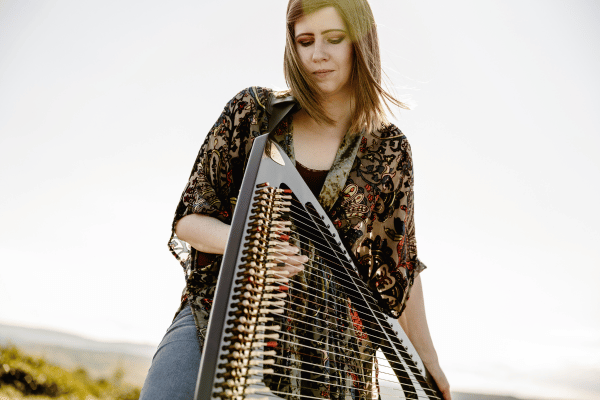
On my phone, I have a “harp” folder with subfolders—videos ready to upload, videos that need editing, electric harp projects (those take longer since I’m still new to pedals and sound effects), backgrounds for Instagram stories, Patreon extras, pedal settings. I also keep folders on my laptop for bigger projects. Having everything organized this way really helps.
HC: Do you make all your recordings with your phone, or do you use other equipment now?
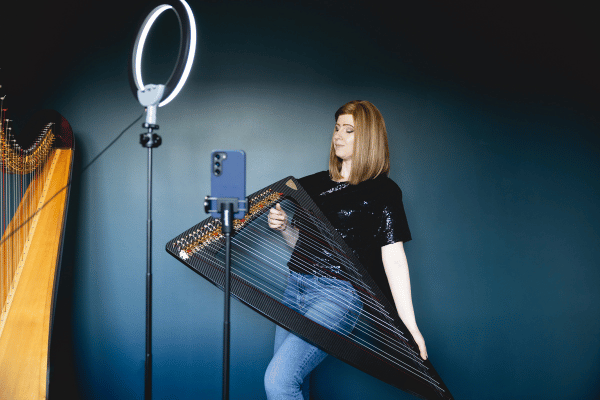
KT: Most of the time I use my phone—it’s just easier. I do have a digital camera that I try to use for horizontal YouTube videos, but honestly, the files are so big my computer can’t handle them well. I also have a really nice Canon camera that I use for photos. I’ve tried it for video once or twice, but being a one-woman production team makes it hard to manage more complex gear.
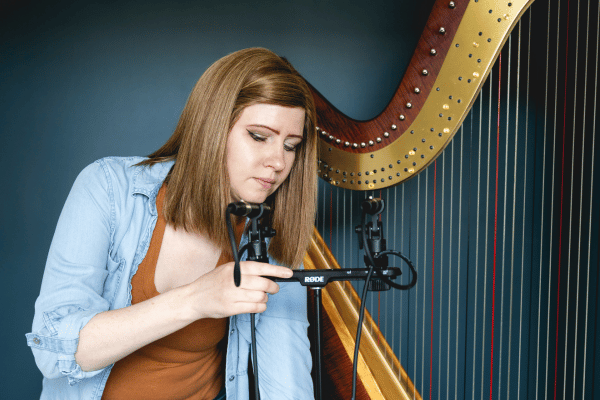
I also have some external mics. For high-quality audio—like what I release on Spotify—I use a pair of Rode TF-5 condenser microphones. They run into an audio interface and then into my laptop. Otherwise it’s just my phone, a tripod, and a light. I like to keep things minimal—if it worked when I started and it still works now, why overcomplicate it?
HC: You built much of your initial following on TikTok, but now you’re active on Instagram, YouTube, and other platforms too. With all the uncertainty around TikTok in the U.S. over the last few years, what’s your perspective as someone who relied heavily on it?
KT: TikTok is still a huge part of my life—it’s where I have the most followers. I think the majority of them are in the U.S., so I’d definitely miss that community if the platform changed. It would feel very different without America.
That said, I’m pretty relaxed about it. Right now I’m riding the wave, enjoying what I do. If a platform shuts down or my account disappears—heaven forbid—I’ll pivot. I had to pivot during COVID, and I know I can again. At the end of the day, I’m a harpist first. Content creator might be part of what I do, but harp is at my core.
And honestly, I don’t make much directly from TikTok. Since growing my Facebook, Instagram, and YouTube, those platforms actually bring me more income than TikTok does. So it’s really the classic “don’t put all your eggs in one basket.” I know some creators who only do TikTok and make it work, but for me, diversifying makes more sense.
HC: That leads to my next question—how have you managed to monetize your audience across these platforms?
KT: It’s kind of like freelancing—you need multiple income streams. TikTok itself doesn’t pay me anything beyond views and the occasional brand partnership. Instagram only pays through subscriptions, so it’s not much. Facebook and YouTube are monetized, so those bring in a small monthly check that depends on views. That’s where reposting viral videos helps—sometimes they take off again and boost income.
But I don’t want it to sound like it’s all about the money. I really do this because I love it and because of the people who watch. Still, bills are bills, and I think it’s important to be honest about that.
I’m a harpist first, but I also have other passions. If I weren’t a harpist, I’d be in art and graphic design. I love photography and have done lots of photo shoots for fellow musicians—headshots, album covers—that’s still a part of my work today. I also do graphic design. I work part-time at a record label, Leaf Music in Halifax, as their art director. I design in-house album art for their classical label, which lets me collaborate with amazing musicians while staying in the classical world. That’s another source of income.
I also do custom songs, recording gigs, and album work remotely, similar to in-person work. As for live gigs, I’ve been living in Newfoundland for two and a half years, so I’m building local connections. I’ve done a few in-person gigs—weddings, background music events—but I don’t need to do them every week.
For me, the real value of social media is as a funnel into other areas—subscriptions, private lessons, streaming recordings, and my sheet music arrangements. I’ve published over 400 scores for lever and pedal harp, making some of the songs featured in my videos accessible as sheet music for harpists of all levels. Teaching is still a huge part of my career. I run a full studio of about 18 students, and I get emails every week from people asking about lessons. I love teaching—it feels like family—and it’s a substantial part of my income.
HC: Of your current students, what percentage would you say have come to you through your online profile?
KT: All of them. Most are in the U.S., some in Canada, and a few in the U.K. The time difference makes Australia too tricky. But it’s amazing—I can teach all over the world this way. It works well for students who don’t have a local teacher, can’t leave their home, or need flexible scheduling.
I like to share educational content for free too—videos on YouTube and elsewhere—which often leads to teaching opportunities. I offer one-off lessons, masterclasses, and teach both pedal and electric harp. More recently, I’ve added social media coaching. Sometimes it’s online, but I also do in-person coaching in my city. Bands and companies hire me to help with album releases, concert promotion, or just revamping their socials. I’ll come in and give them a clear plan—what to change, what’s working, and what they could be doing better.
Another income stream is my own music. Each release contributes a little bit—individually small, but it all adds up. When I released my first album Rock Echoes, I built a full marketing plan: about 45 videos with scripts, links, and posting schedules, spread over several months. That strategy helped the album chart on Billboard’s Classical Crossover list for two weeks. Promoting my music is another way to funnel followers into something free for them that also supports me.
And then there are brand deals. Those are great when they align with my channel. Sometimes it’s just free gear, which I’m happy to promote if I like the product and the people. Other times it’s paid. My very first deal was $300—I had no idea what my worth was. Since then I’ve been paid much more, depending on the project and the brand’s budget. It felt like freelancing all over again at first—figuring out my value, asking colleagues what they were charging. Music creators don’t get as much as categories like beauty or finance, where some influencers earn $100,000 for a single campaign. But still, it’s been eye-opening to see how much marketing money is out there.
HC: You mentioned talking with colleagues about navigating all this. How did you connect with other creators?
KT: Many of us started on TikTok around the same time, and I’m still making new connections. If I find someone’s content—whether they have 10,000 followers or 3 million—and it’s good, I follow them. It’s funny, because you can feel like you know someone just by watching their videos, even if you’ve never spoken. That goes both ways—people feel like they know me, and I feel like I know other creators. Over time, those online connections become real friendships. We start messaging, calling, collaborating, even sharing personal advice. We talk openly about money, content strategies, contracts, dealing with creepy messages—you name it.
Those conversations have been invaluable. They’ve helped me grow not only as a content creator but also as a freelancer. Honestly, I’m grateful for the professional skills I developed first as a harpist. They gave me a foundation to handle opportunities and challenges online that I might not have been prepared for otherwise.
HC: We’ve talked a lot about your followers and your presence on different platforms. Do you have any sense of your overall numbers—how many followers you have in total?
KT: I could look it up, but I try not to focus on numbers too much. It’s easy to get caught up in that—am I performing well? Am I doing well? I post regularly on TikTok, YouTube, Instagram, Facebook, Threads, and Pinterest. [Ed.—Toczko has 4.3 million followers across six social media platforms.]
HC: Being online isn’t without drawbacks. What strategies have you developed to deal with the negative aspects of living your career online?
KT: First, I don’t read comments when I’m tired, and I give each negative comment only a few seconds of my attention before letting it go. I remember the first negative comment I got—it wrecked me for a whole day. Since then, I’ve learned to not waste energy on negativity. Even though I share beautiful music, I get plenty of critical comments, sometimes about the tiniest details. And as a young woman online, there are comments that can be uncomfortable or even threatening. I’m very careful with my personal information, reflections in windows, and anything that could reveal my home. I’ve even re-recorded videos for safety reasons.
Another downside is working from home. I see people mainly via screens. I do see my students weekly, which keeps me grounded, but otherwise it’s just me and my phone all day. I think that’s why my approach focuses on connection—posting for the people, not for ego. It’s the connection and the joy of sharing music that keeps it meaningful.
HC: That goes back to why you started—for the connection you missed performing live.
KT: Exactly.
HC: Five or six years ago, you probably couldn’t have envisioned this career. Have you thought about what your career might look like five or ten years from now?
KT: Honestly, it’s hard to say. That’s why I try to go with the flow. If TikTok disappeared tomorrow, what’s next? Another app? Another platform? I plan and stay organized, but at the core, music will always be there. Even with AI, funding cuts, and canceled music programs, I believe music—and the harp—will continue. It might look different, but flexibility will ensure it stays alive.
HC: I’ve been reading a lot of stories about how AI is taking everybody’s jobs. I think it’s highly unlikely AI will figure out how to play harp anytime soon, but it is already affecting musicians. I’m curious—what are your thoughts on AI and how it might influence what we do as musicians?
KT: I feel like AI is going to make “realness” even more important. By “real,” I mean authenticity in content. You see a lot of viral videos where someone is just holding their phone in the car with no lighting, no makeup, just talking to the camera. People are craving that kind of genuine connection. Music is a great example—AI can’t replicate the emotion we pour into a performance.
That said, AI is now part of our careers, whether we like it or not. We’re going to have to adapt. I think there are ways to use it to enhance our work and create new opportunities, as long as we approach it thoughtfully.
HC: What advice would you give to young harpists inspired by what you’re doing?
KT: If they want to pursue what I do—especially online—my advice is: just post. Don’t wait for the perfect video or image. Share your work. Be genuine. People want to see you, not a version of someone else. Also, remember three things when sharing your music: inspire, educate, or entertain. If your content does at least one of those for even one person, it’s worthwhile. And please don’t get caught up in numbers—your value isn’t in follower counts or views. Focus on connecting with the people who are watching—if you reach even one person meaningfully, that’s success.
HC: That’s great advice. Last question—what do you want to do next?
KT: I’m on summer break right now, so my brain isn’t thinking too far ahead, but I’d love to release more music—full works to streaming platforms. When I first shared videos on TikTok, it was fun and low-pressure, but moving to Instagram and Facebook was harder. I had colleagues, like principal harpists, following me, and I worried about being judged. Making the leap to YouTube was also intimidating, but I ended up posting a catalog of my most viral videos, and it worked. Releasing music to streaming platforms was a challenge because I imagined my first album would be perfect, recorded in the ideal hall, pristine sound—the whole vision. But I realized I could approach streaming like social media: release more music, embrace growth, and keep improving over time. Some early releases aren’t perfect, but that’s okay. Growth as a musician and a person is inevitable, and that’s exciting.
Also, I’ve always loved composing, which is part of why I’m drawn to film music. When I applied to music schools, I initially applied for composition, but I was admitted for harp instead. Over time, I’ve started dabbling in original works because people have asked for them. I recently released my first original piece on electric harp with distortion called Dystopia on Spotify. It did surprisingly well. I’ve also been exploring improvisation, especially using effects pedals on electric harp, and releasing that music online. It’s been a fun new avenue to pursue. So, in short, I want to release more music, especially my own original works. •
Connecting with Kristan
Get to know the Newfoundland harpist in nine quick questions
Would you rather change a pedal rod or change every string on your harp?
I’ve never changed a pedal rod, so because it would require me to learn something new, I’d choose that.
Preferred footwear while practicing?
Socks.
Hockey or curling?
I’m not much into sports, but I’d choose hockey.
What is the best season where you live?
In Newfoundland, definitely summer. There are whales you can watch from shore, icebergs, and the scenery is stunning.
What is your favorite video that you’ve ever made?
My mashup of Black Ops “Zombies” and “Bring Me to Life” by Evanescence. They actually work really well together, and it was quite difficult to play.
What is your favorite TikTok account to follow at the moment?
Right now, I’m really enjoying Becca Bloom’s content (@beccaxbloom). She shares her everyday life as a multi-billionaire. She just seems like such a sweetie.
If you weren’t a harpist, what would you do for a living?
Art. I wanted to work for Disney at one point. Or composition. I also wanted to be a film composer.
Starbucks or Tim Horton’s?
Tim Horton’s.
Would you rather eat everything topped with maple syrup or gravy?
Both are great, but in small quantities.