
Download this issue to get this tune now!
Listen before you learn
Hear a recording of “A Waltz in the Night” and watch an instructional video by Alfredo Rolando Ortiz at Harp Column Music.
Each installment of our Tear-Out Tunes series features a new piece written by one of the best harpist-composer-arrangers in the business. Each composer will tell you a little bit about their piece, and also give you some helpful tips for learning it and getting the most out of the experience. The new piece (in the PDF download of this issue) is yours to keep. We even put it right in the middle of the magazine so you can tear out the whole sheet and put your new tune on your music stand.
If you have ever forgotten about a project deadline until the last minute, you know the urgency—almost panic—you feel as you rush to deliver a finished product. That’s exactly what I experienced when Harp Column editor Alison Reese reminded me that my new composition for the Tear-Out Tune was past due. She kindly told me not to worry and hoped I could have it finished within a couple of weeks.
Here is a timeline of our communications within less than 24 hours:
Monday, May 19, 2:44 p.m. Dear Alison, I will work on this right away and perhaps before the end of this week it can be ready.
Tuesday, May 20, 8:50 a.m.: Dear Alison, I composed the piece last night…went to bed at 2:00 a.m. LOL. That is normal for me when I compose.
I spent that day refining details, tempo alterations, dynamics and wrote the most important words at the very beginning: “molto espressivo.”
Why a waltz? Simply because that is what came to mind as I began to feel that sense of urgency that accompanies my “obsessive composing mode.” I do not compose all the time, but when I do, it is usually with a sense of urgency. My wife, Luz Marina, knows it very well. She will give me a good night kiss and go to bed knowing that, for me, time disappears. And that is what happened on that Monday night in May—nighttime disappeared again as I created A Waltz in the Night.
Originating in the late 18th century in Germany and Austria, the waltz soon became popular around the world. Arriving in Latin America, local music styles influenced the waltz, and it acquired unique regional characteristics and at times even changed the word “vals” (waltz) to something else entirely. There is a Peruvian waltz, the vals venezolano (Venezuelan waltz), which has a unique feeling where 6/8 dominates over the 3/4. Colombia and Ecuador have a type of waltz called “pasillo,” usually written in 3/4, but also with a strong 6/8 feeling accented by instruments like strumming guitars. In Colombia de pasillo tends to be fast while in Ecuador it has a much slower tempo.
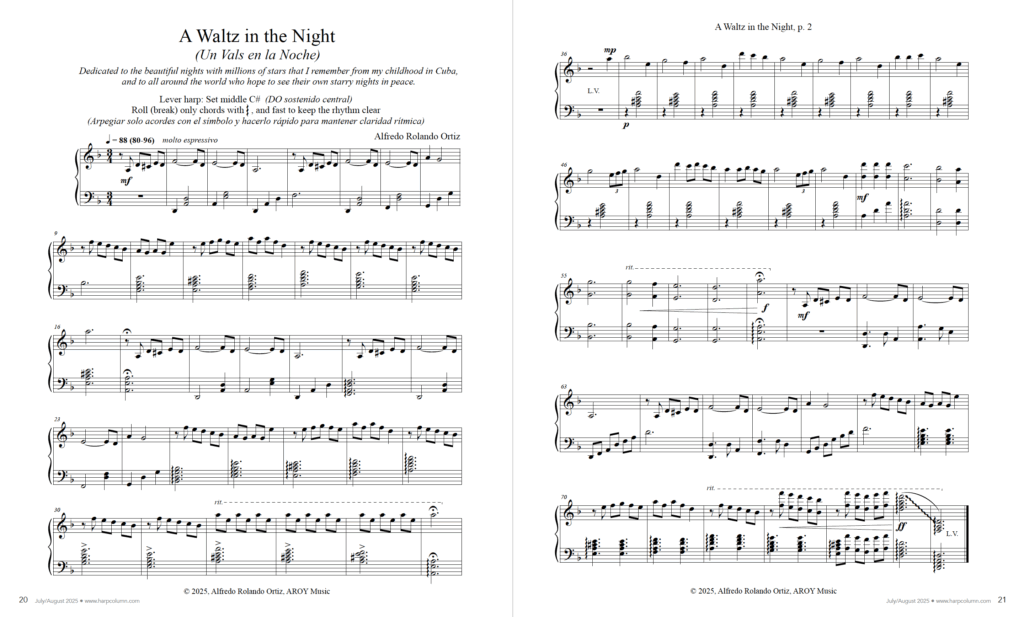
A Waltz in the Night is different. I decided to give it a variety of accompaniment patterns, purposely leaving out the most common pattern of all: the distinctive oom-pah-pah. Observe the different bass patterns during the three times the main melody occurs. The first time (measure 2) the bass only plays on the first and second beats, except measures with just a chord on the bass. Notice that none of the chords are arpeggiated that first time. The second time (measure 18) the bass only plays on the first and third beats, and some of the chords are arpeggiated. Then on the third time (measure 61), I used traditional patterns of the harp music from the plains of Venezuela and Colombia, giving A Waltz in the Night a strong and contrasting 6/8 meter feeling all the way to the end.
First, read the instructions
Yes! There are instructions! I include notes or instructions below the title on most of my music. Read the instructions more than once. Follow these important instructions:
Roll or break only chords with the proper symbol (that long vertical squiggly line to the left of the chord).
To keep the rhythm clear, roll or break those chords fast.
This piece has no arpeggiated chord symbols continuing uninterrupted from bass to treble clefs. That means that both hands should roll the chords simultaneously, not the bass first and then the treble notes.
SLOWLIER: That is not a typo, slowlier is my word. Several thousand harpists that have been at my workshops around the world know it very well. That is the secret to learning or improving challenging parts or phrases or techniques.
Finally, the last two measures are connected by a glissando that begins when the right thumb plays the top note of the treble chord and continues through the duration of the measure, and then finishes with the final chord. Practice this at a slow speed to achieve a beautiful legato, aiming foreven duration of all the notes in the glissando until the last chord.
I dedicate A Waltz in the Night to the beautiful nights with millions of stars that I remember from my childhood in Cuba and to all around the world who hope to see their own starry nights in peace. •