

Sometimes life has a way of playing out in a way that is more poetic than the best storyteller could dream up. Such was the case with the events that unfolded over several weeks this past May in Bloomington, Indiana.
Noticeably absent from the awards ceremony was the woman who had placed the gold medal around the neck of the previous 12 winners of the competition—USAIHC founder Susann McDonald
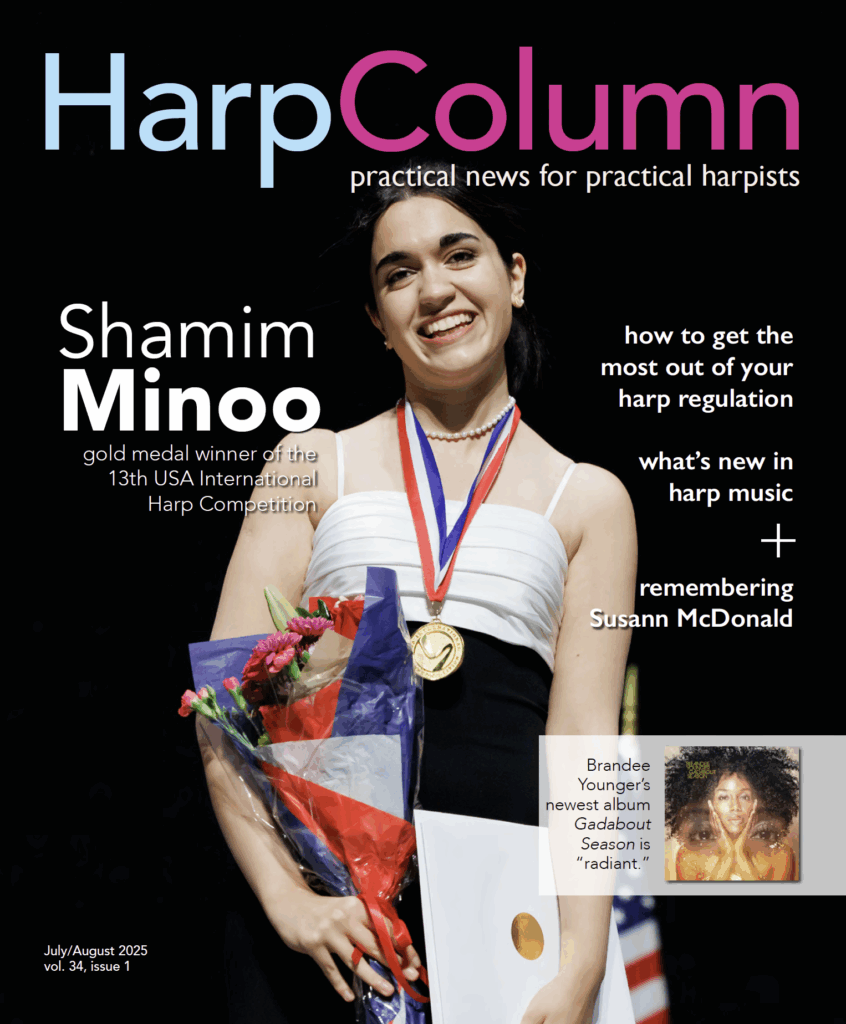
As the harp world looked on from near and far, 44 of the best young players from 19 countries competed for the gold medal of the USA International Harp Competition (USAIHC). Since its inception in 1989, the USAIHC has become one of the premier solo harp competitions in the world—arguably the best and most diverse gathering of talent anywhere. The field was whittled down to three finalists over two weeks of competition. After four grueling stages of music, 20-year-old Iranian harpist Shamim Minoo was crowned the winner. Minoo’s story is nothing short of inspiring. Simply making it to Bloomington is a truly incredible feat, even under ideal circumstances, and I’m always in awe of a harpist with the grit, talent, perseverance, and stamina to compete in the USA competition. Knowing how fiercely difficult it is to even walk on stage in Bloomington, the story of Minoo’s journey is that much more remarkable. As Minoo recounts in our interview (see Shamim Shines in Bloomington), the road to gold was not a smooth one.
Minoo is from a country without the classical harp infrastructure to produce world-class musicians, and her family did not have the means to send her abroad to study for more than short periods of time. Out of money and options to continue studying in France, Minoo nearly quit the harp a few years ago. But all good stories need an unexpected turn, and that is what Minoo received to set her on a path to compete in Bloomington.
As Minoo performed a beautiful encore of traditional Iranian folk songs she arranged and sang during the final stage of the competition, it was hard to imagine she nearly had to walk away from the harp a few years earlier. Stories don’t always have happy endings, but this chapter closed with a sweet note as Minoo stood on stage to receive one of the most coveted prizes in all the harp world.
Noticeably absent from the awards ceremony was the woman who had placed the gold medal around the neck of the previous 12 winners of the competition—USAIHC founder Susann McDonald. Just five days later in Bloomington, the competition announced that Susann McDonald—a grande dame of the harp—had passed away at the age of 90. With McDonald’s death, a great light of the harp world was extinguished, but not before a new light was illuminated for the entire world to see in Minoo’s gold medal win. It almost felt as if McDonald had lived long enough to make sure one last group of young harp stars had taken the stage before taking leave of it.
McDonald spent her entire teaching career bringing out the best in young musicians so audiences could hear what the harp could do in their hands. What I find remarkable about McDonald is that she took care to guide and encourage every harpist she encountered, not just the crème de la crème of classically trained students. Jazz harpist Carol Robbins shared an early memory of McDonald encouraging her to pursue her burgeoning love of jazz, rather than pushing Robbins toward her own classical expertise. Robbins was “gobsmacked” that a musician of McDonald’s stature would give such gracious guidance.
Folk harpist Sylvia Woods wrote in her most recent newsletter of her experience studying with McDonald early in her harp journey, “I was struggling to figure out which harp to pursue and what type of music I wanted to play,” she recalls. “Susann encouraged me to explore a variety of genres and styles, follow my passion, and forge my own path. Fortunately, I took her advice, and the harp became my life’s calling.”
Susann McDonald understood that each harpist’s light shines brightest when it is fueled by the music they truly love. Her steadfast commitment to this idea shaped generations of students and left a profound, lasting impact on the harp world. Today, the harp shines more brightly in the world because of her. •