
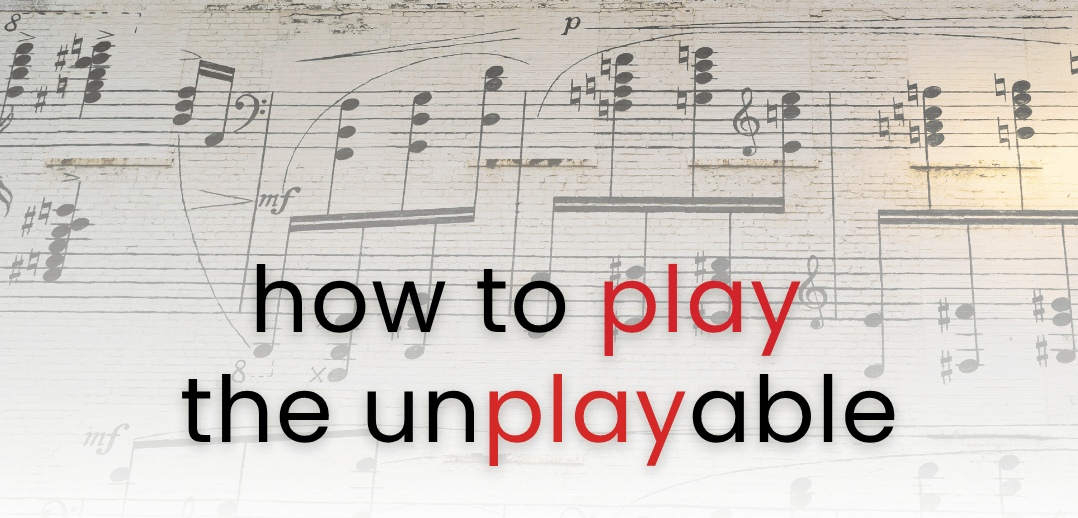
We’ve all been there: you’re deep in a piece, cruising along, and you hit a wall. A five-note chord. A jump from the bottom of the harp to the top in half a second. Pedals that would need three feet to execute. It’s the harpist’s version of showing up to a hiking trail and finding the bridge washed out. So what do you do? Turn around, or find another way across? We asked a wide array of professional harpists how they handle the moments when the composers’ dream and the instrument don’t agree.
Boston, Mass.
Vancouver, Canada
Salt Lake City, Utah

Miami, Fla.

Milan, Italy
Southern California
Washington, D.C.
Sydney, Australia
Philadelphia, Pa.
Denver, Colo.
Why do harpists run into unplayable passages?
The short answer: because most of the people writing for harp have never played one. Add in the fact that hands come in different sizes, most other instruments are louder than ours, and some composers think we use 10 fingers, and you’ve got a recipe for passages that look fine on paper and fall apart in practice.
“The main reason that harpists encounter poorly written parts is lack of experience writing for harp,” says Felice Pomeranz. “If you’re working with a composer or arranger, it would be beneficial to have a meeting with them at the harp to demonstrate better ways of writing passages. At Berklee College, I present a ‘Writing for the Harp’ clinic every year, and the harp students visit composition and arranging classes to do demos each semester. The result is better written harp parts.”
Elizabeth Volpé Bligh points out that sometimes a piece is physically impossible for one body type compared to another. “Harpists must design their own fingerings that still bring out the musical intent of the composer, while making it possible for them to accomplish the passage without buzzing or missing notes.”
Nicole Brady points to a favorite culprit from the Romantic era: composers who didn’t play harp but still felt they could tell other composers how to write for harp. “Berlioz writes in his Treatise for Orchestra about how it’s so great to have lots of notes in the bass, like chords. Are you kidding me? We all would turn that into octaves.”
Harpist and Broadway veteran Laura Sherman traces the problem back to the instrument’s own history. “Lack of knowledge about the harp is the main reason that harpists encounter passages that are difficult or impossible to execute. This is especially true for composers who lived during the early years of the double-action pedal harp, starting around 1810, when little was known about the instrument. Since there were no orchestration treatises or other resources that discussed the double-action pedal harp for a composer to consult at that time, they would need to work closely with a harpist to learn how to properly write for the harp. I was taught that for early performances of Berlioz’s Symphonie Fantastique (1830) the harp parts were sometimes played on the piano because either there were no double-action harps available or no harpists around who could play the parts on the newly-invented instruments.”
The good news, Sherman says, is that things have improved. Composers today have more to go on, and orchestrators who write regularly for Broadway and commercial music tend to know the instrument pretty well. Even so, old habits die hard.
What actually makes a passage unplayable
There’s a real difference between this is hard and this cannot be done.
“We know that certain piano-like writing doesn’t work, nor fast jumps or overly chromatic writing, and all of these [parts] will need to be edited,” Sherman points out. “There are many other types of unplayable parts, but these, in my experience, tend to be the most common. I wish composers understood that the harp is not a piano!”
Volpé Bligh points to editions themselves as a hidden source of trouble. “Sometimes there are mistakes or second editions of the printed music. These can be very different from the original. One example is Hindemith Sonata dynamics from edition to edition. There are [also] many misprints to be wary of in excerpt books.”
Volpé Bligh has also written directly on this subject for Harp Column, and has published her own edited parts for the Nutcracker cadenzas through Harp Column Music (worth a look for anyone facing that particular bridge).
Brady gives an example that turns up again and again: fast, ascending arpeggios in both hands. “A good example is some of the Strauss and Britten excerpts with arpeggios in each hand. These ascending arpeggiated sixths are so difficult! Harpists can play them—it’s possible—there’s just a strong chance they won’t sound good.” Brady found a fix for her students. “Take the sixth at the bottom of the arpeggio and play it as a sixth with one hand, then play the arpeggio in the other hand (the top line of the sixths) and grab another sixth again at the top with the alternating hand.”
Difficult vs. unplayable: how to tell the difference
This is the real judgment call every harpist has to make, over and over. Is this passage asking you to work harder, or is it asking you to do something the instrument physically can’t do? Brady says the answer comes back to the same question every time. “It is so frequent that we have to sit down and look at the piece of music, and when something just is awkward, or difficult, or messy, that we ask ourselves: what did the composer want? What was the intention here?”
Harpist Floraleda Sacchi agrees that part of our job is considering the intention of the composer. “I think one should always consider the whole piece (if an orchestra passage or a chamber music piece) and the effect the composer had in mind. Any change should not affect the musical idea, but instead emphasize it,” she says. “This evaluation has to do with being a musician and knowing the whole score. When something is really challenging, a simplification may be found, but in the light of the above consideration.”
Harpist Liz Zosseder has found recurring themes in what often makes something truly unplayable, not just a challenge. “I think unplayable passages often involve pedal issues with enharmonics that simply don’t work no matter how much one tries to puzzle it out, or more technical issues like fingers placing on top of each other, repeated fast notes where enharmonics aren’t possible, too many fast jumps back and forth that wouldn’t even be possible memorized, or something like a left-hand passage that is super low and requires two hands but the right hand can’t reach.”
Sherman’s method to determine playability is part trial-and-error, part trust your gut. “I always try to learn the original (within reason) while playing with recordings online. If I keep tripping up on certain unidiomatic passages, I’ll edit the parts until it is secure,” she says. “This becomes easier over time as one’s abilities and experience help guide the process. We learn to trust our instincts instead of being fearful or uncertain about what needs to be edited.”
But Sherman also notes an important exception: some famously hard passages are hard on purpose, and everyone just has to learn them as written. “There are certain iconic excerpts or parts that we all learn in school and know are difficult and need to be learned as is, such as Berlioz’s Symphonie Fantastique, Stravinsky’s Symphony in Three Movements and Ravel’s Tzigane cadenza, for example. We might have minor edits or different fingerings for these important parts, but no major changes are considered acceptable. They are simply hard and require more time to learn.”
Harpist Melissa Dvorak points out that you should consider your preparation time when determining a part’s playability. Having to sightread for a rehearsal tomorrow is much different than having weeks or months to prepare. “The timeline will certainly affect how much I will edit a piece of new music,” she says. “A fast tempo with many quick notes (16ths, 32nds), multiple pedal changes, and many repeated strings—those are my first clues that I might have to do some editing.”
Harpist Emily Granger also faces time restrictions on a regular basis. “I encounter awkward and annoying passages nearly every week in my role as principal harp with the Queensland Symphony Orchestra. Almost every week I’m learning and performing around 50 pages of music. There’s far less time to waste on poorly written passages than I ever realized before winning my job. The orchestra relies on our confidence, big sound, and rhythm, and simple rewrites let us get straight to the core of playing and listening.
“The question is always: does the difficulty serve the music? You can only answer that after score study and listening to the best recordings. Only then can you begin to edit your part. In my career, no conductor has ever called me out for editing my part, and let’s be honest, sometimes it can be quite significant! But that’s the goal: it sounds and looks exactly like what’s on their score.
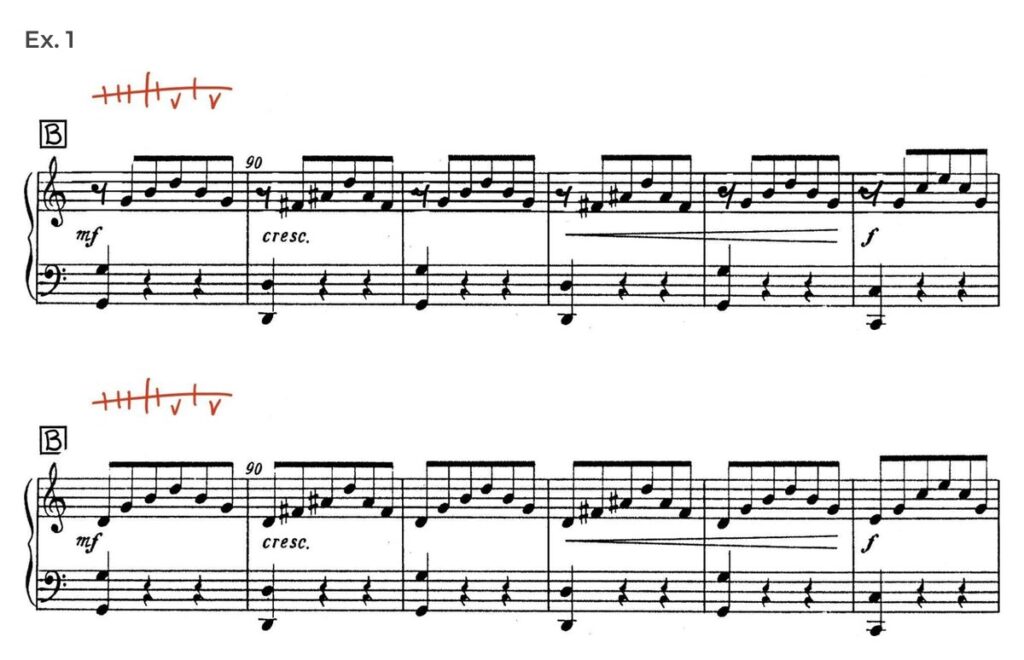
“Dvořák’s Scherzo Capriccioso is a perfect example. The right-hand pattern here is completely doable, but it is fast and forte. My hand cramps up without a moment to relax, especially as this is quite a long passage. Leaving out the first beat in the right hand lets it flow and waltz with ease and authority. [See Ex. 1]
“I owe the art of editing to my teachers, and now strive to pass it along to my students. Sarah Bullen showed me how it’s done from the orchestral point of view, and Lynne Aspnes taught me to keep the music moving rather than getting bogged down in the notes. Bullen’s books are the gold standard, and study of her edits versus originals is invaluable. Instagram is a great resource too: I follow other harpists and post my own practice videos and sneaky edits.”
Granger credits her teachers for her ability to successfully navigate the editing process, so how do teachers pass on this skill?
How to teach unplayable parts
A good teacher doesn’t just show a student what to play; they show a student how to think about the problem. A lot of things we teach never make it on to the page. Traditions are passed down teacher to student, generation to generation, almost like folk music.
“A benefit of the harp world is that the lineage seems to all return to Hasselmans,” notes Pomeranz. “Many of the great harp teachers studied with either students of Hasselmans or the students of students from his studio. I was very fortunate to study both with Marjorie Call, Salzedo’s former wife, and with Bernard Zighera, who studied with Marcel Tournier. It was incredible learning Scintillation with the woman for whom it was written, and to learn many Tournier pieces from a key harpist who studied with this French master at the Conservatoire National Supérieur de Musique et de Danse de Paris. Having these opportunities and writing notes about the interpretation enables one to pass down elements not necessarily written on the page.”
There are also many written resources that can help. “I always find it really useful to make them study the appendix on ‘Harp in the Orchestra’ included in The ABC of Harp Playing by Lucile Lawrence,” says Sacchi. “Studying such a brilliant collection of solutions can be a good inspiration to learn to work alone later.”
Sherman treats editing itself as a skill worth teaching directly, not just something students pick up by osmosis. “Teach [students] the ‘tricks of the trade’ during lessons and have them try editing at home and turn it in to be reviewed by the teacher,” she advises. “Personally, I love the art of editing harp parts and always start early with my students. I try to inspire them to be curious and enjoy the process which, honestly, can be frustrating at times. But to have a collection of well-edited orchestra harp parts is a thing of beauty. Have patience with the editing process and remember that editing is an art form.”
Sherman even keeps a digital folder of her edited parts for easy sharing. “I give all of my students access to my digital folder of parts, even after they have moved on in their education and careers.”
Dvorak helps students understand that editing has been a part of being a harpist for centuries. “When students are reluctant to edit, I reference the Tchaikovsky/Zabel relationship and the famous cadenzas Zabel helped him with. We talk a lot about maintaining the character of the music, and that playing some things is going to be better than playing nothing correctly.”
Zosseder learned a lot about the editing process from her teacher. “I had one teacher (JoAnn Turovsky) who was amazing at editing parts because she was one of the main harpists in the studio and recording industry for years. So she was used to simplifying parts on the spot.” Zosseder says Turovsky had several different approaches. “For more well-known passages, such as Wagner’s Fire Music, the pedal nightmare from the Debussy Danses, or popular orchestra excerpts like The Nutcracker, she would pass on knowledge passed down from her teacher (Susann McDonald) and any changes she preferred and edits from published articles and orchestra books,” she says. “But for new music or even when students are handed piano music, she would always ask us to think about what the composer intended and to try our best to edit it prioritizing what the composer intended (or ask them, if possible). Is the harmony more important (this can be based on instrumentation), and what else might be going on? What notes can be left out without being heard? If it’s fast, finding easy fingerings and cutting out a lot of other notes might be the priority to make it sound smoother. Often if it was a group of notes in a super fast scale, even if glissando was in no way marked, if it’s during a loud passage, that may often be the sound the composer intended. So trying to play a piece as written, even if possible, may not be the best choice. I learned the most by going through parts with [Turovsky] and editing them, and I will always be grateful for that because, as harpists in the professional world, we constantly have to edit parts.”
But most harpists reach a point where they no longer see a teacher on a regular basis. What then?
“The harp world is very small, and harpists are typically generous and kind people,” says Pomeranz. “You could always reach out to professionals in your area to find out information about a score or piece. Take them for coffee or send a thank you note and gift card for their help. The American Harp Society Archives are also a wealth of information about scores, historical information, and more.”
Harpists are often the best source of good edits for unplayable passages, but these edits are often unpublished and hard to find. Granger points out that while some good edits are available online, like Elizabeth Volpé Bligh’s editions on Harp Column Music, we would all benefit from more publicly available edits. “I would love more harpists to be open about their edits and sharing the great ones that work. This is something unique to us that most other instruments never have to worry about, so let’s own it,” she encourages.
Harpist Mindy Cutcher wishes that orchestra librarians would make it easier for us when we don’t have a teacher to help with markings. “It is one of my pet peeves when you receive an orchestral part that has been erased with the fingering and pedals,” she says. “All harpists need to start writing ‘do not erase’ at the top of our rentals!”
Cutcher adds her two cents about editing parts: “If at all possible, listen to a couple of recordings to see how your part fits in and to get a sense of tempos. Be flexible and experiment with different fingering, switching of hands, and rewriting of pedals. Nowadays, our parts are sent to us digitally. Ask the librarian to send you the actual part and not the ‘clean’ copy. You are the expert and probably know more about what is playable than the composer does,” she adds.
How performers approach an unplayable passage
The most important question is: what do you do when you come across these issues? Prokofiev’s Romeo and Juliet gave Cutcher a full toolkit of fixes for problems we see often: chords and jumps that were never built for eight fingers and two feet.
“Sometimes by taking out just one note, the harp part is not only playable but sounds better in the ensemble. You can play the part louder and with confidence. Prokofiev’s Romeo and Juliet is a perfect example. In one number he writes five-note chords in one hand, plus intervals (12ths and 14ths!) that just aren’t playable. I would say: check the notes in both hands of the chord. It makes more sense to take out a duplicated note. In the case of a five-note chord in one hand, take out a middle note if you can, especially if that note is duplicated in the other hand. If there is a lot of impossible jumping back and forth from the extremes of the instrument, see if you can change a lower note to an octave above. Most of the time, tubas and basses are already playing that lowest note. Because high notes cut through the orchestra’s dense texture, if you have to cut something, keep the notes that will actually be heard. With impossible pedaling, enharmonic substitutions can simplify things. With big, fast arpeggios, cut some of the turnaround notes so you’re not late for the next beat. And always check whether another instrument doubles your part; that tells you exactly which notes are safest to lose.”
Sherman learned her own toolkit early from a teacher, Mary Brigid Roman at Florida State University, who treated part-editing as a craft worth passing down in detail. “Since composers often do not understand the harp, keeping the overall effect of the writing in mind is most important. An idiomatic part is going to be far more successful at conveying the overall effect than an unidiomatic one, so edit accordingly,” she advises. “Always try to keep the same or similar rhythmic patterns, harmonies and pitch ranges, but feel free to change arpeggio directions or spacing, revoice chords, use enharmonic spellings, leave out some (or all!) of the left-hand notes to get all of the right-hand ones or vice versa depending on which is more important. Get comfortable with irregular fingerings. They are your best friend for piano-like, five-finger writing.”
And then there’s the problem of the conductor. A passage that’s technically playable but keeps your eyes glued to the strings is its own kind of unplayable.
“Don’t forget to factor in time to look at the conductor,” Sherman adds. “If the part is too hard or unidiomatic then we spend most of our time looking at the music and strings and risk not being with the conductor. I call this concept ‘visual triangulation,’ having to scan between three places—the strings, music and the conductor—and it needs to be practiced. If you can’t look up at the conductor frequently, then the part needs to be edited.”
Harpist Mary Kay Waddington, who edits professionally and developed the Suzuki Harp Method, breaks her approach into concrete moves. First: know what you can safely leave out. “There are many things that are really hard on your hands and can easily be changed. For instance, the left-hand 10th chords with four notes in them are really hard on your tendons and, nine times out of 10, an inner note can be left out so the normal 10th chord is played. Things like three or four octaves played with the same notes in two hands can be played as two octaves with one hand playing each line. This is much easier on the hands and sounds almost the same, especially in orchestra. Always get a copy of the score, usually available on IMSLP. Check everything you’re playing to see if other instruments are playing the same notes. If there’s a difficult section and [other instruments] are playing the same notes, and it’s marked ff, don’t knock yourself out! Play the simplest amount possible and appear busy. The point is to not be afraid to change things to make it easier to play. I like to always keep in mind three things to be sure and retain: harmony, rhythm, and shape. Although I rarely change notes in solo music, there are exceptions. For instance, in the Debussy ‘Danse Profane,’ measures 81 and 82, the original has a fast section with notes repeating—almost impossible to play cleanly and legato. In my edition I’ve changed it.”
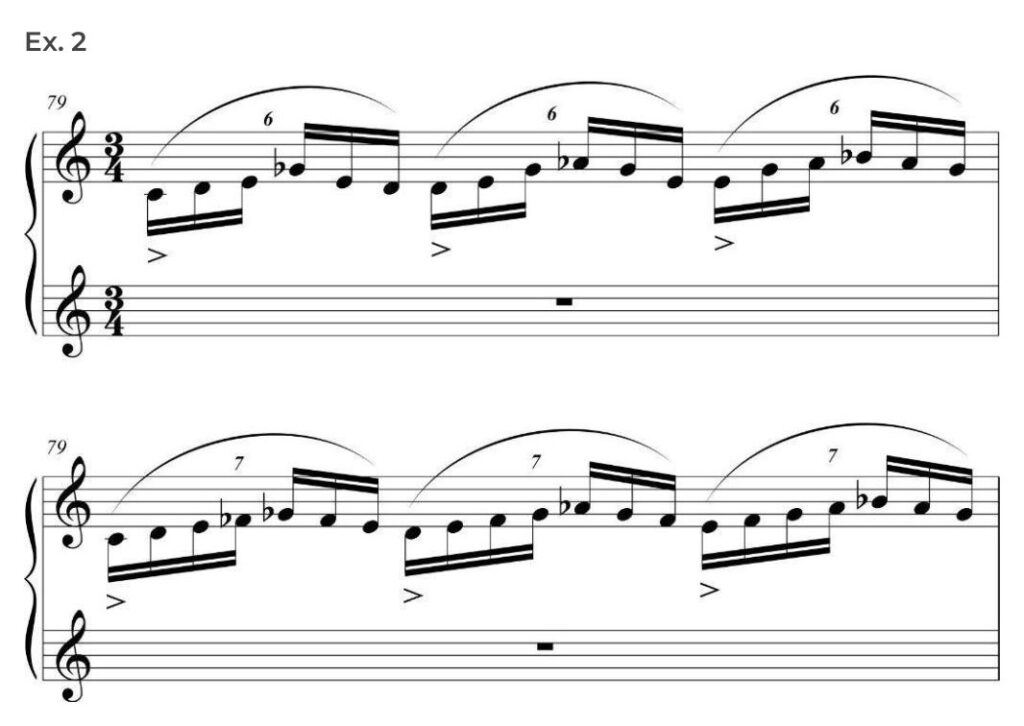
Second: Waddington finds better ways of playing the given notes. “Enharmonics are, of course, the harpist’s best friend,” she says. “There’s usually a way to make the pedals work by finding the right enharmonics, but it often takes time and creativity. For glissandos, always check the score to determine the harmony you should be using, then choose enharmonics accordingly.
“It also helps to divide passages creatively between the hands. For instance, in Renié’s Contemplation, there’s a long, fast section of one-handed arpeggios. Renié occasionally has the left hand jump up to help, but in my edition I’ve added many more opportunities to give the right hand a break: for example, in measure 45. [See Ex. 3]
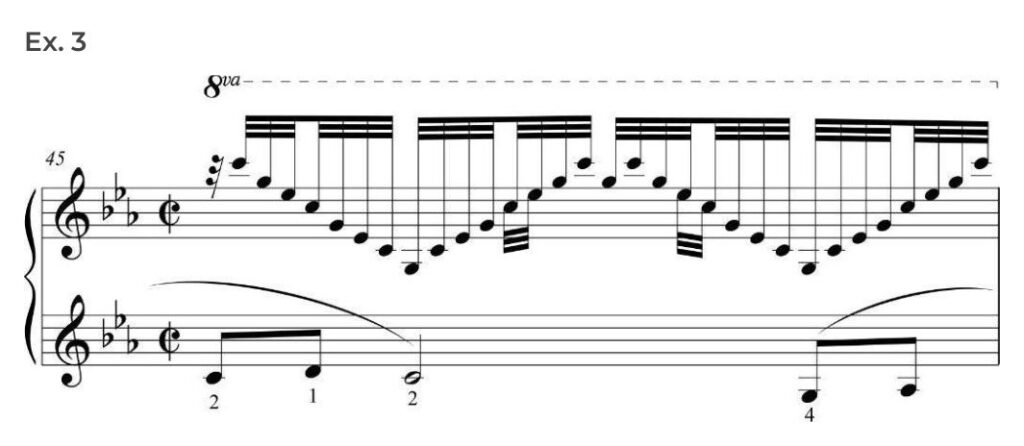
“Again, don’t be afraid to experiment. My students and I sometimes try a dozen different fingerings before we find the one that really works.”
Finally, Waddington believes in making everything visually easier to play. “Sometimes this is as simple as beaming the rhythm according to the beats instead of using one long beam, or using cross-staff beaming to show which hand plays each part of an arpeggio. In the Britten ‘Interlude,’ I’ve changed the notation so the main beats of the compound rhythm are much easier to read. [See Ex. 4]
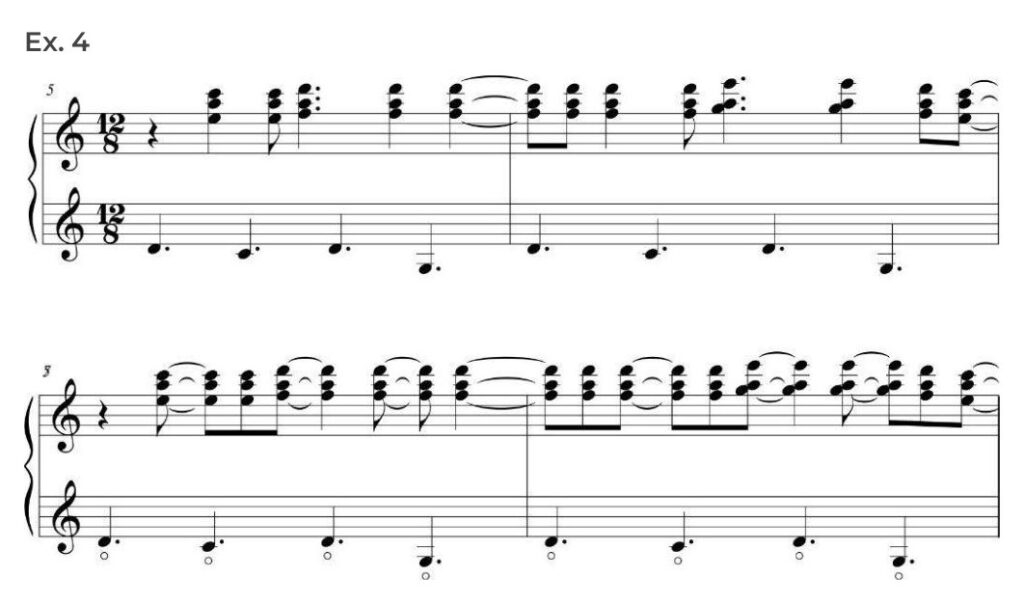
“Sometimes, though, it means rewriting the entire part to make it visually more playable. After years of rewriting unreadable orchestra parts for students, it occurred to me that these editions should be published so all harpists could benefit instead of everyone reinventing the wheel each time a part was handed out. That’s how The Harpists’ Edition came about. It’s now available for a dozen of the most visually challenging orchestral parts. All enharmonics are written as played, all pedals are included, all cues are in concert pitch, exposed passages are clearly marked, page turns have been optimized, fingerings have been thoroughly tested, and the spacing has been designed to be easy on the eyes. If you have any pet-peeve orchestra parts that are especially difficult to read, let me know—I’m always looking for additions to The Harpists’ Edition,” she notes.
“So don’t be afraid to leave awkward notes out of orchestra parts, as long as doing so doesn’t change the harmony, rhythm, or musical shape. Experiment freely to find fingerings that work, and think creatively about how to approach difficult passages. Finally, remember that the visual presentation of the music is enormously important. Making a part easier to read can make just as much difference as making it easier to play.”
Working with composers and performing newer music can make things easier, because you can go right to the source, notes Sacchi. “Speak with the composer, try to play as written as much as possible, and at the end find a solution. If it does not work, use the experience and the knowledge of already commonly used solutions (for example, the ‘Waltz of the Flowers’ cadenza) and proceed accordingly. Observation and musical knowledge of the piece are always the keys to finding a good solution. Working with many composers, I have noticed when showing them a passage with a possible solution they are always quite open to accept the change with enthusiasm.”
Resources for the next washed-out bridge
You’re not the first harpist to hit this particular wall, and you won’t be the last. So what do you do when this happens?
“When learning orchestra parts, for example, it is always good to look at editions by orchestral harpists. Sarah Bullen’s editions are a great resource, as are edited parts of transcriptions by Grandjany, Salzedo, McDonald, and other great player-composers,” recommends Pomeranz.
Laura Sherman keeps a working shelf of orchestra excerpt books for exactly this reason. “I like to consult various orchestra excerpt books written by orchestral harpists and teachers over the years. Mary Brigid Roman has generously shared most of her library of edited orchestra harp parts with me. I always learn new things when I play her edited parts.”
Zosseder has some comforting words for the younger generation: knowing how to edit gets easier the more you do it. “Sometimes doing the easiest option is best. Sometimes spending the time to heavily edit and practice tricky passages is best. It really depends on the context, scope, and priority of the music at hand, but the more experience one has, the easier it gets.”