

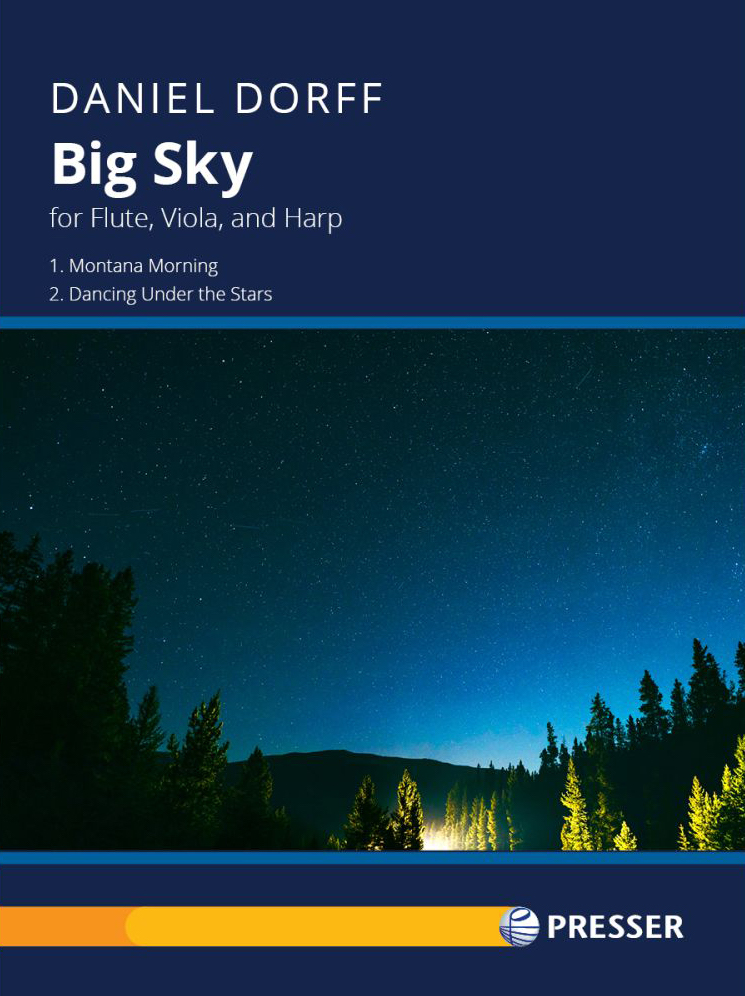
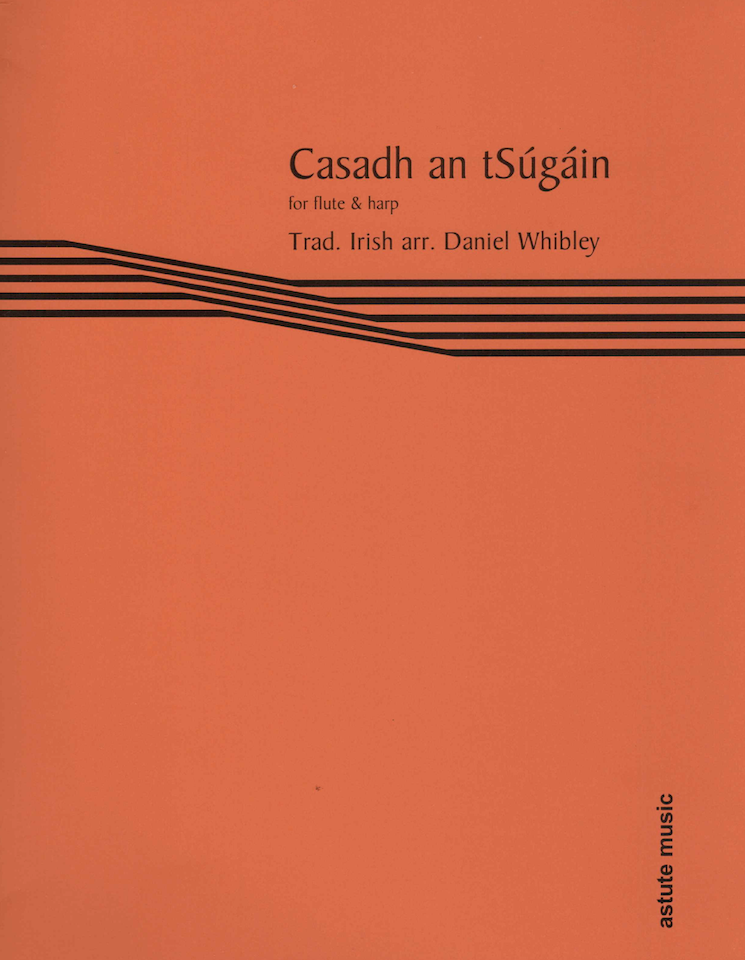
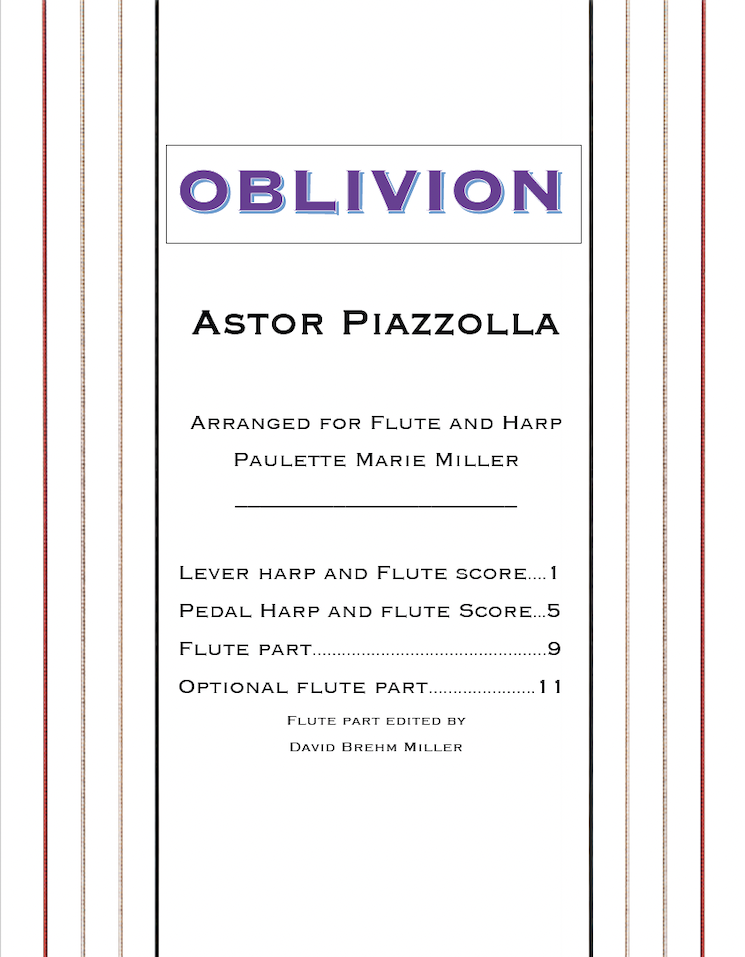
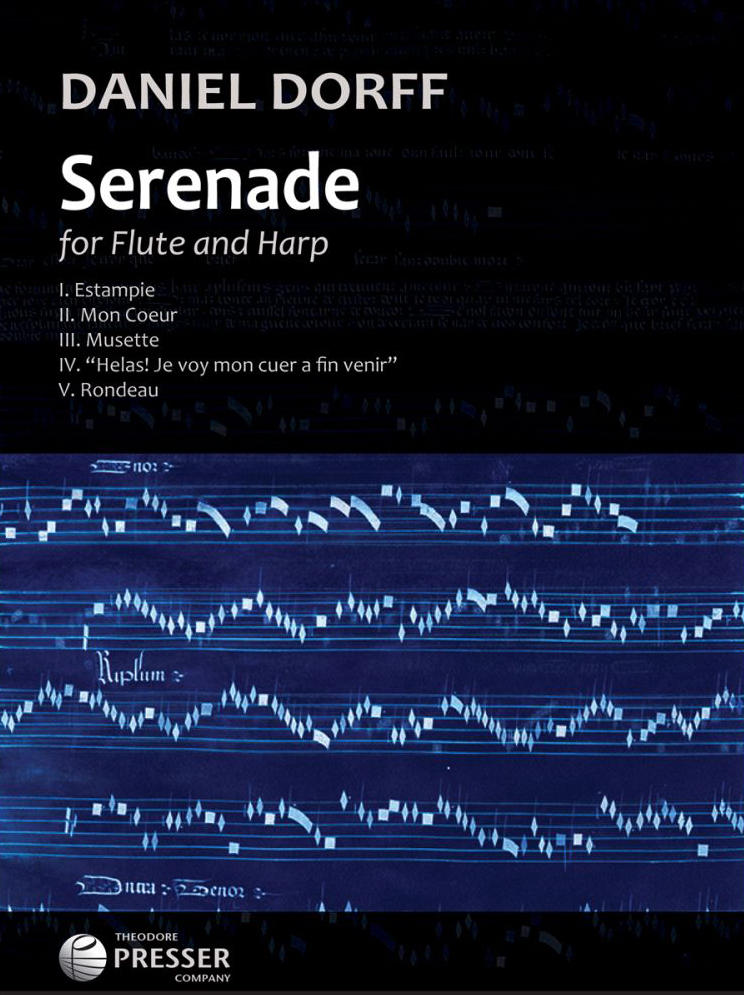
New music to play with others includes (from l. to r.) two works by Daniel Dorff—Big Sky and Serenade; Piazzolla’s famous Oblivion, arranged by Paulette Marie Miller; Casadh an tSúgáin arranged by Daniel Whibley; and Sea of Stars, written by Lauren Scott.
If you like playing with others, here are several recent publications to add to your holiday wish list.
Theodore Presser Company has published a trio for flute, viola, and harp by Daniel Dorff. Big Sky was inspired by the majesty of the Big Sky state, and it was commissioned and premiered by the Hat Trick Trio (April Clayton, flute, David Wallace, viola, and Kristi Shade, harp). There are two movements with a total performance time of 12 minutes.
The first movement, “Montana Morning,” delightfully depicts the awakening of the vast countryside. It is about three and a half minutes and concludes with gentle harmonics on the harp.
The second movement, “Dancing under the Stars,”is an energetic succession of dances. It incorporates special effects such as scale glisses, gushing chords, pedal slides, and harmonics. There are meter changes that become more frequent as the piece progresses. Page turns were thoughtfully considered, and several pedal charts are included throughout the harp part. The many pedals are written below the staff.
Another Dorff composition, Serenade, was commissioned by the Sparx Duo (Joan Sparks, flute, and Anne Sullivan, harp). This harp and flute suite has five movements for a total performance time of 16 minutes. Like the aforementioned work, each movement can be performed alone or as part of the entire suite. Dorff wanted to honor late French medieval music and was specifically inspired by a 14th century love song by Solage.
The first movement, “Estampie,” is a spirited dance with frequent meter and key changes. The second movement, “Mon Coeur,”is a wistful, medieval love poem featuring some bisbigliando.
“Musette”is the third movement. It is primarily a lively dance until near the end when it takes on a more dreamy quality with some bisbigliando as it fades away.
The fourth movement, “Helas! Je voy mon cuer a fin venir,” is a transcription of the actual song by Solage that was originally written for a male singer with accompaniment. It is a typical medieval love song about dying of a broken heart.
The fifth and final movement, “Rondeau,”is an “optimistic answer to the unrequited love of Solage’s work.” An exuberant finale to the suite, it is full of enharmonics, pedal and meter changes, scale glisses, and harmonics. It is the longest movement at about five and a half minutes.
Dorff collaborated with Sullivan several times to craft the harp part so it would be very playable for the harpist. The frequent meter changes make it a challenging piece, suitable for the more advanced player, but worth the effort.
Paulette Marie Miller has arranged and published Oblivion by Astor Piazzolla (1921–1992). This hauntingly beautiful music is one of the well-known Argentinian composer’s most popular pieces. Miller has arranged it for harp and flute.
The set includes two separate harp scores—a lever harp score and a pedal harp score—as well as a flute part. Also included is an optional flute part with added ornamentation that gives the flute a chance to be featured a bit more. The music is available as a PDF download from Harp Column Music (harpcolumnmusic.com) where you can listen to a recording of the lever harp version with the optional flute part.
Lever changes are notated by both diamond-shaped notes and letters (e.g. F#). Pedal changes are marked below the staff. There is an unnecessary A-flat pedal marking in m. 41. There is just one page turn, and it is manageable. The harp parts are suitable for intermediate players, and you can let your flutist decide which flute part, both edited by David Brehm Miller, they prefer. It’s wonderful to have so many options for performing this marvelous and crowd-pleasing piece.
Astute Music has published an arrangement of a traditional Irish tune, Casadh an tSúgáin (The Twisting of the Rope), for flute and pedal or lever harp. This arrangement by Daniel Whibley is also available in versions for harp and B-flat saxophone, or harp and E-flat saxophone. The harp part is five pages and almost four minutes in length.
You can hear the Aquilae Duo (Eleanor Turner, harp, and Lisa Nelsen, flute) play this captivating and lovely piece on the Astute Music website. The harp begins with a repeated pattern, and the flute enters with the melody. There are two verses of this duo version, and then the harp takes a solo verse. The flute rejoins the harp for the final verse, and it ends with the repeated pattern from the beginning. There are no pedal or lever changes or any suggested fingering. It is appropriate for intermediate or above players.
Astute Music has also published Sea of Stars, a dazzling original piece by Lauren Scott. It was originally written as a duo for lever and pedal harp but has since been arranged for harp quartet (four pedal harps or a combination of lever and pedal harps). It is three and a half minutes long.
What is most appealing about this work is the many special effects Scott uses to represent the glow-in-the-dark, bioluminescent plankton that inspired the piece. A few effects are familiar such as tapping and xylophonic sounds, but there are several new or rare effects as well. The most fascinating are xylo harmonics, xylo tremolo, tremolo glisses, and harmonics that alternate between the octave and twelfth point on the string. Luckily, Scott has made a video and provides performance notes to explain the notation and how to execute these effects.
In addition to the extended techniques, there are fast, splashy arpeggios. It is very rhythmic and played at a high-energy tempo, making page turns difficult. You’ll want to memorize this piece anyway so you can nail the harmonics.
There is just one lever change, and it is notated with a tiny, diamond-shaped note enclosed in a box. There are several pedal changes, and they are not marked. It is suitable for upper intermediate to advanced players.
This is a brilliant and charismatic piece that is exciting to play and impressive to hear.
Happy Holidays! •