




Wondering about a lever harp regulation? Understand the differences here.
“I t’s like a spa day for my harp!” This is one of my favorite ways customers have described bringing in their harps for regulation. Others liken it to a trip to the “harp doctor.” You’ve probably had your harp regulated, or at least heard about regulation. But what actually goes on, and more importantly, what’s the point? In this article, I’ll give you a general overview of the harp regulation process, why harps need service periodically, and how you can best prepare for your harp’s next “spa day.”
The basics
Among several definitions of the word “regulate,” Merriam-Webster includes “to bring order, method, or uniformity to.” This is a good description of the overall goal of a harp regulation. Through playing, moving, time, wear and tear, and the movement of wood under string tension, the various parts of a harp stop working together as optimally as they should. Just as a car needs a periodic tune up, a harp’s mechanical parts need adjustments now and then to keep the harp playing its best. Strings and discs are brought into the best alignment possible. Disc rotation is adjusted. Unwanted vibrations are diagnosed and eliminated. The end result is a harp that plays and sounds as good as it possibly can.
Do all harps need regulation? Yes! Any harp that is regularly played will develop intonation problems and lose tone quality. In addition to servicing the mechanical parts, most technicians do a thorough inspection of the instrument’s condition. They can spot minor repair needs before something breaks on your harp. If more extensive repairs might be on the horizon for older instruments, a technician can let you know about them so you can consider timing and budgeting issues. As a result, even if your harp sounds fine to you, it’s a good idea to have it regulated on a regular basis.
While pedal harps generally require regulation more frequently, lever harps benefit from periodic service as well. Much of this article will focus on pedal harp regulation, but we will also explore what goes into a lever harp regulation.
Reasons for regulation
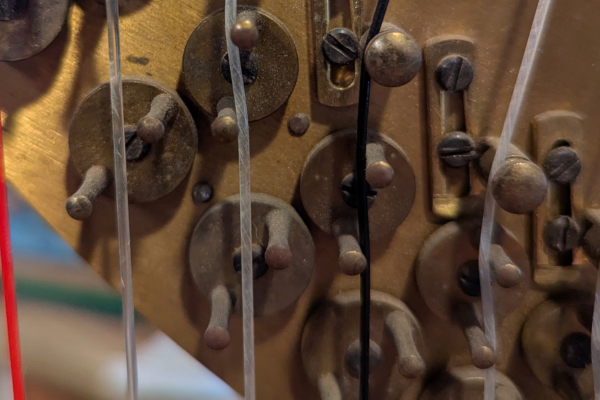
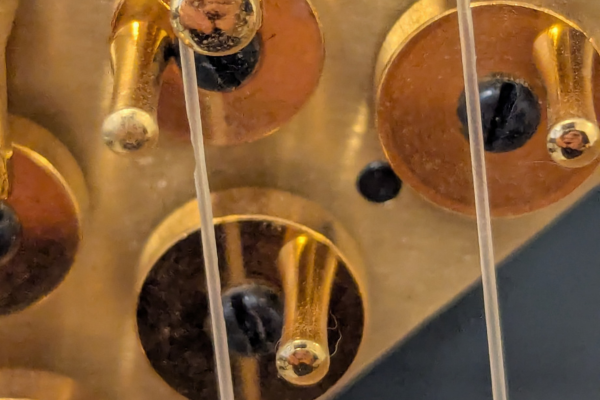
There are five main reasons a harp might need a regulation:
Age: Over time, under the continuous string tension, changes occur in the harp’s structural parts. Most importantly, the soundboard is pulled up over time, and the neck is pulled slightly down and twisted sideways. These changes result in changes to the speaking lengths of the strings relative to the discs, which can lead to intonation problems.
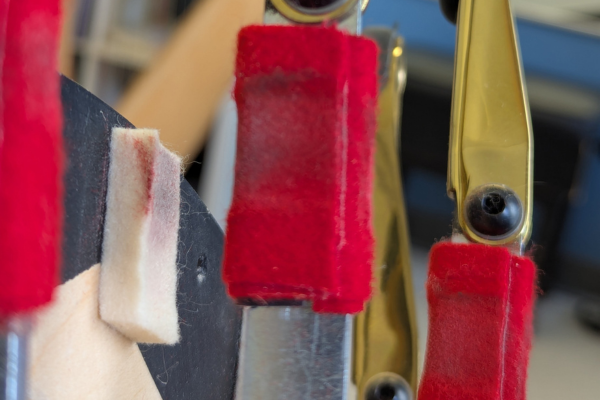
Compaction of pedal felts: Most pedal harps use a wrapping of high quality bushing felt as padding where the pedals pass through the slots in the base. (Note: The main exception is Camac, which uses a pad made from silicone tubing wrapped in Teflon or felt.) In many cases, a rubber cushion of some kind is also used. Over time, the felt compacts, resulting in changes to the discs’ angles of rotation. (See example 2.)
Playing and moving: The more a harp is played, the sooner it tends to go out of regulation. Moving parts wear, slip, and distort slightly, all of which can result in a need for recalibration. Moving a harp can also result in subtle changes that show up as regulation issues as well, so that harps that are frequently driven around for gigs might need service more frequently than those that spend all their time in the studio.
String condition: Over time and with use, harp strings are worn away at the points where they are gripped by the discs. In the upper octaves, even minor string wear can cause changes in intonation. This aspect of regulation is more in the harpist’s hands than the technician’s, and we’ll cover this topic in more detail later on.
Change of string material: If you decide to change the type of string you use, either in one octave or on the whole harp, the regulation will likely be affected. If you switch from gut to nylon or one of the other synthetic fibers (or vice versa), differences in diameter and stiffness will mean you will likely need a regulation.
The process
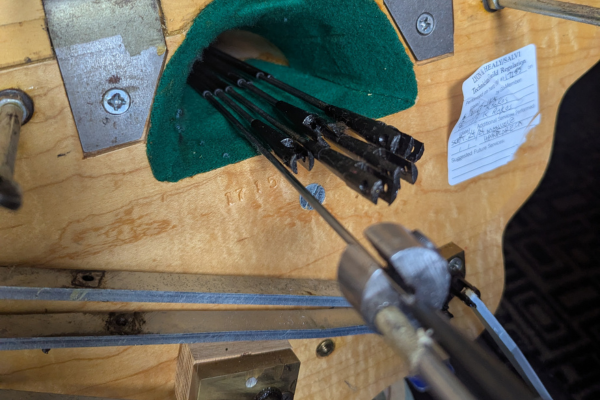
While there are quite a few differences between pedal harp brands and models, in many ways, they are mechanically quite similar. The general procedure outlined here works similarly for many different brands of harp by makers all over the world. There are also numerous brand-specific differences in how regulations are carried out. In the interest of presenting a broad overview of the process, we will ignore these details.
Disclaimer: This article is a general description of the regulation process for information purposes and is not intended as a how-to guide. Certain techniques that are standard practice on some makes of harp can result in damage when used on others. I do not recommend attempting any aspect of pedal harp regulation without training from a harpmaker or professional technician.
Do all technicians use the same procedures? I haven’t met every technician working in the world today, but the many that I do know approach the work the same way I do. Many of us trained at the same harp factory under the same teachers, and those who work for different companies tend to share a common lineage in terms of training. Even in cases where there are notable design differences between harp makes and other differences such as geography or language, there are logical ways to approach the job that I expect are universal. I am confident in saying that most well-trained, professional technicians follow the same approach, broadly speaking. So I will take you through my process for a harp regulation.
Initial inspection: Before starting work on a harp, I look it over for any obvious issues that need to be addressed. If there are broken or missing strings, for example, it’s best to replace those right away. I’ll also look for any serious structural problems that I need to advise the customer about. In some cases, a harp really needs a major repair done at a factory or workshop, and a regulation now is only going to waste the customer’s money, so I try to make sure the instrument is in good shape. I also check with the harpist when they drop it off, asking if they’ve noticed particular problems or concerns. If they have, I check these right away. If I can’t hear something, it is sometimes a matter of technique, so I’ll ask the harpist to produce a buzz or other problem so I can see and hear the circumstances that give rise to it.
Bottom work
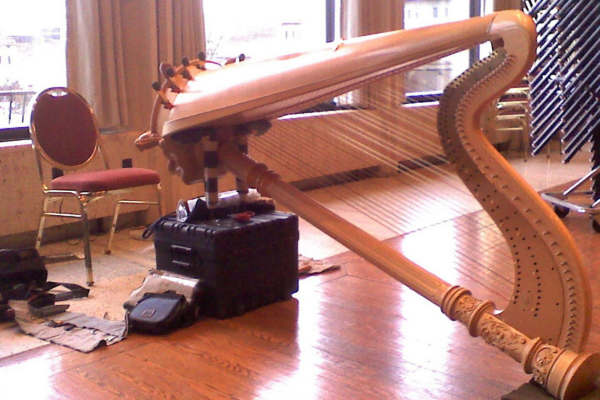
Under the hood: A regulation starts with the pedals and rods, as a number of adjustments can be made that affect the harp generally, before fine tuning is performed on each moving part of the action. This is often referred to as “bottom work.” This work requires removing the base, so the harp needs to be laid down horizontally and raised up off the ground somehow. Technicians in a workshop usually have some kind of stand that holds the harp in the correct position, and traveling technicians often modify their toolboxes so they can be used as stands. (See example 3.)
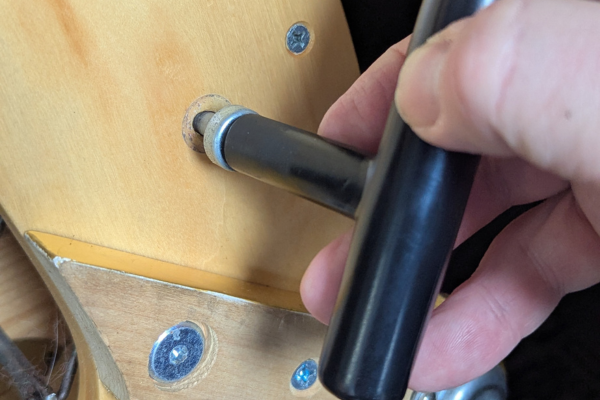
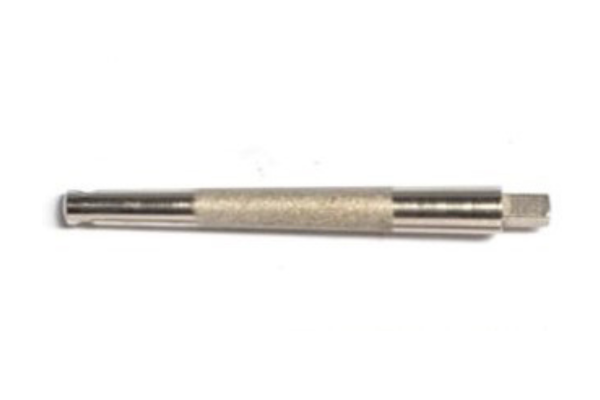
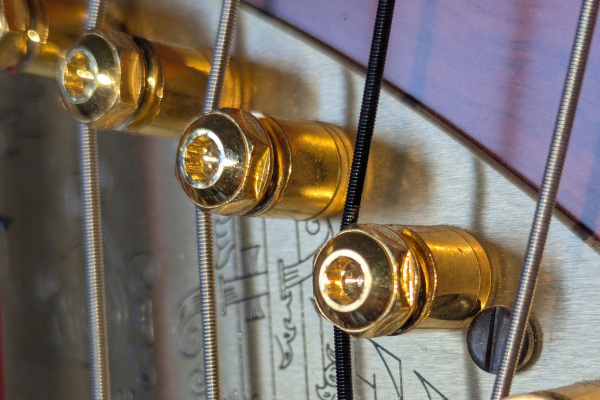
The bolts that attach the base to the body are designed to be screwed on and off by the harp’s tuning key. This means that in the case of an emergency, such as a broken pedal spring or pedal rod, the harpist will always have the correct tool on hand for base removal. (See example 4.)
Pedal felt: After heavy use, pedal felts can be worn through, and the underlying rubber cushions torn. But even felts that are intact tend to compact over time, and this affects the movement of discs. For this reason, it is standard practice to replace the pedal felts at every regulation. The slot felts that pad the upper limit of the flat position also contract over time and are generally replaced as well. Example 2 shows a white slot felt that has become quite compacted over time.
Pedal rods: As changes in the soundboard and neck occur over time, the pedal rods need to be periodically shortened so that they maintain their proper relationship to the other moving parts. The couplings that connect the rod to the pedals are threaded onto the rods, so they can be shortened by disconnecting the rod and coupling from the pedal, turning the coupling clockwise, and reattaching it. The threads on pedal rods are very fine—about 48 threads per inch—so shortening the rod a turn or two doesn’t look very different but can make a big difference in how the mechanics work.
Checking overmovement: Overmovement, or overmotion, is a term some harpists are familiar with or have heard of. It has to do with how technicians judge whether the pedal rods should be adjusted. To check the rods, after replacing the felts and putting the base back on, the technician “flutters” each pedal from the natural position a little bit towards the sharp position while looking at the natural disc for the lowest corresponding string. If the disc rotates noticeably, it is at the wrong point in its range of motion and the rod likely needs to be shortened. This movement is referred to as overmovement. Shortening the rod reduces this movement. In a properly adjusted pedal rod, this movement is virtually invisible, though it should never be completely eliminated. The mechanism should be near the end of its range of motion when the natural disc is engaged, but never at the end. A rod that is adjusted to be too short results in a stiff pedal and can put undesirable stress on the mechanism. Replacing compacted pedal felts reduces overmovement, which is why the felts are replaced first and should always be replaced before adjusting the pedal rods.
Pedal adjustments: If a harp is in good working order, the pedals may not need further work, but the technician will check all the connections between the pedals, rods, and pedal springs, as well as the wad of felt that is inserted into the column to keep the rods from buckling when moved. A variety of conditions can cause clicking, clanking, or squeaking when the pedals are moved, and the technician will check for these and correct them as necessary by tightening fasteners, lubricating moving parts, or whatever else is required. Technicians can also adjust pedal action to some extent. If a pedal seems a little too eager to jump out of position if you bump it with your foot, for instance, let your technician know at your regulation. They can adjust it for you. Pedal caps can also wear out, and these are easy to replace if needed when the harp is on a stand.
Top work
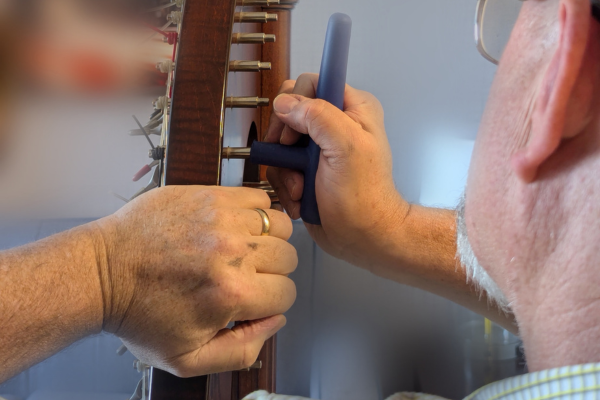
With the felts replaced, pedal rods adjusted as needed, and any needed maintenance on pedals or springs complete, I return the harp to its standing position and begin the “top work.” Since much of the work from here on out involves intonation, I start by checking the tuning pins and then tuning the harp. The pins on most harps, like those in the violin family, are tapered, and fit into holes that match their taper exactly. (See example 5) (Note—Every rule has an exception, and here the exception is Dusty Strings tuning pins on harps made since 2000, which are threaded, not tapered.) As a result, pushing a loose pin deeper into the hole will make it tighter. I accomplish this by bracing my left hand against the neck and pushing the pin deeper into the neck with my right hand and tuning key. (See example 6.) Wiggling the key and pin back and forth a bit helps the pin wriggle deeper into the hole. I check the neck stud screws, which fasten the mechanism to the neck, at this time and tighten them as necessary. This eliminates any possible buzzing from a loose screw. When this is complete, I tune the instrument. Pedal harps are tuned to the C-flat major scale with all of the pedals in the flat position. The tuning doesn’t need to be perfect at this point, just pretty close. If any strings were just replaced, they will need extra attention.
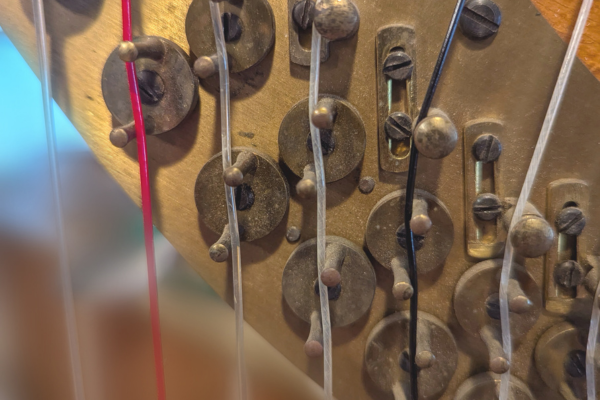
Going forward, I’ll be referring to “nuts” and “discs” quite often, so I’ll illustrate these to avoid confusion. There are two kinds of nuts: stationary and adjustable. Example 7 shows some stationary nuts, and example 8 shows an adjustable nut. The nut defines the endpoint of the string’s speaking length—the part of the string which vibrates and makes sound when played. The non-speaking length is the part between the nut and the tuning pin. Stationary nuts are usually found on the lowest strings, in the fifth, sixth, and seventh octaves, depending on the harp’s make and model. All other strings on the harp will have adjustable nuts.
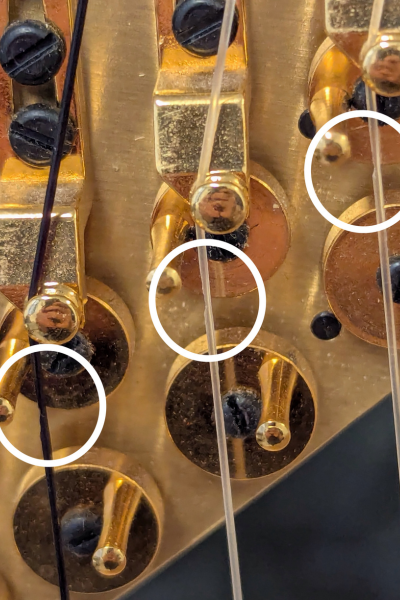
A disc turns when its corresponding pedal is moved, gripping or releasing a string to change its speaking length. If you move the D pedal from the flat to the natural position, all of the D strings should play D-natural, or D-sharp if the pedal is moved to the sharp position. Each string has two discs, the natural disc on top and the sharp disc below it. Discs in the lower and midrange octaves each have two pins. Those in the higher range have only one. (See examples 9 and 10.)
Visual inspection
Flat: In the flat position, I inspect the alignment of each string relative to the discs. If a string is too close to a disc pin, it might buzz against it when played loudly. A string that is aligned too far to one side or the other may result in poor intonation. Depending on the harp, there may be no potential to adjust this, but some harps have nuts that allow for minimal adjustments from side to side.
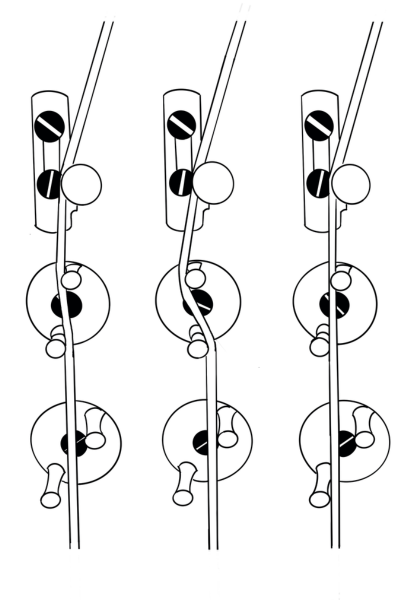
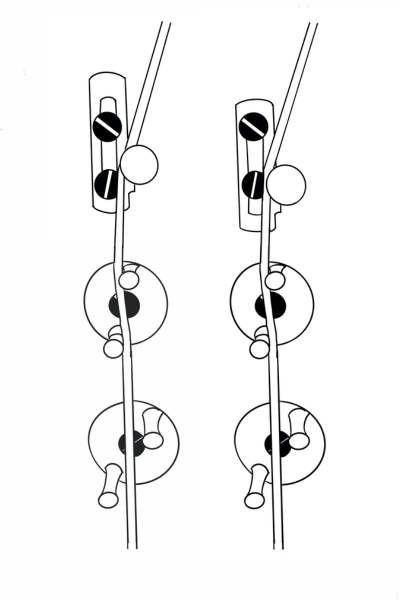
Natural: I put the pedals in natural and check the degree to which each disc twists the string when the pedal is engaged. There must be enough grip that the string sounds clean and buzz-free when played. If the grip is excessive, it will stress the string more, and make the pitch sharper. In bass strings, too much grip can make the pedals feel stiffer as well. I also check alignment of the strings through the sharp discs, again making sure no strings are too close to a disc pin. Figure 1 illustrates discs exerting varying amounts of grip on strings. The leftmost string has a gentle curvature. It is probably sufficient for the string to play cleanly. In the center, the grip is excessive. Being twisted this aggressively is likely to shorten the string’s life. In addition, the string passes through the sharp disc very close to the upper pin, and could snap against it when played. This pitch may also be too sharp when we check the intonation. On the right, the string looks nearly straight through the disc. It is likely that not only will the string snap against the lower pin of the sharp disc, it may also snap against the lower pin of the natural disc. (See figure 1.)
Sharp: I put the pedals in sharp and check the grip of the sharp discs in the same way.
Aural inspection
After years of regulating harps, I’ve developed a pretty good sense of what a good string/disc setup looks like, but my ear is the final judge. After a complete visual inspection of all strings and discs, I play each string a few times at a strong forte volume, first with the pedals in flat, then natural, then sharp. I listen for any unwanted noise and try to eliminate any that I can. There are so many reasons playing a harp string can create a noise that I couldn’t hope to cover them in an article. I could probably write a whole book about buzzing harps. But for a list of the most common issues, see the sidebar on this page.
Intonation
After checking for and addressing buzzes on every string in the three pedal positions, I check the intonation in each string. First, I tune the note very precisely in the flat position. Then I move the pedal to natural and play it. Ideally, the natural pitch will be precisely in tune as well. If it isn’t, I will do what I can to make it as in tune as possible. Then, I put the pedal in the sharp position and check to see if the sharp pitch is in tune, and again try to correct it as much as possible.
How can intonation be adjusted? There are two variables that can be worked with to varying extents depending on the string: string length and disc grip.
Let’s look at string length first, and confine the discussion to checking intonation of only the natural pitch for now. When the natural disc engages the string, it shortens the string’s speaking length and raises the pitch. The exact amount the pitch is raised depends on how much shorter the string becomes. If the natural pitch is not a perfect half step higher than the flat pitch, we can improve it by doing something to change the degree of length difference between the flat and natural pitches. If we could somehow move the disc higher or lower on the string, that would change the relationship, but we can’t because the disc is in a fixed position. However, if the nut is adjustable, we can move it up or down, changing the length of the flat string and therefore its relationship with the fixed length of the natural pitch. This can be a bit difficult to understand, and hard to explain. In practice, it means that moving the nut higher makes the natural pitch sharper, and moving the nut lower makes the natural pitch flatter. See figure 2 for an illustration.
If the nut is stationary, we can’t change the string’s speaking length. So why aren’t all nuts adjustable? I wasn’t around when the modern pedal harp mechanism was developed, but I believe the reason is strength. The bass strings, being the thickest in diameter, exert the most force against the nuts when under tension. Designing and producing a nut that would be both adjustable and strong enough would add complexity and cost to the mechanism. In addition, the longer the string, the farther you need to move the nut to make a meaningful change in intonation. An adjustable nut in the bass would need a greater adjustable range, which would complicate the design of both the mechanism and the neck. The stationary nut was likely a compromise geared toward simplicity and reliability.
Next, let’s examine how disc grip is involved. As I mentioned earlier, the amount of grip is the degree to which the disc twists the string. The grip adds tension to the string, making it a little sharper. The more strongly the disc grips the string, the sharper it will be. As I said earlier, there must be enough grip so that the string doesn’t buzz when played, but not so much as to damage the string or align it too close to other parts of the action that it might buzz against. Within these parameters, there is a small window in which the grip can be adjusted to optimize the intonation. So, for the natural pitches, the intonation is adjusted by a combination of adjusting grip and moving the string nut up or down, if it is an adjustable nut.
When the pedal is moved into the sharp position, the sharp disc engages the string, making it shorter still, so that it plays the sharp pitch. If adjustment is needed, we can adjust the grip of the sharp discs just as we can the natural discs. This is the only option we have for affecting the sharp pitches, as the vertical positions of both discs are fixed. In the bass strings, where the nuts are stationary, any adjustments to intonation in both natural and sharp are made with grip adjustments alone.
To recap, now that we have more details, I tune each string in flat, then check the pitch in natural. If it can be improved, I do so using a combination of moving the nut (if adjustable) and altering grip. Then I check the pitch in sharp (likely after retuning it in flat again), and adjust as needed by adding or reducing grip. After this procedure is complete on each string, the regulation is complete. Between the bottom and the top work, the process generally takes two to three hours, depending on how much adjustment is needed, and whether any minor repair needs came up.
Other services
There are some services that fall outside the scope of a regulation, but that you may wish to have a technician do in connection with your regulation appointment. Here are some examples.
String replacement: New gut, synthetic gut, and nylon strings do not mix well with regulation, as they stretch extensively, making it very difficult to accurately check the intonation. If a harp comes in for service with one or two missing or broken strings, it’s not a big problem, assuming the customer or technician has the replacement strings. A couple can be installed and tuned frequently over the course of the service, and hold well enough to check the intonation. If it’s more than one or two, say up to an octave, I can often still do a regulation over the course of a day if the strings are replaced first thing, then they are tuned several times before the regulation. If a customer wants several octaves or the entire harp restrung, this will introduce so much instability in the tuning that the harp can’t be regulated the same day. I usually ask customers who want harps both restrung and regulated to leave the harp with me for at least three days. That gives me enough time to tune the new strings a number of times, until they can hold long enough to check the intonation. If you want your technician to replace a lot of strings in addition to a regulation, definitely let them know ahead of time so you can work out the logistics.
Bass wire replacement: Unlike gut and nylon, metal bass wires become stable in pitch very quickly, so replacing them at a regulation appointment goes much more smoothly. Most technicians charge an additional fee for this service. Many harpists prefer not to replace the wires themselves because they are stiffer and physically harder to work with than gut or nylon strings. This is a routine service that technicians perform. Again, contact the technician in advance to arrange logistics.
Why replace bass wires? Wires lose sustain and brightness slowly over time. Even if you don’t use the wires a lot in the pieces you are playing, keeping the wires fairly new makes the whole harp sound better. There is sympathetic ringing of overtones in the bass wires even when the harpist is playing in another register.
Tubing buzz elimination: Under certain conditions, the pedal rods will vibrate sympathetically on a particular note or two, most commonly the G and A bass strings and low fifth-octave strings. This can be repaired, but involves disconnecting and removing all the pedal rods, which adds time and expense.
Pedal rod replacement: While pedal rods rarely have the decency to break when your technician is in town, pedal rod replacements are something we are set up to do, and we can replace broken rods as long as the replacement has been ordered in advance. Example 11 shows a pedal rod that has been disconnected from the mechanism and pulled partway out of the column.
Finish touch-up: Some technicians offer repairs for dents, scratches, and other minor finish damage, while others do not. Finish work is a separate set of skills and tools that not all technicians are trained in, and many of the chemicals used in finish work can’t be transported if your technician is traveling by air. If your tech doesn’t do finish work, I recommend contacting piano technicians in your area. Some do touch up work themselves, and if they don’t they may be able to refer you to a specialist comfortable working with musical instruments.
What is outside the scope of regulation? Many technicians I know are not trained woodworkers, so generally speaking, major structural repairs such as repairing body base frames, replacing necks or soundboards, etc., fall outside the scope of our services, especially when it comes to traveling technicians like myself who are limited to the tools they can carry on an airplane. There are some technicians who offer major repairs at their workshops, but this usually involves the harps being brought to them rather than them traveling to the harps. The same goes for problems inside the mechanism. If you hear clicking and clunking when the pedals are moved, the cause may be in the pedals—in which case a technician can often fix it—but it may actually be wear in the rivets of the mechanism. Your technician can let you know if the mechanism is getting to the point where it needs to be re-riveted. This involves complete disassembly, so it’s also a situation where the harp will have to go back to the factory.
Preparing for a regulation
The more a harp is played, the more often it should be serviced. If harp is a big part of your life—meaning you are a professional or student majoring in harp performance—you should have your main harp regulated every year. This is true for two reasons. First, the more you play, the more wear and tear on the felts and other parts. Second, the more you play, the better your skills as a harpist, the better your ears, and the more you will demand from your instrument. If you have more than one main harp, maybe have them regulated in alternate years. If you play less often and less demanding repertoire, you likely put less demand on the instrument and will be able to stretch out the time between regulations. My stock answer is to recommend that folks in this situation have their harps serviced every two years, though some people don’t feel the need to get service that often. I would strongly recommend a regulation at least every four years even if you think everything is fine. Have a professional inspect your harp periodically to spot small problems before they become large, and you will notice an improvement in your harp’s sound even if you thought it sounded good enough before.
Once you decide to get your harp regulated, there are several things you can do to get the best quality service and a more long-lasting, stable regulation.
String condition: Strings wear away slowly at the points where they are gripped by the discs. Eventually, the disc pins dig little divots in the strings, as shown in example 12, especially in the top two octaves. These divots reduce the grip, as the disc pin settles into its divot instead of gripping the string as it did when the string was new. As we know, less grip means a flatter pitch. A technician can regulate the disc to the worn string, but when you do replace it, the grip on the new string will be different, and the string will be out of regulation. For this reason, to get the most accurate regulation, it is ideal to replace the strings in the top two octaves about two weeks prior to the regulation. If you don’t want to replace them all, carefully inspect them for wear, and if you see any wear, replace just those strings. This effect is far less of a problem in the third octave and lower, so you don’t need to change all the strings for a regulation. Concentrate on those top two octaves.
Take notes: Write down problems, buzzes, etc. in advance, including pedal diagrams. If you are hearing a buzz in your instrument that’s bothering you, try to note as much as you can about it. Which string or strings? What key or pedal position? How would you characterize the sound? Is it a little bug buzzing in your ear or a low growl? The more you can tell a technician about what you’re hearing, the better chance we have of finding and troubleshooting it. We are happy to get a list of issues you’ve noted and happy to take some time at drop-off for you to play the harp and demonstrate the issues.
When the work is done: When you pick up your harp, take time to play it. If you noted any buzzes, check for them, but also play through a favorite piece or two to see how you like the sound of your harp. If you noticed the intonation wasn’t so good before the regulation, see what you think now. If you feel like something isn’t quite right, it’s best to bring it to the technician’s attention at the appointment. There are variations in a harpist’s technique and technician’s approach to regulation, which can result in something sounding a little off. Let your technician know what you notice, and they will see what they can do to address it. In many cases, there are limits to how perfect a harp’s intonation can be depending on age, string condition, and other factors, but often the technician and harpist can work together to get a decent compromise that works for the harpist. The bottom line is that the time to notice concerns is before you leave with your harp. The technician might be flying to another city the next day. Many people hate to be confrontational or rush to judgment, but it is much better to voice any concerns you have when you, the harp, and the technician are all in the same place.
If you did your best to catch problems but something still comes up later, it’s fine to reach out to your technician again. They can try to understand the issue, and possibly help you troubleshoot it remotely. If they really made an error, they should find a way to help you get it fixed as soon as possible.
Here’s one last tip to help prolong the life of your harp’s regulation: keep the pedals in the flat position when not playing. This minimizes compaction of the felts.
I hope you’ve enjoyed this brief overview of what goes into a harp regulation. I’ve had to leave lots of details out, as this topic could easily fill a book or several. So go get your harp regulated if it’s due for service, and tell your technician Steve says hi! •
Lever harp regulation—understanding the differences
While a pedal harp has three pedal positions for each string (flat, natural, and sharp), a lever harp has just two: lever disengaged and lever engaged. Assuming you’ve read over the section on pedal harp regulation, you know that we can adjust intonation by manipulating both string length and grip. The same thing is true for lever harps, with some important differences.
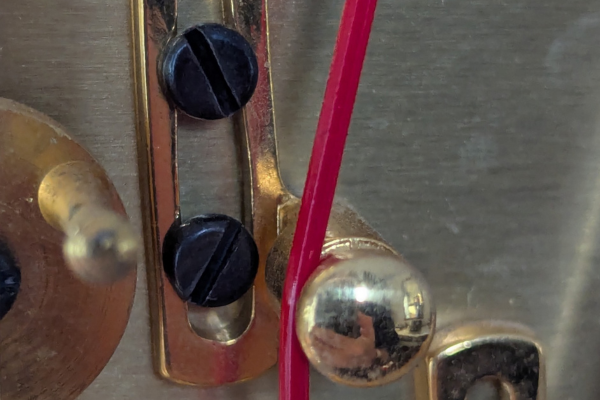
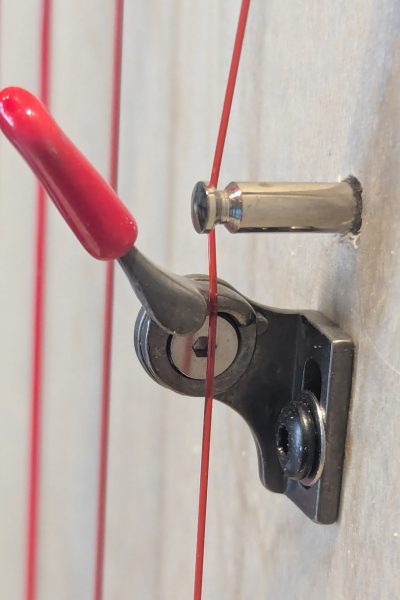
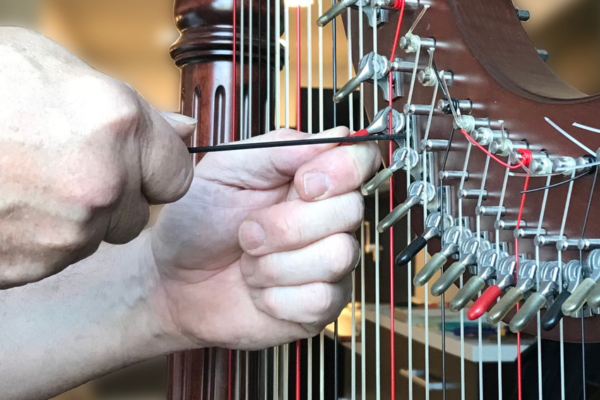
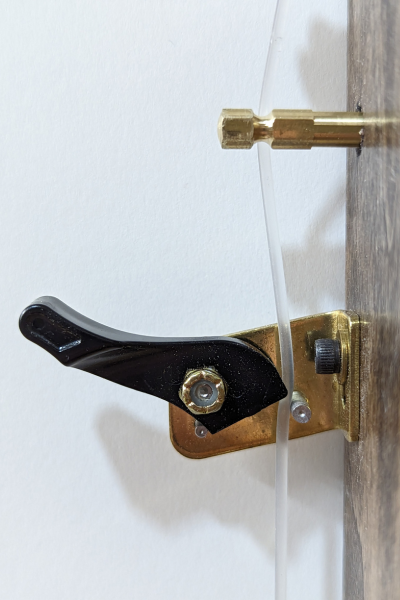
Stationary Nuts: On lever harps, the nuts are all stationary, and as a result, we cannot alter the length of the string. Levers are designed with vertical slots for the screws with which they attach to the harp, and this allows for adjustment up or down. (See example 13: Lever harp nuts are stationary. A slot in the lever allows it to be moved up or down.) On a pedal harp, the disc, which raises the pitch, can not be moved up or down, so we change the length of the string relative to the disc by adjusting the nut where possible. On a lever harp, we do the opposite. The original pitch is not changed. Instead, we move the lever up or down. Moving a lever up lowers the pitch of the raised (“sharped”) string, and moving it down raises the pitch of the sharped string. (See example 14: Adjusting a lever.)
Grip: Like discs, levers push or twist the string in some way to hold it at its shorter length. Many levers, such as Loveland, Camac, and Salvi Pro levers, push the string toward the neck until it is stopped by a fret. With Truitt levers, the string is pushed away from the neck. The Lyon & Healy Performance Lever functions more like a disc, twisting the string between two points. On these, grip is adjusted by rotating the lever to increase or decrease the amount of twist. On the other levers mentioned, grip adjustments are actually made by adjusting the bridge pin, which plays the same role as the nut on a pedal harp. Some bridge pins are threaded and can be adjusted by turning a screw or nut driver. Others are press fit and need to be driven in or pried out. (See example 15: On this Loveland lever, grip is adjusted by screwing the nut in or out.)
Frequency: While I recommend a regulation every one or two years for a pedal harp, lever harps can go five or six years without issue. I do recommend having them serviced every five years even if you’re not having problems. A thorough inspection every so often can correct potential issues before they arise.