
Numbers were never really my thing in school. I just tried to survive my math classes and make sure they didn’t inflict too much damage on my GPA. I was more of a word warrior than a numbers ninja. But sometimes numbers can illustrate a story even better than words, and when that’s the case, I’m a big fan. Let’s take a spin through this issue … by the numbers.
2—The number of weeks you should change any worn-out strings before having your harp regulated. This was the consensus of our panel of experts for this issue’s Advice column. Check out the other pre-regulation tips they share in this article.
4—That’s how many professional harpists weighed in with their strategies to ensure your preparation holds up between the practice room and the performance stage. If you’ve ever nailed a piece at home only to crash and burn when you try to play it for someone else, then you’ll want to check out the feature article Mind the Gap. Author Li Shan Tan and three other pros show us that we’re in good company if we’ve stumbled on this gap. But there are also some tried-and-true practices that can help you close the gap and feel confident on stage.
8—Years Andrea Wittchen was out of music school before the aha moment that made her—and her audience—much happier. Find out what simple piece of advice from her college teacher she now shares with her students in her Sounding Board article Leave Hindemith at Home.
10—The number of notes in chords we often see in music written by well-meaning composers who forget harpists don’t use their pinkies. See how to tackle this and many other impossible passages in How to Play the Unplayable.
24—The number of Tear-Out Tunes we’ve published to date, including the one in this issue, Jacqueline Pollauf’s serene arrangement of the Austrian carol Still, Still, Still. Like all of our Tear-Out Tunes, it is playable on lever or pedal harp, and you can rip it right out of the center of the magazine and put it on your music stand. If you’re new to Harp Column or a tune or two has gone missing from your music stack, don’t worry—all two dozen pieces are available to download from harpcolumn.com free to magazine subscribers.
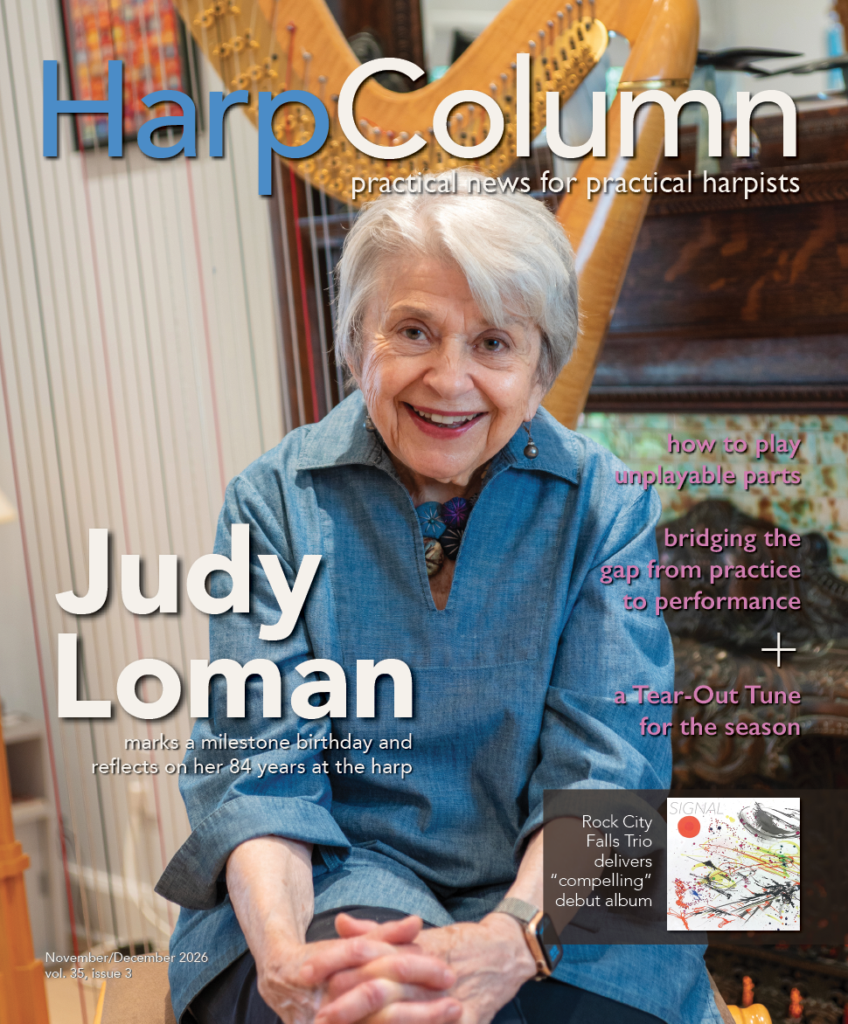
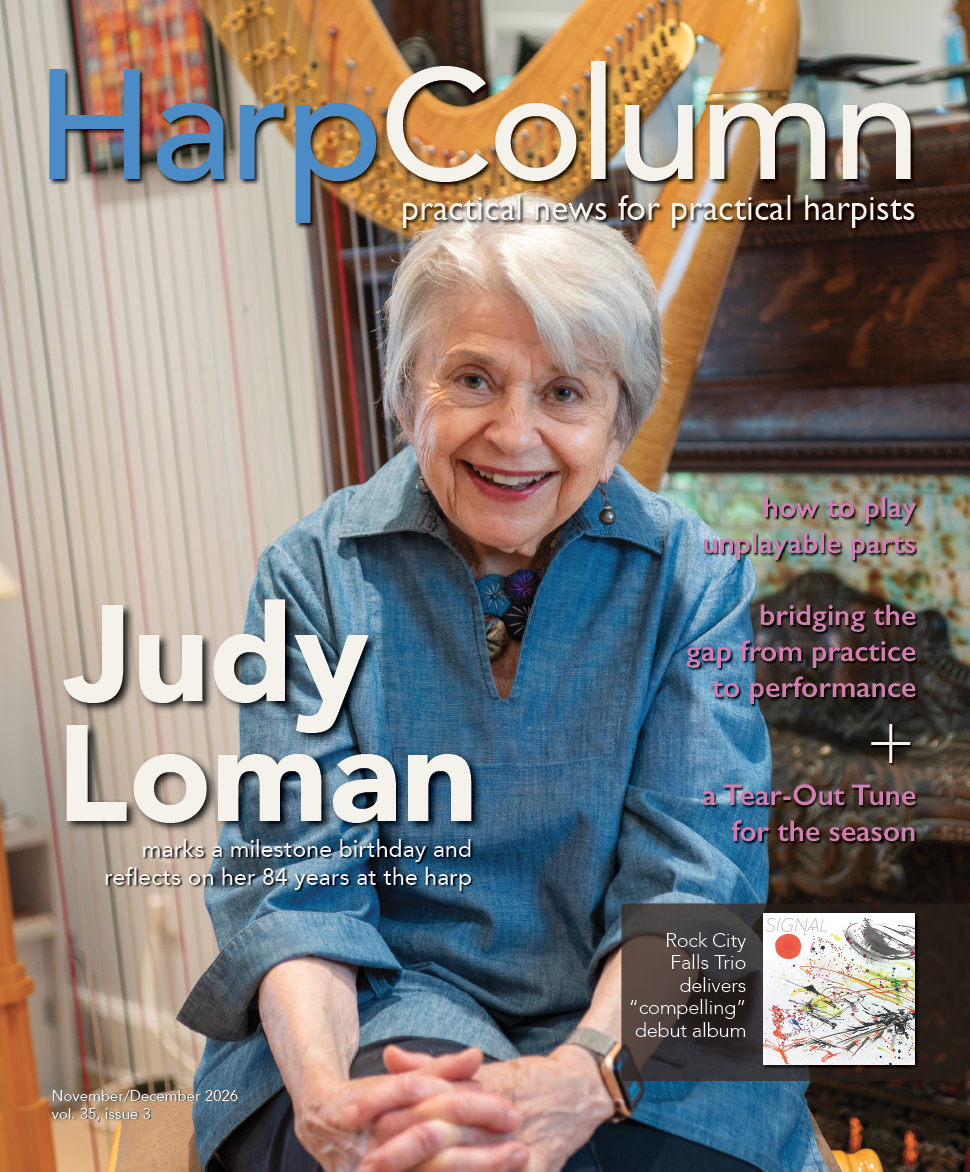
30—It’s been that many years Judy Loman last graced our cover. We rarely feature a harpist on the cover more than once (by our count Loman is only the sixth harpist to receive a second solo cover). Back in our November/December 1996 interview, Loman said she didn’t know how she would choose between teaching and solo performing if she ever had to pick one to focus on for the rest of her career. Fortunately for the harp world, Loman never had to decide. She’s spent the last three decades as one of the world’s best at both. So why did we come back to Loman for a second interview? The next number is your answer.
90—The milestone birthday Judy Loman celebrates on Nov. 3, 2026. As if a 90th birthday isn’t remarkable on its own, Loman continues to teach and perform, as you’ll find out in Playing the Long Game. There are a few more numbers that pop out in this interview—Loman has played the harp for 84 years, 70 of them professionally. In all those years, she has rarely gone a day without practicing, which means a conservative estimate of her total practice days would be north of 25,000.
201—If you follow Harp Column on social media, you might have noticed that our last issue (September/October 2026) was our 200th. We threw a little celebration on the socials and took a fun look back at the last 33 years of the magazine. As we look to the future with issue no. 201, we want to offer our heartfelt gratitude to you, our readers. Without you, none of these numbers would mean anything. Here’s to you and the next 200 issues.