
Download this issue to get this tune now!
Each installment of our Tear-Out Tunes series features a new piece written by one of the best harpist-composer-arrangers in the business. Each composer will tell you a little bit about their piece, and also give you some helpful tips for learning it and getting the most out of the experience. The new piece (on the following pages) is yours to keep. We even put it right in the middle of the magazine so you can tear out the whole sheet and put your new tune on your music stand.
I wrote Søster during a period when music became a place of refuge. In the midst of a difficult and uncertain time in my family, I found myself drawn to the harp not as a vehicle for complexity or performance, but as a source of comfort and quiet focus.
In many ways, I think of Søster as a piece harpists play for themselves.
The piece is dedicated to my little sister, Mia. I began writing it after she was diagnosed with aggressive breast cancer shortly after giving birth to her third child. Søster is the Norwegian word for “sister.”
What emerged was a simple piece—not simple in the sense of being empty or emotionally neutral, but simple in the sense that I could live inside the music without having to navigate too much complexity. I wanted to create something I could return to again and again. Something I could rest in.
Although there is melancholy in the piece, it is intentionally written in a major key. When you are afraid of losing someone close to you, it is easy to dwell in sorrow, but I needed the music to hold hope. The repetitive motion functions almost like a form of meditation, creating a steady flow in which the harmony can unfold naturally and inviting the player to focus on resonance, breathing, and the physical sensation of sound moving through the instrument.
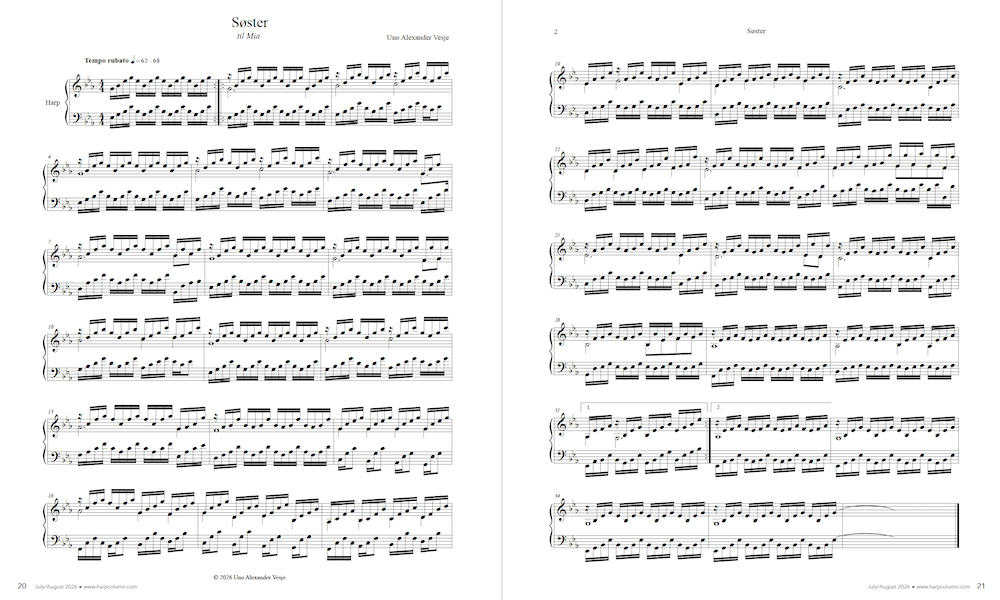
At first glance, Søster may resemble an etude or technical study, with its repetitive arpeggios and the absence of detailed dynamics or articulation markings. I chose not to include these markings in order to leave interpretive space for the performer and to encourage harpists to approach the piece personally and intuitively rather than trying to find a single “correct” interpretation. The most important thing is to find an approach that feels natural and meaningful for the player. In many ways, I think of Søster as a piece harpists play for themselves.
The music of pianist and composer Joep Beving has been an important inspiration in this regard. I admire how his work creates emotional closeness through simplicity and vulnerability. I wanted Søster to carry some of that same intimacy: something deeply personal, yet open enough for each harpist to enter with their own experiences.
From the beginning, I wanted the music to feel natural and calm to play. I spent a long time refining the key and arpeggio patterns so they would lie comfortably in the hands. One compositional choice that became especially important was allowing the melody notes to ring freely within the resonance of the instrument. I deliberately avoided repeating melodic strings within the arpeggio patterns so the melody and bass tones could continue to sing freely within the harmonic texture. In this way, the arpeggiated figures function like gentle waves of sound that support the melody and bass line.
In the score, the melody is notated in the treble clef using downward stems. If the arpeggios feel challenging, the piece can be simplified by playing only the melody and the changing bass notes that outline the harmonic progression. Even in this reduced form, the music retains its essential character. Another possibility is to create your own left-hand arpeggios while playing the melody, choosing whichever notes from the harmony feel most supportive.
Because both hands are in continuous motion throughout most of the piece, I also wanted to avoid excessive lever changes. The tonal language therefore remains stable and centered in a key that resonates naturally on both pedal and lever harp.
Søster will become part of a larger solo harp project titled Listening of Light, which I will premiere at One Harp World in Toronto. In this project, I explore a wide range of the harp’s sonic and technical possibilities within a simple and distilled musical language. Some pieces are built from the instrument’s most elemental resonances, while others unfold through more intricate patterns, shifting harmonies, and gradual modulations.
For several months, I played Søster each morning and evening, using it almost as a form of meditation. One morning, while I was playing the piece, I received a video from my sister. She was sitting alone in a stairwell at the hospital, still wearing her hospital gown. She had just been told that the tumors removed during surgery no longer contained living cancer cells. After six months of intensive treatment, she had achieved a complete response.
I hope Søster can offer harpists what it first offered me: a moment of calm, reflection, and hope. Or perhaps simply the quiet joy of sitting down and playing our extraordinary instrument. •