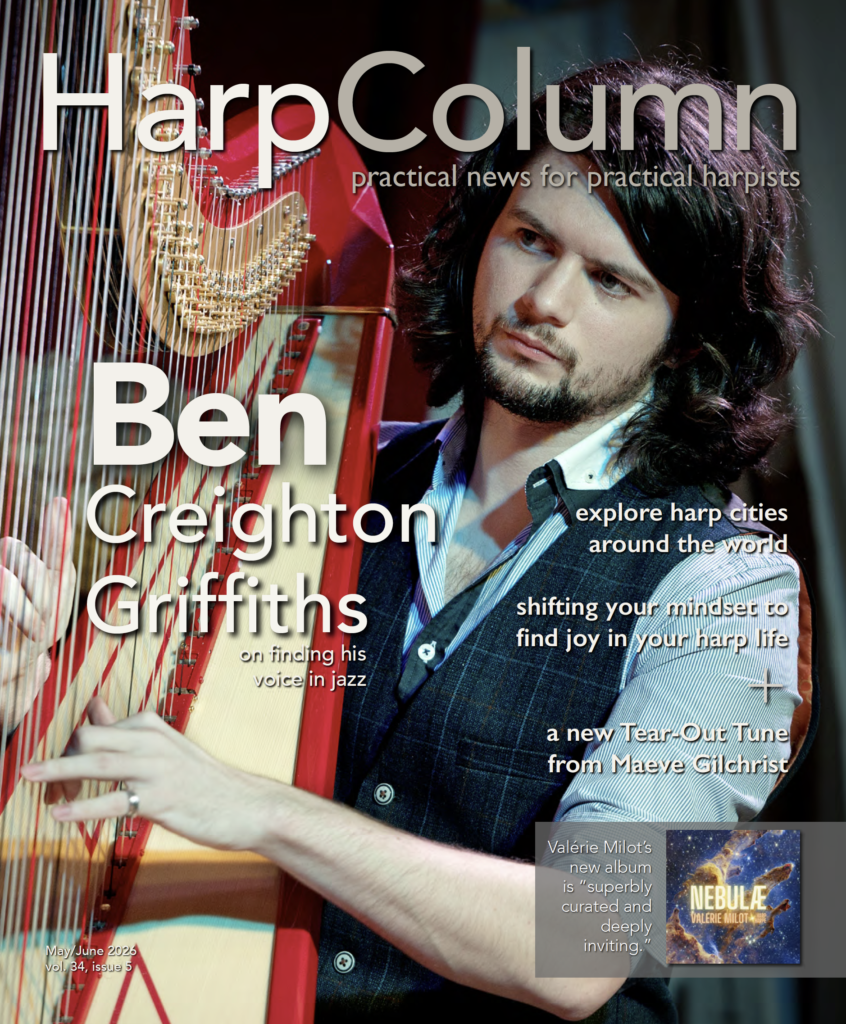

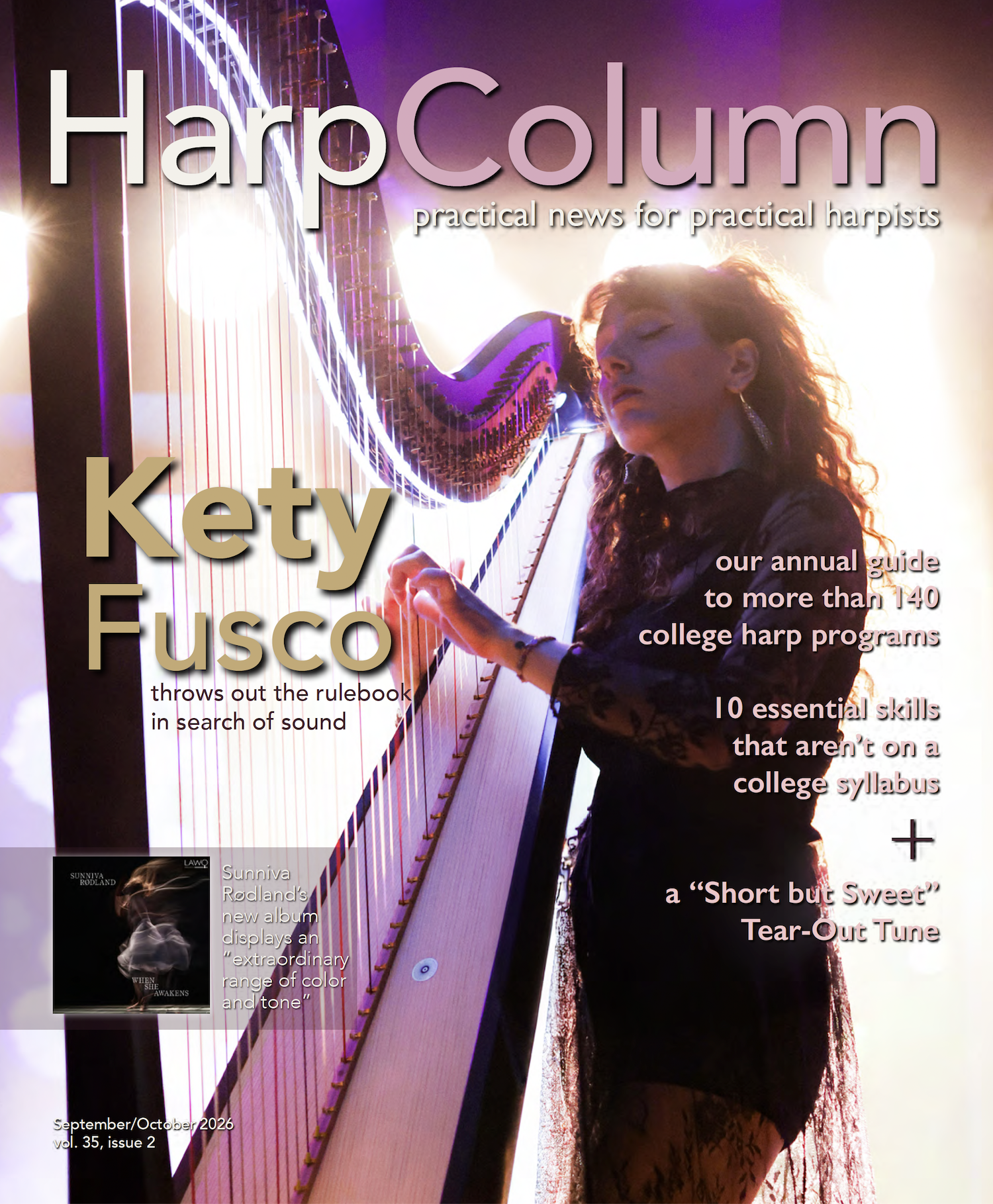

Editor’s note: This is the second installment of a two-part series touring 25 harp cities around the world. If you missed the first half of our journey, be sure to catch up in the March/April 2026 issue of Harp Column to follow along with our travel guide to the best harp spots in each city.
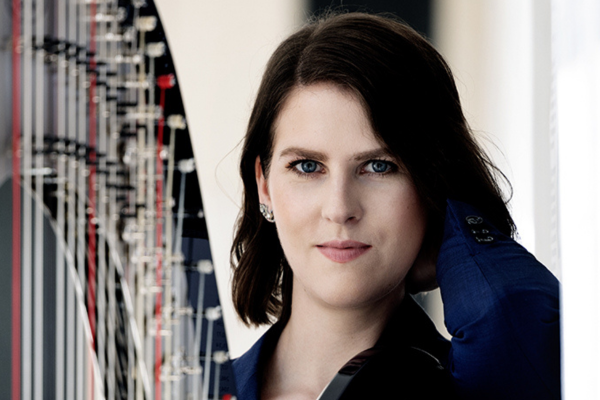
Elizabeth Plank
Vienna
 Vienna, Austria
We begin the second half of our trip around the world in Vienna, Austria, a historic center for classical music. “Vienna has always been home to important harpists—like our most famous export Marie-Antoinette, royal harpist Elias Parish Alvars (who is also buried here), the Zamara family [father Antonio and son Alfred, both Vienna conservatory professors, harpists, and composers], Alfred Holý, and Josef Molnar,” says Elisabeth Plank, an international solo performer who founded Vienna Harp Days to celebrate her city’s rich harp heritage. Today, Plank says most Viennese harpists find their own career niches through a combination of freelance work and teaching.
Vienna State Opera and Vienna Philharmonic solo harpist Anneleen Lenaerts says the community in Vienna deeply values its classical music legacy while celebrating its regional heritage and folk tradition. If our journey coincides with a local folk festival, we may get the chance to hear the Tyrolean harp. “[This folk instrument] has long played a central role in volksmusik, appearing at local festivals, family gatherings, and seasonal celebrations,” Lenaerts says. According to Plank, the western part of Austria is still home to builders of the Tyrolean folk harp.
On our tour, we’ll hear the best of Vienna’s classical music with concerts by top ensembles, among which Plank recommends the city’s five large orchestras, various chamber orchestras, and other specialized ensembles. Lenaerts says, “Renowned concert halls, opera houses, prestigious ensembles like the Vienna Philharmonic, and a strong culture of chamber music create countless opportunities for performance, collaboration, and growth.”
We can explore that spirit of collaboration by hearing a studio performance by harp students of Professor Mirjam Schröder at the University of Music and Performing Arts, Vienna (abbreviated in German as “mdw”), where Plank is also a lecturer. We can also stop by the Music and Arts University of the City of Vienna (MUK) to meet students pursuing bachelor’s and master’s degrees with Gabriela Mossyrsch and Certificates of Performance in Harp with Lenaerts.

Elizabeth Jaxon
Utrecht
 Utrecht, The Netherlands
We catch an all-day train northwest to our next stop, Utrecht, The Netherlands. “Located in the center of the Netherlands, Utrecht has long been the pulsing heart of harp in this country,” says Elizabeth Jaxon, who immigrated to Utrecht from the United States in 2014. “Before its harp department was phased out, the Utrecht Conservatory nurtured such greats as Erika Waardenburg, Lavinia Meijer, and Remy van Kesteren.”
Two events make Utrecht a global harp destination today: the Dutch Harp Festival and its World Harp Competition, for which Jaxon serves as competition director. “Every two years, an inspiring line-up of versatile and innovative harpists gathers in the city’s multi-hall music venue TivoliVredenburg to celebrate the instrument in all its forms,” Jaxon says.
Not far from Utrecht is the manor of Queekhoven, which Jaxon points out as the birthplace of the World Harp Congress. Beginning in the 1960s, Phia Berghout and Maria Korchinska brought together harpists from around the world to exchange ideas each summer at the International Harp Weeks in Queekhoven. When the event reached nearly 300 attendees by the 1980s, the World Harp Congress formed to continue organizing international gatherings for harpists (now held every three years).

Uno Vesje
Oslo
 Oslo, Norway
A quick flight across the North Sea brings us to Oslo, Norway. “Though sparsely populated, Norway has cultivated exceptional musicianship across genres and generations,” says Norwegian harpist and composer Uno Alexander Vesje. “At the forefront stands Oslo—not only Norway’s cultural capital, but also its most vibrant and influential harp hub.”
We’ll attend a few performances to get a taste of the city’s musical variety. “In addition to its three major orchestras, all featuring Norwegian harpists in principal roles, Oslo is also home to a growing community of freelancers who shape the city’s contemporary harp scene,” Vesje says. He mentions Sunniva Rødland and Ellen Bødtker as artistic innovators and Sidsel Walstad as a genre-blending electric harp player, while Vesje’s own projects center on urgent social themes.
“This vibrant harp scene builds on the legacy of Dutch trailblazer Willy Postma, who transformed harp education in Norway and inspired a generation known for orchestral brilliance and individual artistic voices,” Vesje says. The Norwegian Academy of Music in Oslo, where Postma taught for many years, now boasts Scandinavia’s largest harp class under French harpist Isabelle Perrin. “Although the harp still lacks widespread recognition in Norway, Oslo offers fertile ground for harpists to explore, innovate, and define their own artistic path,” Vesje says.

Natalia Shameyeva
Moscow
 Moscow, Russia
Crossing the Baltic Sea by air, we’ll land in Moscow, Russia, to explore the Russian pedagogical tradition. Natalia Shameyeva, former principal harp of the Bolshoi Theatre Orchestra and former professor at the Gnessins’ Academy of Music, guides us on a tour of the Moscow Conservatory and its heritage for harpists. Shameyeva says foreigners such as French virtuoso and teacher Jean-Baptiste Cardon first brought the harp to Russia in the 18th century. Johann Christoph Hochbrucker brought his pedal harp to Russia in 1745. (The first Russian-made instruments were not built until the late 1940s, when harpmakers Alexei Caplyuk and Sergei Maykov founded Resonance Harps in St. Petersburg.)
According to Shameyeva, one of the most influential events in Russian harp education was the opening of two conservatories, first in St. Petersburg (1862) and then in Moscow (1866). “The first harp professors came from Germany: Albert Zabel in St. Petersburg and Ida Eihenvald in Moscow,” Shameyeva says. She traces the prominence of the Moscow harp school to the efforts of those who taught at the Moscow Conservatory. “[Early on, professor] Alexander Slepushkin founded the Moscow harp school on his principles of articulation of fingers deep into the palm and wrist movement,” Shameyeva says. She adds that Slepushkin’s student Maria Korchinska contributed the principle of playing strictly according to the composer’s intentions written in the score. Xenia Erdeli also taught at the Moscow Conservatory and was known for her work with composer Reinhold Glière, who dedicated his harp concerto to her.
Vera Dulova, a prolific teacher, also educated many harpists at the conservatory, including many of Russia’s notable harp teachers today (including Shameyeva, Emilia Moskvitina, Milda Agazarian, and many others). “[Dulova] was the first who represented her achievements abroad, giving concerts and masterclasses all over the world,” Shameyeva says. “She edited many harp compositions and enriched harp repertoire by working with composers.”
Today, Russia offers a full slate of events for harpists to attend. “Moscow’s harp life is bright and varied,” Shameyeva says, highlighting several festivals and competitions (some devoted to specific genres or composers). Two Moscow-based harp associations for harpists and for harp teachers organize concerts, masterclasses, conferences, meetings, and other harp events, while the nearby port city of St. Petersburg hosts the “Golden Harp” competition and the “Northern Lyra” festival.
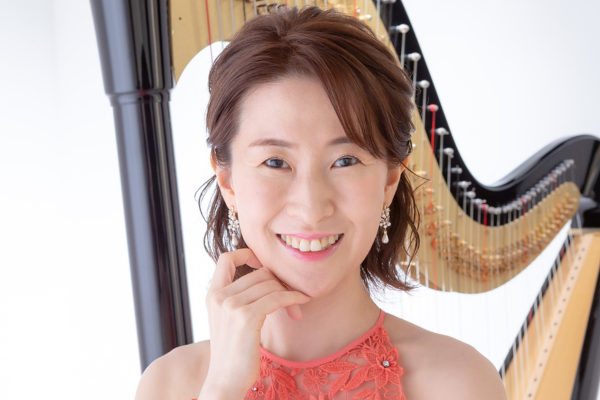
Mai Fukui
Tokyo
 Tokyo, Japan
A 12-hour connecting flight takes us across the Eurasian steppe to Tokyo, Japan. According to Japanese harpist and Kobe College School of Music teacher Mai Fukui, the key player in Japan’s harp history was Josef Molnar, who came to Japan from Vienna in 1952. “Since then, thanks to his effort and passion, the harp community started growing,” Fukui says.
Tokyo offers several universities with harp studios, including the Tokyo University of the Arts and the Toho School of Music, fostering a young generation of skilled Japanese harpists. Among them, Fukui highlights prize winners at the International Harp Contest in Israel, USA International Harp Competition (USAIHC), and ARD International Music Competition, in addition to young performers featured in the USAIHC’s “Stars of Tomorrow” showcase.
We’ll hit the shops in Tokyo to try out harps and browse strings and music scores. We’ll try out models from Camac Harps at the Takada Harp Salon, and we’ll find Lyon & Healy/Salvi Harps at Jujiya Harp Store. At Aoyama Harp Store, we’ll test out harps made right here in Japan—of which Fukui says the Japanese harp community is very proud. Though Aoyama got its start as a manufacturer of bowed stringed instruments, the founder’s son Masao Aoyama was fond of the harp. Under his direction, the company began producing folk harps, followed by pedal harps when current director Kenzo Aoyama took over the business.
Fukui also suggests a 40-minute train ride from Tokyo to Soka City, host of the Soka City-Nippon International Harp Competition and Festival since 1989.

Guan Wang
Beijing
 Beijing, China
After three and a half hours in the air, we find ourselves in Beijing, China, where the harp has become an increasingly popular instrument in the last decade, according to Guan Wang, harp professor at the Central Conservatory of Music in Beijing. The vitality of Beijing’s harp community springs from harp programs at two of its conservatories and one university, as well as private studios. “Every year, numerous harp concerts, masterclasses, summer camps, and festivals are held in the city, and the skill level of students continues to rise,” Wang says. “Notably, students from the Central Conservatory of Music have won many awards in recent years at international competitions in St. Petersburg, Nippon, Korea, Hong Kong, and other locations.”
We’ll stop by to meet some of these students at a masterclass. The Central Conservatory of Music, with its prime location in China’s capital, has been a hub for harp training since Professor Yin Zuo established its harp major in 1965 after returning from her studies with Vera Dulova at the Moscow Conservatory. “[Zuo’s] first student, Mr. Linlin Wei, stayed on to teach at the conservatory after graduating, and his students are now spread across various music conservatories and orchestras,” Wang says. Wang now continues in their footsteps, helping Beijing’s harp community grow.

Angela Yau
Hong Kong
 Hong Kong
Only a three-hour flight away, Hong Konghas also seen an expansion of its harp community in recent years. Harpist Angela Yau says that Hong Kong is now home to hundreds of harp students, due in part to the efforts of the Hong Kong Harp Chamber, which Yau started in 2005 to encourage more interest in studying the harp. The organization serves as a harp store, center for studies, and performance venue and hosts events such as the Hong Kong Harp Festival and the Hong Kong International Harp Competition. We’ll check out a student recital at the Hong Kong Harp Chamber and listen in on a weekly rehearsal of its harp ensemble for members.
“The city has rapidly emerged as a leading center for harp music, hosting the prestigious 2017 World Harp Congress, which drew over 1,000 harpists (many from Asia) and featured more than 100 harps,” Yau says. Harp students in Hong Kong have had access to a harp program at the Hong Kong Academy for Performing Arts since the 1980s, when the program began under former Hong Kong Philharmonic principal harp Moya Wright. Today, the Hong Kong Harp Society organizes the Hong Kong International Harp Competition, which has grown to receive hundreds of entries from over 20 countries in recent editions.

Renee Yadav
Singapore
 Singapore
Continuing our journey, we’ll catch a three-and-a-half-hour flight to Singapore, a small island nation in Southeast Asia. “Despite the harp being a relatively new instrument to Singapore, we have a thriving harp scene,” says Singaporean harpist Renee Yadav, a current student at Juilliard. During our visit to Singapore, we can’t miss checking out the latest harp musicals produced by Yadav’s previous teacher Katryna Tan, in which costumed harpists play their instruments, act, and sing to recount the adventures of a fairy named Pluck. “[Tan’s harp academy] Rave Harps Singapore created the world’s first ever harp musical in 2012, PLUCK: The Harp Musical, which includes famous classics and original music performed by harpists of all ages, from toddlers to senior citizens,” Yadav says. “The musical has since been performed around the world, and you might have even caught it at the 2022 World Harp Congress in Wales!” Rave Harps has since created two sequels, Pluck and the Magical Banyan Tree and Legends of the Harp.
“My favorite thing about being a harpist in Singapore is the close-knit community we have,” Yadav says. “All the harpists are super supportive of each other and often attend each other’s recitals and performances. We also engage in a lot of harp chamber music, and getting to make music with some of my closest friends has given me so many wonderful memories.”

Emily Granger
Brisbane
 Brisbane, Australia
After eight hours in the air, crossing over the islands of Indonesia, we’ll reach Brisbane, Australia, in the northeastern Australian state of Queensland. “When people think of the arts in Australia, they often picture Sydney’s Opera House,” says Emily Granger, principal harp of the Queensland Symphony Orchestra. “But Brisbane, host city of the 2032 Olympics, is quickly becoming a major cultural hub, and today, it’s arguably the most exciting city in Australia for harpists.”
We’ll visit the country’s largest harp department at the Queensland Conservatorium and attend concerts by some of Brisbane’s orchestras. “The Queensland Symphony Orchestra frequently features the harp in both orchestral and chamber programs, and the Queensland Youth Orchestras currently include four harpists across three ensembles,” Granger says. “Leading ensembles such as Ensemble Q, Camerata, and the Brisbane Philharmonic Orchestra regularly feature local and international harpists in performance.”
Granger says the Harp Society of Queensland, which offers a rental pool of eight harps, is at the core of today’s harp community and part of a long-standing harp tradition in Brisbane. Among the city’s well-known harpists, she names mid-20th-century Australian harpists Una and Rees Morgan, in addition to former Berlin Philharmonic principal harp Sebastien Lipman (who later taught at the Queensland Conservatorium) and his wife Sayo, and harpist Jill Atkinson, who served as principal harp of the Queensland Symphony Orchestra for many years.

Elisa Thorn
Vancouver
 Vancouver, Canada
We’re looping back to North America for the last few stops on our journey around the globe. After a long flight across the Pacific, we’ll arrive in Vancouver, Canada, where we’ll have plenty of opportunities to meet the city’s numerous harpists, including contemporary genre-blending harpist, composer, and recording artist Elisa Thorn. Among Vancouver’s harp event highlights, Thorn mentions the annual Harp Day hosted by the West Coast Harp Society, as well as summer festivals touring the province of British Columbia. During our exploration, Thorn reminds us to take our time to enjoy the Canadian Rockies. “The stunningly beautiful, awe-worthy natural landscape of British Columbia is a huge source of inspiration, and living in a rainforest means the humidity keeps our instruments happy!”
Thorn says her community works hard to promote the arts, and the city’s strong network of harp teachers is active both in private studios and at educational institutions such as the Vancouver Academy of Music, the VSO School of Music (a community school affiliated with the Vancouver Symphony Orchestra), and the University of British Columbia.
“There are so many pockets of the music scene in Vancouver that leave space for everyone to contribute their own unique voice—whether that’s in classical, Celtic, or contemporary genres,” Thorn says. “As someone working in contemporary fields (folk, pop/indie, experimental, pop, and jazz), I feel so lucky to have been welcomed into these communities as a harpist.”
Elizabeth Landis
Seattle
 Seattle, USA
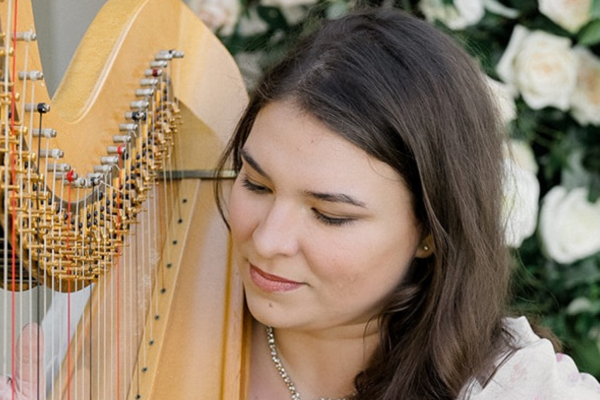
We’ll take a five-hour Amtrak ride along picturesque bays and inlets to Seattle, Washington. Elizabeth Landis, principal harp of the Symphony Tacoma, Northwest Sinfonietta, and Olympia Symphony and harp instructor at Pacific Lutheran University and the University of Puget Sound, will show us around. She’s especially excited about the groundbreaking concerts in her area. “Seattle–Tacoma has one of the most prolific music scenes of all the metropolitan areas in which I’ve lived,” Landis says. “From chamber groups to solo recitals to orchestras, there are so many interesting programs and performances here at any given time, and tons of these musicians are pioneering brand new works, or works by women and people who have been marginalized. I usually have two or three premieres per season, and my seasons have a huge variety of repertoire beyond the standards.” After attending some performances, we’ll also visit the Dusty Strings shop to try out a few lever harps.
Landis says the whole music community in Seattle is very supportive of the harp. “People here are very excited to feature harp, making for lots of collaborative opportunities with other musicians and ensembles with a big focus on community and outreach,” she says. “We also have some fantastic solo and orchestral harpists in the area, like [former Seattle International Music Festival director] Heidi Lehwalder, [Seattle Symphony principal harp] Valerie Muzzolini, and [Pacific Northwest Ballet Orchestra and Auburn Symphony principal harp] John Carrington, to name a few. This is an area with a deep love and respect for the arts, and music is held in high esteem. It’s a great place to make music.”
Natalie Man
Chicago
Chicago, USA
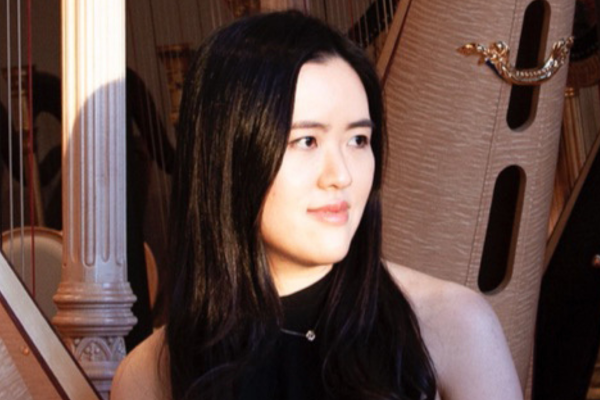
A four-hour flight brings us to Chicago, Illinois, where the harp manufacturer Lyon & Healy (now a joint company with the Italian-based harpmaker Salvi) built its first harp in 1889. When the World Exposition came to Chicago four years later, Lyon & Healy held daily concerts for six months straight at a two-story pavilion adorned with terracotta and gold, and the company still holds regular concerts today. Professional harpist and harp technician Natalie Man encourages us to take advantage of a free recital by one of the well-known harpists often invited to perform at Lyon & Healy Hall.
We’ll enjoy another concert by the Chicago Symphony Orchestra, where former principal harp Sarah Bullen played for 24 years. While serenaded by the Chicago Lyric Opera, we’ll admire the Civic Opera House’s gilded designs in Art Nouveau and Art Deco styles. We’ll catch a masterclass and concert by the Chicago Harp Quartet, which tours the United States performing original transcriptions and commissions. We might also get a chance to hear student recitals at the Northwestern Bienen School of Music and the Chicago College of Performing Arts at Roosevelt University.
Man, a former vice president of the Greater Chicago Chapter of the American Harp Society, says her city offers many possibilities for networking and collaborating with other harpists and musicians. “As a harpist serving the Chicago area, I find this community to be kind, supportive, and have many opportunities for growth,” Man says.
Julia Johnson
Bloomington
Bloomington, USA
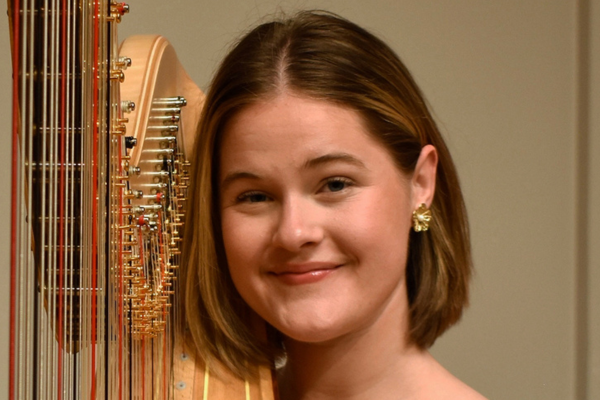
A four-hour drive from Chicago takes us to our final destination, Bloomington, Indiana. It’s only fitting to end our journey at this international mecca for harpists, the host city of the triennial USA International Harp Competition (USAIHC) since former Indiana University professor Susann McDonald founded the event in 1989. “Every three years, the world’s best up-and-coming harpists participate in a four-stage competition over the course of two weeks. This competition has produced some of the world’s finest harpists that now teach and perform all over the world,” says Julia Johnson, associate instructor of harp and master’s student at the Indiana University Jacobs School of Music in Bloomington. Johnson has participated in the USAIHC as both an employee and a competitor, and she says she has enjoyed making friends with other harpists who traveled from around the globe to compete in Bloomington.
We may not time our arrival for the competition, but we can still enjoy a performance in one of the concert halls where its four stages take place. “Aside from the competition, the Jacobs School of Music is one of the largest music schools with 1,500 students and over 1,100 performances annually,” Johnson says. “This gives harp students an opportunity to be a part of a large studio, perform new compositions, and participate in large and small ensembles.” Reflecting on her overall experience as a competitor and student, Johnson concludes, “Bloomington, Indiana, is truly a remarkable place to be a harpist!”
Landing the plane
It’s time to wrap up our harp-themed journey around the globe. I hope our brief tour of the culture and harp connections of 25 cities inspires you to travel the harp world, meet new harpists, share ideas, and discover your own destinations. Bon voyage! •