

10/10
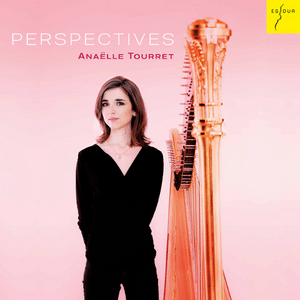
Anaëlle Tourret, harp. Es-Dur, 2021.
About her exquisite new recording Perspectives, the French harp sensation Anaëlle Tourret says that the music “represents the realization of an artistic approach that is deeply anchored in my past and traces my musical development.” She further queries the unique soundworld of four 20th century works written within a 60-year span, as one encompassing stylistic and technical innovation, and thus representing a peak moment in the discovery of what the harp—and perhaps she herself—can express.
The journey begins with a mainstay in the repertoire, André Caplet’s Divertissements pour harpe. In the first of two, à la française, Tourret conjures a gentle gust of air, the listener unaware of the complicated fingerings required to produce an iridescent sonority that’s often interrupted by brusque accents. It’s as if the running lines (Baroque-inspired?) have suddenly hit turbulence, but always remain aloft. The second in this short work, à l’espagnole, is all sensuality, right from the musical directive avec galbe et drapé which, rather than suggesting a tempo, describes a woman’s shapely leg appearing beneath the folds of her skirt. Caplet underscores the intensity with rhythmic pedal glissandi followed by sultry, non-measured cadenzas. Tourret underscores the tension with spot-on timing in the tremolos and just the right touch of imperious poise to suggest flamenco.
The mood shifts dramatically in Paul Hindemith’s Sonata. Written at a time when Hindemith was living in exile, the piece is nonetheless full of optimism and numinous character for which the ringing quality of the harp is perfectly suited. Tourret exemplifies nobility in her playing, producing a recitative-like line right from the first arpeggiated statement. Angular and off-set rhythms offer moments of repose that are elegant and freighted with expression, a perfect jumping-off point for the virtuosic Lebhaft, Tourret’s incisive performance of this kaleidoscope of motives leaving us breathless. Finally, the work ends not with fireworks, but with a Lied, slow and stately, demanding a poetry of surprising tone colors for which Tourret shines as an artist.
As if going back in time, Benjamin Britten explores the sound possibilities of the harp in his Suite, playing a sort of game of “new wine in old bottles.” Tourret is dauntless in the Overture, seemingly sampling strings and what they might do under her fingers. Her playing is fresh, the notes coming to life just as she touches the instrument. Brilliantly executed, the miniature Toccata dances, light as a feather, every note clear, while in the Nocturne, Tourret reveals the mystery at the harp’s extremes. When Britten wrote the work for his friend and colleague, Osian Ellis, he claimed it was not profound, and in the Fugue, things feel more clever and exercise-like, executed with a childlike playfulness. The final Hymn is more than twice as long as any other movement, and is far more contemplative, offering a chance for Tourret to engage in storytelling that holds the listener’s attention throughout.
Heinz Holliger’s Prelude, Arioso and Passcaglia was written precisely 25 years after his one solo work for harp, despite the fact that his wife was a professional harpist. In this atmospheric and haunting piece, he explores the chromatic possibilities of the instrument. Tourret relishes in the tension and slow build of musical material. An added touch to this superb CD are four collaborators (including Holliger) to explain the intentions of the composers, all of whom illuminate Tourret’s dramatically colorful and impeccable playing in equally effective language.