

JOB SHADOW
This article kicks off a new series in Harp Column where we give readers a glimpse into different careers in the harp world. The ways to make a living with the harp are as interesting and diverse as the people carving their own niches. Stay tuned to see who we shadow next. Is there a harp-related career you’d like to see featured? Let us know! Tag us on social media @harpcolumn or email us at info@harpcolumn.com.
When you dreamed of becoming a harpist, what did you dream about? Perhaps your dream was to be a soloist, traveling the world and giving concerts to thousands of people. Maybe you pictured yourself working with others as a chamber musician, constantly exploring new repertoire and new combinations of instruments. Or maybe larger ensembles appealed to you, and you dreamed of sitting in the opera pit or onstage with an orchestra, letting the sound of your harp merge into the music of dozens of other instruments.
Harpists have been dreaming for years. By following their dreams, many of them have created entirely new careers. The possibilities for harpists to find their own musical niche are amazingly rich and diverse. As a renowned teacher with a decades-long career as a solo, chamber, and orchestral harpist, Judy Loman agrees. “One thing I have seen more recently in many students is the creative side of their musical personalities,” Loman says. “Although they work hard to be technically proficient, these students are also very much interested in what they can do with the harp: improvising, composing, trying different sounds on the harp, using electronics, and transcribing music from film and pop literature.”
Loman encourages harpists to seek out different harp-related jobs. “I think it is important for someone who wants a career as a harpist to keep an open mind about how that career will look,” Loman says. “I believe most harpists will have to be proficient in many different kinds of musicianship to make a good career.”
Ann Hobson Pilot, teacher and former principal harpist of the Boston Symphony Orchestra, expands on this idea. “It would be advisable for young harpists to diversify their training as much as possible. It would be wise to not count entirely on orchestra jobs, which may be increasingly more difficult to obtain, but to include courses in composition, arranging, and jazz which would open up other avenues to pursue.”
Throughout our Job Shadow series, we’ll investigate the fascinating variety of harp-related professions and the inspiring creativity of the musicians who work in them. In this issue, we’ll look at the ins and outs of being a harp technician. Steve Moss has been servicing harps since 1995, both at Lyon & Healy in Chicago and as the owner of his company, Moss Harp Service. For eight years, Moss trained and worked with master harp technician Peter Wiley at Lyon & Healy. As he gained new skills, Moss oversaw the company’s lever harp production, then began assembling pedal harps and working in the regulation department. He says having a bachelor’s degree in music theory and history from Yale University was an important part of his preparation.
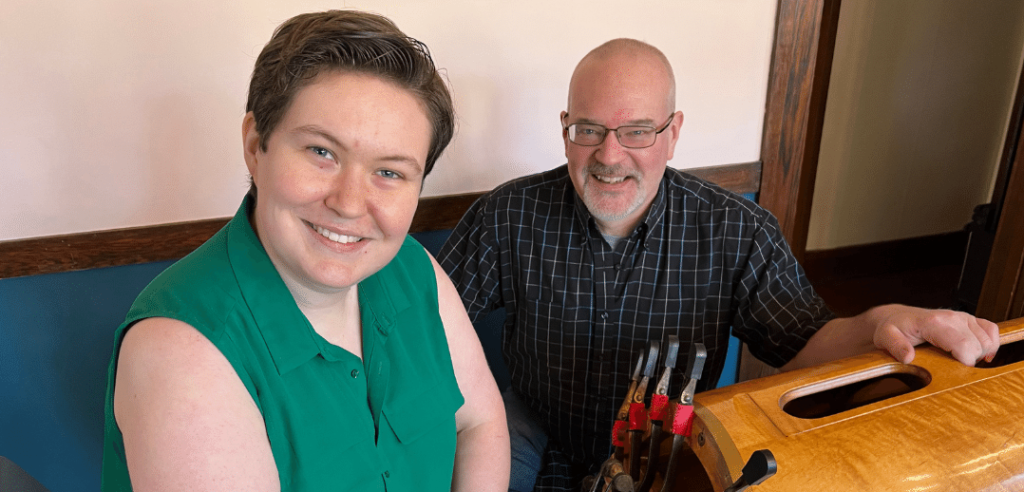
We’re also asking Steve’s daughter Liza about her experience learning the craft from her dad. Her full-time apprenticeship, which she began in May 2019, will give her the skills she needs to become a harp technician. Liza has a bachelor’s degree in vocal performance from the Cleveland Institute of Music, and performs in regional operas in Kansas and Missouri when she’s not servicing harps with her dad. Together, Steve and Liza travel across North America, spending a few days at a time in each location to regulate and repair harps. On average, they spend about 20 weeks per year on the road.
How did you choose this career in the harp world?
Steve: I’m a guitar player and banjo player, so I was originally interested in repairing and building other string instruments. I lived in Chicago, so I was aware that harps were made in Chicago. I was actively developing my repair skills at the time and dabbling in building instruments. When I found out I had an opportunity to work for a company that actually made instruments, I jumped at the chance and applied for the job. I originally worked in the regulation department at Lyon & Healy.
Liza: I have a bachelor’s degree in vocal performance and I would love to do that for the rest of my life, but I decided I need to support that with another job. There are always harpists, and they always need their harps regulated. I thought, “What a great opportunity—my dad’s right here, and I will learn all of his great skills and then use them to support myself as well.”
What’s the best part of job shadowing your dad?
Liza: We have a really great relationship, and I feel like we communicate really well. And it’s cool to get to hang out with my dad. I went to boarding school and then college, so I’ve been gone from the household for eight years of my life. Now I’m getting to hang out with my family again, on the road and at home.
Describe a typical work day.
Steve: When we’re on the road we usually set up shop in a location; it can be a hotel, or sometimes it’s a college or a store. And we will have a series of harps dropped off, usually four or five a day. We just work on one after another in most cases, but if there are repairs, sometimes we’ll do a couple of things at once.
What are the steps when you do a regulation?
A lot of our customers are professional harpists and symphony principal harpists, so it’s great for us to have an understanding of music beyond just knowing how to fix a harp.
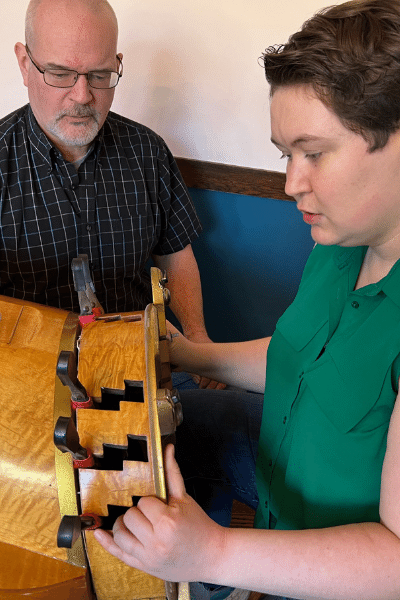
Steve: We start with the pedals—we’ll change the pedal felts and adjust the pedal rods that connect the pedals to the mechanism. We look for any clicking or any other problems with the pedals. So that’s the first part of the process, and Liza is doing the bulk of those herself now. And once that is finished, we stand the harp up and tune it. We check to see that all the screws are tight and little maintenance things like that. Then we go over all the moving parts on every string and check for buzzing. Once that’s done, we go through and tune all the strings again and check all the different pedal positions to see that each string is in tune with itself in flat, natural, and sharp.
Do you work at your job full time?
Steve: We consider it full-time in that it’s our only means of income, except for Liza’s artistic work. It’s not a typical 40 hours a week situation. When we travel we’ll generally work seven days a week and fairly long hours. When we’re home we’re still working, but it’s not necessarily a full-time job at those points. We have all the administrative work, the bookkeeping and the scheduling that we work on, but it doesn’t necessarily amount to a 40-hour week.
Liza: I do continue to work while I’m at home. I help with the administrative work, as you mentioned. I’m working on some of my other skills that are hard to perfect on the road. For example, I’m working with special tools that we don’t get a chance to use every day, but I’ll need to use at some point. He’s been kind enough to continue to support me while we are at home and not on the road, so that I can continue learning and I don’t have to get another job as well.
What do you love about the job?
Liza: I love gaining new skills and then perfecting them, and feeling like I’m accomplishing something on my own.
Steve: I enjoy that too. I also like interacting with harpists—it’s a wonderful community. I’m glad that my customers are harpists. They’re people who made an individual choice to take up an atypical instrument, so they tend to be very interesting people. They’re all generally very honest and trustworthy people, so as a community of customers they’re great to work with.
If you could change any aspect of your job, what would it be?
Steve: The travel is somewhat grueling, and it’s also tough for the harpists. If anybody has a question or something comes up after their harp is regulated, we may be across the country unable to help them. I sometimes envy repair people in bigger industries. For example, pianists usually have a piano technician in town. If your piano has a problem, you call the technician and they’ll come that week. We can’t offer that to harpists. It’s a very rare treat when somebody says, “I broke a pedal rod. Are you in town?” and I’ll say, “As it happens, I am!” But that almost never happens.
What parts of your job surprise you?
Liza: I think I was surprised by how much mental work goes into adjusting all the parts. I figured there would just be a lot of lifting and pulling and screwing. But you have to make a lot of choices to decide if something is perfect or as close as it’s possibly going to get without going too far one way—otherwise if you go back the other way, you’ll be there for hours.
Steve: I think I’m continually surprised that surprises still come up. After I’ve been doing this for almost 25 years, I still will find new issues or problems that I’ve never seen before. Just last week we had a 40-year-old harp, and there was an extra piece that belonged to the mechanism that I found inside the column of the harp. It might have been dropped in there when the harp was made or something. It had been there for 40 years, and we just happened to come across it and pull it out. I thought, “Well, that’s a new one!” So I’m still being surprised after all this time.
What do you imagine the future of your profession looks like?
Steve: I don’t see any big changes for us technicians on the horizon. I think there’s so many instruments that have been around a long time—some companies are making various changes and improvements, but the basics of the harp have not changed a whole lot. It’s unlikely that something like automation is going to come to our industry. We’re just way too hands-on to be replaced by robots. I think that in the harp making industry, we’ll probably see a trend towards automation, but as far as we technicians go, I think our work is going to be fairly consistent.
Did you have any specialized training to become a harp technician?
Steve: At Lyon & Healy at the time, I remember at my interview I said I didn’t know much about harps, and the production manager who interviewed me said, “We don’t really expect anybody to know anything about harps; we’re used to training people.” So they were just looking for some mechanical aptitude and ideally an ear for music. I was a musician; I majored in music in college, and I had also been dabbling in instrument repair and building. So with those background pieces, the company was able to fill me in on the harp-specific information.
Liza: I’m obviously learning from the best [laughs], but if you don’t get your own personal teacher, you can be an apprentice at the company as well. I guess I also had the advantage of always having harps around. I played harp as a child, not for very long, but I did play. So I’ve been familiar with the harp from a young age.
What aspects of your educational or musical background prepared you for your job?
Steve: I think that we’re both very glad to have a strong academic background in music. A lot of our customers are professional harpists and symphony principal harpists, so it’s great for us to have an understanding of music beyond just knowing how to fix a harp. I do think being a musician of some kind is pretty critical.
How many of the harp technicians that you know are harpists?
Steve: There are a few harp technicians that play the harp—there’s Karen Gottlieb, and Rachael Galbraith, and Karen Rokos in Boston. I wish I could play the harp myself, and I’ve studied a little bit, but I realized that I would have to work awfully hard to ever be as discerning as my most demanding customers are. So the amount of time that was going to take was prohibitive. Many harpists, though, prefer to just play the harp, and so there’s a relatively limited number of them that are interested in being technicians, but we do welcome them.
Liza: I think that a lot of harpists would probably love to have some of these skills, in case they find a crazy noise or something. Or sometimes you have to change a pedal rod, like my dad was saying, and you don’t know what’s going on down there. But if you know some of those things, that probably makes it easier to be a harpist.
What advice do you have for someone reading this who wants to become a harp technician?
Steve: You ideally need at least a mentor that can help you get started. As Liza mentioned, Lyon & Healy does take some apprentices, and there’s no substitute for learning in an environment like a harp factory. Or if a full-time technician like myself is able to take on an apprentice, that’s a good option. There’s very little information out there to try to teach yourself, if you’re looking on the internet. Again, since we’re such a small industry, there’s just not a lot of people putting out information publicly. You should get to know the technicians and the companies, and see if there’s any opportunities to learn in connection with someone else. And you have to like traveling! [Laughs] You don’t actually—you can do it part time, especially if you’re in a fairly large city. That’s another option. Some people don’t travel.
What did you learn in the first couple years working with your dad that might help
someone else starting out?
Liza: I learned a lot of new skills I had no idea I would be picking up. Just to scratch the surface, I had to learn the skill of moving something less than a millimeter and having control of my body and my hands. I would regularly stab myself with the chisel the first six months or so. Now I’ve been doing it a while, so I have a lot more control. There’s always something new I’m learning. I’ve definitely gotten better at incorporating all my skills and experience into the situation I’m working on, so I can think through what will make the harp sound the best. •