

9/10
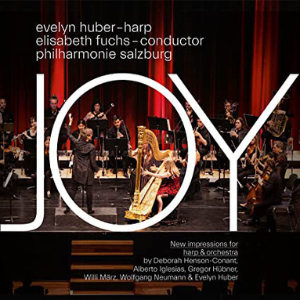
Evelyn Huber, harp; Elisabeth Fuchs, conductor, and Philharmonie Salzburg. Fine Music, 2022.
Joy is exactly the right title for German harpist Evelyn Huber’s new album. Filled with ebullient exuberance and vitality, it comprises Latin-inspired and original travelogues presented expertly by Huber and the sonorous and exacting Salzburg Philharmonic under the direction of Elisabeth Fuchs. It’s a collection that will inspire and deepen how we define the classical harp.
Huber’s eclectic and groundbreaking style has its origins in a jazz course she took as a teenager with the dazzling Deborah Henson-Conant, an experience that left an indelible mark on her career. Hers is the first complete recording of Henson-Conant’s flamenco-influenced Soñando en Español, a concerto “tone poem” that tells the story of a second generation American who doesn’t speak her mother’s language, but begins dreaming in Spanish when she receives a Mexican Hat. A stunning work in three movements, it highlights Huber’s ease moving from deeply contemplative to impassioned, as well as her improvisation skills. Rehearsing and coaching through Zoom, Henson-Conant herself put both her mark and imprimatur on this superb premiere recording.
Other tracks also represent musical connections and encounters including an upbeat arrangement of Sunday Morning by Huber’s longtime collaborator Wolfgang Neumann. Laying back slightly on the beat, it’s all insouciance and delight. Munich-based composer Willi März’s composed Viva Brasil specifically for Huber, with her bright and delicate tone in mind, and introduced flashy and percussive Carnivale-esque rhythms.
Particularly stunning is Para un major mundo sinfonico by Gregor Hübner, the lead violinist of the crossover quartet Sirius. The orchestra sparkles in the lilting mixed meter, with shimmering luminosity even as the music begins to rock out, Huber sounding as if she’s playing two instruments.
Particularly stunning are Huber’s own works, especially the gentle Lavendel, a tone portrait of the coast of Corsica complete with sand and waves, changing light, and fresh breeze. Similarly, Nilade, a piece written originally with Sirius in mind, is now painted with broader brush strokes. Huber is especially skilled using a technique with a piece of wood at the soundboard that elicits an ancient quality, one that gives bends and warbles.
The musical journey ends with film composer Alberto Iglesias’ score for Pedro Almodóvar’s romantic thriller, Los abrazos rotos. With harp front and center, this is some of the most ravishing music written for the screen, and Huber inhabits the darkly nuanced emotions of the story, one told in flashbacks and regret.