
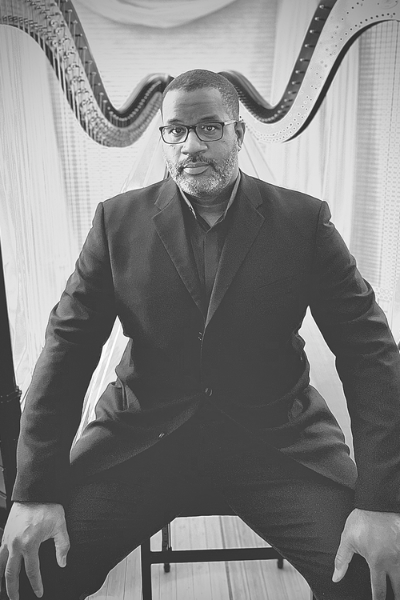
Harpists have unique insight into the challenges and potential of their own instrument. There’s a long tradition of harpist-composers who take the best of their instrument and make it available for their fellow performers. In this issue, we’re asking harpist Maurice Draughn to give us a window into his compositional process. Draughn is co-director of the Harp Instruction and Performance Program, which provides harp instruction for elementary and middle school students in the Detroit area. In addition to teaching at Cass Technical High School, Draughn freelances with orchestras and ensembles in the area. With over 40 arrangements for harp ensemble and chamber groups with harp, and more than a dozen original compositions, he is busily expanding the harp repertoire and has received 24 commissions to date. A Harp Column Music artist, Draughn is a founding member of the Modern Harp Quartet, for which he has arranged several works.
How did you become interested in composing?
When I was in high school, we had a composition project where I composed a piece for harp, flute, violin, and cello. Even though I was doing it as an assignment, the piece worked out so well that it piqued my interest in composing.
After my undergraduate studies, I began to get into composing and did a great deal of arranging for the harp, just to understand the capabilities of the instrument.
When you compose, what is your process? How do you work through the ideas and build the piece?
I’ll sing my ideas into the memo recorder on my phone. Or during my practice time, I’ll play through some patterns. Once I’ve worked out the style of the piece, I start to think about the melodic content and the structure.
I’ve also used poetry to inspire my writing. I recently wrote a piece called Metamorphosis for harp, violin, and cello. It was based on a poem of the same title by Robert Duncan, which helped inspire the effects that I created on the harp and the mood that I set between the three instruments. There’s a lot of conversing between the characters in the poem, so the violin and cello play together, and then the harp fits into the texture of the piece.
I love creating something that others can enjoy. It’s always one of those vulnerable things—when you compose or you create, there’s always that fear of whether it will be accepted or received well.
What instrumentation do you write for?
I recently had a commission for harp and alto trombone. I was at an AHS [American Harp Society] conference in New Orleans a few years ago, and Rachel Brandwein did a presentation on music for trombone and harp. It struck me then as a combination that I wouldn’t have thought of. But several years later, I got a commission from the principal trombonist of the Detroit Symphony Orchestra for a piece for alto trombone and harp. I remembered that experience at the conference, and thought, “Okay, it’s possible.” The trombonist really loves the piece, so I’m looking forward to the premiere of it.
My greatest volume of work is music for harp ensemble, specifically harp quartet. I have more arrangements and original compositions for harp ensemble, because I’ve spent about a decade arranging for my harp quartet and for different student harp ensembles. I composed a set of pieces for a series that was designed to help beginning, intermediate, and advanced harpists learn theory and apply it to performance. I wrote six pieces for each difficulty level.
I write for harp and voice or choir. I have some pieces for more traditional combinations, like flute, viola, and harp, and violin, cello, and harp. But I also try to expand and be open to other possibilities. It depends on what instrumentation the person who commissions the work would like to have.
I recently composed my first original solo for harp, the Doralice Suite. It’s a tribute to Dorothy Ashby and Alice Coltrane. It incorporates their style from the jazz idiom into a classical setting. It’s pretty challenging, but it’s rewarding to play. I’m hoping more harpists get a chance to experience it.
How would you describe your compositional style, and what are the influences that contributed to it?
I’m influenced by Carlos Salzedo’s compositional technique. When I studied his pieces alongside the standard harp repertoire, it struck me that his pieces stretch the boundary of the harp. Salzedo composed for the harp as a contemporary instrument, worthy of more than just arpeggios, glisses, and harmonics—you know, the things that we typically get relegated to as harpists [laughs].
Another influence was arranging pieces by composers that I took a liking to. Early on, I heard a friend of mine perform a piece by George Gershwin called Three Preludes for Piano. I thought, “That would be great on the harp.” I tried arranging it for solo harp, and that was just not working at all. So I did it for two harps. It really challenged me to think, because the harp is limited in its chromaticism. Then I thought, “Wow, if I can do a two-harp arrangement of this piece, then let me try Pictures at an Exhibition [by Modest Mussorgsky].” I arranged that suite for two harps, and I did some Stravinsky and a few Ravel pieces. One of my favorite quartet pieces I arranged is Le Tombeau de Couperin by Maurice Ravel.
How did you come to the harp?
I started late on harp. My primary background is as a keyboardist. I started piano at age 4, and I went into high school playing primarily saxophone and piano. I went to a college prep high school where I could major in a program. I started in graphic arts, believe it or not, but then the music department pulled me in. My sophomore year in high school I started harp, and as I say, the rest is history—I fell in love with the instrument. Eventually I put piano on the back burner and pursued harp as my principal instrument. I’m a church musician as well, so for grad school, I went to seminary. I double-majored in organ and harp performance. I continued my keyboard skills by playing organ, and started writing music for harp and organ. There’s such a limited catalog of original works for harp and organ, so I want to expand it.
Where do you start when you’re arranging a piece?
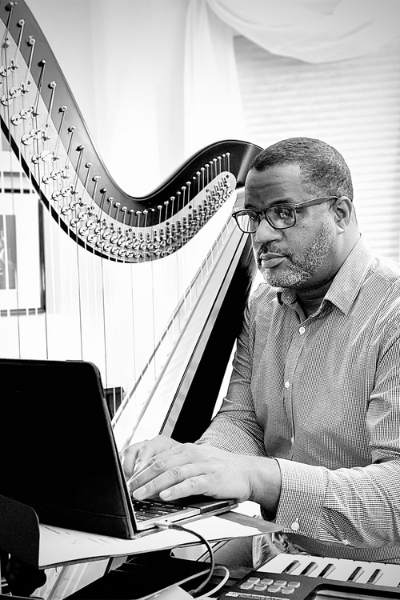
I always go through with a pencil and mark edits on a clean copy. I scan through the score for chromaticism, or things that I know are not natural on the harp, like repeated notes. And I look for enharmonic spellings or ways to rework certain figures (like five-finger patterns on the keyboard) so that those passages are doable on the harp. I’ll sketch out ideas that might work, then I’ll sit at the harp and try to play through them. And then I input the arrangement into the music notation software and do another round of edits, where I make sure the pedaling works and that it’s playable.
One of the things that I always run into is that I have large hands. Some of the harpists that I’ve composed and arranged for have said to me, “Maurice, you wrote this for your hands, not mine.” So I have to consider that when I’m writing. I also consider how to sustain melodic lines on the harp as if it were a wind instrument or a bowed instrument holding a note. Sometimes I use a tremolo of enharmonics to make the sound carry over.
I often start arranging a piece without knowing which instruments I want to arrange it for. But usually as I dive into the process, I realize, “This would be a great line on the flute with harp accompaniment,” or “This would be great in a harp ensemble.”
How much of your time do you spend composing and arranging?
It’s a juggling act. During the pandemic, I had a chance to compose and arrange a few things. It was nice that I had time because things were shut down. But typically, I’m kind of a night owl when it comes to composing and arranging. I just fit time in between teaching during the day, spending time with my family, and rehearsing for performances.
Sometimes I’ll take mini-retreats, if I have a project coming up and I really want to have dedicated time to get my creative process started. Often I’ll jot down ideas and then listen to the fragments and try to piece them together. I like to zero in on a time, to devote a few hours to letting the creativity flow. Some people can do it in fragments—they can compose eight measures today, eight measures tomorrow—but I need to let everything flow, and then go back and refine it after setting it aside for a couple of days.
What parts of your musical or educational background prepared you for composing?
One impactful experience was the opportunity to go to the Tanglewood Institute during my summer study with Lucile Lawrence. My first time there, I was in a dorm with all composers on my floor. When they found out I was a harpist, I was their guinea pig for the whole summer. I think I played two or three pieces with harp in them. I took part in the composers’ seminars, and Miss Lawrence did a workshop that I sat in on.
Did you have any specialized training in composition?
Not in the traditional sense. My theory professor at the university I attended for undergrad was the head of the composition department, so his theory classes were more composition-based. Because my high school classes had given me a lot of the theory that students would typically have their first year or two in college, I was able to do additional projects outside of what other students were doing in the theory classes.
I did take an orchestration class, so I had the opportunity to write for other instruments, both in undergrad and grad school. I always went above and beyond what the project called for, just to get the experience of writing for other instruments outside of my own background. I also read method books for the harp.
I didn’t know that I was going to compose as much as I am today, because at the time I was just doing it as a hobby. I was interested in it because that was kind of the tradition of a lot of the master harpists in our history. They all composed pieces—Hasselmans, Renié, Salzedo, Grandjany all composed pieces. So in that tradition, I came to develop my own compositional style. It’s formalized in the sense that I apply the information that I received in my training in undergrad, but also just from my experience of playing the instrument.
What do you love about composing?
I love creating something that others can enjoy. It’s always one of those vulnerable things—when you compose or you create, there’s always that fear of whether it will be accepted or received well. But it brings me joy to see people, both listeners and performers, enjoy the experience of what I was able to compose.
The process itself is also rewarding. It’s always nice to see the finished product, even though I always find something else I could have done differently. I particularly enjoy commissions, because I can collaborate with other artists, even other harpists, to refine the music.
If you could change any aspect of your work as a composer, what would it be?
Just more time! My biggest dream is to be able to have time to not only compose more works, but also to study with other established composers who write well for the harp, or who write well in general.
I definitely see it now more than ever, that composition is an avenue that I’ve been able to thrive in. I’m contributing to the harp canon, and making an impact not only as a harpist, but as an African American male. It’s been a great journey and one that was unexpected for me, because it started as something that I just wanted to try and experiment with. It’s turned out to be fruitful and beneficial for me as an artist.
Is there anything about composing for harp that surprises you?
Sometimes I’ll compose something one day, and come back to it the next day, and I’m unsure how it worked the day before. I think that’s just the nature of the harp itself. I’ll play a passage on one of my harps and then play it on the other harp, and it’s like two totally different sounds. One has more resonance, and the other one has a bit drier sound, so sometimes I’ll write something that works well on one harp but not the other.
A piano generally is a constant—if it’s well maintained and in tune, you can depend on the sound you’ll get. But the harp has little nuances that can always surprise you, because there are so many different makes and models and ages of harps.
What do you imagine the future of composition or new music will look like?
I had the pleasure of working with young harpists in the Young Composers Project at the AHS SummerFest last year. It was just a joy to see the potential in these young harpists who were composing phenomenal pieces. They were so excited about writing for their own instrument and also performing their pieces. We have an instrument that’s often misunderstood, and obviously we edit a lot of orchestral parts. But to me, it has a lot of meaning to play something that was composed or arranged by another harpist, because it’s been worked out from a harpist’s perspective.
I think if we continue to instill in young harpists that excitement for composing, through programs like those offered by the AHS and World Harp Congress, we’ll be in good hands for the future.
What advice do you have for our readers who want to write music for harp?
Always expand beyond the limitations of the instrument. I think writing for the harp can be daunting. But there are certain things the harp can do that other instruments cannot, like using enharmonics for repeated notes.
I think if people who are approaching composition can start with the mindset that anything’s possible on the harp, they can work around any challenges they find. •