

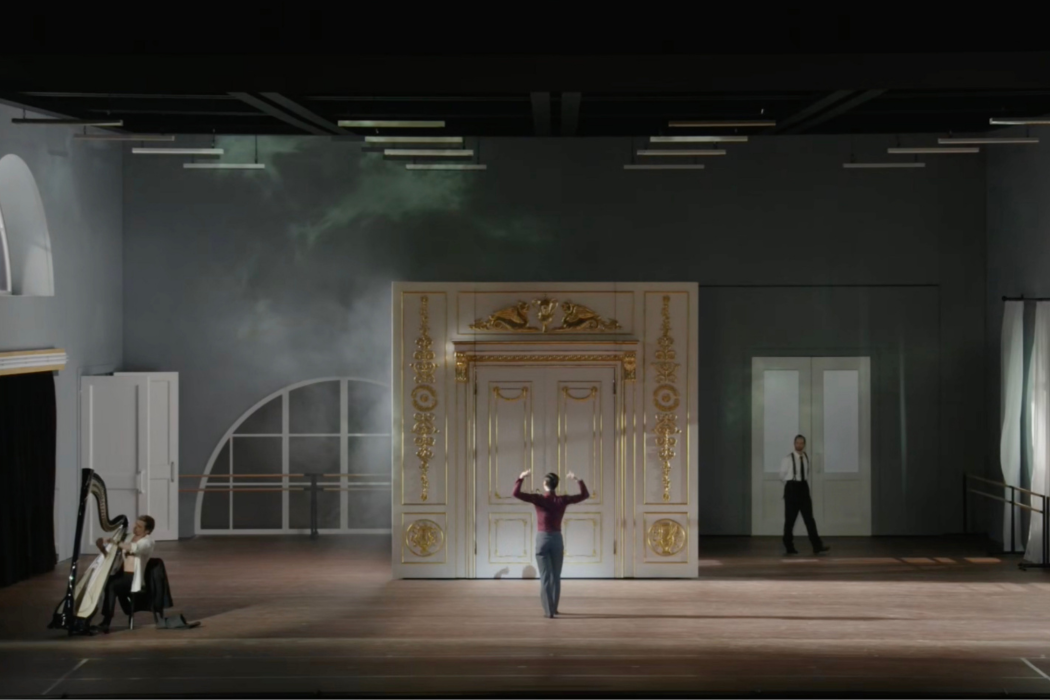
Nearly 2,000 people pack Germany’s second-largest opera house, awaiting the premiere of a new ballet. Suddenly, from the wings, a harpist appears in a wide-open shirt and pushes a harp in front of him (its model name, “Diva,” is fitting). He passes the corps de ballet, glides by the scenery, reaches the very edge of the stage right in front of the orchestra, sits down in the beams of the spotlights, and begins to play. The music is not just some abstractly beautiful melody, but Mahler’s “Adagietto.” It feels like a dream of a harpist with a high fever, but this is a new reality and an important page in the history of the harp’s development.
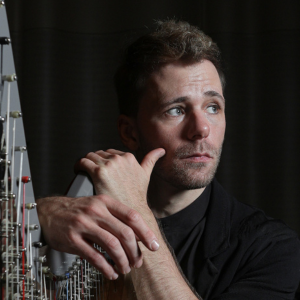
This moment does not belong to some long-ago musical era when ballet and opera were the preeminent forms of cultural entertainment, but to March 2026. The venue: Deutsche Oper Berlin. On stage: the ballet Nureyev, created by Kirill Serebrennikov (stage designer, director), Yuri Possokhov (choreographer), and Ilya Demutsky (composer). The harpist: me, Alexander Boldachev. Amid the uproar about Timothée Chalomet’s assertion that “no one cares” about ballet and opera, I was playing 12 sold out ballets this spring. It appears we don’t need Timothée’s help “keeping this thing alive.” We already have what we need: legendary premieres, viral interest from the public, and the harp in the middle of it. So how did it happen?
This story began long before this moment in Berlin. My friendship with Kirill Serebrennikov started about 10 years ago, on my first day of a three-year journey as a guest soloist at the Bolshoi Theatre. We met at a ballet rehearsal, and I, as usual, spoke with enthusiasm and love for the harp, its limitless possibilities, and the freedom it gives.
Just a few months later, our first collaboration began: a short instrumental dance film about the visionary filmmaker and artist Sergei Parajanov, for which I arranged the music and acted. We followed that with a large-scale dramatic production based on Anna Akhmatova’s Poem Without a Hero. Using three harps and a piano, I moved from instrument to instrument to create the show’s entire sound design. First time in my life I had “music director” before my name.
So when Serebrennikov took on the monumental project about legendary ballet dancer and choreographer Rudolf Nureyev, one of the first ideas was to integrate the harp into the very fabric of the performance. This was a breakthrough. He gave the harp a chance to prove, through numerous projects, that it can be a solo, all-encompassing instrument capable of conveying the full palette of emotions and the entire spectrum of feelings.
Ilya Demutsky—a composer whose music is enchanting and poetic, yet incredibly complementary to ballet, film, and opera, without distracting from the main characters—worked with me to create a unique on-stage harp part. The harp’s role appears in two large fragments, about 10 minutes each, in the first and second acts. In these moments, the stage is occupied only by me, a prima or premier, and a reader who recites letters from Nureyev’s students and colleagues. This is an extremely dramatic, deeply intimate, and in many ways fundamental part of the ballet. It not only conveys certain biographical facts, but also creates a connection across time—past, present, and future.
In the first letter reading, original music by Demutsky is heard in which the harp exists for a long time, almost without the orchestra, combining a long, flowing melody with complex scales and passages. In the second letter, the musical fabric grows out of Mahler’s world: everything begins with the beloved “Adagietto,” then develops into a more dramatic modulation that leads to a climax and release.
Everything about the role is serious: the makeup, the costume (even if unbuttoned and requiring preparation not only at the instrument but also in the gym), an acting task, a precisely timed plan down to the second, and, as a reward, a solo bow in front of thousands of ovations. In this moment, I think I am in the right place.
Smiling at the standing ovations, I understand how important this project is to the harp. Both on the stage of the Bolshoi Theatre and now on the stage of the Berlin Opera, these are not singular moments, but important, connected steps in the development of the instrument. Each step opens the way for new projects in different genres, showing that the harp can be relied upon to withstand the demands of a large stage, carry dramatic weight, and command the center of attention. The instrument even glides across the stage—quite literally—under my hands to the required point, as if the harp itself were also a ballerina.
And this is my main mission—to be a pioneer of the harp in the world, to take on impossible projects, to pass on knowledge, experience, and skill, and to create my own universe with the harp at its center.
Some people would say, “You were just fortunate to be in the right place at the right time.” Yes, but you can’t imagine how many opportunities I missed before learning how to react properly, be ready for anything, fit and hungry for action. The first thing Kirill Serebrennikov taught me is: “Never doubt your possibilities, as you will never know your level if you don’t try. First, answer ‘yes’ to a proposal, and then think about how to make it happen.” •