

Jump to our interviews with:
In February of 2019, the International Harp Contest in Israel announced the repertoire for its 21st competition, planned for 2021. Though the journey to Israel for the world’s oldest and most storied competition is long and grueling, it always starts out with excitement and optimism when the repertoire is announced, goals are set, and hope is abundant for the possibilities that await. No one could have predicted what the world would collectively endure with the coronavirus pandemic in the years leading up to the competition. In more than 20 countries around the world, dozens of harpists practiced and prepared through lockdowns and isolation. Performances were canceled and lessons held through a computer screen. Resilience and fortitude became requirements along with the four stages of challenging repertoire.
Though the competition did not begin until 18 months after the beginning of the pandemic, the 21st Israel Contest was far from normal. Organizers decided to move up the start of the competition and the hold the first two stages online in August and September of 2021, inviting the semifinalists to compete live in Israel in December. Pandemic concerns delayed the final two stages until the end of March 2022, stretching the competition to span three seasons.
At last, the nine semifinalists traveled to Israel to perform in stage three, albeit in the shadow of the war in Ukraine and amid a recent increase in terrorist attacks in Israel. They all risked getting COVID and not being able to compete. There was even concern that the Chinese contestant would not be able to travel due to the country’s strict lockdown. Miraculously, all of the semifinalists made it. One of the members of the jury, Willy Postma, was busy helping Ukrainian refugees and watched the final stages livestreamed while she remained in Norway.
From the semifinal stage on March 28, three finalists were chosen: Beatriz Cortesão of Portugal, Lea Maria Löffler of Germany, and Claudia Lamanna of Italy. The stakes seemed higher now that the Contest is livestreamed and available to rewatch online. It felt similar to sports matches on television. You can watch and rewatch passages up close and in slow motion. Every missed note, fumble, or phrase that didn’t go as planned is laid bare for all to hear, see, and analyze. It must have felt like the Olympics for these finalists, yet all three walked on stage beaming with positive energy. It was clear that they all love the harp and were happy (and probably very relieved) to be performing the final-stage concerto after so many delays.
Immediately after the last round of the Israel Contest, I always try to interview each of the finalists about their experience. I was prepared to interview stressed-out harpists, but, to my surprise, they were smiling—almost glowing. I felt uplifted by the optimism from all three. The harp world can look forward to following the bright futures that lie ahead of them. They are already off and running, busy with rehearsals and performances immediately after the contest. I felt lucky that they could squeeze in time for an interview on Zoom within a week of the finals.
All three are at least trilingual, and needless to say, I was impressed with their fluency in English. They were all very grateful and provided me with long lists of people to thank for their support. It is heartwarming to see their gratitude and maturity. If it takes a village to raise a child, it is clear that it takes a supportive family and a cast of dedicated, world-renowned teachers to raise a harpist to the elite international level required to compete in the finals of the Israel Contest.
Musicians have different ways of approaching music, and all this changing of professors, in a way, helped me find my own voice and unique approach to the instrument.
—Claudia Lamanna
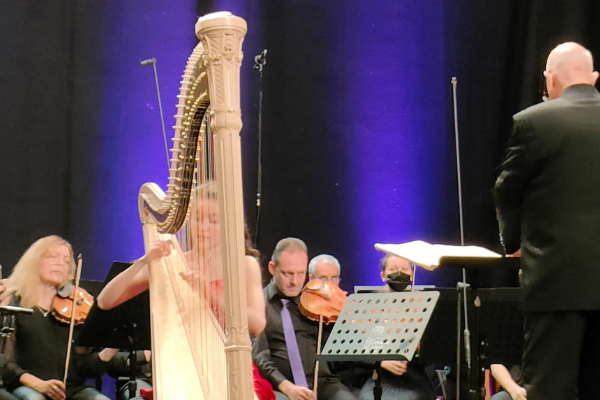
Claudia Lamanna has an infectious smile and eyes beaming with light. When she is performing, you can see that she is completely focused. Claudia plays expressively and with vibrant energy. Her arpeggios glisten. I sat at the edge of my seat for her entire performance. I spoke with Claudia at her home in Noci, in the province of Bari in southern Italy.
Harp Column: Congratulations on winning one of the most prestigious harp competitions in the world. It must feel like winning a gold medal in the Olympics. Your concerto performance was absolutely stunning. You are an exciting performer and play with a wide palette of colors and textures.
Claudia Lamanna: Thank you very much. It’s always a pleasure to know when people appreciate my playing.
HC: You won a concert grand harp! Do you know which harp you will select?
CL: I haven’t decided yet, but I will probably opt for a Lyon & Healy Model 23 gold.
HC: What were the pros and cons of competing during the never-ending pandemic?
CL: There were a lot of adaptation efforts coming from all sides—from the Contest’s organizers who had to deal with many issues to ensure the running of the competition in a safe environment, to all the participants who had to be ready for the first two stages a month in advance from the original scheduled dates. That didn’t make much difference for me, but it may have caused discomfort for some people. Let’s also consider the difficulty of finding adequate equipment and acoustically suitable halls where to play the first two rounds—this was not easy for me. Then, of course, the several postponements of the two final stages of the competition meant extra time to prepare for all the semifinalists. For this reason, it is obvious that we were all competing at a much higher level. We also have to mention the psychological effect caused by an unusual situation like this—rescheduling the mind to the new dates didn’t just cause the feeling of never being ready enough, but it was also a source of further stress because it required—at least for me—searching for new performance opportunities and asking chamber music mates to play with you again (something not to be taken for granted). All this during a historical period in which the opportunities to perform concerts in front of an audience were practically non-existent. So, I’m sure it has not been easy for anybody.
HC: How did you keep calm under so much pressure? Do you do any breathing work?
CL: Yes. I focus on my breath.
HC: Did the pandemic change your priorities?
CL: No, I wouldn’t say that. I had just finished my internship at La Scala Academy Orchestra in Milan when the pandemic started, but I had already decided to focus on solo repertoire before the lockdowns. So, I started working on the repertoire for the Contest quite late. The only piece I already knew was the free choice one, together with Liszt’s Le Rossignol, although I finally decided to change it last minute with Glinka’s The Lark, because it was my wish to learn it. Besides this, I also worked on other new pieces for some projects during all my preparation.
HC: What is your background? Who are some of your other teachers?
CL: I come from a family of non-musicians, but there has always been great interest in culture. When I was 7 years old, I heard the harp in a concert and fell in love. They asked me after the concert if I would like to play and instrument and which one. I told them that I wanted to play the harp. At the age of nearly 9, I started harp lessons. One year later, I was admitted to my first conservatory in Monopoli where I had several teachers because there was not a full-time harp position there at the time. Musicians have different ways of approaching music, and all this changing of professors, in a way, helped me find my own voice and unique approach to the instrument. I learned to think for myself and find what works best for me from a really young age.
After receiving my master’s degree in Italy, I deepened my studies with Isabelle Perrin at the Norges musikkhøgskole in Oslo. Then I moved to London for a year where I achieve a postgraduate degree at the Royal Academy of Music, where Karen Vaughan was my main teacher. I finally completed my studies at Mozarteum in Salzburg with Stephen Fitzpatrick, with whom I prepared the competition.
HC: It is clear that learning from so many teachers has been to your advantage. What an impressive list of world class harp instructors. What kept you motivated to practice during the pandemic?
CL: I tried to always stay positive and in a good mood, thanks also to my loving and supportive family.
HC: You are a very expressive musician. From where do you draw inspiration?
CL: I usually listen to every style of music, and I also enjoy cinematography. I am inspired by nature and I love animals, especially my dog. Life in general helps me to communicate something with my music. I think that it is very important to experience a life beyond the harp and the practice room.
HC: What are you thinking about when you play? Do you use imagery?
CL: I usually follow the emotions of the music. I work on maintaining the excitement and energy of the music. All my past experiences have helped me to be who I am today and I look for my music to be truly genuine and authentic.
HC: What are your future plans? Your international career now has been launched!
CL: I wish to pursue a solo career. I am also actively expanding the repertoire for the harp and enjoy making new transcriptions. In 2020, I published my transcription for harp of the Variaciones del Fandango español by Félix Máximo López, which represents a totally new addition to the harp repertoire. I also recorded it on my debut album.
HC: What do you see in the future of the harp world in general?
CL: The harp is still a bit on the fringe, and I plan to continue pushing our instrument into a more prominent role in the music world.
HC: I see a very bright future for you and the harp. Congratulations once again. Brava!

What I love most about the harp is the unique timbre and versatility.
—Lea Maria Löffler
Lea Maria Löffler was awarded the second prize—$10,000 donated by the Municipality of Akko (Acre), the historic city on the Mediterranean Sea where the final two rounds were held. The city is very supportive of the competition, and many local residents were in the audience.
Löffler is at one with the harp. She plays as if it is a part of her and looks comfortable and confident on stage. It is clear that she loves performing. I was mesmerized by her phrasing and musicianship. Löffler is finishing her master’s degree, and I caught up to chat in Cologne.
Harp Column: Congratulations! I loved your performance!
Lea Maria Löffler: Thank you very much.
HC: Why did you decide to compete in the International Harp Contest in Israel?
LML: I knew that I wanted to compete in the Israel Contest at some point. It’s such a big and prestigious competition. Along with the USA International Harp Competition and the ARD (the largest international classical music competition in Germany), it’s one of the most important harp competitions in the world. When the lockdowns came, I had time to prepare for the Contest in Israel and seized this opportunity.
HC: How did the pandemic affect your preparation for the Contest?
LML: The pandemic had a huge impact. I took part in the German Music Competition in 2018 (Deutscher Musikwettbewerb—four rounds of a demanding program similar to the Israel Contest), and reached the semifinal. I was awarded a scholarship that gave me the opportunity to build different chamber music groups, put interesting programs together, and perform around 50 concerts throughout Germany. I’m playing in various ensembles, duos with saxophone, flute, violin, clarinet, and I also played concerts with a string quartet. When the pandemic began, all of these concerts were postponed or canceled, so I had the time to start preparing for Israel. There was the advantage of having a lot of time to practice with fewer distractions, but the lockdowns also led to a lack of inspiration because I was not interacting with others anymore and just staying at my place of study.
As the Contest got postponed so many times, I had to carefully balance my projects. Concerts were starting to take place again, and I had quite a tight schedule from November on (when the Contest would have been over). So with the postponements, I had to manage the preparation time needed between my future performances and the Contest repertoire.
We had to be super flexible concerning the schedule, and nothing took place as intended. We had more time after the second round to prepare the repertoire for the third and fourth rounds, but in return, the first two rounds were moved up nearly two months from their original date. Before going to Israel in March, there was additional stress to make sure not to contract COVID before flying to Israel to compete in the final two stages.
HC: You are such a musical performer. What are your sources of inspiration?
LML: I love traveling and being with people from different cultures.

I am incredibly inspired by collaborating with other artists. In 2018–2019 and 2020, I received a scholarship for a residence for further creative development at the Cité internationale des arts in Paris. The Cité internationale des arts welcomes more than 300 artists from a wide range of disciplines for residencies every month and encourages cross-cultural dialogue as well as provides a place where artists can meet with their public and other professionals. I collaborated witharious artists, including an Egyptian comic artist, a dancer from Cameroon, a blues/jazz/rock singer from Togo, a DJ from Saudi Arabia, and many more. It is incredible to meet such outstanding artists from such different backgrounds without prejudices in one place, be part of extraordinary projects, and create stunning works of art with them. All of this happens in the fantastic surroundings of Paris, a city filled with history, architecture, culture, and beauty. There are so many concerts of different musical styles, opera performances, and exhibitions you can attend. It is mind-blowing. I could dive deeper into another language and learn more about French culture by living there. It was one of the best experiences of my life.
HC: What an amazing opportunity! Tell us a little about your background. What drew you to the harp?
LML: I was raised in a musical family. My mother is a singer and my father a conductor and organist. I started to study the harp at the age of 5 and have benefited from the constant support from my parents. As musicians themselves they understood what was required to master an instrument. What I love most about the harp is its unique timbre and versatility. Its special features provide me with the options to play it as a soloist, in chamber music, and even in an orchestra. I can best express myself through the music of the harp. It is really “my” instrument.
HC: I really love your sense of phrasing.
LML: Thank you. I enjoy working on phrasing and thinking of how another instrument would carry a phrase. I try to tell a story through the music and have exact pictures in my head when playing the notes.
HC: You changed harps between the third and fourth stages. Why?
LML: I really liked the Lyon & Healy Style 30 that I selected for the third stage. It was a good choice for performing chamber music. But I felt that the Lyon & Healy 23’s tone and volume were more suitable for the concerto. I was able to change to that harp for the final stage.
HC: Who are your primary teachers?
LML: My former teachers include Andreas Mildner (University of Music Würzburg), Mirjam Schröder (University of Music and Performing Arts Vienna), and Silke Aichhorn. From 2018–19 I studied at the CNSMD in Paris with Isabelle Moretti and Geneviève Letang. Currently, I am studying in Detmold, Germany, with Godelieve Schrama. I am filled with gratitude for all those I could learn from and who helped me become the musician and human being I am now. I would like to thank especially Godelieve for her tireless efforts and special commitment and my family and friends who have been incredibly supportive.
HC: You have a great future ahead. What is next for you?
LML: I’m still playing a lot of chamber music concerts throughout Germany, but I am open to all opportunities. The Contest was a great experience. I would love to share my music worldwide and move people, touch their hearts. I am curious and open to seeing the world’s diversity and really getting to know people on a deeper level. I want to tell my story but also experience theirs. I love that I can combine my job with traveling and exchange.
HC: How do you picture the future of the harp world?
LML: I think new opportunities and niches are opening up, such as the jazz and electric harp scene. I recently bought an electric harp! I’m still discovering the potential of this instrument and completely enjoying getting to know it. I also have a synthesizer and a looper, which is totally exciting and completely different from the classical harp.
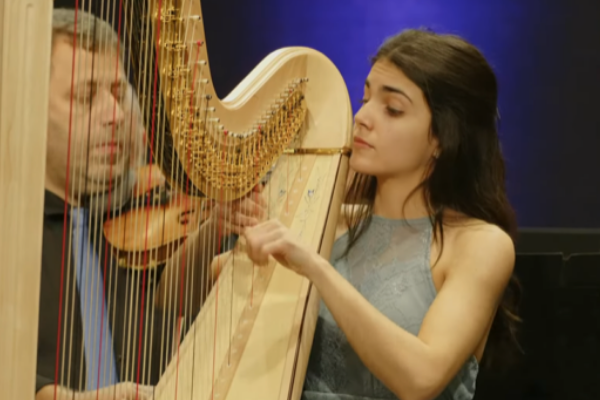
Beatriz Cortesãowas the first of the three finalists to perform the concerto. She walked out on stage beaming with confidence, with a bounce in her step. I enjoyed watching her play. Beatriz moves to the beat and smiles. Her energy is infectious. And of course, her technique is clean and absolutely stunning.
Harp Column: Congratulations on winning two prizes—third place in the Contest and the award for the best performance of the contemporary composition, Puzzle.
Beatriz Cortesão: Thank you. The work on the obligatory contemporary piece, Puzzle, was a process of a lot of joy but at the same time challenging, which was very stimulating for me not only as a harpist but as a musician. My goal was to discover the musical essence of the Puzzle. The composition offers the listener rich development in tone, timbre, sound, and dynamics. This is supported by firm yet progressive and tenserhythmic structure.As I spent more time in January developing my understanding of the piece, I adjusted my interpretation and developed the intensity of the rhythmic structure.
HC: How did the pandemic influence your preparation and your life?
BC: COVID brought with it so much uncertainty to all of us. I started preparing for the Contestand then due to lockdowns, I spent 16 months studying with my teacher, IrinaZingg, online. I had more time to study, but I suffered at times from a lack of motivation. I am inspired by the warmth of personal connections and dialogue with others. I really missed spending time with friends and having lessons in person. The semifinal round was postponed a few times, and it was frustrating not knowing whether or not to accept other performances. I found it difficult to remain focused on the program and adjust to the changing deadlines. At the same time, especially during the first period of lockdown, I could take time off for walking, to be closer to nature, to hear the birds, and discover myself. During my normal, hectic life, it is difficult for me to find time to take time off.
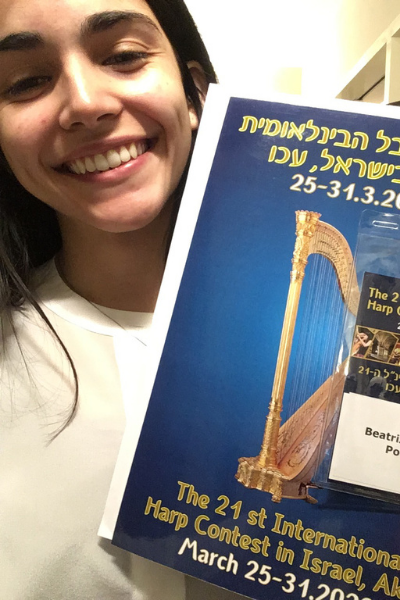
HC: Your hard work and sacrifices paid off. The separation between first and third place was very narrow this year. You have a bright future ahead of you. What are your future plans?
BC: I love my profession, and I am open to all it can offer. I enjoy being on the stage as a soloist and to speak with my music to the audience.I also enjoy playing in an orchestra and performing chamber music because the human exchange is very important to me. I look forward to returning to my projects, which had to be postponed due to the pandemic and preparations for the Contest. I collaborate with a few music agencies to present the harp in different musical styles and on different platforms. It is important for us to celebrate and develop our Portuguese heritageand the harp. I really look forward to continuing to work on new pieces, extending my repertoire, and continuing to develop as a musician, person, and, of course, a harpist!
HC: We see very few harpists from Portugal on the international stages. Do you think that placing in the finals of one of the most prestigious harp competitions will have an impact on the harp world of Portugal?
BC: Actually, we are lucky to already have an extended and rich harp tradition in Portugal with many accomplished harpists and teachers. Renowned harpist, composer and pedagogue Clotilde Rosa (1930–2017) was a student of Phia Berghout, Jacqueline Borot, and Hans Zingel. She enriched the Portuguese harp school.Mario Falcão is a devoted harp advocate and such an inspiring person especially for the younger generation. Áurea Guerner, the former professor of Conservatorio Porto, educated numerous Portuguese harpists. Carolina Coimbra, professorat the Escola Superior de Musica de Lisboa, continues these established harp traditions. I am very happy and honored to continue this path and invest into the development of the harp world in Portugal. I will encourage Portuguese composers not only to compose for the harp, but also use our national musical heritage to be reflected in the music for the harp in the 21st century. I see this all as my personal and professional mission.
HC: Thank you for helping present the harp to greater audiences!We look forward to watching your future career blossom.
BC: Thank you very much! I have many people to thank and am filled with gratitude for all the support I have received from my mentors and family. First, I would like to thank my teacher at the Civica Scuola di Musica Claudio Abbado in Milano, Dr. Irina Zingg, for everything she has taught me since I began my studies with her in 2017. I offer my deepest gratitude toprofessors Luisa Prandina, Mara Galassi, Silva Costanzo, and Flora Papadopoulos for guiding my preparation for the Contest. And to my dear professor Milda Agazarian for her warm and treasured support.
HC: Do you have any other thoughts you would like to share about your experience in this Contest?
BC: Competing in the Contest was a grandiose experience on many levels: professional, artistic, personal, human, and much more. I went through such an intense period of preparation.I was steadily expanding my goals, stretching my limits, and deeply exploring the music. It was an enormous opportunity to grow as a musician, harpist, and person. I am truly grateful. •