
Nearly a half century after its founding, Dusty Strings has reached two milestone serial numbers representing 45,000 instruments handcrafted in Seattle. These milestone instruments are harp number 25,000 and dulcimer number 20,000. “We see [reaching these milestones] as an important validation for the art form of instrument-building and the musicians and music-lovers who continue to find joy and value in tangible, handcrafted musical instruments,” the company says. Both are special instruments made with highly-figured wood to celebrate the occasion. Harp number 25,000 is a FH36S model featuring a soundbox, neck, and pillar made from waterfall bubinga wood, with a soundboard veneer of bird’s-eye maple, framed with an abalone inlay.
The company says it is proud to be a small, locally-owned manufacturer. Dusty Strings Company sprang up during a wave of interest in folk music and folk instruments in the late ’70s. In 1979, entrepreneurs Ray and Sue Mooers began handcrafting hammered dulcimers in their basement workshop in Seattle’s Ravenna district. Dusty Strings later moved to the Fremont neighborhood, where the store and music school remain. Today’s hammered dulcimers and lever harps are made in a purpose-built workshop in the Interbay district.
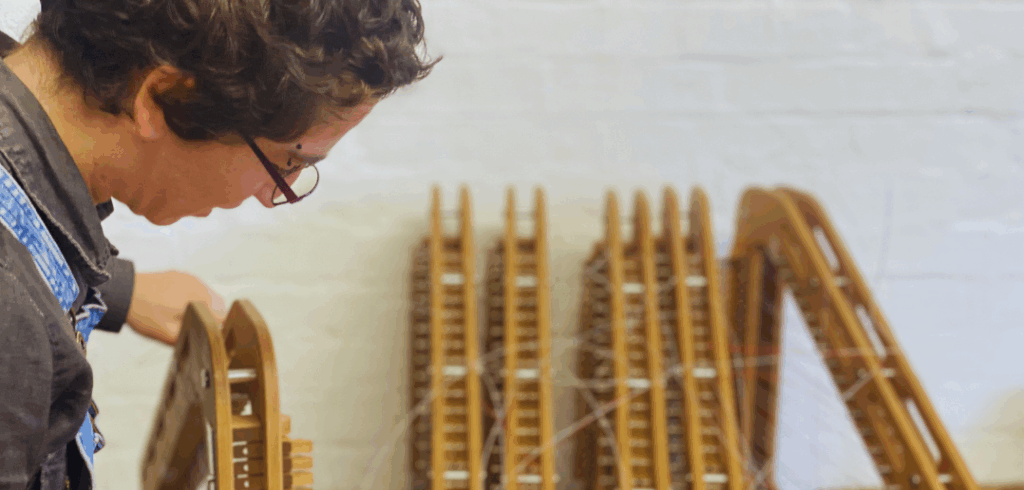
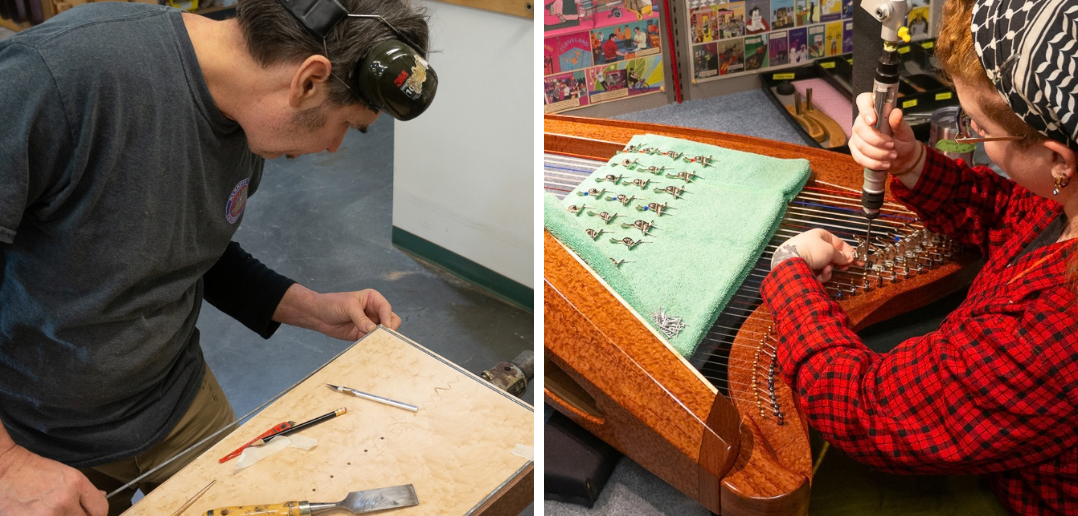
Though technology continues to evolve, Dusty Strings says the majority of its manufacturing processes are still done by hand by skilled craftspeople. Paper drawings and plywood templates have been replaced with tools that operate with computerized precision, using Computer-Aided Design (CAD) diagrams and computer-controlled (CNC) router part manufacturing. Spending weekends at craft fairs has given way to maintaining a website and shipping instruments by air freight. Despite all these changes, the company says its love for the craft has remained the same, as it continues transforming beautiful hardwood lumber into works of musical art, guided by maintaining its personal approach to doing business, its connections with customers and suppliers, and its ongoing mission to bring music into people’s lives.
Read more about Ray and Sue Mooers and their instrument-building journey in our cover interview from the January-February 2015 issue of Harp Column.