

Download this issue to get this tune now!
Each installment of our Tear-Out Tunes series features a new piece written by one of the best harpist-composer-arrangers in the business. Each composer will tell you a little bit about their piece, and also give you some helpful tips for learning it and getting the most out of the experience. The new piece (on the following pages) is yours to keep. We even put it right in the middle of the magazine so you can tear out the whole sheet and put your new tune on your music stand.
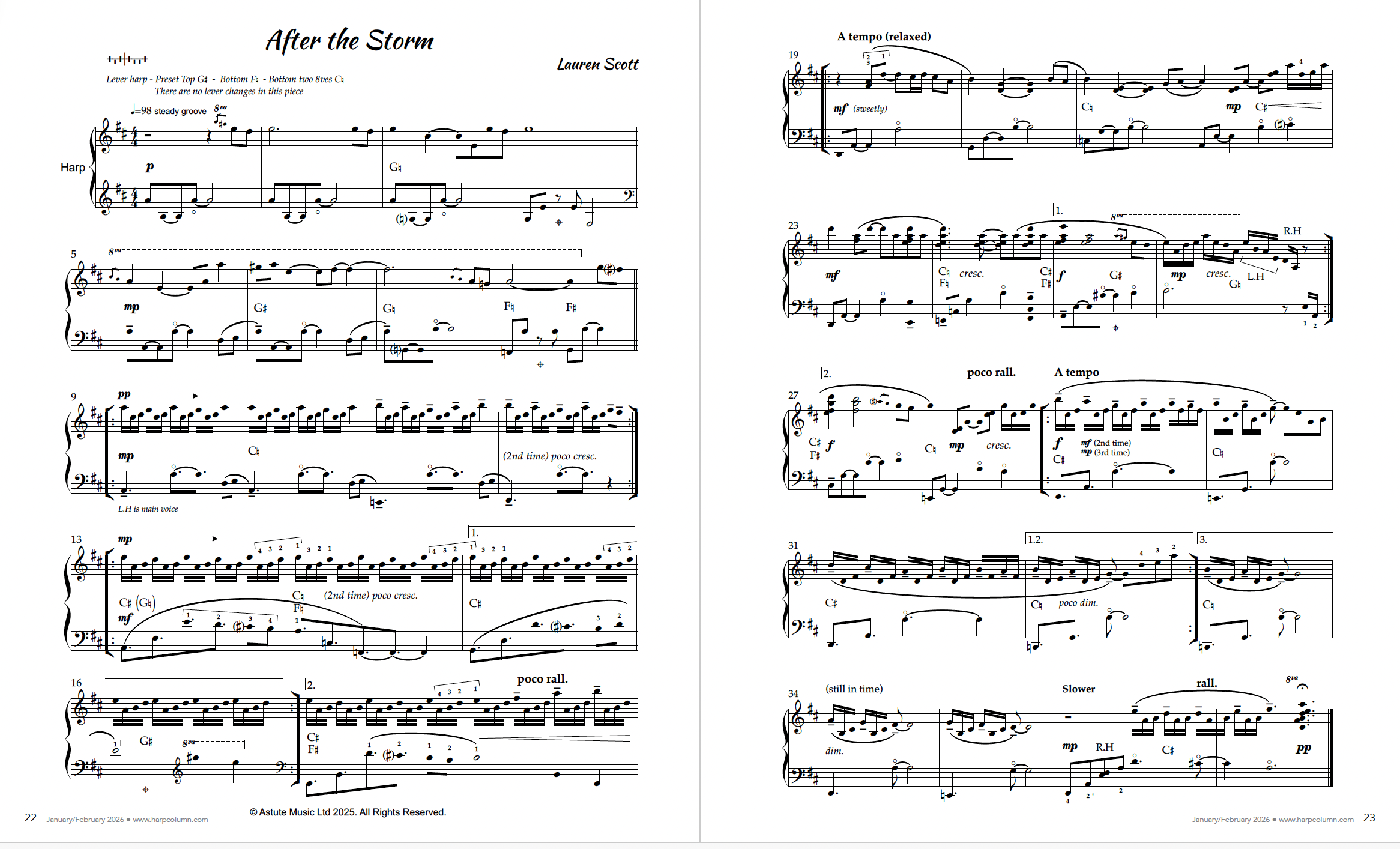
I am honored to join esteemed colleagues in composing a piece for Harp Column’s Tear-Out Tunes series. As someone who came to composing later in life—I started composing at age 48—I am very much on a voyage of compositional discovery. I have written over 40 individual pieces (20 of which are contained in my Adventures for Lever Harp series), as well as ensemble music and, most recently, a collection of 22 etudes titled Modern Etudes for Solo Harp.
My principal compositional output has been for lever harp, though most of my music can be played on either lever or pedal harp. What I particularly enjoy about writing for lever harp—and something I have explored in this piece—is what I refer to as the lever harp’s “superpower.” That is, with pre-set levers, you can write chromatic music without the need to change any levers throughout the piece. Apologies to the pedal harpists out there, as you will need to make quite a few pedal changes! But for lever harpists, just pre-set the levers marked at the beginning before you play, and you are set to go.
I have been recently studying and exploring modes, particularly mixolydian, and how the scale can pivot around various key centers. This is the harmonic inspiration behind After the Storm. The flattened seventh degree gives the mode its distinctive open, slightly bluesy quality, and I wanted to exploit its flexibility to create shifting tonal centers. This modal ambiguity allows the music to drift between keys in a way that feels both unsettled and hopeful—mirroring the emotional arc of a storm passing.
Tear out the entire set
This issue marks the beginning of the fourth year of our popular Tear-Out Tunes series. As a subscriber, you have access to all 18 previously published tunes in our digital library of back issues at harpcolumn.com. If you missed the print edition, you can download (and print) the PDF version!
Coming up
Stay tuned for upcoming Tear-Out Tunes from harpists Uno Vesje, Monika Stadler, Maeve Gilchrist, and more in 2026. Make sure your subscription is current so you don’t miss a beat!
I also recently had the honor of doing some freelance orchestral work with the Hallé Orchestra in Manchester, which was presenting a festival celebrating John Adams’ music. Playing second harp in a concert of his music, with John Adams himself conducting, was probably one of the most intense concerts I have done in quite some time. The rhythms (and the counting) were relentless. I don’t think I have counted so much in my life! His music is extraordinary and inspiring, and I wanted After the Storm to be rhythmical—full of pulse and groove.
The title came to mind almost immediately. I wrote this during a period of intense solar geomagnetic storms in November 2025. One remarkable byproduct was the aurora borealis appearing in places far south of their usual range—visible even in northern England. But storms are not only geophysical. They are political, spiritual, emotional. They disrupt, disorient, and demand resilience. A theme that runs through all my compositions is nature and hope, and I wanted to write a piece for the harp community that acknowledges turmoil while offering balm and reassurance: storms do eventually pass, and calm returns.
Here are a few things to look out for in After the Storm:
Pulse and Groove: Maintain a steady internal pulse throughout. The piece should groove—think of it as a heartbeat beneath the surface tension. In the sixteenth-note passages, resist the urge to rush. Consistent articulation is key: place each note with intention, using the marked fingerings as anchors.
Cross-Rhythms and Fingering: Measure 17 in the left hand uses a deliberate 1-2-1-2 grouping rather than 1-2-3-4. This may feel counterintuitive at first, but it aligns the hands more naturally at tempo and prevents the left hand from lagging. Trust the fingering—it’s there to serve the rhythm.
Dynamic Shaping and Rubato: The section beginning at measure 19 invites a slight relaxation. Lean into the chord changes; quick, resonant spread chords will illuminate the harmony. Allow subtle rubato here, but keep it controlled—too much will fracture the rhythmic flow. When the sixteenths return at measure 29, snap back to the original energy.
Left-Hand Harmonics: These function as both counter-melody and rhythmic punctuation. Place them with precision; a firm, centered touch ensures clarity.
The key to the entire piece is secure placing and mental subdivision. Keep the sixteenth-note pulse ticking in your head like a metronome, and the cross-rhythms will align. The swing, the groove, the emotional journey—they all emerge from consistency.
I had great fun writing After the Storm, and I hope it brings you joy, challenge, and a moment of peace. May it remind us all that after every storm, the sky clears. •