




The USA International Harp Competition signifies one of the largest and most challenging ventures for young harpists across the world. This triennial gathering of players demands the highest levels of performance, endurance, and repertoire, in front of a renowned jury of harpists. Many harpists grow up watching the competition and its contestants, with similar aspirations to someday play in Bloomington, competing for the top prize—a gilded Lyon & Healy Style 23 concert grand harp. The
USAIHC announces the repertoire for any year’s competition roughly two years before it is held. The first two rounds of music are dictated by the repertoire committee, with a couple of options in both rounds, whereas the third round allows for contestants to prepare and present a free-choice program of 40 minutes. The winning piece of the coinciding Ruth Inglefield Composition Contest is incorporated into each contestant’s free-choice program. The final round consists of a standard concerto and, occasionally, an encore. These four rounds of music require months (if not years) of preparation, as each round is designed to challenge the technical, expressive, and musical limits of each performer.
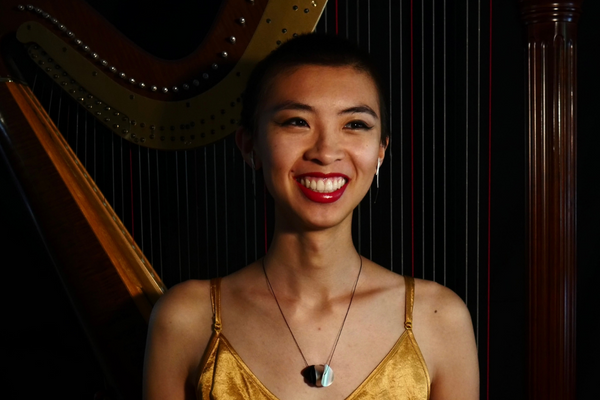
Although competitors prepare in hopes of performing well, the preparation in and of itself provides incredible experiences for young harpists, juggling hours of repertoire within a practice routine. The harp community gathers with incredible support and encouragement in the months leading up to each competition, as contestants present their recitals across the world before making the journey to Bloomington, Indiana, for the 11-day competition. In preparing for both the 2019 and 2022 USAIHC, I can say that there are few things more inspiring than the outpouring of support from the harp community for each and every contestant. The hours of practicing, non-stop performances, and mentorship from our teachers are all recognized at the Indiana University Jacobs School of Music, as we all patiently await the results from the final round. This year, we congratulate and celebrate the gold medalist, Noël Wan, in her inspiring performances at the USAIHC.
Harp Column: Congratulations on this incredible achievement, Noël! When we spoke at the opening of the competition, you had mentioned your prior experience with the USA International Harp Competition (USAIHC). Could you tell us what your biggest motivation or inspiration has been to compete in the USAIHC?
Noël Wan: My main motivation was to improve my playing and push myself as hard as possible, for myself. When I competed in the 2016 USAIHC and didn’t advance, I took a big hiatus from the international competition scene. This time around, partly because of the pandemic and having a lot of time to practice, I decided I really wanted to challenge myself to do better. My goal this year was to make it to the third round, and use this as an opportunity to work on bad practice habits. And since I wasn’t in school this time, I was able to really explore my own artistic voice.
HC: Would you share with us your journey at the harp? When did you start playing the harp, and what has your life looked like as a rising player in our generation?
NW: I started playing when I was 4, and I had lessons briefly with Cui Junzhi. My first primary teacher was Linda Rollo. I studied with Linda for about six or seven years, then I studied with Douglas Rioth and Dan Yu at the same time. When Ms. Yu moved, I started studying with Erika Waardenburg from Amsterdam, then I started my time with Dr. Ann Yeung at University of Illinois Urbana-Champaign. I took some lessons with Chi-Mei Hung, and then studied with June Han at Yale University, before returning to Illinois for my doctorate with Dr. Yeung. In studying a variety of pedagogical backgrounds, my journey with the harp has been very eclectic. Not having one specific style is kind of grounding, and the versatility of technique has been helpful.
New at fsu
This fall Wan begins her appointment as Assistant Professor of Harp and Entrepreneurship at Florida State University (FSU). Wan replaces Mary Brigid Roman as FSU’s harp professor, but her joint appointment of harp and entrepreneurship is a new position.
I started taking the harp more seriously in my teens, and then got my three degrees (undergrad at Illinois, master’s at Yale, and doctorate at Illinois). During my competition hiatus, I got busy with teaching and have been teaching at the university level, which is leading me to my next job in Florida. I’ve been living in Canada for the past three years, teaching in the University of [Western Ontario in London,Ontario], and I’ve really enjoyed it. I plan on being in and around Canada and staying connected with my students in Canada.
Being Asian-American and doing the more advanced competitions, I remember often being one of the few people of color representing the U.S. [in international competitions]. Of course, now that’s changed so much, and there is so much more diversity. But that identity component has always lingered, and I have spent years grappling with where I stand as an American harpist. Now that I’m older, I’m glad to see that there is more diversity in the competition scene. For this round of the USAIHC, I decided to represent Taiwan as an homage to my cultural background, and in honor of my parents, who immigrated to the U.S. in the 1980s.
HC: You presented a really unique and personal free-choice program in the third round, with works by Brouwer, Ives, Bach, Parish-Alvars, and Schwartz, as well as your fourth-round encore byAlexina Louie. Would you share your thought process in selecting and performing works that resonate with your musical voice?
Age is just a number
International Music Competitions are a young person’s pursuit. The age range for contestants of the USA International Harp Competition is 18–32 years old. At age 28, Wan was one of the older harpists to compete. Most international competitions cap a contestant’s age in the early 30s. (The International Harp Contest in Israel tops out at age 36, the ARD Music Competition at age 31, and the Van Cliburn International Piano Competition at age 31.) Often, prestigious competitions are won by musicians still in college or just out of college, a fact that is often attributed to the time, focus, and guidance that students have to prepare for a major competition while in school.
NW: As an older contestant I decided I could play really any music that I wanted. My selections of Brouwer, Bach, and Ives are all pieces that I love. I had been working on these for a couple of years, and playing them on the harp is something I wanted to share with as many people as possible, especially in the harp community. Practicing the extreme chromaticism in the Bach and Ives, I became really aware of pedal virtuosity, and I wanted to showcase that within the realm of the competition. It was a very symbolic decision, for sure, wanting to have diverse representation in the composers, and playing music that I love.
I have a lot of memories of the Parish-Alvars. I first learned it when I was 12 years old, so I’ve been playing it for a long, long time and still think that Norma is a beautiful opera. I thought to myself, “If I’m going to pick a virtuosic piece, I should pick something that is really, really fun to play.” So my approach really was, “I need to enjoy myself.”
HC: What has helped you prepare the most for this competition?
NW: I think learning to be organized and systematic with learning and memorizing the music, developing a discipline around details. It was my first big competition I prepared for outside of school, so there was a lot of self-accountability. I didn’t have to face any teachers, so building that self-discipline was really helpful. I let go of bad practice habits and tried to relearn some of my practice routines.
[Another thing that was helpful] was listening to a lot of music, especially with the repertoire that we were asked to play, including the Liszt. I tried to listen to many interpretations of the transcriptions to gauge how I wanted to sculpt some of my phrasing. I actually love listening to R&B and soul and can learn a lot listening to the way that singers add nuance to their lines, taking note of the special moments that are crafted. This kind of listening has inspired me to make those same special moments while I play. I try really hard to think about the technical aspects and accuracy, of course, but also, “How can I speak and move people through my music?” I think that was really important to my preparation.
HC: The work that goes into these high-caliber competitions can span years. What have been some of the challenges in preparing and maintaining four rounds of difficult repertoire?
NW: Stamina is a big part. My background is not super typical, but between 2007 and 2016, I was doing a competition every year, many of which required multiple rounds of music. The more competitions you do, the more overlap of the repertoire you’ll see. The toughest thing to prepare for was probably my first time competing in the Israel competition where I learned every piece from scratch. But as time has passed, these competition lists have covered a lot of repertoire, so I ended up knowing about 50 percent of this year’s[USAIHC] rep, not including the free choice round. So in many ways, the preparation gets easier.
I also think being able to play through all of the rep in one sitting is so helpful, just to gauge where everything is and testing how sharp your brain is at the end. I would spend days running through all four rounds of music in a day, and programming multiple rounds in recital programs to build that stamina in performance. In a competition, you know it will never be that difficult because you’ll only be playing three to four pieces rather than two or three rounds of back to back music.
I would say getting organized with learning the notes and knowing when to cycle music in or out of your rotation is very important as well. Taking breaks and putting pieces down is also very helpful. It really is an athletic craft. Practicing is like training, and we are working towards guaranteeing that we are as consistent as possible. I have been thinking about gymnast Simone Biles, and her public experience with performance anxiety last summer. Seeing her bounce back from a mental block shed light on the overlap between musicians and athletes at the competitive level. It changed the way I practice, oriented more around “training” rather than just learning music.
HC: You’ve competed and had a lot of success in major competitions—have you discovered any sort of formula or system of preparing and performing or has each process been different?
NW: There’s not really a formula, especially with rep changing every time. Mental and emotional state are the most important, especially as you head into the performance stage of preparation. I wouldn’t consider myself a consistent competitor either. There have been some competitions where I didn’t advance past the first round, and some that I ended up in the finals. If there’s one thing that I’ve learned, it’s not to take competition success for granted. Success across different unrelated competitions means that we still have to work hard to achieve the next competition. The biggest change between the 2016 and 2022 USAIHC was in my mental approach. Not advancing beyond the second round was really tough for me then, but it was huge motivation to find a new way of preparing, and opened my mind for new mental approaches.
For young harpists, it’s helpful to have a progress chart for each piece. Tracking your repertoire and being honest with yourself helps with accountability and organization. For peace of mind, learn everything well and be secure with it before you head into the competition.
HC: Major international competitions tend to attract young musicians—many still in school—because there is time to focus and prepare all of the repertoire. This becomes trickier when you are balancing the demands of a career on top of your preparation. How was preparing for the USA different from preparing for competitions when you were a student?
NW: There’s a lot more self-evaluation that I had to do. I’ve never been great at recording myself on my phone, and no one likes listening to themselves, but you have to. On one hand, it’s terrifying not having a teacher keeping you on top of things, and I have to trust my own intuition much more than I did before. You don’t have as much of an objective voice when you listen back to yourself, but you definitely get to have more freedom in your decisions. I didn’t have anyone questioning my decisions, and it felt liberating to be working on my own artistic voice.
When you’re not in school, it’s entirely up to you how much you practice. Of course, because I was working to build practice time and motivation into my schedule, it was a big change, and not having that weekly studio class as a cushion meant that I needed to prepare really, really well. I became aware of what I needed to do to avoid doubting my playing, just because I wasn’t able to get out and play for people as often as before.
In some ways, you have less focus when you’re out of school because you’re juggling all of your own responsibilities, so you have less capacity to devote just to the competition. This is very unscientific, but you even have to keep yourself from getting overwhelmed with everything else and devote your brain to practicing. Even during the competition, I wasn’t reading the news, I wasn’t on social media. I told my husband, “I am just trying to empty my brain,” because once you’re out of school, it’s really easy to get distracted.
HC: What are you looking forward to the most as the newest USAIHC gold medalist?
NW: The first word that comes to mind is advocacy. I’ve already had to work and develop my career, and now that I’m in this role as a performer, I have an opportunity to showcase a person-of-color playing the harp. For instance, to be that person that young harpists can look up to and say, “Hey, you know, maybe she doesn’t look like a stereotypical harpist, but she was able to achieve this.” So it’s this idea of representation and advocacy surrounding the music that I want to perform. I picked more contemporary repertoire that will hopefully resonate well in the growing world of new music reception. Through my musicianship and performances, I was able to highlight my identity, and have that identity be accepted and celebrated in an international setting. That idea of acceptance and what winning represents for the next generation of harpists is a good sign that the field has changed, with more openness around repertoire and what that repertoire represents for contestants. I’m looking forward to being back and involved with the international harp community. It was a huge part of my childhood, and it’s a great way to get to know harpists from across the world and back in that circle.
HC: You are an accomplished academic, and will be starting your position as the new Professor of Harp and Entrepreneurship at the Florida State University (FSU). What kinds of goals and aspirations do you have for the program?
NW: I want to build on what Mary Roman has established, attracting students to the school and adding a more international reputation for the harp program. My dream for the next 10–30 years is to attract students from all different parts of the world, to explore unique artistic expression. I would like to attract students who have really different musical and artistic interests to FSU, and taking a cue from Susann McDonald, put FSU on the map. I hope to bridge communities through the FSU programs, linking diverse student pools and creating a space for innovative research and performance. I hope FSU can be a home/haven for harpists who share that sensibility. I’ll also be teaching music entrepreneurship, and one really important thing for me is making sure that the musicians of the next generation come up with entrepreneurial projects and give back to the communities they represent through their art. These projects don’t necessarily need to be oriented around social justice, but will nourish the other musicians within our circles.
HC: What can we look forward to next from your musical and academic pursuits?
NW: I have a commission with a friend, Ralph Lewis, for harp and electronics, so that’s in the works. I received a grant from the Ontario Arts Council to create a group called “ASMR Girlfriend.” I am aiming for a multi-disciplinary project that combines my experiences as a racialized, female-identifying individual and the harp’s relationship with gender, as well as the intersectionality with technology. The project is really inspired by Anne Anlin Cheng’s book, Ornamentalism. There will be some solo pieces by Georges Aperghis (whose works I researched for my dissertation), John Cage, and experimentation with sound art. Research-wise, I have been writing semi-regularly for The Collective, so I’ll continue contributing to this journal. And of course, performing for the next few years if people invite me to perform!
HC: What is your advice to young harpists who aspire to pursue careers in music?
NW: I would say the biggest thing to prioritize—number one: work hard. You are able to find your success through the work that you invest in your craft.
As an artist or someone in a creative field, be able to accept rejection, and process feedback very openly. Listen to your teachers—taking advice and guidance at a young age will create a solid foundation for young musicians to have artistic freedom down the road.
Do not get fussed if your career path doesn’t go the way you expect. There will always be doors open, and it is important to walk boldly through those doors rather than worry about which doors will be open.
It’s about the journey, and anyone interested in a musical career should really think about this, because you can’t control everything. So when you feel like you can’t control everything, go with the current, and see where life takes you.
Finally—and I would say this is super important, even if you’re a really introverted person—develop an approach to connecting as an artist, both with audiences and your peers. Once you’re a professional musician, it’s about 75 percent networking. •
Notes on noël
Favorite food: Any type of Asian noodle dish. I can’t say no to some good hand-pulled noodles.
Harpmobile: Subaru Forester
Favorite author: Raymond Carver, American short story writer, and Billy Ray Belcourt, young queer Cree poet
Favorite genre of music to listen to: R&B, soul, and hip-hop
Most memorable harp move: It’s the one that broke my heart, basically. I was moving my harp for a gig, a couple of months before the 2016 USAIHC, and the harp fell and the neck broke at the kneeblock. I had to wait about six months to get a new neck.
Favorite harp shoes: I have a bunch, and without any attachment to any pair. I do enjoy wearing crazy stilettos, so any five-inch stiletto that I can pedal in is great.
Secret talent: Being able to arrive extremely on-time. Like, on the dot.
Career if you weren’t a harpist: I’ve always wanted to be an architect.
Basically, I learned it’s very similar to being a musician.
Binge watch a Netflix show or watch one at a time: What show? Probably more of a binge-watcher. The old HBO show Six Feet Under is really well done.
Competition Success
2005, 2007, 2009, 2015, 2019: American Harp Society National Competition—prize winner
2008: Lily Laskine International Harp Competition—prize winner
2009, 2012: International Harp Contest in Israel—semi-finalist
2009: Pacific Musical Society Instrumental Competition—only harpist to have won first prize
2010: Dutch Harp Competition (now World Harp Competition)—youngest first prize winner
2012, 2015: Chimei Arts Foundation Award—only two-time harp recipient
2013: Nippon International Harp Competition—prize winner
2014: Carmel Music Society Instrumental Competition—only harpist to have won grand prize
2015: Korea International Harp Competition—prize winner
2019: Lyon & Healy Awards—prize winner
2021: Orford Music Award—prize winner
2022: USA International Harp Competition—gold medal winner