

9/10
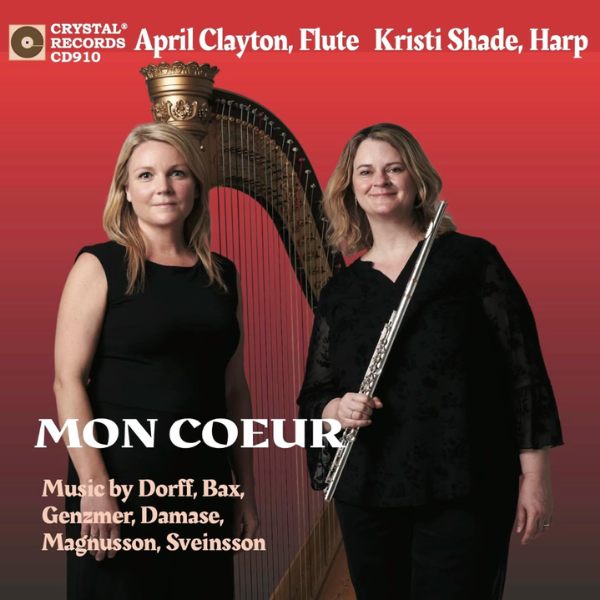
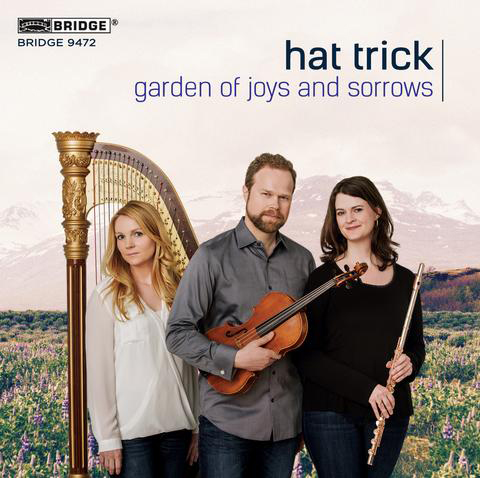
Hat Trick: Kristi Shade, harp; April Clayton, flute; and David Wallace, viola. Bridge Records, 2016
When we see Claude Debussy on a CD program, it conjures in our minds one of the most important composers of the 20th century. But harpist Carl Swanson points out in his seminal series of articles on Debussy’s Sonate that Debussy, in fact, did not maintain a good the reputation among his peers and struggled ceaselessly to have his music published and performed. Knowing that, it no longer comes as a surprise that from the introduction of his Sonate for flute, viola, and harp in 1916, while war raged in Europe, Debussy’s intentions would become fuzzy upon publication. It would take nearly 100 years for all of Debussy’s diligently expressed markings to be unearthed and published.
Are there huge surprises? Yes, in nearly half the piece—with 124 out of 319 measures containing alterations of dynamic, tempo, articulation, and character.
While the pitches are the same from the original autograph and the changes are subtle, the newly published edition in performance blows away any dark corners on Debussy’s masterpiece with a bright, glowing light. Hat Trick—flutist April Clayton, violist David Wallace, and harpist Kristi Shade—secured Swanson’s articles and the Carl Fischer publication before anyone else to make this first authentic recording. Their tone is velvet, almost a whispery pastel that epitomizes Debussy’s own words about the art form, that music is “a dream from which veils have been lifted. It’s not the expression of feeling, it’s feeling itself.”
To me, their approach of sound and color feels like they’re sitting back in their chairs and allowing the sounds to simply emanate from their bodies—no stress, nothing forced. The bar-lines disappear, giving way to pure line. This is particularly abundant in the shadowy And then I knew ‘twas Wind by Toru Takamitsu. The ensemble is so lusciously blended, whether blown, bowed, or plucked; the edges between sounds that indicate where one ends and the other begins are non-existent. This is the great skill of this trio, that they are so enmeshed it gives you a shivery thrill.
Theodore Dubois’s lovely Terzettino is a delightful discovery, though in a far more conservative French salon fashion. He scored it for flute, viola and harp over a decade earlier than Debussy wrote his Sonate. It is unclear if Debussy was aware this piece existed, but where there is one, there may have been others left unpublished. In this little gem, a French sound was born utterly manifested by Clayton and Wallace, who sing with lighter-than-air freshness, the harp gently balancing them with a warm pulse.
Out of necessity, Hat Trick devotes itself to commissioning new music for their ensemble, and they begin the CD with the premiere of a work by the Grammy-winning Uruguayan Miguel del Aguila called Submerged. They gave him only two stipulations: to create a work in his own idiomatic style and to have this work based on text. He was inspired by Alfonso Storni’s poem “Me at the Bottom of the Sea” which takes on a whole new meaning when we know she ended her own life drowning herself in the ocean. The music begins as a lighthearted dance, but when the trio submerges, the piece becomes a dramatic narrative of wonder mixed with an almost existential loneliness. A superb new addition to the repertoire and stunningly delivered.