
Forum Replies Created
-
AuthorPosts
-
Elizabeth Volpé Bligh
ParticipantHave you seen Gertrude Pasveer’s edition? She takes a very scholarly approach to the urtext, and shows her edits compared with the original on separate lines. I highly recommend it. You can always fill in more,
ParticipantRe: your question about what to do during the anthem: If there is a harp part, then you stayed seated and play it as normal. Consider that the harp column is doing the standing for you! If there is no harp part, then by all means stand up. As for the book: if there is a really long gap, I usually leave the stage and read or chat with the stage hands, but stay connected to what is going on in rehearsal. In most halls, there is a monitor in the green room, so make sure it is turned on so that you can hear what’s happening. Also, my orchestra has a clearly posted rehearsal order which the conductor is supposed to adhere to. Nonetheless, once in a blue moon, he or she will deviate from that, so do not leave the building to get a coffee unless it is a break for everyone. Brass players and percussionists sometimes read onstage at rehearsals, but it really offends some conductors, so it’s best to avoid it and leave your book, crocheting, lace-making, etc. backstage. A good book can be so engrossing that you can forget to pay attention and miss an entrance. Bringing a score sounds like a great idea, but make sure the conductor knows that you’re not reading a book!
 Participant
Beatrice Schroeder Rose is my hero for writing that great book The Harp in the Orchestra!
ParticipantThis piece is on the repertoire list for the International Harp Contest in Israel (2009).
ParticipantTurn the harp so they can see the pedals and show them how they work! Point out how the discs work like mechanical fingers pushing on the strings and explain how the shortened string makes a different pitch. Do a few pedal slides such as the ones in “La Desirade” or play a jazz piece that uses them. If you have an Irish jig in your repertoire, maybe have them clap or play spoons or tom-toms to accompany you.
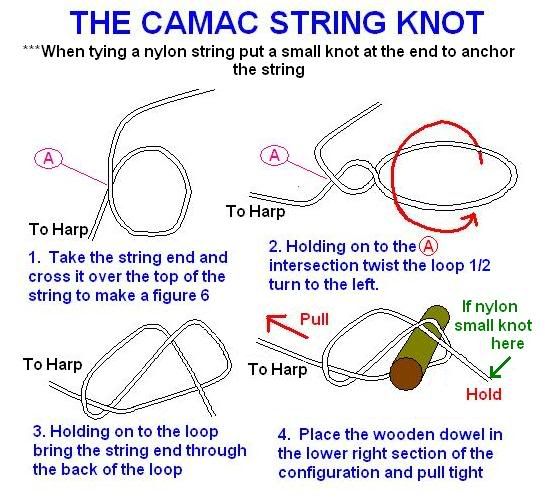
ParticipantI remember a previous thread about Camac knots and this link was in one of the answers:
http://i4.photobucket.com/albums/y117/VR4Harps/CAMACStringKnot.jpgThe Camac knot is very different from the Lyon & Healy knot. I found this out when I was storing a student’s Camac here, and a string broke. By googling Camac knots, I was able to correctly replace the string.
ParticipantI don’t have this music in front of me, but I love using enharmonics to make some of the chord structures less awkward. For example, at the end, after the mounting C flat major inversions, I use a B natural in the three chords that follow them, thus making them really easy to grab. Also, in the exposed middle section, there are some opportunities for enharmonics that you can either play or use as “safety” notes.
ParticipantIt is French for “like a pathetic scene”. So your audience should be sobbing and wringing out their handkerchiefs after you have performed it.
ParticipantBack when I used to do weddings (before I decided to let the younger people have a go at them), I had one bride ask for my qualifications. When I told her I had been playing principal harp in the Symphony since 1982, she asked if she could hear a sample of my playing before she decided. It took every ounce of restraint not to hang up then. I explained that I was not looking for these engagements and could only take them if my busy schedule permitted, so I was not putting up samples of my playing on my web site. Anyway, once she heard my price, (which was very reasonable), that was the end of the conversation.
ParticipantMaybe Kim would add a font for musical symbols if we ask her nicely.
ParticipantYes, I have, and we still haven’t found the cause in spite of a trip back to the factory. The rivets and bushings were changed, but that didn’t fix the persistent sizzling sound that pervades the mid-range of the harp. So, if you find it, let me know! Do you think it could be a loose, broken or missing spring inside a back plate screw? I found a loose screw in a natural disc, but that was a different sound, and tightening the screw fixed it. I have heard this could be in “the main arm”. If it were the pedal tubing assembly, it would be only in the bottom range, so I have been told. Please do email me if you find out something.
ParticipantI think, if you tried to play the Waltz of the Flowers cadenza as written for an audition, they would be surprised or even shocked. Everyone is used to hearing it in edited form. I played the version that I learned from Judy Loman (cascading arpeggios, one hand after the other) for all the auditions I did, and nobody ever asked me to play it as written. I would be curious to hear if anyone has had a different experience with it.
ParticipantNicholas, did you ever get the buzzing fixed?
ParticipantThanks, everyone! All good advice! The cast came off today, but now I have to wear a walking cast boot for the next 3 weeks, and only put 25% of my weight on the foot. So it hasn’t completely healed in the 6 weeks!
 Symphony season starts at the end of the 3 weeks. If this experience teaches me anything of value to the forum, I’ll keep you posted.Participant
No, I jump to the B with the right hand thumb, just as it looks in the music.
-
AuthorPosts