

The only decision that matters is whether you’re going to be the best you can be in everything you do.
“How many wedding bookings are you projecting for the next fiscal year?”
This was the question posed to me by a successful wedding coordinator. I thought we were making small talk at a wedding show where we were both exhibiting, but this felt more like a 400-level business school class I never took. I was equally dumbfounded when he asked about my conversion rate and follow-up strategy. It was early in my career, but I had been playing weddings for years and done plenty of wedding shows. This was not my debut, yet I had never considered any of these basic business concepts in my own freelance work.
It’s an awkward intersection—these titles of professional, musician, entrepreneur, business owner, marketing manager, artistic director. We claim them all because we must, yet some fit better than others. Early in my career, I leaned into the professional and musician parts of my work—I was confident in my ability to nail the parts of my job that involved playing the actual gig. Where I wasn’t so confident, or interested, was the business aspect.
“I’m a musician, an artist, so I shouldn’t have to be good at business. I wasn’t trained for it,” was how I justified my disinterest and complete lack of engagement in developing my business skills. Well, the super successful wedding photographers and florists and stylists weren’t trained in business either, yet many of them were running circles around my rinky-dink wedding business. It comes down to whether or not you want to be the best you can be in everything you do.
Yikes, that’s a high bar. The best? At everything? I don’t mean the best in a competitive way, I mean putting your best effort into all aspects of your harp life—even the parts that don’t come naturally. That’s where Harp Column comes in. We try to pack each issue with articles to help you live your best harp life.
Author Rachel Brandwein tackles the question of what it means to be a professional musician in our feature Be a Pro. Preparation, presentation, and communication are the keys, and Brandwein offers practical tips for improving your professionalism both at the gig and away from the harp.
What if I told you there’s a tech tool that could free up mental space you’d rather use to think about music than logistics? Intrigued? Turn to pg. 24, where Anna Hagen breaks down customer relationship management (CRM) software and if your business actually needs it.
Our advice column tackles another perennial question: how do you know when it’s time to raise your rates? Three experts weigh in, each with a different take. And in our Sounding Board column, New York harpist Katy Wong breaks down the work she’s doing with Carnegie Hall, and how her findings offer a blueprint for independent musicians charting their own path.
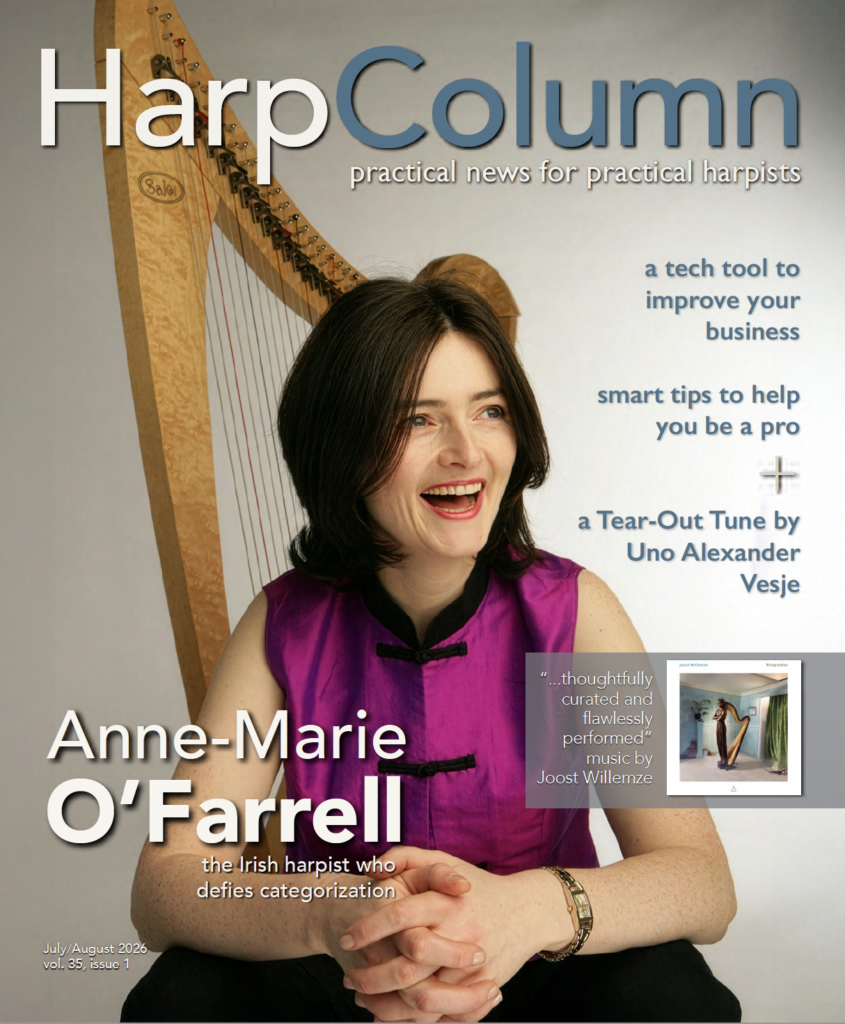
If you just want to watch a pro in action, look no farther than our interview with Irish harpist Anne-Marie O’Farrell on pg. 12. Her story proves you can do everything you want to do—and do it at the highest level. Marketing experts will tell you that you must define your brand to succeed. O’Farrell, a pedal and lever harpist, proves it doesn’t have to be either/or—one kind of music, one type of harp. The only decision that matters is if you’re going to be the best you can be in everything you do. That’s what makes a pro. •