


Remember that warm feeling of finding the perfect first harp to buy as your very own? Maybe you enjoy the anticipation of seeing harp friends at competitions and conferences, or just listening to a talented harpist perform for your local harp community. A harp center offers all that, and more. It’s a place for community and connection, not only to reunite harpists, but also to invite new people who are interested in the instrument’s bright future.
We’re profiling four harp centers that have recently gained new momentum and a fresh perspective with new owners. Two are existing businesses that have changed hands in the past couple of years; the two are new start-ups that recently launched. Let’s meet the new owners of these four stores and find out how they are putting the future of the harp front and center.
Harp and Saxophone handoff: Kristina Finch and Dannel Espinoza
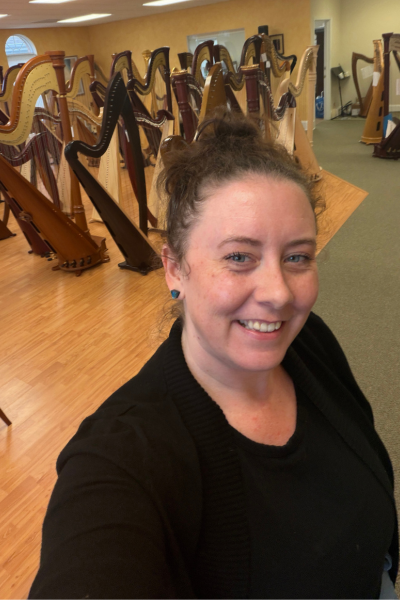
Harpist Kristina Finch and her husband, saxophonist and University of Southern Mississippi professor Dannel Espinoza, are the new co-owners of the Atlanta Harp Center, the Virginia Harp Center, and the Virginia Harp Center of New Jersey. Finch and Espinoza are taking over from the previous owners, David and Mary Jane “MJ” D’Arville, who are also a husband-and-wife duo with a harpist (MJ) and saxophone player (David).
Finch performs across the East Coast, including as principal harp of Miami City Ballet and second harp of the Charlotte (N.C.) Symphony. She is also a certified Harp Mastery coach and educator. As co-owners of the Virginia and Atlanta Harp Centers, Finch and Espinoza say they hope to build a vibrant future for the instrument through accessibility, innovative programming, and community engagement.
The Virginia and Atlanta Harp Centers
Finch says owning a harp center was not a life goal, but an opportunity that developed organically. “My relationship with [previous owners] MJ and David [D’Arville] goes back to childhood—my first pedal harp came from the Virginia Harp Center (VHC)when I was 10, and [longtime VHC employee and current Virginia Showroom manager] Amy [Roberts] helped my family choose it,” Finch says. “I’ve always admired how David and MJ created a true home for harpists, not just a store. They built their business around genuine care, dependable service, and a deep respect for the harp community. When MJ mentioned they were thinking about selling, [my husband] Dannel and I were already looking for a new adventure. Everything unfolded faster than any of us expected, but it felt unmistakably right.”
Finch says she hopes to continue the D’Arvilles’ legacy by promoting even more growth of the harp community in the mid-Atlantic. “We’re continuing and expanding the regional conferences [the Virginia Harp Festival and Atlanta Harp Festival hosted by the centers], building stronger educational relationships, and creating opportunities for harpists in smaller communities across the country,” she says. “We want the business to be a catalyst for connection, creativity, and long-term support for players and teachers alike.”
The center has three locations: VHC Virginia Showroom (just outside Richmond), VHC New Jersey Showroom (across the river from Philadelphia), and the Atlanta Harp Center (AHC). All three spaces are getting a refresh. “We’re moving toward a boutique, community-driven vibe,” Finch says. “Atlanta is our first full redesign, and the Virginia showroom will soon include a performance area for workshops, concerts, and community events.”
The VHC and AHC inventory includes new instruments from Camac, Lyon & Healy, Salvi, and Dusty Strings, plus a variety of consignment pedal and lever harps. The centers also provide strings, music, accessories, rentals, and regulation services, making the stores a one-stop shop for harpists. “Rentals and strings see the most [customer] traffic, but personalized harp trials are a major draw for players at every level,” Finch says.
Despite this variety of supplies and services, Finch says that’s not the heart of the store. “The real magic is our staff,” Finch says. “Their expertise, care, and long-standing relationships with customers make each experience personal and reliable. They’re the ones who turn inventory, rentals, and services into something meaningful—and that’s what truly sets us apart.”
West Coast Connection: Xochitl Derycz
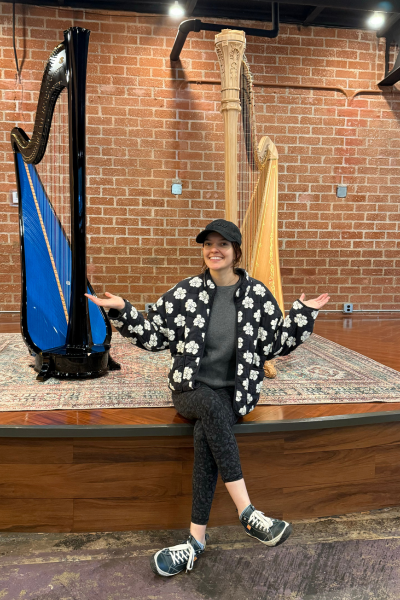
A native of Santa Monica, Xochitl Claire Derycz is a French-American harpist who just launched Harp Center Los Angeles (HCLA). She earned her master’s in harp performance in 2024 from the Conservatorio di Giuseppe Verdi in Milan, studying with several European pedagogues. Derycz also graduated from the University of Southern California with a degree in Non-Governmental Organizations and Social Change, and she says she combines her passions for music, the arts, and social causes through the harp.
Harp Center Los Angeles
Derycz celebrated the grand opening of her store in mid-October. “As much as I love playing the harp, I’d always sensed that my relationship with it would take a different form—one rooted in community-building and entrepreneurship,” Derycz says. She credits her father, her family, and her fellow LA harpists with making that dream a reality.
Derycz says she founded HCLA to meet the needs she encountered as a harpist in LA, in light of recent closures of other stores in Southern California: challenges like finding local places to buy replacement strings, have a regulation, or rent a pedal harp. She says HCLA is “a place where we [Southern California harpists] can find what we need quickly, reliably, and locally. A place that brings new energy into the harp world, makes the instrument feel more accessible, and invites emerging generations to see it not as an artifact of the past, but as a vibrant part of today’s musical culture.”
Harnessing the creative energy of LA, HCLA hopes to create a central space to bring harpists together and spark collaborations. “Here, harpists can gather over coffee, explore performance ideas on our stage, teach, and simply spend time with fellow musicians in a welcoming, vibrant environment right in the heart of Los Angeles,” Derycz says. The center will also launch an educational department this year, featuring the Boldachev Academy and offering lessons to harpists of all ages and skill levels.
At 4300 square feet, HCLA’s brick building has room for more than just harps. A 32-foot semi-circular stage, designed to enhance the acoustics of the harp, is at the center of the store. “[The stage] anchors the space, giving harpists—students, professionals, and the simply curious—a place to gather, listen, and perform,” Derycz says. Opposite the stage is Honesto Café, another women-run business led by a couple specializing in Colombian coffee. “A café allows for increased foot traffic, organic exposure to the harp, and a natural sense of community—dissolving the invisible barrier that often surrounds classical instruments,” Derycz says. The coffee shop is HCLA’s nod to LA’s coffee culture. In the back wing of the building, musicians can take advantage of four quiet lesson rooms and practice studios.
In one corner, a neon sign with the store’s name gives a modern urban look, while California artwork and plants and modern furniture add a welcoming local touch. Derycz says the center’s artsy, industrial aesthetic challenges preconceptions of the harp as out-of-date, delicate, or reserved for an elite few. “The hope is to push the harp forward and help spark a renewed wave of interest in the instrument,” she explains.
“As a newly opened space, our first priority has been listening closely to the harp community and understanding its needs,” Derycz says. “Our most requested service so far has been harp rentals—a flexible and practical option for those not ready to purchase an instrument or for visitors to LA who want to keep up with their practice while in town. We’ve streamlined the process by eliminating extra fees and large upfront payments that can hold people back.” Also in the works is a streamlined e-commerce system to make it easier to shop online. The store prioritizes keeping strings in stock and helping harpists with last-minute needs, including delivering harps and strings and offering storage for instruments when owners are out of town.
“At its core, the [store’s] mission is simple: remove barriers, support artists, and help cultivate the next generation of harpists,” Derycz says. “Where community thrives, so does art!”
Southwest Strings: Heidi and Juan Hernandez
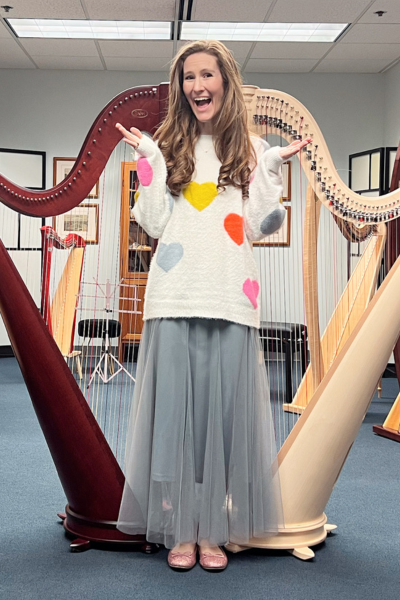
Harpist Heidi Hernandez and her husband Juan took over the Phoenix Harp Center (which was previously co-owned by harpist Stephen R. Hartman with Willard E. White) at the end of 2024. Heidi played with The Phoenix Symphony for 20 seasons. She has competed internationally and traveled for orchestral and solo work in Europe, Asia, and across the U.S. Her current studio ensemble HarpSynergy performs 40 to 50 concerts a year. Heidi’s husband Juan serves as a conductor, professor, and assistant dean of music at Grand Canyon University.
Phoenix Harp Center
Hernandez says she has been drawn to helping people find harps for a long time. “I bought my first Troubadour to rent to a student in rural Oklahoma when I began teaching as a teenager, so this passion to help people get their hands on high-quality harps was present for about 25 years before the shop became a reality,” she says.
Hernandez says the store has always been owned and operated by professional harpists and got its start as Arizona Harps, run by Dr. Shelley Wiest for seven years, before Stephen Hartman and Willard White converted it to the Phoenix Harp Center (PHC) seven years ago. Hernandez began her role as the new owner at the beginning of last year. Hernandez knew Hartman well, having played with him for a decade in the Phoenix Symphony, so when he sold the center as a step towards retirement, it was a natural transition. “I am so grateful not just for the opportunity but for the relationship that we have,” Hernandez says. “Stephen still teaches at the store and, as a certified technician, still works on lever harps.”
“[Phoenix Harp Center] is a wonderland of its own, more like a boutique than a store,” Hernandez says. She adds that she wants the space to be inviting, warm, and welcoming to communicate that the center values people as individuals and supports their desire to grow as musicians. A pair of angel wings on the wall reminds visitors that this is a place where dreams come true, reinforced by a painting of a girl’s reflection in a mirror as she meets her first harp. A glass room and adjacent meeting space hosts visiting artists for recitals and American Harp Society chapter events. Down the hall, families can relax while waiting during lessons or consults in a lounge equipped with tables, chairs, a TV, and a fridge.
The center carries Lyon & Healy, Salvi, Dusty Strings, and Neveltec (electric lever) harps, as well as strings. PHC also sells wooden benches in several finishes to match new harps. As an additional service for all Arizona harpists, the center brings in a guild technician three to four times per year to regulate harps.
Hernandez says she hopes customers feel taken care of like family as they are guided to an instrument that fits their needs. “As a professional harpist, teacher, and mom, I care so deeply about helping find a match that is really perfect for the harpist and their family. This has been the greatest delight to watch unfold in the store repeatedly, both rentals and sales,” Hernandez says. “We also started the Phoenix Harp Center Awards [program], which helps extremely hard-working and financially challenged students acquire harps of their own.”
Music in the Mitten: Brittany DeYoung
Brittany DeYoung founded the MI Harp Center to fill the gap left behind by the Michigan Harp Center, which closed abruptly when its owner Kelly Yousoufian passed away. In addition to owning the MI Harp Center, DeYoung is principal harp of the Ann Arbor and Lansing Symphony Orchestras and serves as harp instructor at Hillsdale College and Flint School of the Performing Arts. She has performed across the U.S. and internationally, loves playing chamber music with her colleagues, and enjoys teaching young students.
MI Harp Center
The MI Harp Center (pronounced as “my” harp center) began as a way to honor the legacy of the Michigan Harp Center when its owner, Kelly Yousoufian, tragically passed away in 2021. “I knew Kelly Yousoufian as a friend and colleague,” DeYoung says. “She would regularly come to my student workshops to showcase her collection of instruments, teaching my students about the rich and vibrant history of the harp.”
Yousoufian founded the Michigan Harp Center in 1993, and it became a catalyst for building the Michigan harp community. Located in Clawson (just north of the Detroit city limits), the little square brick building proudly advertised its specialties on its front awning: historical and modern harps, lessons, performances, and gift items. Michigan harpists who knew Yousoufian say she loved finding all kinds of harps and teaching others to play them. The store wasn’t just for everyday lever and pedal harps—visitors could try historical and ethnic harps, like Erard, cross-strung, and double-strung harps.
“For many years I loved visiting our small Michigan Harp Center,” DeYoung says. “I couldn’t bear to see our community lose this local gem.” Since 2022, DeYoung has led the MI Harp Center in its place. MI Harp Center is currently located in a small building in Belleville, Michigan, on the southern outskirts of Detroit, but DeYoung is looking for a new permanent location with more space and easier access. “We envision a place that can become a welcoming hub where all people can come and learn about harps, take lessons, attend small concerts and engage in community events,” DeYoung says.
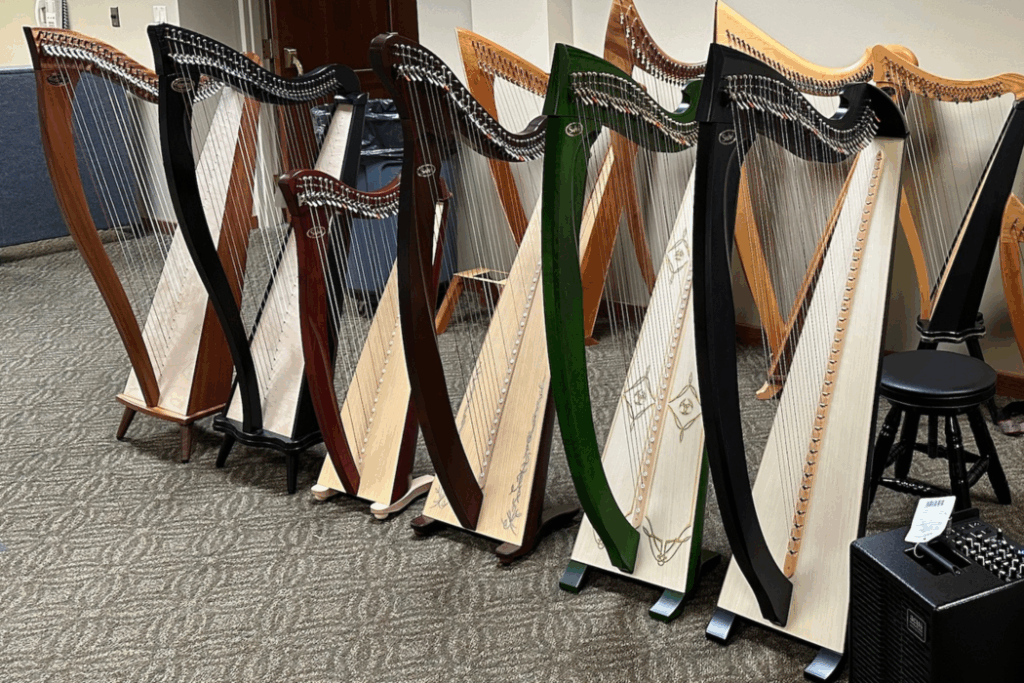
Currently, the MI Harp Center offers access to harps through short- and long-term rentals as well as purchases. DeYoung says the store provides personalized attention to help people find their very own harp—celebrating the excitement of a beginner’s first harp or a student’s first pedal harp, and inviting harpists to gather to share music. The store is a dealer for Lyon & Healy, Salvi, Dusty Strings, and Stoney End harps, and also sells harps on consignment, along with music, strings, and accessories. MI Harp Center also restrings harps and hosts regulation events. DeYoung says its most popular service is the Rent-to-Own program, developed for beginning students to help them start owning their instrument from day one.
“The thing I hear most from our clients is that they appreciate getting to try the instrument in person,” DeYoung says. “We provide the opportunity for our clients to sit behind the harp, feel the balance on [their] shoulder, and hear its unique voice. These are things you just can’t get from a purchase made over the internet. MI Harp Center may not be the biggest store, but the value we offer to the people in our area is essential.” •