

Your undergraduate degree is just one chapter in a lifelong journey, and every step along the way—whether expected or unexpected—will shape you into the artist you are meant to become.
—Eliza Fichialos
With nearly 4,000 colleges in the U.S., there is no shortage of choice in higher education. Though the selection is more limited if you are searching for a college with a harp program, there are still plenty of options. Our annual directory of higher ed harp programs features more than 125 schools this year. While it is not a comprehensive list (schools must opt into our directory), it is a great place to begin your search for a college harp program.
Still, 125 options can be overwhelming for a high school harpist trying to find that perfect fit. So how do you narrow it down? We asked four current college harp students to share how they navigated the search process. Their paths are as varied as their destinations, but their insights just might help guide you on your own college journey.
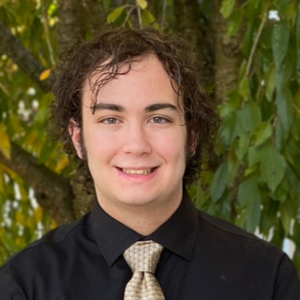
Vinny Conlon
State University of New York-Fredonia
Junior pursuing bachelor’s degrees in sound recording technology and harp performance
Hometown: Lancaster, New York
During the summer after my freshman year of high school, COVID forced the cancellation of all the activities I loved—marching band, the youth bureau musical, and other clubs I was involved in. With so much unexpected free time, I decided to explore songwriting, and, to my surprise, I became completely captivated by it. That summer not only deepened my passion for music but also solidified my decision to pursue a music-related major in college.
I auditioned and applied at three schools that offered harp and sound recording technology majors: SUNY Fredonia, NYU, and the Berklee College of Music. I didn’t take any trial lessons before applying, but I discussed the harp programs and teachers at each of the schools with my harp teacher Suzanne Thomas, former harpist of the Buffalo Philharmonic, and got her recommendation.
One thing I learned from the audition process is to approach the repertoire preparation as a chance to develop a practice schedule and routine tailored to your needs. College life can be overwhelming, demanding strong time-management skills and the flexibility to adapt to constant changes. By establishing a well-structured practice routine, you’ll not only prioritize your musical growth but also learn to balance your other academic commitments effectively.
The three major factors [in deciding where to attend] were my desire for a high-quality program, location (the ability to go home if needed), and affordability. Fredonia stood out as the ideal choice, offering the perfect balance of all three.
When deciding between colleges, I initially struggled with the idea of passing up the opportunity to attend a prestigious institution like Berklee, known for its exceptional programs in harp performance and sound recording. As a harpist, I was drawn to Berklee’s renowned faculty and cutting-edge resources, which have produced some of the most innovative musicians in the industry. However, after speaking with a family member in the music production industry, I gained a valuable perspective. He reminded me that while a school’s reputation matters, success ultimately depends on skill, dedication, and real-world experience. He spoke highly of Fredonia’s sound recording program, praising its hands-on training, strong industry connections, and impressive alumni network. Knowing that I could receive a top-tier education in both harp performance and audio engineering—just an hour from home and at a fraction of the cost—shifted my outlook entirely. Rather than feeling like I was settling, I realized how fortunate I was to have such a high-quality program within reach, allowing me to pursue my passion without the burden of excessive debt.
Starting college can be overwhelming—both academically and socially. One of the best ways to ease the transition is by joining a club. From personal experience, having a strong social network, which clubs provide, can make all the difference. I joined the acappella group “Much More Chill.” Not only will you find support and friendship, but you’ll also thrive in your studies with greater confidence and balance.
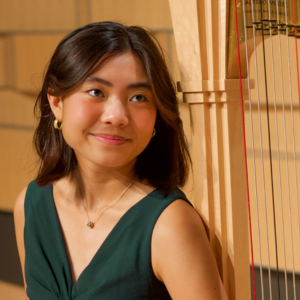
Megan Apostol
Peabody Institute of Johns Hopkins University
Junior pursuing a bachelor’s degree in harp performance
Hometown: San Diego, California
I knew I wanted to study music in college after attending Interlochen Arts Camp. Up until I went to Interlochen, I had not considered music as a career and was more academically focused in high school. While at Interlochen, I learned about the many career paths possible through music and thrived, both personally and as a musician, in the immersive environment of like-minded artists. This experience introduced me to the environment of music school and the possibility of furthering my passion after high school. I attended Interlochen Arts Academy for my senior year of high school which ultimately led me to the decision to study music in college as I loved being able to concentrate on music in an arts-focused school environment.
I had one in-person trial lesson during the spring break of my junior year. I found taking a trial lesson on campus to be extremely valuable as I was able to see all harp-related facilities and meet members of the harp studio. Besides the one trial lesson, I primarily met college teachers through summer festivals, because I wanted the opportunity to work with them for an extended period of time. Summer festivals allowed me to build strong connections with teachers and made me more confident through the process of choosing schools and auditioning.
My decision of which schools to apply to was completely based on the relationships I had with the teacher. Because I only applied as a harp performance major, the quality of my education relating to the harp was most important to me. Therefore, I applied to schools where I felt most compatible with the teacher and could see myself working with them over the next several years. I auditioned for three schools: the Cleveland Institute of Music, the University of Michigan, and the Peabody Institute.
The schools I applied for did not require prescreens. When given the choice to audition in-person or virtually, I opted to audition live at all the schools I applied for. I felt confident and comfortable going into and during each of my auditions because of my preparation and having met each teacher beforehand. To prepare, I spent a lot of time score studying, doing mental practice (visualizing my fingers playing each note of my repertoire), and listening to recordings. I performed all of my audition repertoire, including orchestra excerpts, as much as possible. I also did weekly mock auditions with my family acting as a jury, simulating as many factors as possible (i.e. limited warmup time, audition attire, and randomized order of repertoire). During these mock auditions, I would also practice performing in less-than-ideal circumstances (i.e. inappropriate bench height or uncomfortable temperatures). By the time audition day rolled around, because I had practiced several audition scenarios, I truly felt at ease and prepared for anything. My auditions were overall wonderful experiences, and I thoroughly enjoyed meeting members of the harp studios and other harpists also going through the audition process.
With the high cost of tuition, the amount of scholarship money I received and whether or not the school offered frozen tuition were some of the most important factors in my decision. Other factors I considered included undergraduate ensemble opportunities, school population, and the size and dynamic of the harp studio. Some factors that I did not consider, which I now think I should have thought more about in making my decision, include the rigors of academic requirements and how the relationship between the music schools and main campuses affect students’ social life. However, despite overlooking these factors, I feel I was still able to choose the school that was the best fit for me. I thought that the presence of a teacher on campus would be important in my future college experience. However, I realized that a teacher’s presence on campus does not necessarily equate to their dedication or how involved they are in their students’ education. Therefore, I would no longer consider how frequently a teacher is on campus to be an important factor. Instead, I would consider how accessible and available a teacher makes themselves to students to be more important.
I would advise high school harpists to start their college search as early as possible to allow them enough time to meet teachers from the schools they are considering applying to. I highly recommend researching and applying to summer festivals that are led by the teachers who they are interested in studying with. Summer festivals are great opportunities to better gauge what it would be like to study with the teacher and to meet other harpists with insight on different harp programs. Trial lessons are also always valuable opportunities, especially if taken at least a few months before your audition; the time between your lesson and audition gives you the chance to show improvement.
Through my college experience so far, I’ve learned the importance of time management and maintaining a balanced life. During the first months of college, it is easy to overestimate your abilities and overwhelm yourself. I experienced burnout early on because I was eager to make the most out of every opportunity that came my way. I quickly overworked myself and was unable to accomplish quality results with my severely divided time. My teacher helped me realize that not taking every opportunity did not mean that I was incapable or unmotivated, but rather, time simply does not allow anyone to do everything at a high level no matter how talented they are. From this experience, I learned the importance of being intentional about the opportunities I take, not only because my time is valuable and limited, but because the higher quality the work, the bigger and more plentiful future opportunities there will be. Making connections with my peers, taking time to enjoy college life, and prioritizing my health increased my productivity and helped maintain my motivation and energy for the long-term.
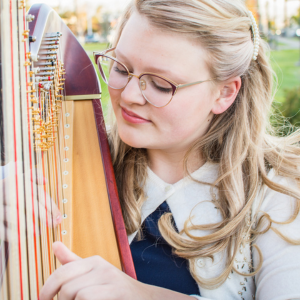
Eliza Fichialos
University of North Texas
(transferred from the University of Toronto)
Junior pursuing a bachelor’s degree in harp performance
Hometown: Holladay, Utah
I’ve wanted to study music in college for almost as long as I can remember. When I was very young, I wanted to be an opera singer, but as soon as I began playing the harp, I knew I could never go back! However, my vision for what “majoring in music” looks like has changed dramatically through the years. Through early high school, I wanted nothing more than to perform professionally in an orchestra. During my junior and senior years of high school, I became obsessed with musicology and the history of the harp, and even considered a dual major. Now, after two years in university, my focus has shifted to pedagogy, and my current goal is to become a harp professor at a university. All this to say, while my personality, interests, and understanding of the industry have changed significantly through the years, my love of music is the through line that pushes me back to the practice room day after day.
I auditioned for the University of Michigan, University of North Texas, Cleveland Institute of Music, University of Toronto, Vanderbilt University, Southern Methodist University, and University of Utah—this was a backup school where I applied for pre-law. I wrote essays for a few additional schools, but decided against submitting applications for varying reasons, including application fees, feelings after trial lessons, and the offerings of the school outside of the music department.
In preparing for my college auditions, I created a massive spreadsheet with practically every bit of information you could ever want to know about the programs I was interested in. This helped me compare and contrast the offerings of each institution and details about their harp studios. I narrowed down this list of 50-plus schools with the help of my teachers—both past and present. Each harpist I had studied with knew my playing and personality well, and their opinions and connections helped me to narrow down my list based on what would best suit me personally, rather than just the “best” schools. This also extended to my non-musical teachers as well. Before I attended Interlochen Arts Academy, I had been confident that I wanted to study at a conservatory, but after numerous conversations with a beloved English teacher, I realized that I wouldn’t be satisfied focusing only on my musical skills for my undergraduate degree. Due to her advice, I decided to apply to primarily universities rather than conservatories, so that I would have the opportunity to learn different subjects and meet people my age with a wide array of interests.
I took trial lessons with the teachers from every university I applied at except for one. I also decided against applying for several programs after taking trial lessons. Many times, the trial lesson was an important part of deciding if the program would be a good fit for me. I think trial lessons are an essential part of the application process. It is a time when you can see how the teacher’s communication style works with your brain, and it’s an opportunity get additional questions about the program answered. Even if the teacher is extremely skilled and well regarded, they (or their program) may not be the right fit for you. For example, I knew that I wanted to be able to collaborate with choirs and vocalists in my undergraduate degree, and in one trial lesson, a teacher let me know that their school was eliminating the vocal program. Although I loved working with the teacher, that was a dealbreaker for me and helped narrow down my lengthy list of potential schools.
[The audition process] was such a wonderful and exciting time. I have never struggled with audition anxiety, but creating a sort of ritual around each audition was very helpful in keeping any worries at bay. Wearing the same clothes and shoes for each audition, playing a non-audition piece in the warm-up room before going to the audition (the harp accompaniment to Faure’s Cantique de Jean Racine was my choice because it’s very relaxing, idiomatic, and beautiful!), and of course, getting a sweet treat afterwards are all techniques that I found essential.
I received numerous offers, and finances became a significant factor in narrowing down my options. I also seriously considered the auxiliary offerings of each institution, and I wanted to choose a school where I felt the teacher would be able to help me achieve my personal goals. I connected with alumni and current students of every school I was seriously considering, and had conversations about their experiences and what they had gained from their undergraduate studies. I remember a specific conversation I had with Prof. Johanna Wienholts at University of Wisconsin-Madison, who, like me, had attended Interlochen and later, the University of Toronto (the school I ended up deciding to attend). As we discussed her time at both of these institutions, she shared how her experiences led her to the life she has now—a professor of a budding harp program, with a beautiful home, loving spouse and pets, and innovative performance experiences at every corner. I distinctly remember thinking, “Yes! This is the sort of life I want.” Being able to tangibly see how her educational experiences helped her to create such a lovely and fulfilling life had a significant impact on my own decision.
I narrowed down my choices to two institutions: the University of Toronto, studying with Judy Loman, and the University of North Texas, studying with Jaymee Haefner. The primary factor of concern was finances. UNT made an incredibly generous offer, but I couldn’t shake the feeling that I needed to study with Ms. Loman before she retired. I had fallen in love with Canada and ended up taking the leap after much encouragement from my best friend and fellow musician, Viviane. Her logic was that if I didn’t choose the “more daunting” option, I would always wonder what might have happened abroad. That advice proved absolutely necessary, as my life was forever altered for the better by my year in Toronto, even though I ended up transferring to UNT the next year due to an unforeseen financial circumstance.
I thought that location was significantly more important than it has turned out to be. As a member of the LGBTQ+ community, I was very nervous about living in Texas, to say the least. Additionally, I had always wanted to live in a big city, and I cannot deny that a desire to expand my horizons past the United States was a major factor. However, I have ended up finding just as many, if not more, opportunities in Texas. And while I cannot speak for the entire state, Denton has proven a very supportive and safe community.
During my senior year of high school, I felt as though my college decision was the one thing my entire life had been leading up to. And at 17, the hours upon hours of practice, developing connections, and sitting through orchestra tacets felt like the world. However, I have come to realize that, while the four years of an undergraduate degree is a wonderful opportunity to hone my harp skills, it is just that: an opportunity—one of many opportunities that I have had and will continue to have before, during, and after my undergrad. Whether you attend a community college or the most competitive conservatory, college isn’t going to be the last time you learn new things about the harp. The most important thing I have found is to learn as much as you can from each teacher, friend, and colleague you meet within the harp community.
The institution you choose or how long you stay matters infinitely less than recognizing every experience as an opportunity for growth. Attending both the University of Toronto and the University of North Texas has shown me that growth can happen in many different environments, and that changing paths can open doors you never knew existed. Each school, teacher, and community has taught me something invaluable, both musically and personally. Your undergraduate degree is just one chapter in a lifelong journey, and every step along the way—whether expected or unexpected—will shape you into the artist you are meant to become.
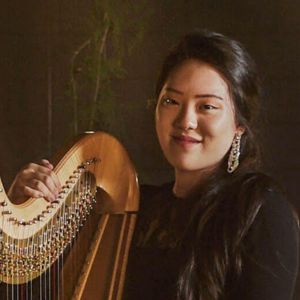
Grace Kikuchi
Carnegie Mellon University
Second-year master’s student studying harp performance
Hometown: Brisbane, Australia
I knew that I wanted to pursue music during my high school years. Once I had graduated from my undergraduate degree, I also knew that I wanted to study more to continue to improve myself. Carnegie Mellon University (CMU) was the only school I applied to for my master’s. My former teacher was the one who actually recommended CMU and Gretchen Van Hoesen, so it was one school that was already at the back of my head before I applied.
I did not take any trial lessons prior to applying. My audition process was via video, as I was overseas. It was a fairly easy and straightforward process. I submitted everything online and then received contact from Professor Van Hoesen who gave me insight into life on campus at CMU. After arrival, I helped with the in-person audition process as well, so I feel like I’ve seen both sides of it. I think auditions are always a nerve-wracking experience, but they are also such a good challenge to practice performing under pressure.
A big factor in deciding to attend was definitely financial aid and stipends, especially as an international student. The other aspect that I was aware of was the cost of living— from rent, transportation, food, etc.
Going into it, I was worried about making friends, feeling comfortable, and assimilating, but I found it much easier than I anticipated.
My college experience thus far has been great. I love that being at CMU means that I can be focused on harp, with plenty of harps to practice on. Whilst our studio workload is constantly increasing our solo performance opportunities, there is a huge focus on chamber music, orchestra, and orchestral repertoire classes with Professor Van Hoesen, who is principal harp of the Pittsburgh Symphony Orchestra. There is also the opportunity to study things outside of music, if that is of interest. Beyond all these resources, I really appreciate that we have such a friendly and warm environment where we can grow relationships that I’m sure will last a long time.
I think the best advice I could give [to high school students] is to consider why you want to study harp at the college level. I think the best motivation comes from yourself, so deciding which degree and what options will set you up best is great. Practice hard but also enjoy every experience, as that grows you as a person and a musician. •