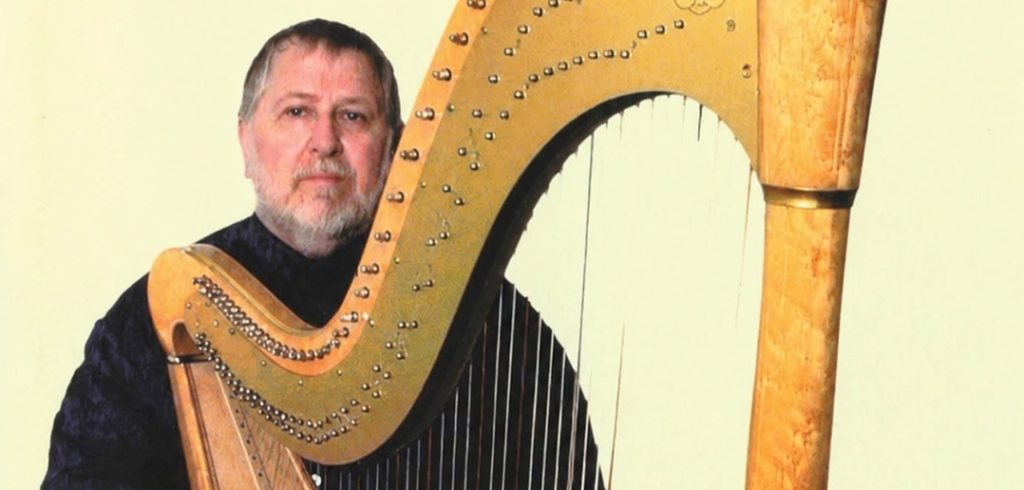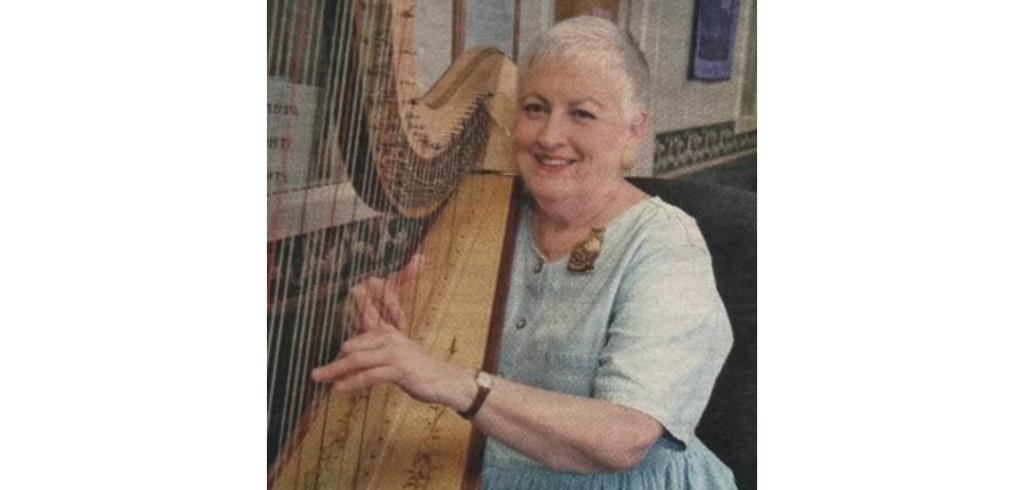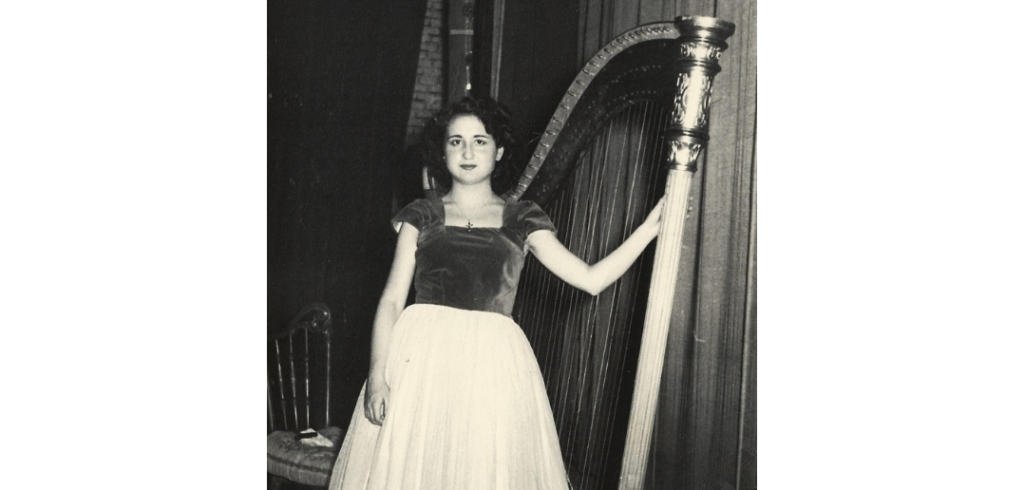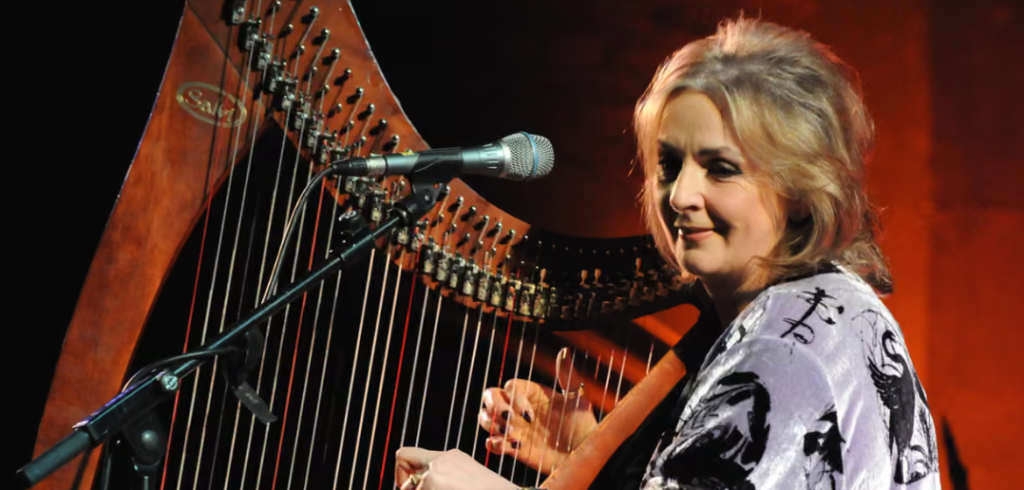

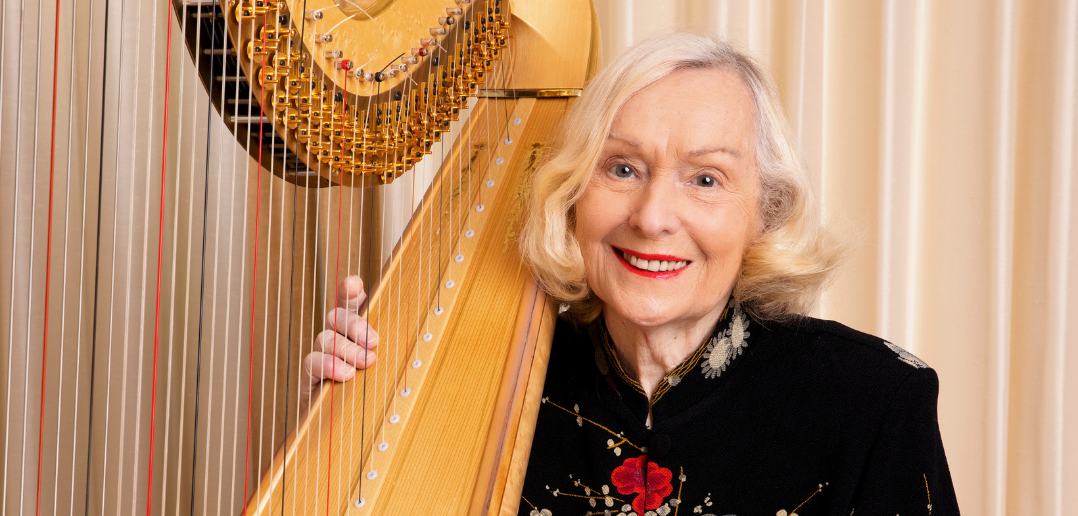
Legendary harpist and pedagogue Susann McDonald, distinguished professor emeritus of harp at Indiana University (IU) Jacobs School of Music and founder of the USA International Harp Competition (USAIHC), died on May 29 at the age of 90.
McDonald was born on May 26, 1935, in Rock Island, Illinois, to George McDonald and Catherine (Hackett) McDonald. A harp prodigy, she left her hometown of Rock Island while still in her teens to study in Paris with renowned harpist and teacher Henriette Renié. In 1955, at the age of 20, she became the first American to receive the Premier Prix de Harpe from the Paris Conservatory. One year later she performed for an audience of 60,000 at the Chicagoland Music Festival at Soldier Field. After leaving Paris, she was under the concert management of Columbia Artists and quickly earned a reputation as one of the world’s foremost performers and teachers for the harp.
“The fact that Susann McDonald left her Midwest hometown to study in France in the 1950s was practically unheard of for a young woman,” says Elizabeth Hainen, who studied with McDonald at IU and is now the artistic director of the USAIHC. “When she returned to the USA, she…gave three back-to-back Carnegie Hall solo concerts. She was the Yuja Wang of her day! This was during a time that Carlos Salzedo and Marcel Grandjany were the major teachers, both immigrant men from France; both very powerful and competitive. I believe Ms. McDonald’s performance success immediately validated her here and in Europe, coupled with her capacity to bridge our countries together in the harp. She was an inspiration to all she touched.”
“Susann McDonald was a treasured and beloved teacher, musician, and friend to harpists around the world,” says Joyce Claflin, president of the USAIHC, the competition McDonald founded in 1989. The triennial competition, which held its 13th edition just days before McDonald’s death, is considered one of the most prestigious solo harp competitions in the world.
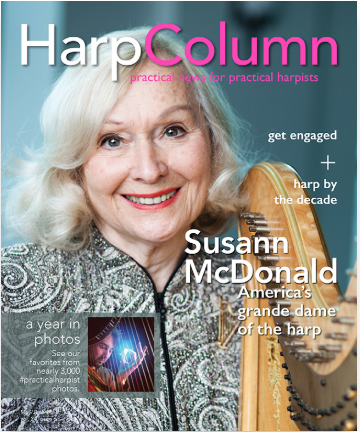
In Harp Column’s May/June 2016 feature interview with McDonald, printed just before the 10th edition of the USAIHC, McDonald said of the competition, “Our goal is to promote the harp, but also to give young artists, harpists, a boost up to make a career. That is where I feel we really have felt at home, because most of our first-prize winners have had and are having incredible careers. That is one major goal of the harp competition that has been realized.”
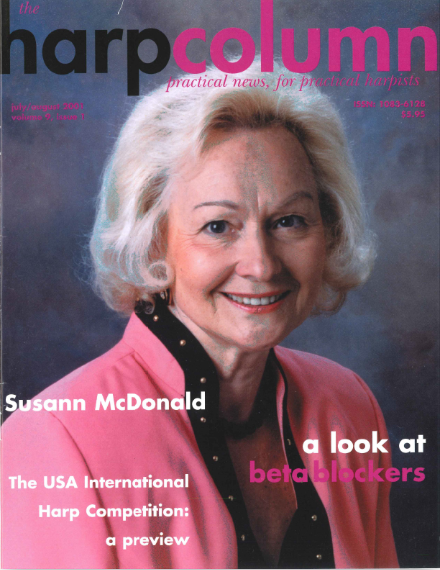
McDonald served as the artistic director of the World Harp Congress from its inception in 1983 until 2011. In 2008, she received the World Harp Congress Award of Recognition for Service to the International Harp Community at the 10th World Harp Congress, one of a select few to have received this award. “Her friendships abroad are what encouraged her to co-found the World Harp Congress and create an international harp competition in the USA,” Hainen says. “She was truly an ambassador of the harp.” In Harp Column’s July/August 2001 feature interview, McDonald said, “There are so many wonderful harpists in the world; it gives me a tremendous sense of humility, because there are just so many talented people, almost from every country. I think I do have a sense of mission, and it is that I would like all of us to appreciate each other more and to support each other. I do feel that Phia Berghout [who held Harp Weeks in Holland] was a mentor to me in this area, because she really started bringing people together in a non-judgmental way. It was not a competition but rather a chance for a free exchange of ideas. From her wonderful Harp Weeks in Holland came the World Harp Congress, where our goals are to nurture and foster harp performances as well as new music for the harp—to be a supportive influence.”
“I think what made Susann McDonald such a unique harp figure in the last seven decades was her constant presence and leadership at most of the harp events around the world,” says Elzbieta Szmyt, who came to IU to study with Susann McDonald, and later joined the faculty, where she now serves as chair of the harp department. “She judged practically all major international harp competitions, performed in numerous countries, and taught masterclasses on each continent. You could always notice her with her elegant look, her charming smile, and let’s not forget her perfectly styled platinum blond hair!” McDonald served on juries for virtually all the world’s major harp competitions, including Israel, Italy, France, Hong Kong, and Mexico.
McDonald is well-known beyond the harp world for her many performances on the PBS television show “The Joy of Music” with host and acclaimed organist Diane Bish. With well over a dozen solo and chamber albums to her name, McDonald has recorded on the BAM, Delos International, Klavier Records, Orion, and Allen Organ Company labels.
Recordings to remember
Récital de Harpe (1964) • Dussek Sonatas for Harp (1971) • Rosetti Six Sonatas, Op. 2 (1971) • 20th Century Harp (1972) • Spohr Three Sonates Concertantes for Harp and Violin with Louis Kaufman (1972) • Susann McDonald Plays the Romantic Harp (1973) • Mediterranean Reflections (1973) • The Virtuoso Harp (1975) • Masters of Flute and Harp with Louise Di Tullio, vol. 1 (1976) and vol. 2 (1978) • The World of the Harp (1979) • Songs of the Harp (1987) • Sonatas for Flute & Harp with Louise Di Tullio (1989) • Masters of Flute & Harp with Louise Di Tullio (1989) • Harp Spectacular (1990) • Sacred Favorites for Organ and Harp (1992) • Caprice (2002)
In 1981 McDonald started a publishing company, MusicWorks–Harp Editions, with fellow harpist Linda Wood Rollo, and together they created arrangements and teaching method books that are now standard instructional materials used around the world. Hainen says their publications are “incredible resources for harpists, including five volumes of Graded Recital Pieces and a comprehensive method book, Harp for Today, which is published in five languages. What a gift to harpists today and tomorrow.”
Wood Rollo tells a memorable story of the inception of their publishing venture. “In 1981, Susann was invited by Lucille Jennings to give a masterclass for her students at Ohio State. We drove from Bloomington, and on the way home, we started talking about writing music that would fill the gap of repertoire for beginning to intermediate students and what else we could do to really help harp teachers,” she recounts. “We were intensely discussing this idea when the car sputtered and came to a sudden halt on the freeway. It was 10:00 p.m., and we had run out of gas! We had to climb over snow banks on the side of the freeway and walk to a distant farmhouse with lights on and ask to use the phone to call for AAA [roadside assistance]. That night marked the beginning of MusicWorks–Harp Editions!”
Also in 1981, McDonald joined the Jacobs School of Music faculty at Indiana University, having been recruited by Dean Charles Webb from her high-profile performing career and teaching positions at the Juilliard School, the University of Southern California, and the University of Arizona. She taught at Indiana for 35 years before retiring in 2016.
“Along with her performance career and recordings, Susann McDonald was a pedagogue at heart,” Hainen says. “She deeply loved her teacher Henriette Renié and would often speak of their conversations while studying in France. She was a testament to that relationship that deeply impacted her students on what an honor it is to have such a special teacher-student connection.”
In Harp Column’s July/August 2001 feature interview with McDonald, she said of her studies in Paris, “Those lessons were so precious, and Mademoiselle Renié was such a magnificent teacher and a very demanding teacher. I often tell my students, ‘Many times I left in tears, because she, for instance, worked on the quality of one glissando for much of a lesson when I had two or three whole pieces that I wanted to play.’ I think I learned from her the importance of attention to detail—that just one phrase, one nuance, a bit more time here—this is what can make an entire performance work. Certainly she was a great mentor to me, and I really grieved when she died the year after I came home from studying with her. Her influence was enormous for me.”
Hainen says of her own relationship with McDonald, “My first encounter with Ms. McDonald was for a private lesson during a family road trip. Her beautiful beige suit suggested more of a powerhouse Wall Street broker than a harp teacher. But when she smiled and spoke, she was as warm as a fine cashmere sweater. After [my] performance of Tournier’s Au Matin, she trilled in delight and made me feel like I could play anything. After that lesson, I listened to her recordings every day, amazed at her virtuosity.
“That next fall I joined her IU harp studio in Bloomington, Indiana, and looked forward to each week’s lesson with delight,” Hainen says. “In our lessons, she would encourage me to strive for a warm sound, pressing each finger meaningfully into each string and creating lyricism through every phrase while singing along in solfège. At our weekly masterclasses, she encouraged every student to find their unique voice and never placed any limitations on their potential. Her positive presence made us all feel secure, and we never heard her make a disparaging remark about another colleague.”
At the time of Harp Column’s May/June 2016 feature interview with McDonald, her studio at Indiana University was the largest harp department in the country. When asked what makes a successful lesson, she said, “I always hope I leave a student feeling encouraged. I think one of the most important things a teacher can do is to encourage. Maybe lift their sights a little higher to hopefully inspire them to do a little bit more, get better, develop better tone quality and musicianship.” She said the single most important teaching point she wanted to convey to her students was to do your best and to realize that you cannot compare yourself to somebody else. “I think that people often do [make comparisons], particularly in a big class when you hear very different ways of playing and whatnot. I think [the most important thing is] to emphasize the individuality of each student and to help them realize that they just need to be the best of themselves in their fingers, minds, and hearts. And to appreciate the good points of each student. Everyone has some, and I try to accentuate those.”
“Her lasting legacy will be all of us—all her students who she touched with her pure love and devotion to the harp,” Szmyt says. “She worked with hundreds of students around the world. I truly cannot think of any other teacher who would devote her or his entire life to teaching and performing with such a depth and commitment as Susann McDonald did. Her students are everywhere, and many of us stay connected and keep in touch throughout the years, always paying tribute to her. We all continue to spread her contagious love of the harp among our own students. We share her knowledge, commitment, and passion. There will never be another one like her, and we all who were so lucky to study with her will make her proud.”
“[She] had an exceptionally warm and communicative personality, with a gift for eloquence, diplomacy, and tact,” Wood Rollo recalls. “She always strove to be a peacemaker in difficult situations. She had an innate ability—a kind of laser vision—to hone in on what a student needed most in his or her development. Both musically and technically, [she pinpointed] whatever was needed, right where they were, ages 7 to 70. She always saw the strengths (as opposed to flaws) in each person and encouraged them to build on those strengths while continuing to develop as harpists.”
Wood Rollo says this ability to see a student’s strengths and help them fulfill their musical potential was integral to what made McDonald a special teacher. “I believe part of her legacy was a genuine kindness of spirit to everyone,” she observes. “This attitude enabled students to shoot for the moon without fear of excessive criticism. While she was very hard on herself, she had a tender soul and never wanted to hurt or discourage anyone.”
Inspired by her teacher, Henriette Renié, who wrote daily devotions, McDonald began writing her own daily devotional book in the early 2000s following a devastating house fire. She completed her book Praise the Lord with the Harp—A Journal of Faith: 365 Daily Devotionals with Scripture and Prayer, published by Author House, Bloomington, Indiana, in 2007, with many new reflections on the impact of the fire on her life. The fire also damaged much of her sheet music collection marked with priceless notations and fingerings. Several harpists, including the late Eleanor Fell of the Vanderbilt Music Company and McDonald’s graduate student at the time, Jaymee Haefner (now professor of harp at the University of North Texas), re-constructed her vast collection of burned harp sheet music that is now a part of her archives that reside at the Indiana University Jacobs School of Music.
McDonald’s Christian faith was always a guiding light in her life. “Ms. McDonald’s steadfast faith in the Lord was something many of us looked up to and connected us deeply,” Hainen says. “Her published devotionals are inspirational and personal.”
McDonald also loved reading and gardening. She enjoyed her golf community, The Wilderness, in Naples, Florida, where she spent her winters beginning in 1999.
“Susann McDonald was extremely committed and dedicated to anything—anything—she did in her life, starting with her deep Christian faith, her teaching, her publications, and performances,” Szmyt says. “She applied the same engagement and involvement to time she shared with friends. She was an outstanding golfer having learned the game with her father and older brother at a young age. She was a superb cook who entertained with effortless style at her beautiful home in Bloomington. She was extremely disciplined and rigorous with her daily practicing and, when away from home, she always made arrangements to have a harp available. She had a passion for reading, gardening, and she loved to travel.”
“Susann had a great sense of humor,” Szmyt adds. “One of the most memorable lines was her saying that each student should always go to McDonald’s before their recital and eat two Big Macs to calm their nerves, because, of course, she got a commission.”
Szmyt recalls a story from a dinner out after a long day of teaching. “Susann McDonald, Diane Bish, my husband John, and I went out. Since it was right after Miss McDonald and I just finished teaching that day, we kept talking about the pedagogical challenge of how to teach students not to make mistakes in performances. In the middle of her narrative, Susann started to count on her fingers: ‘I made only one, two, three, four…five mistakes in my life!’ We all burst out with a polite laugh, but she was totally serious. My only regret is that I never asked her what mistakes they were! Of course, I heard proof of this statement listening to the recording of her performance of most of Renié’s pieces at the [2002] AHS Conference at St. Paul, Minnesota. From the beginning until the end, it was an unbelievable, stunningly beautiful, and absolutely perfect performance. No doubt, she was serious.”
Wood Rollo also remembers how much McDonald loved to laugh. “She had a wonderful sense of humor and never took herself too seriously. She felt humor relieved a lot of stress,” she recalls. “She loved giving class parties and even invented many harp-related games where she would play the beginning of a harp piece in the air away from the harp and see who could guess what she was playing. It was amazing how quickly the students were able to get it, and of course there was much fun and laughter involved.”
Wood Rollo says McDonald had an incredible photographic memory. When looking for a home in Bloomington, she saw six houses one day and three another day. At the end she was able to sit down and sketch the interior of each of the nine homes by memory in vivid detail. “Many students will testify that in her lessons or in masterclasses, she could just spring to the harp and demonstrate any passage of music, starting in the middle or at whatever point the student needed help. It was amazing!” she recalls.
McDonald forged many friendships around the world through the harp, and she fostered that same sense of community in her harp studio at IU. “She encouraged friendships among all harpists,” Wood Rollo says. “It made her happy to see the close friendships developing in each of her classes of students over the years.”
Susann McDonald Legacy Donations can be made to the USA International Harp Competition. Read more about McDonald in Harp Column’s two feature interviews with her from our May/June 2016 and July/August 2001 issues.
—The USA International Harp Competition and Harp Column staff contributed to this article.